



DINISOR RETARD 120 mg Comprimidos liberación modificada

Revisión de receta online
Un médico revisará tu caso y determinará si la prescripción es médicamente apropiada.

Habla con un médico sobre este medicamento
Comenta tus síntomas y las opciones de tratamiento en una consulta online.



Cómo usar DINISOR RETARD 120 mg COMPRIMIDOS LIBERACION MODIFICADA
Contenido del prospecto
- Introducción
- Qué es DINISOR y para qué se utiliza
- Qué necesita saber antes de empezar a tomar DINISOR
- Cómo tomar DINISOR
- Posibles efectos adversos
- Conservación de DINISOR
- Contenido del envase e información adicional
Introducción
Prospecto: información para el usuario
DINISOR RETARD 120 mg comprimidos de liberación modificada
diltiazem hidroclouro
Lea todo el prospecto detenidamente antes de empezar a tomar el medicamento, porque contiene información importante para usted..
- Conserve este prospecto, ya que puede tener que volver a leerlo.
- Si tiene alguna duda, consulte a su médico o farmacéutico.
- Este medicamento se le ha recetado a usted y no debe dárselo a otras personas, aunque tengan los mismos síntomas, ya que puede perjudicarles.
- Si experimenta efectos adversos, consulte a su médico o farmacéutico, incluso si se trata de efectos adversos que no aparecen en este prospecto. Ver sección 4.
Contenido del prospecto:
- Qué es DINISOR y para qué se utiliza
- Qué necesita saber antes de empezar a tomar DINISOR
- Cómo tomar DINISOR
- Posibles efectos adversos
- Conservación de DINISOR
- Contenido del envase e información adicional
1. Qué es DINISOR y para qué se utiliza
DINISOR, cuyo principio activo es diltiazem, pertenece a un grupo de medicamentos llamados antagonistas del calcio. DINISOR se utiliza para el tratamiento y prevención de la angina de pecho, ya que ensancha (dilata) las arterias del corazón, aumentando el riego sanguíneo. DINISOR también actúa ensanchando los demás vasos sanguíneos del cuerpo, por lo que también se utiliza en el tratamiento de la tensión arterial elevada (hipertensión).

¿No estás seguro de si este medicamento es adecuado para ti?
Comenta tus síntomas y tratamiento con un médico online.
2. Qué necesita saber antes de empezar a tomar DINISOR
No tome DINISOR
- Si es alérgico (hipersensible) al principio activo o a cualquiera de los demás componentes de DINISOR.
- Si padece alguna enfermedad del ritmo o de la conducción cardíaca, tales como Síndrome de disfunción sinusal en pacientes sin marcapasos, bloqueo aurículo-ventricular de 2º ó 3º grado en pacientes sin marcapasos o bradicardia severa (frecuencia cardiaca inferior a 40 latidos por minuto).
- Si padece alguna enfermedad cardiaca como una insuficiencia ventricular izquierda.
- Si está en tratamiento con dantroleno.
- Si está tomando medicamentos que contienen ivabradina para el tratamiento de ciertas enfermedades del corazón.
- Si ya está tomando un medicamento que contiene lomitapida utilizado para el tratamiento de niveles altos de colesterol (ver sección: "Toma de DINISOR con otros medicamentos”).
Advertencias y precauciones
- Si padece alguna arritmia cardiaca(síndrome del nodo sinusal enfermo, bloqueo auriculo-ventricular) o si recibe tratamiento con otros medicamentos utilizados para tratar enfermedades del corazón (beta bloqueantes, digitálicos) ya que el uso de diltiazem en estas situaciones puede dar lugar a un pulso y ritmo cardiaco excesivamente lentos (bradicardia).
- Si va a ser operado,ya que diltiazem puede potenciar los efectos de los anestésicos
- Si tiene una alteración de la función del ventrículo.
- Si presenta hipotensión: el tratamiento con diltiazem puede dar lugar a una bajada excesiva en la tensión arterial. Su médico le informará acerca de cómo evitar los síntomas resultantes de la hipotensión y qué medidas tomar si se presentan esos síntomas.
- Si padece una enfermedad del hígado o del riñón o es anciano: dado que no hay datos disponibles en estos pacientes, DINISOR debe ser utilizado con precaución.
- El uso de diltiazem se ha asociado con reacciones en la piel y cambios del estado de ánimo (incluyendo depresión). Su médico valorará estos síntomas y le indicará las medidas a tomar.
- Si tiene usted riesgo de desarrollar una obstrucción intestinal, ya que al igual que sucede con otros medicamentos del mismo grupo, diltiazem produce una disminución del movimiento de los intestinos.
- Si tiene antecedentes de insuficiencia cardíaca, dificultad nueva para respirar, latidos cardíacos lentos o presión arterial baja. Se han notificado casos de lesión renal en pacientes con estas afecciones, es posible que su médico necesite controlar su función renal.
Uso de DINISOR con otros medicamentos
Informe a su médico o a su farmacéutico si está usted tomando, o ha tomado recientemente cualquier otro medicamento, incluso los adquiridos sin receta.
Uso contraindicado:
No debe utilizarse diltiazem junto con dantroleno (relajante muscular).
En particular, no tome este medicamento e informe a su médico si está tomando:
Medicamentos que contienen lomitapida utilizados para el tratamiento de los niveles altos de colesterol. Diltiazem puede aumentar la concentración de lomitapida que puede conducir a un aumento en la probabilidad y la gravedad de los efectos secundarios relacionados con el hígado.
Efectos de otros fármacos sobre DINISOR
Los siguientes fármacos pueden aumentar los efectos de DINISOR al aumentar su concentración en sangre:
- fluconazol (utilizado para tratar infecciones por hongos)
- eritromicina y otros macrólidos (antibióticos)
- ritonavir (utilizado para el tratamiento de infecciones por virus)
- amiodarona (utilizada para disminuir el ritmo del corazón (amiodarona)
- cimetidina y ranitidina (utilizadas para disminuir la producción de ácido del estómago)
Los siguientes fármacos pueden disminuir los efectos de DINISOR al reducir su concentración en sangre:
- fenitoína (utilizada para tratar la epilepsia)
- hierba de San Juan (utilizada en casos de decaimiento, cansancio o alteraciones del sueño)
- rifampicina (antibiótico)
Efectos de DINISORsobre otros fármacos
DINISOR puede aumentar los efectos de los siguientes fármacos, al aumentar sus concentraciones en sangre o al potenciar su efecto:
- fenitoína, carbamazepina (utilizadas para tratar la epilepsia)
- triazolam, midazolam, buspirona (utilizados para tratar la ansiedad)
- digoxina (utilizada para tratar enfermedades del corazón)
- ciclosporina, sirolimus (utilizados para suprimir el sistema inmunitario)
- metilprednisolona (corticoide utilizado para tratar problemas inflamatorios)
- simvastatina y lovastatina (medicamentos para disminuir los niveles de colesterol en sangre)
- teofilina (utilizada para tratar el asma)
- medicamentos que reducen la formación de coágulos en la sangre (anticoagulantes orales, tales como acenocumarol o warfarina)
- rifampicina (antibiótico)
- medicamentos utilizados para reducir la tensión sanguínea (nitratos, alfa y beta bloqueantes, diuréticos, inhibidores de la enzima convertidora de angiotensina) y para disminuir el ritmo del corazón (amiodarona)
- anestésicos
- sales de litio (utilizadas para el tratamiento de algunas enfermedades mentales): puede aumentar el riesgo de agitación intensa (episodios psicóticos)
- sirolimus, temsirolimus, everolimus (medicamentos que reducen la actividad del sistema inmunológico)
El uso conjunto de DINISOR con otros fármacos deberá realizarse bajo control médico y ajustando las dosis de forma progresiva.
Uso en niños
No existe experiencia sobre el uso de DINISOR en niños.
Embarazo y lactancia
Si está embarazada o en periodo de lactancia, cree que podría estar embarazada o tiene intención de quedarse embarazada, consulte a su médico o farmacéutico antes de utilizar este medicamento
Consulte a su médico o farmacéutico antes de utilizar cualquier medicamento.
Este medicamento no debe administrarse a mujeres embarazadas ni a mujeres en edad fértil que no estén utilizando un método anticonceptivo eficaz.
No se debe tomar este medicamento durante la lactancia, ya que pasa a la leche materna. Si el médico considera esencial la toma de este medicamento, el bebé deberá ser alimentado con otro método alternativo.
Conducción y uso de máquinas
La capacidad para desarrollar actividades tales como el manejo de maquinaria o la conducción de vehículos, puede verse disminuida, sobre todo al comienzo del tratamiento con DINISOR.
DINISOR RETARD 120 mg contiene lactosa, aceite de castor (aceite de ricino) hidrogenado y sodio
Este medicamento contiene lactosa. Si su médico le ha indicado que padece una intolerancia a ciertos azúcares, consulte con él antes de tomar este medicamento.
Este medicamento contiene aceite de castor (aceite de ricino) hidrogenado. Puede provocar molestias de estómago y diarrea.
Este medicamento contiene menos de 1 mmol de sodio (23 mg) por comprimido; esto es, esencialmente “exento de sodio”.
3. Cómo tomar DINISOR
Siga exactamente las instrucciones de administración de este medicamento indicadas por su médico o farmacéutico. En caso de duda, consulte a su médico o farmacéutico.
DINISOR se administra por vía oral. Su médico le indicará cuantos comprimidos debe usted tomar cada día.
Adultos:
Angina de pecho:la dosis inicial es de 1 comprimido al día. Su médico le irá aumentando la dosis gradualmente hasta obtener la respuesta óptima. La dosis máxima es de 4 comprimidos al día (480 mg/día).
Hipertensión arterial:la dosis inicial es de 1 comprimido al día. Su médico le irá aumentando la dosis gradualmente hasta obtener la respuesta óptima. La dosis máxima es de 4 comprimidos al día (480 mg/día).
Pacientes ancianos, insuficiencia renal o hepática:
El ajuste inicial de la dosis deberá realizarse con precaución.
Todas las modificaciones de la dosis y el control de las mismas se realizarán bajo supervisión médica.
Instrucciones para la correcta administración
Ingiera los comprimidos enteros, sin masticar, con una cantidad suficiente de líquido (por ejemplo, un vaso de agua). Los comprimidos no deben dividirse ni machacarse. DINISOR debe tomarse preferiblemente antes de las comidas. Si su médico le indica que necesita 2-4 comprimidos al día, debe tomarlos repartidos a intervalos regulares (cada 6-12 horas).
Tome DINISOR todos los días y aproximadamente a la misma hora. Tomar los comprimidos a la misma hora cada día tendrá un mejor efecto en su presión sanguínea. También le ayudará a recordar cuándo tomar los comprimidos.
Siga estas instrucciones a menos que su médico le haya dado otras indicaciones distintas. Recuerde tomar su medicamento.
Su médico le indicará la duración de su tratamiento con DINISOR. No suspenda el tratamiento antes ya que puede ser perjudicial para su salud.
Si usted tiene la impresión de que el efecto de DINISOR es demasiado fuerte o demasiado débil, consulte a su médico o a su farmacéutico.
Si toma más DINISOR del que debe:
Una sobredosis de DINISOR puede producir una bajada de tensión, enlentecimiento de la frecuencia cardiaca, alteraciones de la conductividad cardiaca y disminución de la función renal. En caso de bajada de la tensión sanguínea, siéntese con la cabeza hacia abajo.
En caso de sobredosis importante, debería ser trasladado a un centro especializado para aplicar las medidas adecuadas.
En caso de sobredosis o ingestión accidental, consulte inmediatamente a su médico o farmacéutico, acuda al hospital más cercano o llame al Servicio de Información Toxicológica, teléfono 91 562 04 20, indicando el medicamento y la cantidad ingerida.
Si olvidó tomar DINISOR:
No tome una dosis doble para compensar las dosis olvidadas. Es importante que tome DINISOR regularmente a la misma hora cada día. Si olvida tomar una dosis, tómela en cuanto pueda. Sin embargo, si ya es casi la hora de la siguiente dosis, no tome el comprimido olvidado.
Si interrumpe el tratamiento con DINISOR:
Si interrumpe el tratamiento con DINISOR, usted puede tener un empeoramiento de su enfermedad, presentando síntomas tales como dolor u opresión en el pecho o una subida brusca en la presión arterial. No interrumpa el tratamiento con DINISOR sin antes consultarlo con su médico. Si tiene cualquier otra duda sobre el uso de este producto, pregunte a su médico o farmacéutico.

¿Has empezado a tomar el medicamento y tienes preguntas?
Comenta tus síntomas y tratamiento con un médico online.
4. Posibles efectos adversos
Al igual que todos los medicamentos, este medicamento puede producir efectos adversos, aunque no todas las personas los sufran. Las reacciones de Diltiazem varían en intensidad de un paciente a otro y deben tenerse en cuenta especialmente al inicio del tratamiento o al cambiar de medicación.
Interrumpa el tratamiento con DINISOR y contacte inmediatamente a su médico si experimenta alguno de los siguientes síntomas:
- hinchazón de la cara, lengua o garganta, dificultad para tragar, urticaria y dificultad para respirar (angioedema), frecuencia no conocida.
- una reacción alérgica extremadamente grave con erupción cutánea, generalmente en forma de ampollas o úlceras en la boca y los ojos, así como en otras membranas mucosas, por ejemplo los genitales (síndrome de Stevens-Johnson), frecuencia no conocida.
- daño cutáneo grave y extenso (descamación de la epidermis y de las membranas mucosas) (necrólisis epidérmica tóxica), frecuencia no conocida.
Otros efectos secundarios:
Muy frecuentes (pueden afectar a más de 1 de cada 10 pacientes)
- Edema en los miembros inferiores.
Frecuentes (pueden afectar hasta 1 de cada 10 pacientes)
- Dolor de cabeza, mareo.
- Bloqueo aurículo-ventricular (un tipo de arritmia), palpitaciones, frecuencia cardiaca lenta (bradicardia).
- Enrojecimiento.
- Estreñimiento, digestión difícil (dispepsia), dolor de estómago, náuseas.
- Erupciones cutáneas.
- Hinchazón de las articulaciones.
- Cansancio (astenia), fatiga, malestar.
Poco frecuentes (pueden afectar hasta 1 de cada 100 pacientes)
- Nerviosismo, dificultad para conciliar el sueño (insomnio).
- Bajada de tensión al incorporarse rápidamente asociada o no con mareos (hipotensión).
- Vómitos, diarrea.
- Aumento de los niveles de los enzimas del hígado en la sangre.
Raras (pueden afectar hasta 1 de cada 1.000 pacientes)
- Sequedad de boca.
- Irritación y picor de la piel (urticaria).
Frecuencia no conocida (no puede estimarse a partir de los datos disponibles)
- Reducción del número de plaquetas (trombocitopenia).
- Disminución del apetito, niveles elevados de azúcar en sangre (hiperglucemia).
- Cambios de humor incluyendo depresión, confusión, alucinaciones, alteraciones de la personalidad y del sueño.
- Alteraciones del movimiento (síndrome extrapiramidal), pérdida de memoria (amnesia), sensación anormal de hormigueo, adormecimiento o ardor (parestesia), tendencia a quedarse dormido (somnolencia), pérdida temporal del conocimiento (síncope), temblor, sacudidas repentinas e involuntarias de un músculo o grupo de músculos.
- Ojo vago (pérdida parcial de la visión en uno o en los dos ojos), irritación de los ojos.
- Zumbido de oído (acufenos).
- Interrupción o alteración de la señal eléctrica en el corazón (bloqueo sinoauricular, parada sinusal), dificultad del corazón para bombear sangre (insuficiencia cardíaca congestiva), latidos rápidos (taquicardia), contracciones cardiacas anormales (extrasístoles ventriculares), latidos irregulares (arritmia), dolor u opresión en el pecho (angina de pecho).
- Inflamación de los vasos sanguíneos (vasculitis).
- Dificultad para respirar (disnea), sangrado de nariz (epistaxis), congestión nasal.
- Inflamación de las encías (hiperplasia gingival).
- Hepatitis (enfermedad inflamatoria que afecta al hígado), alteración del hígado (enfermedad hepática granulomatosa).
- Sensibilidad a la luz (fotosensibilidad), eritema multiforme (enfermedad grave de la piel asociada con manchas rojas, ampollas), sudoración, dermatitis exfoliativa (enrojecimiento cutáneo, picor, caída del cabello) y dermatitis pustular exantemática generalizada aguda (erupción repentina acompañada de fiebre, con formación de pústulas o lesiones en la superficie de la piel que se caracterizan por ser pequeñas, inflamadas, llenas de pus y similares a una ampolla), pequeñas manchas rojas en la piel (petequias), picor (prurito).
- Dolor en las articulaciones, dolor en los músculos.
- Necesidad de orinar por la noche (nicturia), aumento del número de veces que necesita orinar (poliuria).
- Volumen excesivo de las mamas en el hombre (ginecomastia), alteraciones de la función sexual.
- Problemas para caminar
- Elevación de la enzima creatinfosfoquinasa (CPK) en los análisis de sangre, aumento de peso.
- Estado en el que el sistema de defensa del organismo ataca el tejido normal provocando síntomas como articulaciones inflamadas, cansancio y erupciones cutáneas (llamado "síndrome tipo lupus").
Comunicación de efectos adversos
Si experimenta cualquier tipo de efecto adverso, consulte a su médico o farmacéutico, incluso si se trata de posibles efectos adversos que no aparecen en este prospecto. También puede comunicarlos directamente a través del Sistema Español de Farmacovigilancia de medicamentos de Uso Humano: https://www.notificaram.es. Mediante la comunicación de efectos adversos usted puede contribuir a proporcionar más información sobre la seguridad de este medicamento.
Al igual que todos los medicamentos, este medicamento puede producir efectos adversos, aunque no todas las personas los sufran. Las reacciones de Diltiazem varían en intensidad de un paciente a otro y deben tenerse en cuenta especialmente al inicio del tratamiento o al cambiar de medicación.
Interrumpa el tratamiento con DINISOR y contacte inmediatamente a su médico si experimenta alguno de los siguientes síntomas:
- hinchazón de la cara, lengua o garganta, dificultad para tragar, urticaria y dificultad para respirar (angioedema), frecuencia no conocida.
- una reacción alérgica extremadamente grave con erupción cutánea, generalmente en forma de ampollas o úlceras en la boca y los ojos, así como en otras membranas mucosas, por ejemplo los genitales (síndrome de Stevens-Johnson), frecuencia no conocida.
- daño cutáneo grave y extenso (descamación de la epidermis y de las membranas mucosas) (necrólisis epidérmica tóxica), frecuencia no conocida.
Otros efectos secundarios:
Muy frecuentes (pueden afectar a más de 1 de cada 10 pacientes)
- Edema en los miembros inferiores.
Frecuentes (pueden afectar hasta 1 de cada 10 pacientes)
- Dolor de cabeza, mareo.
- Bloqueo aurículo-ventricular (un tipo de arritmia), palpitaciones, frecuencia cardiaca lenta (bradicardia).
- Enrojecimiento.
- Estreñimiento, digestión difícil (dispepsia), dolor de estómago, náuseas.
- Erupciones cutáneas.
- Hinchazón de las articulaciones.
- Cansancio (astenia), fatiga, malestar.
Poco frecuentes (pueden afectar hasta 1 de cada 100 pacientes)
- Nerviosismo, dificultad para conciliar el sueño (insomnio).
- Bajada de tensión al incorporarse rápidamente asociada o no con mareos (hipotensión).
- Vómitos, diarrea.
- Aumento de los niveles de los enzimas del hígado en la sangre.
Raras (pueden afectar hasta 1 de cada 1.000 pacientes)
- Sequedad de boca.
- Irritación y picor de la piel (urticaria).
Frecuencia no conocida (no puede estimarse a partir de los datos disponibles)
- Reducción del número de plaquetas (trombocitopenia).
- Disminución del apetito, niveles elevados de azúcar en sangre (hiperglucemia).
- Cambios de humor incluyendo depresión, confusión, alucinaciones, alteraciones de la personalidad y del sueño.
- Alteraciones del movimiento (síndrome extrapiramidal), pérdida de memoria (amnesia), sensación anormal de hormigueo, adormecimiento o ardor (parestesia), tendencia a quedarse dormido (somnolencia), pérdida temporal del conocimiento (síncope), temblor, sacudidas repentinas e involuntarias de un músculo o grupo de músculos.
- Ojo vago (pérdida parcial de la visión en uno o en los dos ojos), irritación de los ojos.
- Zumbido de oído (acufenos).
- Interrupción o alteración de la señal eléctrica en el corazón (bloqueo sinoauricular, parada sinusal), dificultad del corazón para bombear sangre (insuficiencia cardíaca congestiva), latidos rápidos (taquicardia), contracciones cardiacas anormales (extrasístoles ventriculares), latidos irregulares (arritmia), dolor u opresión en el pecho (angina de pecho).
- Inflamación de los vasos sanguíneos (vasculitis).
- Dificultad para respirar (disnea), sangrado de nariz (epistaxis), congestión nasal.
- Inflamación de las encías (hiperplasia gingival).
- Hepatitis (enfermedad inflamatoria que afecta al hígado), alteración del hígado (enfermedad hepática granulomatosa).
- Sensibilidad a la luz (fotosensibilidad), eritema multiforme (enfermedad grave de la piel asociada con manchas rojas, ampollas), sudoración, dermatitis exfoliativa (enrojecimiento cutáneo, picor, caída del cabello) y dermatitis pustular exantemática generalizada aguda (erupción repentina acompañada de fiebre, con formación de pústulas o lesiones en la superficie de la piel que se caracterizan por ser pequeñas, inflamadas, llenas de pus y similares a una ampolla), pequeñas manchas rojas en la piel (petequias), picor (prurito).
- Dolor en las articulaciones, dolor en los músculos.
- Necesidad de orinar por la noche (nicturia), aumento del número de veces que necesita orinar (poliuria).
- Volumen excesivo de las mamas en el hombre (ginecomastia), alteraciones de la función sexual.
- Problemas para caminar
- Elevación de la enzima creatinfosfoquinasa (CPK) en los análisis de sangre, aumento de peso.
- Estado en el que el sistema de defensa del organismo ataca el tejido normal provocando síntomas como articulaciones inflamadas, cansancio y erupciones cutáneas (llamado "síndrome tipo lupus").
Comunicación de efectos adversos
Si experimenta cualquier tipo de efecto adverso, consulte a su médico o farmacéutico, incluso si se trata de posibles efectos adversos que no aparecen en este prospecto. También puede comunicarlos directamente a través del Sistema Español de Farmacovigilancia de medicamentos de Uso Humano: https://www.notificaram.es. Mediante la comunicación de efectos adversos usted puede contribuir a proporcionar más información sobre la seguridad de este medicamento.
5. Conservación de DINISOR
Mantener fuera de la vista y del alcance y de los niños.
No utilice DINISOR después de la fecha de caducidad que aparece en el envase después de CAD. La fecha de caducidad es el último día del mes que se indica. Conservar en el envase original.
Este medicamento no requiere ninguna condición especial de conservación.
Los medicamentos no se deben tirar por los desagües ni a la basura. Deposite los envases y los medicamentos que no necesita en el Punto SIGRE de la farmacia. En caso de duda pregunte a su farmacéutico cómo deshacerse de los envases y de los medicamentos que no necesita. De esta forma, ayudará a proteger el medio ambiente.
6. Contenido del envase e información adicional
Composición deDINISOR RETARD 120 mg
- El principio activo es diltiazem hidrocloruro. Cada comprimido contiene 120 mg de diltiazem (como hidrocloruro).
Los demás componentes son:
Núcleo:lactosa monohidrato, aceite de castor (aceite de ricino) hidrogenado, carboximetilcelulosa, acido esteárico, estearato de magnesio.
Recubrimiento:hipromelosa, dióxido de titanio (E-171), talco, macrogol 6000, agente antiespumante de silicona S184
Aspecto de DINISOR RETARD 120 mgy contenido del envase
DINISOR RETARD 120 mg comprimidos son comprimidos blancos, redondos y con “D120” marcado en una cara.
DINISOR RETARD 120 mg comprimidos se presenta en estuches con blister de aluminio/PVC conteniendo 40 comprimidos.
Otras presentaciones
DINISOR® RETARD 180 mg comprimidos de liberación modificada
Titular de la autorización de comercialización
Pfizer, S.L.
Avda. de Europa, 20-B
Parque Empresarial La Moraleja
28108 Alcobendas (Madrid).
Responsable de la fabricación
Pfizer Manufacturing Deutschland GmbH
Mooswaldallee 1
79108 Freiburg Im Breisgau
Alemania
Fecha de la última revisión de este prospecto: noviembre 2024
La información detallada y actualizada de este medicamento está disponible en la página web de la Agencia Española de Medicamentos y Productos Sanitarios (AEMPS) http://www.aemps.gob.es/
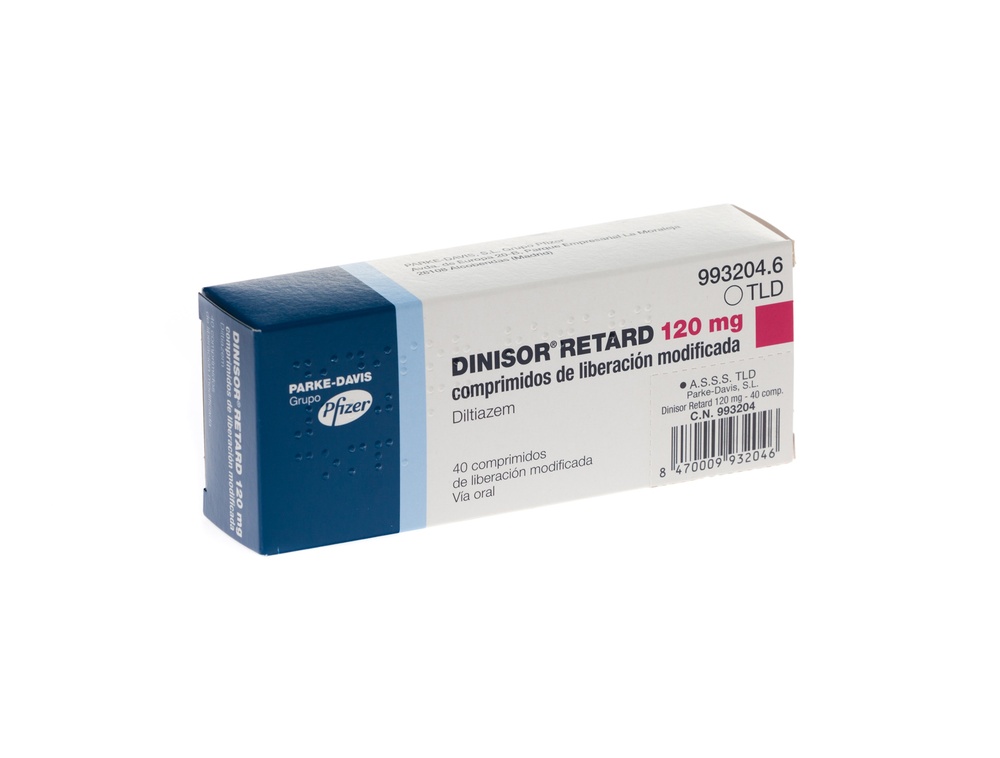
- País de registro
- Forma farmacéuticaCOMPRIMIDO LIBERACION MODIFICADA, 120 mg
- Código ATCC08DB01
- Precio medio en farmacia12.18 EUR
- Principio activo
- Requiere recetaSí
- Fabricante
- ComposiciónCROSCARMELOSA SODICA (4,5 mg mg), LACTOSA (213,05 mg mg)
- Esta información es de carácter general y no sustituye la consulta con un profesional sanitario.
- Alternativas a DINISOR RETARD 120 mg COMPRIMIDOS LIBERACION MODIFICADAForma farmacéutica: CAPSULA LIBERACION MODIFICADA, 120 mgPrincipio activo: diltiazemFabricante: Viatris Healthcare LimitedRequiere recetaForma farmacéutica: CAPSULA LIBERACION MODIFICADA, 180 mgPrincipio activo: diltiazemFabricante: Viatris Healthcare LimitedRequiere recetaForma farmacéutica: CAPSULA LIBERACION MODIFICADA, 300 mgPrincipio activo: diltiazemFabricante: Viatris Healthcare LimitedRequiere receta
Médicos online para DINISOR RETARD 120 mg COMPRIMIDOS LIBERACION MODIFICADA
Comenta la dosis, los posibles efectos secundarios, interacciones, contraindicaciones o la revisión de receta de DINISOR RETARD 120 mg COMPRIMIDOS LIBERACION MODIFICADA, sujeto a valoración médica y a la normativa local.
Obtén una receta de DINISOR RETARD 120 mg COMPRIMIDOS LIBERACION MODIFICADA online
Rellena un formulario de 2 minutos
Cuéntanos tus síntomas, historial y el medicamento que necesitas.
Elige un médico o nosotros te asignamos uno
Escoge un especialista o te conectamos con el próximo médico disponible.
El médico revisa tu caso
Normalmente en 30 minutos. Puede hacerte preguntas adicionales por chat.
Recógela en cualquier farmacia
Receta electrónica enviada a tu correo, válida en toda España.
Preguntas frecuentes
DINISOR RETARD 120 mg COMPRIMIDOS LIBERACION MODIFICADA requiere receta en España. Puedes confirmarlo con un médico online según tu caso.
El principio activo de DINISOR RETARD 120 mg COMPRIMIDOS LIBERACION MODIFICADA es diltiazem. Esta información ayuda a identificar medicamentos con la misma composición pero con diferentes nombres comerciales.
El precio medio en farmacia de DINISOR RETARD 120 mg COMPRIMIDOS LIBERACION MODIFICADA es de aproximadamente 12.18 EUR. Puede variar según el fabricante y la forma farmacéutica.
DINISOR RETARD 120 mg COMPRIMIDOS LIBERACION MODIFICADA es fabricado por Pfizer S.L.. La marca y el envase pueden variar según el distribuidor.
Los Médicos de familia, Psiquiatras, Dermatólogos, Cardiólogos, Endocrinólogos, Gastroenterólogos, Neumólogos, Nefrólogos, Reumatólogos, Hematólogos, Infectólogos, Alergólogos, Geriatras, Pediatras, Oncólogos pueden valorar la prescripción de DINISOR RETARD 120 mg COMPRIMIDOS LIBERACION MODIFICADA cuando esté clínicamente indicado. Puedes reservar una videoconsulta para comentar tu caso y las opciones de tratamiento.
España cuenta con una infraestructura sanitaria bien desarrollada en ciudades principales como Madrid, Barcelona, Valencia y Sevilla. Las farmacias están ampliamente disponibles y operan bajo estrictas regulaciones, garantizando el acceso a medicamentos con receta.
Puedes comprar DINISOR RETARD 120 mg COMPRIMIDOS LIBERACION MODIFICADA en Madrid, Barcelona, Sevilla o Valencia en cualquier farmacia local con una receta válida.
Para obtener una receta, puedes utilizar Oladoctor:
Otros medicamentos con el mismo principio activo (diltiazem) incluyen ANGIODROX 120 mg CAPSULAS DURAS DE LIBERACION PROLONGADA, ANGIODROX 180 mg CAPSULAS DURAS DE LIBERACION PROLONGADA, ANGIODROX 300 mg CAPSULAS DURAS DE LIBERACION PROLONGADA. Pueden tener diferentes nombres comerciales o formulaciones, pero contienen el mismo componente terapéutico. Consulta siempre con un médico antes de cambiar o iniciar un nuevo medicamento.
