



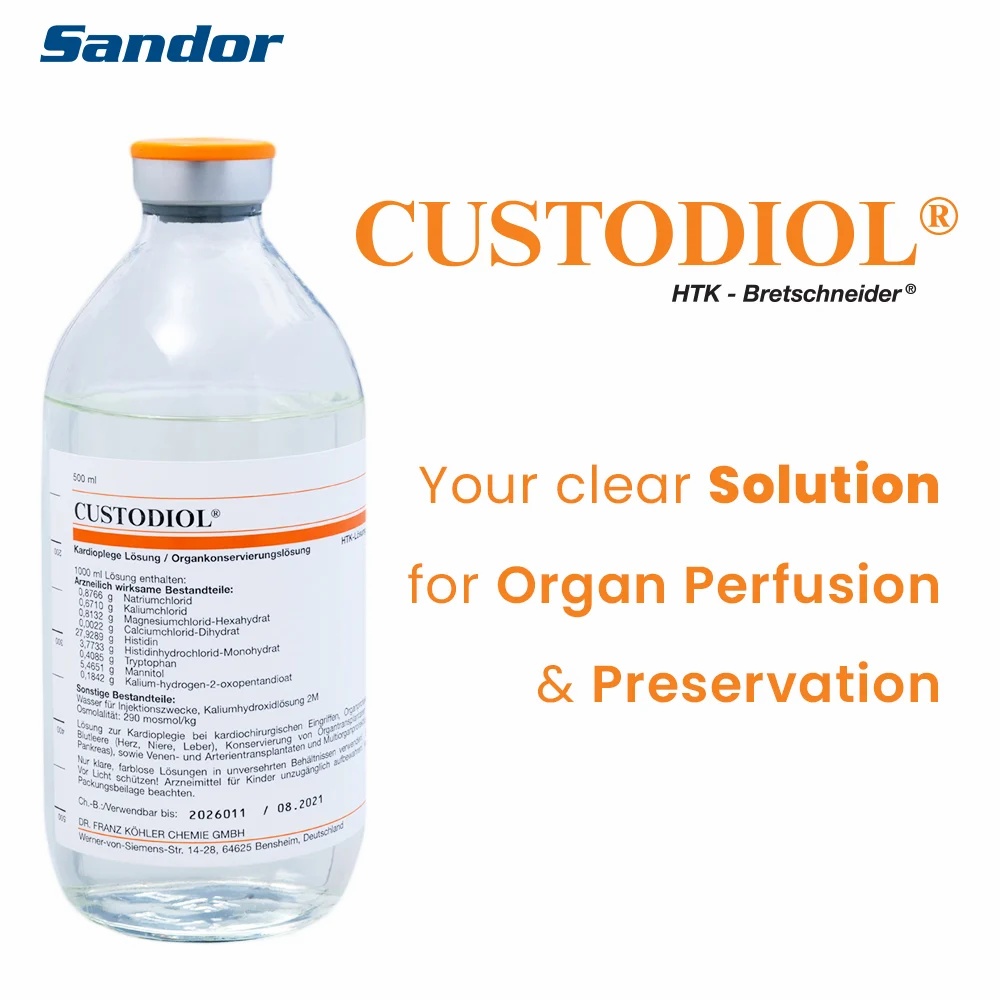
CUSTODIOL SOLUCION PARA CARDIOPLEJIA Y PARA CONSERVACION DE ORGANOS

Revisión de receta online
Un médico revisará tu caso y determinará si la prescripción es médicamente apropiada.

Habla con un médico sobre este medicamento
Comenta tus síntomas y las opciones de tratamiento en una consulta online.



Cómo usar CUSTODIOL SOLUCION PARA CARDIOPLEJIA Y PARA CONSERVACION DE ORGANOS
Contenido del prospecto
- Introducción
- Qué es Custodiol y para qué se utiliza
- Qué necesita saber antes de empezar a usar Custodiol
- Cómo usar Custodiol
- Posibles efectos adversos
- Conservación de Custodiol
- Contenido del envase e información adicional
Introducción
Prospecto: información para el paciente
Custodiol Solución para cardioplejía y paraconservación de órganos
Lea todo el prospecto detenidamente antes de empezar a usar este medicamento, porque contiene información importante para usted.
- Conserve este prospecto, ya que puede tener que volver a leerlo.
- Si tiene alguna duda, consulte a su médico.
- Si experimenta efectos adversos, consulte a su médico o enfermero, incluso si se trata de efectos adversos que no aparecen en este prospecto. Ver sección 4.
Contenido del prospecto
- Qué es Custodiol y para qué se utiliza
- Qué necesita saber antes de empezar a usar Custodiol
- Cómo usar Custodiol
- Posibles efectos adversos
- Conservación de Custodiol
- Contenido del envase e información adicional
1. Qué es Custodiol y para qué se utiliza
Custodiol es una solución acuosa con una mezcla de electrolitos y aminoácidos.
Custodiol se utiliza:
- solo durante las intervenciones quirúrgicas cardiacas y la extracción de órganos para su trasplante
- en la parada cardiaca inducida y reversible en las intervenciones quirúrgicas a corazón abierto (cardioplejía en intervenciones quirúrgicas cardiacas)
- para la protección de órganos durante las intervenciones en campo libre de sangre (corazón, riñón, hígado)
- para la conservación de trasplantes de órganos: perfusión y conservación en frío (corazón, riñón, hígado, páncreas)

¿No estás seguro de si este medicamento es adecuado para ti?
Comenta tus síntomas y tratamiento con un médico online.
2. Qué necesita saber antes de empezar a usar Custodiol
Custodiol solo debe usarse intraoperatoriamente.
No usar Custodiol:
- si es alérgico a los principios activos o a alguno de los demás componentes de este medicamento (incluidos en la sección 6).
Advertencias y precauciones
Niños y adolescentes
Solo se dispone de una limitada cantidad de datos sobre el uso en niños y adolescentes.
Uso deCustodiol con otros medicamentos
Informe a su médico si está tomando o utilizando, ha tomado o utilizado recientemente o pudiera tener que tomar o utilizar cualquier otro medicamento.
No se conocen interacciones con los siguientes medicamentos que se utilizan especialmente durante y también con frecuencia antes y después de la intervención:
- ciertos medicamentos para tratar la insuficiencia cardiaca (glucósidos cardiacos)
- comprimidos para orinar (diuréticos)
- medicamentos para tratar los síntomas de la angina de pecho (p. ej., dolor u opresión en el pecho).
- medicamentos utilizados en situaciones en las que el suministro de oxígeno al músculo cardiaco es insuficiente (como nitratos, betabloqueantes o antagonistas del calcio)
- medicamentos que reducen la presión arterial (como, p. ej.,. betabloqueantes o bloqueantes de los receptores del calcio).
Embarazo y lactancia
Si está embarazada o en periodo de lactancia, cree que podría estar embarazada o tiene intención de quedarse embarazada, consulte a su médico antes de utilizar este medicamento.
Conducción y uso de máquinas
La influencia de Custodiol sobre la capacidad para conducir y utilizar máquinas es nula.
Custodiol contiene sodio
Custodiol contiene 15,0 mmol de sodio por 1.000 ml, lo que debe ser tenido en cuenta en pacientes con dietas pobres en sodio.
Custodiol contiene 10,0 mmol de potasio por 1.000 ml, lo que debe ser tenido en cuenta en pacientes con insuficiencia renal o en pacientes con dietas pobres en potasio.
3. Cómo usar Custodiol
La pauta de tratamiento y la dosis debe determinarlas un especialista. Custodiol solo debe ser administrado por profesionales sanitarios, es decir, por un médico o un enfermero. Consultar las recomendaciones posológicas en la información detallada para profesionales del sector sanitario al final de este prospecto.
Si se ha usado más Custodiol del prescrito
El traspaso de grandes cantidades de Custodiol a la circulación sistémica puede provocar una sobrecarga de volumen y alteraciones electrolíticas (niveles sanguíneos demasiado bajos de calcio o sodio o demasiado altos de rmagnesio o potasio). En este caso, su médico le realizará análisis de sangre periódicos.
Nota para el médico:puede encontrar más información sobre la sobredosis al final de este prospecto.
Si tiene cualquier otra duda sobre el uso de este medicamento, pregunte a su médico o enfermero.

¿Has empezado a tomar el medicamento y tienes preguntas?
Comenta tus síntomas y tratamiento con un médico online.
4. Posibles efectos adversos
Al igual que todos los medicamentos, este medicamento puede producir efectos adversos, aunque no todas las personas los sufran.
Efectos adversos de frecuencia no conocida (no puede estimarse a partir de los datos disponibles):
El uso sistémico de Custodiol puede provocar una reducción temporal de la presión arterial durante la intervención quirúrgica.
Comunicación de efectos adversos
Si experimenta cualquier tipo de efecto adverso, consulte a su médico o enfermero, incluso si se trata de posibles efectos adversos que no aparecen en este prospecto. También puede comunicarlos directamente a través del sistema nacional de notificación Sistema Español de Farmacovigilancia de Medicamentos de Uso Humano: www.notificaRAM.es
Mediante la comunicación de efectos adversos usted puede contribuir a proporcionar más información sobre la seguridad de este medicamento.
5. Conservación de Custodiol
Conservar en nevera (entre 2 ºC y 8 ºC).
Conservar el frasco o la bolsa de plástico en el embalaje exterior para protegerlos de la luz.
Mantener este medicamento fuera de la vista y del alcance de los niños.
No utilice este medicamento después de la fecha de caducidad que aparece en el envase después de CAD. La fecha de caducidad es el último día del mes que se indica.
Usar solamente soluciones transparentes, de aspecto incoloro a amarillo pálido, en envases sin daños. Para un solo uso. Una vez abierto, usar inmediatamente. Desechar la solución sobrante.
No utilice este medicamento si la solución presenta un color excesivamente amarillo.
Tras la apertura, el producto no utilizado debe diluirse con agua y desecharse por el desagüe.
6. Contenido del envase e información adicional
Composición de Custodiol
- Los principios activos son cloruro de sodio, cloruro de potasio, cloruro de magnesio hexahidrato, histidina, clorhidrato de histidina monohidrato, triptófano, manitol, cloruro de calcio dihidrato, ácido ?‑cetoglutárico.
- Los demás excipientes son agua para preparaciones inyectables e hidróxido de potasio (para ajuste del pH).
Aspecto del producto y contenido del envase
Custodiol es una solución transparente y se presenta en los siguientes tamaños de envases:
Frascos de 500 ml
Frascos de 1.000 ml
Bolsas de 1.000 ml
Bolsas de 2.000 ml
Bolsas de 5.000 ml
10 frascos x 500 ml
6 frascos x 1.000 ml
6 bolsas x 1.000 ml
4 bolsas x 2.000 ml
2 bolsas x 5.000 ml
Puede que solamente estén comercializados algunos tamaños de envases.
Titular de la autorización de comercialización y responsable de la fabricación
Titular de la autorización de comercialización
DR. FRANZ KÖHLER CHEMIE GMBH
Werner-von-Siemens-Str. 14-28
64625 Bensheim
Alemania
Representante Local
Cardiolink S.L.
Córcega 270, 3º-2ª
08008 Barcelona
España
Tel: +34 932 370 274
email: [email protected]
Responsable de la fabricación
DR. FRANZ KÖHLER CHEMIE GMBH
Werner-von-Siemens-Str. 14-28, 64625 Bensheim
Alemania
Tel.: 06251 1083-0 - Fax: 06251 1083-146
www.koehler-chemie.de - [email protected]
Este medicamento está autorizado en los estados miembros del Espacio Económico Europeo con los siguientes nombres:
Austria Organosol Kardioplege Lösung / Organkonservierungslösung
Bélgica Perisoc Solution de cardioplégie / preservation d'organe
Spain Custodiol Solución para cardioplejía ypara conservación de órganos
Francia Perisoc Solution de cardioplégie / preservation d'organe
Italia Conasoc
Países Bajos Cetomedic Solution for Cardioplegia / bewaaroplossing voor organen
Portugal Custodiol Solução para cardioplegia oupara conservação de órgãos
Reino Unido Custodiol Solution for Cardioplegia / Organ Preservation
Fecha de la última revisión de este prospecto:Febrero 2022.
--------------------------------------------------------------------------------------------------------------------
Esta información está destinada únicamente a médicos y profesionales del sector sanitario:
Sobredosis
El traspaso de grandes volúmenes de Custodiol a la circulación sistémica puede provocar una sobrecarga de volumen y alteraciones electrolíticas (hipocalcemia, hiponatremia, hipermagnesemia, hiperpotasemia). Se recomienda una monitorización periódica de los electrolitos séricos tras la aplicación sistémica.
La inactivación completa hace que el miocardio sea propenso a la distensión. Por lo tanto, es importante garantizar un adecuado drenaje ventricular. No se deben superar los volúmenes y presiones de perfusión recomendados. Es necesario actuar con especial cautela en los corazones de niños y lactantes.
Posología y forma de administración
- Cardioplejía:
-Volumen de perfusión:
- Procedimientos a corazón abierto:
Temperatura de la solución entre 6 °C y 10 °C en procedimientos a corazón abierto
La velocidad de perfusión es de 1 ml/minuto/gramo de peso cardiaco. El peso normal del corazón corresponde a aproximadamente el 0,5 % del peso corporal en un adulto, lo que resulta en un volumen total de Custodiol entre 1,5 y 2 litros.
Presión de perfusión (= presión en la raíz aórtica):
En los adultos, se utiliza inicialmente una presión hidrostática de 110 a 140 cm, equivalente a 80 a 110 mmHg. El cirujano debe asegurarse de que la válvula aórtica se esté cerrando adecuadamente. Tras el inicio de la parada cardiaca, la presión se reduce a la mitad, es decir, a una presión hidrostática de 50 a 70 cm, equivalente a 40 a 50 mmHg. En caso de estenosis coronaria grave, se debe utilizar una presión más alta (aprox. 50 mmHg).
Tiempo de perfusión:
Utilizando esta pauta de dosificación y presión, el tiempo de perfusión debe ser de 6 ‑ 8 minutos con el fin de lograr un equilibrio miocárdico homogéneo y no debe ser de menor duración bajo ninguna circunstancia.
Técnica de perfusión:
Tras el pinzamiento de la aorta y la aspiración simultánea del ventrículo izquierdo, la solución se administrará de forma anterógrada. La perfusión para cardioplejía puede administrarse mediante una bomba de rodillo con volumen constante o mediante gravedad (después de la parada cardiaca, la bolsa con la solución se debe mantener 40 - 50 cm por encima del nivel del corazón).
Directrices de administración de las perfusiones para cardioplejía adicionales:
Si resulta necesario administrar más perfusiones para cardioplejía, el tiempo de perfusión debe ser de 1 ‑ 2 minutos (equivalente a 200 ‑ 400 ml); la presión de perfusión debe corresponder a la presión en el último minuto de la perfusión coronaria para cardioplejía inicial.
En la mayoría de los casos, se somete al paciente a una hipotermia sistémica moderada.
Custodiol se suele administrar a través de la raíz aórtica. En caso de insuficiencia aórtica y de cirugía de disección de la aorta torácica, la solución se debe administrar mediante perfusión coronaria selectiva en los orificios coronarios.
Debido a una limitada cantidad de datos clínicos, todavía no se ha confirmado una relación beneficio/riesgo positiva para el uso de Custodiol en procedimientos quirúrgicos cortos (<90 minutos).
Directrices de administración de las perfusiones retrógradas en el seno coronario
No superar una presión de perfusión de 30 mmHg (normalmente unos 250 ml/min) en las perfusiones retrógradas de la misma duración que las anterógradas (6 ‑ 8 minutos como mínimo).
- Trasplante cardiaco :
Tras el pinzamiento transversal de la aorta ascendente, el corazón se perfunde durante al menos 6 minutos. Esto se realiza con una velocidad de perfusión de 1 ml/minuto por gramo de peso del corazón, hasta una cantidad total de 3,5 litros o más para los adultos.
Presión de perfusión (= presión en la raíz aórtica):
En los adultos, se utiliza inicialmente una presión hidrostática de 110 a 140 cm, equivalente a 80 a 110 mmHg. El cirujano debe asegurarse de que la válvula aórtica se esté cerrando adecuadamente. Tras el inicio de la parada cardiaca, la presión se reduce a la mitad, es decir, a una presión hidrostática de 50 ‑ 70 cm, equivalente a 40 ‑ 50 mmHg. En caso de estenosis coronaria grave, se debe utilizar una presión más alta (aprox. 50 mmHg).
Tiempo de perfusión:
Utilizando esta pauta de dosificación y presión, el tiempo de perfusión debe ser de 6 ‑ 8 minutos con el fin de lograr un equilibrio miocárdico homogéneo y no debe ser de menor duración bajo ninguna circunstancia.
Técnica de perfusión:
Tras el pinzamiento de la aorta y la aspiración simultánea del ventrículo izquierdo, la solución se administrará de forma anterógrada. La perfusión para cardioplejía puede administrarse mediante una bomba de rodillo con volumen constante o mediante gravedad (después de la parada cardiaca, la bolsa con la solución se debe mantener 40 ‑ 50 cm por encima del nivel del corazón).
Si el corazón perfundido con Custodiol va a ser trasplantado, para mantener la protección, debe ser almacenado y transportado en Custodiol frío a entre 2 °C y 4 °C. De este modo, es posible lograr una protección fiable durante un máximo de cinco horas
- Trasplante de riñon
Para el riñón se recomiendan las siguientes directrices generales de administración:
Temperatura de la solución: entre 5 °C y 8 °C
Volumen de perfusión:
Perfusión de 1,5 ml de Custodiol por minuto y gramo de peso del riñón estimado (el peso normal de un riñón en un adulto es de aproximadamente 150 gramos). Incluyendo los 500 ml de solución de conservación, esto resulta en un volumen total de aprox. 2,5 litros de Custodiol por órgano.
Presión de perfusión (arteria renal):
Columna de 120 a 140 cm de agua sobre el nivel del riñón, equivalente a aproximadamente 90 a 110 mmHg en la punta del catéter de perfusión en la arteria renal.
Tiempo de perfusión:
Utilizando esta pauta de dosificación y presión, el tiempo de perfusión es de 8 ‑ 10 minutos. Este tiempo es necesario para lograr un equilibrio homogéneo del espacio extracelular del riñón (incluidos el intersticio y el sistema tubular) y no debe ser de menor duración bajo ninguna circunstancia.
Medidas acompañantes:
Con el fin de obtener el máximo beneficio de la eficacia protectora de Custodiol en el riñón, es importante garantizar una pronunciada diuresis antes del inicio de la perfusión (mediante fármacos y/o hidratación del paciente).
Custodiol se administra a través de la arteria renal.
Si el riñón perfundido con Custodiol se va a trasplantar, se debe conservar y transportar en Custodiol frío, entre 2 °C y 4 °C, con el fin de mantener la protección. De este modo, es posible lograr una protección fiable durante 48 horas.
- Trasplante de hígado
Para el hígado se pueden recomendar las siguientes directrices generales de administración:
Temperatura de la solución: entre 5 °C y 8 °C
Tiempo de perfusión:
Utilizando esta pauta de dosificación y presión, el tiempo de perfusión es de 8 minutos (10 ‑ 15 minutos).
Volumen de perfusión:
Si es preciso proteger de forma conjunta el hígado, el páncreas y los riñones en un denominado organismo donante, se necesita un volumen de perfusión de 150 ‑ 200 ml de solución de Custodiol/kg de peso corporal. Con esta "protección global", esto equivale a un volumen de perfusión de solución de Custodiol fría de 8 ‑ 12 litros en los pacientes con un peso aproximado de 70 ‑ 80 kg.
Si solo se va a extraer el hígado o parte del mismo (p. ej., en caso de un donante vivo) sin otros órganos, el volumen perfundido se reduce en consonancia.
Presión de perfusión:
Columna de agua de 100 cm por encima del nivel del hígado.
Medidas acompañantes:
En un donante de órganos, la sangre debe heparinizarse antes del inicio de la perfusión.
Medidas adicionales para el trasplante:
Los conductos biliares deben lavarse abundantemente con un mínimo de 100 ml de Custodiol frío dentro o fuera del cuerpo, generalmente con la ayuda de un catéter de pequeño calibre.
A continuación, el hígado extraído quirúrgicamente se embala o se envía para trasplante inmerso en Custodiol frío. El órgano debe estar completamente cubierto de Custodiol frío. Se recomienda un tiempo de isquemia fría <10 horas.
- Páncreas
El volumen y el tiempo de perfusión se deben ajustar, con respecto al hígado, a un injerto de mucho menor tamaño, como es el páncreas. La perfusión óptima depende de un enfriamiento y una exanguinación minuciosos del órgano. Esto se puede lograr con aproximadamente 3 ‑ 4 litros de Custodiol. Se deben evitar el sobretratamiento y el relavado del injerto.
Investigaciones previas sugieren que se debe tener cuidado de no lavar excesivamente el aloinjerto de páncreas con ninguna solución de conservación, ya que esto puede provocar edema y pancreatitis del aloinjerto y parece existir un claro beneficio de mantener un tiempo de isquemia fría lo más corto posible. Se recomienda un tiempo de isquemia fría <10 horas.
Con volúmenes de lavado más grandes (>5 litros) y tiempos de isquemia más prolongados (>12 h), puede existir un riesgo de pancreatitis del aloinjerto.
Población pediátrica:
Solo se dispone de una limitada cantidad de datos sobre el uso en niños y adolescentes.
Corazón
- Presión de perfusión: en recién nacidos y lactantes, inicialmente columna de 110 ‑ 120 cm de agua sobre el nivel del corazón, equivalente a 80 ‑ 90 mmHg; tras el inicio de la parada cardiaca, reducción a columna de 40 ‑ 50 cm de agua, equivalente a 30 ‑ 40 mmHg. En los pacientes con esclerosis coronaria grave, se deben mantener presiones más altas durante un periodo de tiempo más prolongado. Se debe abrir la aurícula derecha y aspirar completamente la cardioplejía fuera del circuito de derivación para evitar la hemodilución.
El volumen de perfusión depende de la edad del niño: 50 ml/kg (1er mes de vida), 30 ml/kg (2º mes ‑ 1er año), 20 ml/kg (>1er año), mientras que el tiempo de perfusión es de 4 ‑ 6 minutos en todos los casos. Por ejemplo, un peso cardiaco estimado de 50 g precisaría aproximadamente 350 ml.
- País de registro
- Forma farmacéuticaCONSERVACION ORGANOS, -
- Código ATCB05XA16
- Principio activo
- Requiere recetaSí
- Fabricante
- ComposiciónPOTASIO, HIDROXIDO DE (E-525) (0,48 - 0,53 g mg)
- Esta información es de carácter general y no sustituye la consulta con un profesional sanitario.
- Alternativas a CUSTODIOL SOLUCION PARA CARDIOPLEJIA Y PARA CONSERVACION DE ORGANOSForma farmacéutica: INYECTABLE PERFUSION, 500 mlPrincipio activo: cardioplegia solutionsFabricante: B Braun Medical S.A.Requiere recetaForma farmacéutica: INYECTABLE PERFUSION, 500 mlPrincipio activo: cardioplegia solutionsFabricante: B Braun Medical S.A.Requiere recetaForma farmacéutica: NULL, -Principio activo: cardioplegia solutionsFabricante: Mit Gesundheit GmbhRequiere receta
Médicos online para CUSTODIOL SOLUCION PARA CARDIOPLEJIA Y PARA CONSERVACION DE ORGANOS
Comenta la dosis, los posibles efectos secundarios, interacciones, contraindicaciones o la revisión de receta de CUSTODIOL SOLUCION PARA CARDIOPLEJIA Y PARA CONSERVACION DE ORGANOS, sujeto a valoración médica y a la normativa local.









Obtén una receta de CUSTODIOL SOLUCION PARA CARDIOPLEJIA Y PARA CONSERVACION DE ORGANOS online
Rellena un formulario de 2 minutos
Cuéntanos tus síntomas, historial y el medicamento que necesitas.
Elige un médico o nosotros te asignamos uno
Escoge un especialista o te conectamos con el próximo médico disponible.
El médico revisa tu caso
Normalmente en 30 minutos. Puede hacerte preguntas adicionales por chat.
Recógela en cualquier farmacia
Receta electrónica enviada a tu correo, válida en toda España.
Preguntas frecuentes
CUSTODIOL SOLUCION PARA CARDIOPLEJIA Y PARA CONSERVACION DE ORGANOS requiere receta en España. Puedes confirmarlo con un médico online según tu caso.
El principio activo de CUSTODIOL SOLUCION PARA CARDIOPLEJIA Y PARA CONSERVACION DE ORGANOS es cardioplegia solutions. Esta información ayuda a identificar medicamentos con la misma composición pero con diferentes nombres comerciales.
CUSTODIOL SOLUCION PARA CARDIOPLEJIA Y PARA CONSERVACION DE ORGANOS es fabricado por Dr. Franz Koehler Chemie Gmbh. La marca y el envase pueden variar según el distribuidor.
Los Médicos de familia, Psiquiatras, Dermatólogos, Cardiólogos, Endocrinólogos, Gastroenterólogos, Neumólogos, Nefrólogos, Reumatólogos, Hematólogos, Infectólogos, Alergólogos, Geriatras, Pediatras, Oncólogos pueden valorar la prescripción de CUSTODIOL SOLUCION PARA CARDIOPLEJIA Y PARA CONSERVACION DE ORGANOS cuando esté clínicamente indicado. Puedes reservar una videoconsulta para comentar tu caso y las opciones de tratamiento.
España cuenta con una infraestructura sanitaria bien desarrollada en ciudades principales como Madrid, Barcelona, Valencia y Sevilla. Las farmacias están ampliamente disponibles y operan bajo estrictas regulaciones, garantizando el acceso a medicamentos con receta.
Puedes comprar CUSTODIOL SOLUCION PARA CARDIOPLEJIA Y PARA CONSERVACION DE ORGANOS en Madrid, Barcelona, Sevilla o Valencia en cualquier farmacia local con una receta válida.
Para obtener una receta, puedes utilizar Oladoctor:
Otros medicamentos con el mismo principio activo (cardioplegia solutions) incluyen CARDI-BRAUN MANTENIMIENTO SOLUCION PARA PERFUSION, CARDI-BRAUN REPERFUSION SOLUCION PARA PERFUSION, CARDIOPLEXOL SOLUCION PARA CARDIOPLEJIA. Pueden tener diferentes nombres comerciales o formulaciones, pero contienen el mismo componente terapéutico. Consulta siempre con un médico antes de cambiar o iniciar un nuevo medicamento.
