


Coversoral 5 mg comprimidos bucodispersables

Solicitud de receta online
Un médico revisará tu caso y determinará si la prescripción es médicamente apropiada.

Habla con un médico sobre este medicamento
Comenta tus síntomas y las opciones de tratamiento en una consulta online.



Cómo usar COVERSORAL, 5 mg COMPRIMIDOS BUCODISPERSABLES
Contenido del prospecto
- Introducción
- Qué es Coversoral y para qué se utiliza
- Qué necesita saber antes de empezar a tomar Coversoral
- Cómo tomar Coversoral
- Posibles efectos adversos
- Conservación de Coversoral
- Contenido del envase e información adicional
Introducción
Prospecto: información para el paciente
Coversoral 5mg comprimidos bucodispersables
perindopril arginina
Lea todo el prospecto detenidamente antes de empezar a tomar este medicamentoporque contiene información importante para usted.
- Conserve este prospecto, ya que puede tener que volver a leerlo.
- Si tiene alguna duda, consulte a su médico, farmacéutico o enfermero.
- Este medicamento se le ha recetado solamente a usted y no debe dárselo a otras personas, aunque tengan los mismos síntomas que usted, ya que puede perjudicarles.
- Si experimenta efectos adversos informe a su médico o farmacéutico o enfermero, incluso si se trata de efectos adversos que no aparecen en este prospecto. Ver sección 4.
Contenido del prospecto:
- Qué es Coversoral y para qué se utiliza
- Qué necesita saber antes de empezar a tomar Coversoral
- Cómo tomar Coversoral
- Posibles efectos adversos
- Conservación de Coversoral
- Contenido del envase e información adicional
1. Qué es Coversoral y para qué se utiliza
Coversoral es un inhibidor del enzima convertidor de angiotensina (IECA). Actúan ensanchando los vasos sanguíneos, por lo que su corazón bombeará sangre más fácilmente a través de los mismos.
Coversoral se utiliza para:
- tratar la tensión arterial elevada (hipertensión),
- tratar la insuficiencia cardiaca (una enfermedad en la que el corazón es incapaz de bombear suficiente sangre para cubrir las necesidades del organismo),
- reducir el riesgo de acontecimientos cardiacos, tales como ataques de corazón, en pacientes con enfermedad coronaria estable (una enfermedad en la que la aportación de sangre al corazón está reducida o bloqueada) que han sufrido ya un ataque de corazón y/o una operación para mejorar el aporte de sangre al corazón ensanchando los vasos sanguíneos que llegan a él.

¿No estás seguro de si este medicamento es adecuado para ti?
Comenta tus síntomas y tratamiento con un médico online.
2. Qué necesita saber antes de empezar a tomar Coversoral
No tome Coversoral
- si es alérgico a perindopril, o a cualquiera de los demás componentes de este medicamento (incluidos en la sección 6), o a cualquier otro inhibidor del ECA,
- si ha experimentado síntomas como respiración con pitos, inflamación de la cara, lengua o garganta, picor intenso o erupciones cutáneas graves con algún tratamiento previo con inhibidores del ECA o si usted o un miembro de su familia ha tenido estos síntomas en cualquier otra circunstancia (un trastorno denominado angioedema),
- si está embarazada de más de 3 meses (Es también mejor evitar Coversoral al principio del embarazo – ver sección Fertilidad, embarazo y lactancia),
- si tiene diabetes o insuficiencia renal y le están tratando con un medicamento para bajar la presión arterial que contiene aliskirén,
- si está recibiendo diálisis o cualquier otro tipo de filtración de la sangre. Dependiendo de la máquina que se use, Coversoral puede no ser adecuado para usted,
- si tiene problemas de riñón por los que disminuye la entrada de sangre a sus riñones (estenosis de la arteria renal),
- si ha tomado o está tomando actualmente sacubitril/valsartan, un medicamento para la insuficiencia cardiaca, ya que aumenta el riesgo de angioedema (hinchazón rápida bajo la piel en un área como la garganta) (ver “Advertencias y precauciones” y “Uso de Coversoral con otros medicamentos”).
Advertencias y precauciones
Si se dan algunas de las siguientes circunstancias consulte con su médico, farmacéutico o enfermero antes de tomar Coversoral, si usted:
- padece estenosis aórtica (estrechamiento del principal vaso sanguíneo que sale del corazón) o cardiomiopatía hipertrófica (enfermedad del músculo del corazón) o estenosis de la arteria renal (estrechamiento de la arteria que lleva sangre a los riñones),
- padece cualquier otro problema del corazón,
- padece problemas de hígado,
- padece insuficiencia renal o si usted está en diálisis,
- tiene niveles anormalmente elevados de una hormona llamada aldosterona en la sangre (aldosteronismo primario),
- sufre una enfermedad vascular del colágeno (enfermedad del tejido conjuntivo) como un lupus
eritematoso sistémico o escleroderma,
- tiene diabetes,
- sigue una dieta sin sal o utiliza sustitutos de la sal que contengan potasio,
- va a someterse a anestesia y/o cirugía mayor,
- va a someterse a una aféresis de LDL (que consiste en la eliminación del colesterol de su sangre
mediante una máquina),
- va a recibir un tratamiento para hacerle menos sensible a los efectos de una alergia por picadura
de abeja o avispa,
- ha sufrido recientemente diarrea o vómitos, o está deshidratado,
- le ha comunicado su médico que tiene intolerancia a algunos azúcares,
- le ha comunicado su médico que tiene fenilcetonuria,
- es de procedencia negra, ya que puede tener mayor riesgo de angioedema y este medicamento puede ser menos eficaz para disminuir su tensión arterial que en pacientes que no son de raza negra,
- está tomando alguno de los siguientes medicamentos utilizados para tratar la presión arterial alta (hipertensión):
- un antagonista de los receptores de angiotensina II (ARA) (también conocidos como "sartanes" - por ejemplo, valsartán, telmisartán, irbesartán), en particular si sufre problemas renales relacionados con la diabetes.
- aliskirén.
Puede que su médico le controle la función renal, la presión arterial y los niveles de electrolitos en la sangre (por ejemplo, potasio), a intervalos regulares.
Ver también la información bajo el encabezado “No tome Coversoral”.
- si está tomando alguno de los siguientes medicamentos, el riesgo de angioedema aumenta:
- racecadotril (utilizado para el tratamiento de la diarrea)
- sirolimus, everolimus, temsirolimus y otros medicamentos pertenecientes a la clase llamada inhibidores mTor (utilizados para evitar el rechazo en trasplante de órganos y para el cáncer),
- sacubitril (disponible como asociación a dosis fijas con valsartan), utilizado para tratar la insuficiencia cardiaca a largo plazo,
- linagliptina, saxagliptina, sitagliptina, vildagliptina y otros medicamentos pertenecientes a la clase de las también llamadas gliptinas (utilizados para tratar la diabetes).
Angioedema
En pacientes tratados con inhibidores de la ECA, incluyendo Coversoral, se ha notificado angioedema (reacción alérgica grave con hinchazón de la cara, labios, lengua o garganta con dificultad para tragar o respirar). Esto puede ocurrir en cualquier momento durante el tratamiento. Si usted desarrolla dichos síntomas, debe interrumpir el tratamiento con Coversoral y acudir al médico inmediatamente. Ver también Sección 4.
Debe informar a su médico si piensa que está (o podría quedarse) embarazada. Coversoral no está recomendado al principio del embarazo, y no lo debe tomar si está embarazada de más de 3 meses, ya que puede causar un daño grave a su bebé si se usa en ese periodo (ver sección “Embarazo”).
Niños y adolescentes
No está recomendado el uso en niños y adolescentes.
Uso de Coversoral con otros medicamentos
Comunique a su médico o farmacéutico que está utilizando o ha utilizado recientementeo podría tener que utilizar cualquier otro medicamento.
El tratamiento con Coversoral puede verse afectado por otros medicamentos. Puede que su médico deba modificar su dosis y/o tomar otras precauciones. Estos incluyen:
- otros medicamentos para la tensión arterial alta, incluyendo antagonistas de los receptores de angiotensina II (ARA), aliskirén (ver también la información bajo los encabezados “No tome Coversoral” y “Advertencias y precauciones”), o diuréticos (medicamentos que aumentan la cantidad de orina producida por los riñones),
- fármacos ahorradores de potasio (p. ej., triamtereno, amilorida), suplementos de potasio o sustitutos de la sal que contengan potasio, otros medicamentos que pueden aumentar el potasio en su cuerpo (como la heparina, un medicamento usado para diluir la sangre y prevenir coágulos; trimetoprima y cotrimoxazol también conocido como trimetoprima/sulfametoxazol para infecciones causadas por bacterias),
- fármacos ahorradores de potasio utilizados en el tratamiento de insuficiencia cardiaca: eplerenona y espironolactona a dosis entre 12,5 mg y 50 mg al día,
- litio para manía o depresión,
- medicamentos antiinflamatorios no esteroideos (ej. ibuprofeno) para el tratamiento del dolor o dosis altas de ácido acetilsalicílico, una sustancia presente en muchos medicamentos utilizados para aliviar el dolor y bajar la fiebre, así como para prevenir la coagulación de la sangre,
- medicamentos para tratar la diabetes (como la insulina o metformina),
- baclofeno (utilizado para el tratamiento de la rigidez muscular en enfermedades como la esclerosis múltiple),
- medicamentos para tratar trastornos mentales tales como depresión, ansiedad, esquizofrenia, etc (ej.
antidepresivos tricíclicos, antipsicóticos),
- inmunosupresores (medicamentos que reducen el mecanismo de defensa del organismo) utilizados
para tratar trastornos autoinmunes o después de un trasplante (ej. Ciclosporina, tacrolimus),
- trimetoprima (para el tratamiento de infecciones),
- estramustina (utilizado en el tratamiento del cáncer),
- medicamentos que son utilizados de forma frecuente para el tratamiento de la diarrea (racecadotril) o para prevenir el rechazo del trasplante de órganos (sirolimus, everolimus, temsirolimus y otros medicamentos pertenecientes a la clase llamada inhibidores de mTor). Ver sección “Advertencias y precauciones”,
- sacubitril/valsartan (utilizado para tratar la insuficiencia cardiaca a largo plazo). Ver secciones “No tome Coversoral” y “Advertencias y precauciones”,
- alopurinol (para el tratamiento de la gota),
- procainamida (para el tratamiento de latidos del corazón irregulares),
- vasodilatadores incluyendo nitratos (medicamentos que producen el ensanchamiento de los vasos
sanguíneos),
- medicamentos utilizados para el tratamiento de la tensión arterial baja, shock o asma (ej. efedrina,
noradrenalina o adrenalina),
- sales de oro, especialmente en administración intravenosa (utilizado para el tratamiento sintomático de artritis reumatoide).
Toma de Coversoral con alimentos y bebidas
Es preferible tomar Coversoral antes de una comida.
Embarazo y lactancia
Si está embarazada o en periodo de lactancia, cree que podría estar embarazada o tiene intención de quedarse embarazada consulte a su médico o farmacéutico antes de utilizar cualquier medicamento.
Embarazo
Debe informar a su médico si piensa que está (o podría quedarse) embarazada. Normalmente, su médico le aconsejará que deje de tomar Coversoral antes de quedarse embarazada o tan pronto como sepa que está embarazada y le recomendará que tome otro medicamento en lugar de Coversoral. Coversoral no está recomendado al principio del embarazo, y no debe tomarlo cuando esté embarazada de más de tres meses, ya que puede causar un daño grave a su bebé si se toma después del tercer mes del embarazo.
Lactancia
Informe a su médico si va a empezar o si está en periodo de lactancia. Coversoral no está recomendado en madres que están en periodo de lactancia, y su médico puede elegir otro tratamiento para usted si desea continuar con la lactancia, especialmente si su bebé es recién nacido, o nació prematuramente.
Conducción y uso de máquinas
Coversoral no modifica el estado de alerta, pero debido a la bajada de la tensión arterial algunos pacientes pueden notar diferentes reacciones tales como mareos o debilidad. Si le ocurre lo anterior, su capacidad para conducir o usar maquinaria puede verse alterada.
Coversoral contiene lactosa y aspartamo.
Si su médico le ha indicado que padece una intolerancia a ciertos azúcares, consulte con él antes de tomar este medicamento.
Este medicamento contiene 0,2 mg de aspartamo en cada comprimido. El aspartamo contiene una fuente de fenilalanina que puede ser perjudicial en caso de padecer fenilcetonuria (FCN), una enfermedad genética rara en la que la fenilalanina se acumula debido a que el organismo no es capaz de eliminarla correctamente.
3. Cómo tomar Coversoral
Siga exactamente las instrucciones de administración de Coversoral indicadas por su médico o farmacéutico. En caso de duda, consulte de nuevo a su médico o farmacéutico.
Coloque el comprimido sobre la lengua para disgregarlo y tragarlo con la saliva, preferiblemente a la misma hora cada día, por la mañana, antes del desayuno.
Su médico decidirá la dosis correcta para usted.
Las dosis recomendadas son las siguientes:
Hipertensión arterial: La dosis inicial y de mantenimiento generalmente es de 5 mg al día. Si es necesario, después de un mes de tratamiento, su médico podrá aumentar la dosis a 10 mg al día. La dosis máxima recomendada para la hipertensión arterial es de 10 mg al día.
Si usted tiene 65 años o más, la dosis inicial generalmente es de 2,5 mg al día. Si es necesario, después de un mes de tratamiento, su médico podrá aumentar la dosis a 5 mg al día, y si fuese necesario hasta 10 mg al día.
Insuficiencia cardiaca: La dosis inicial generalmente es de 2,5 mg al día. Si es necesario, después de dos semanas de tratamiento, su médico podrá aumentar la dosis a 5 mg al día, que es la dosis máxima recomendada para insuficiencia cardiaca.
Enfermedad coronaria estable: La dosis inicial generalmente es de 5 mg al día. Si es necesario, después de dos semanas de tratamiento, su médico podrá aumentar la dosis a 10 mg al día, que es la dosis máxima recomendada para esta indicación.
Si usted tiene 65 años o más, la dosis inicial generalmente es de 2,5 mg al día. Si es necesario, después de una semana de tratamiento, su médico podrá aumentar la dosis a 5 mg al día, y si fuese necesario, una semana más tarde, se podrá aumentar hasta 10 mg al día.
Si toma más Coversoral del que debiera
Si usted ha tomado más comprimidos de Coversoral 5 mg de los que debe, contacte inmediatamente con su médico o llame al Servicio de Información Toxicológica, teléfono 91-562 04 20.
El síntoma más frecuente en caso de sobredosis es la disminución de la tensión arterial con posibles síntomas de mareos o desmayo. Si esto ocurre, puede ayudar acostarse con las piernas levantadas.
Uso en niños y adolescentes
No está recomendado el uso en niños y adolescentes.
Si olvidó tomar Coversoral
Es importante tomar este medicamento cada día ya que un tratamiento continuo es más eficaz. Sin embargo, si olvidó tomar una dosis de Coversoral, tome la siguiente dosis a la hora habitual. No tome una dosis doble para compensar las dosis olvidadas.
Si interrumpe el tratamiento con Coversoral
Como el tratamiento con Coversoral normalmente será de por vida, debe hablar con su médico antes de dejar de tomar este medicamento.
Si tiene cualquier otra duda sobre el uso de este medicamento, pregunte a su médico o farmacéutico o enfermero.

¿Has empezado a tomar el medicamento y tienes preguntas?
Comenta tus síntomas y tratamiento con un médico online.
4. Posibles efectos adversos
Al igual que todos los medicamentos, este medicamento puede tener efectos adversos, aunque no todas las personas los sufran.
Interrumpa el tratamiento con este medicamento y acuda inmediatamente a su médico si experimenta alguno de los siguientes efectos adversos que pueden ser graves:
- inflamación de la cara, labios, boca, lengua o garganta, dificultad respiratoria (angioedema) (Ver Sección 2 “Advertencias y precauciones”) (Poco frecuentes - pueden afectar hasta 1 de cada 100 personas),
- mareos intensos o desmayos debido a la tensión arterial baja (Frecuentes - pueden afectar hasta 1 de cada 10 personas),
- latidos del corazón anormalmente rápidos o irregulares, dolor en el pecho (angina) o ataque de corazón (Muy raras - pueden afectar hasta 1 de cada 10.000 personas),
- debilidad de brazos o piernas, o problemas en el habla que podrían ser señal de un posible ictus (Muy raras - pueden afectar hasta 1 de cada 10.000 personas),
- sibilancias repentinas, dolor en el pecho, falta de aliento o dificultad para respirar (broncoespasmo) (Poco frecuentes - pueden afectar hasta 1 de cada 100 personas),
- inflamación del páncreas que puede causar dolor intenso en el abdomen y espalda acompañado de malestar (Muy raras - pueden afectar hasta 1 de cada 10.000 personas),
- coloración amarillenta de la piel o de los ojos (ictericia) que podría ser una señal de hepatitis (Muy raras - pueden afectar hasta 1 de cada 10.000 personas),
- erupción cutánea que a menudo comienza con manchas rojas que pican en la cara, brazos o piernas (eritema multiforme) (Muy raras - pueden afectar hasta 1 de cada 10.000 personas).
Informe a su médico si experimenta alguno de los siguientes efectos adversos:
- Frecuentes (pueden afectar hasta 1 de cada 10 personas):
- dolor de cabeza,
- mareos,
- vértigo,
- hormigueos,
- trastornos visuales,
- acúfenos (sensación de ruidos en los oídos),
- tos,
- dificultad respiratoria (disnea),
- trastornos digestivos (náuseas, vómitos, dolor abdominal, alteración del gusto, dispepsia o dificultad para la digestión, diarrea, estreñimiento),
- reacciones alérgicas (como erupciones cutáneas, picor),
- calambres musculares,
- sensación de debilidad.
- Poco frecuentes (pueden afectar hasta1 de cada 100 personas):
- depresión,
- cambios de humor,
- trastornos del sueño,
- sequedad de boca,
- picor intenso o erupciones cutáneas graves),
- formación de ampollas en la piel,
- problemas renales,
- impotencia,
- sudoración,
- exceso de eosinófilos (un tipo de células blancas sanguíneas),
- somnolencia,
- desfallecimiento,
- palpitaciones,
- taquicardia,
- vasculitis (inflamación de los vasos sanguíneos),
- reacciones de fotosensibilidad (aumento de la sensibilidad de la piel al sol),
- artralgia (dolor de las articulaciones),
- mialgia (dolor muscular),
- dolor en el pecho,
- malestar general,
- edema periférico,
- fiebre,
- caída,
- cambio en los valores analíticos: niveles altos de potasio en sangre reversibles al interrumpir el tratamiento, niveles bajos de sodio, hipoglucemia en pacientes diabéticos (niveles muy bajos de azúcar en sangre), elevación de la urea sanguínea, y elevación de la creatinina en sangre.
- Raras (pueden afectar hasta 1 de cada 1.000 personas):
- insuficiencia renal aguda,
- orina concentrada, sensación de malestar (náuseas) o de estar enfermo (vómitos), calambres musculares, confusión y convulsiones. Estos síntomas pueden ser de una enfermedad llamada SIADH (secreción inadecuada de hormona antidiurética),
- disminución o ausencia de diuresis
- enrojecimiento facial,
- empeoramiento de la psoriasis,
- cambios en los parámetros de laboratorio: niveles aumentados de enzimas hepáticas, nivel alto de bilirrubina sérica.
- Muy raras pueden afectar hasta 1 de cada 10.000 personas):
- confusión,
- neumonía eosinófila (un tipo raro de neumonía),
- rinitis (congestión o moqueo nasal),
- cambios en los parámetros sanguíneos como disminución del número de glóbulos blancos y rojos, disminución de la concentración de hemoglobina, descenso en el número de plaquetas.
Si tiene estos síntomas, contacte con su médico lo antes posible.
Frecuencia no conocida (no puede estimarse a partir de los datos disponibles): Cambio de color, entumecimiento y dolor en los dedos de las manos o los pies (enfermedad de Raynaud).
Comunicaciónde efectos adversos
Si experimenta cualquier tipo de efecto adverso, consulte a su médico, incluso si se trata de posibles efectos adversos que no aparecen en este prospecto. También puede comunicarlos directamente a través del Sistema Español de Farmacovigilancia de medicamentos de Uso Humano: https://www.notificaram.es. Mediante la comunicación de efectos adversos usted puede contribuir a proporcionar más información sobre la seguridad de este medicamento.
5. Conservación de Coversoral
Mantener este medicamento fuera de la vista y del alcance de los niños.
No utilice este medicamento después de la fecha de caducidad que aparece en la caja y en el envase. La fecha de caducidad es el último día del mes que se indica.
Mantenga el envase perfectamente cerrado para protegerlo de la humedad.
Los medicamentos no se deben tirar por los desagües ni a la basura. Deposite los envases y los medicamentos que no necesita en el Punto SIGRE de su farmacia habitual. En caso de duda pregunte a su farmacéutico cómo deshacerse de los envases y de los medicamentos que no necesita. De esta forma ayudará a proteger el medio ambiente.
6. Contenido del envase e información adicional
Composición deCoversoral5mg
- El principio activo es perindopril arginina. Cada comprimido bucodispersable contiene 3,395 mg de
perindopril (que se corresponden con 5 mg de perindopril arginina).
- Los demás componentes del comprimido bucodispersable son: Estearato de magnesio (E470B), sílice coloidal anhidra (E551), pulverizado seco compuesto de lactosa y almidón (lactosa monohidrato 85%, almidón de maíz 15%), aspartamo (E951) y acesulfamo de potasio (E950).
Aspecto del productoy contenido del envase
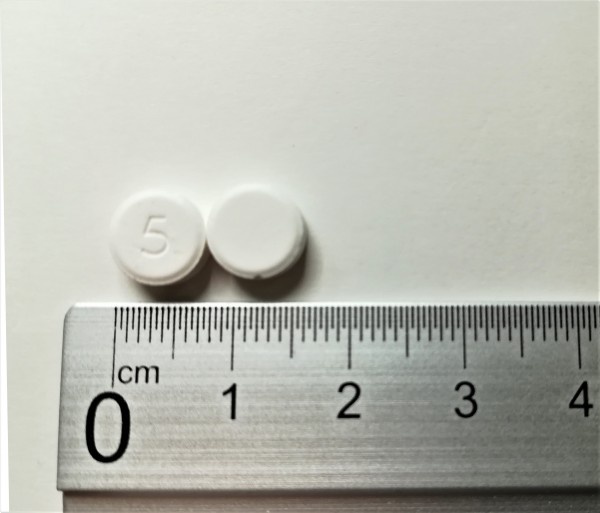
Los comprimidos bucodispersables de Coversoral 5 mg son blancos y redondos.
Los comprimidos están disponibles en envases de 5, 10, 14, 20, 30, 50, 60, 90, 100, 120 ó 500 comprimidos.
Puede que solamente estén comercializados algunos tamaños de envases.
Titular de la autorización de comercialización y responsable de la fabricación
Titular de la autorización de comercialización
Les Laboratoires Servier
50, rue Carnot
92284 Suresnes cedex – Francia
Responsable de la fabricación
Les Laboratoires Servier Industrie
905 route de Saran
45520 Gidy – Francia
y
Servier (Ireland) Industries Ltd
Gorey Road
Arklow – Co. Wicklow – Irlanda
y
ANPHARM Przedsiebiorstwo Farmaceutyczne S.A.
UI. Annopol 6B-03-236
Varsovia -Polonia
Este medicamento está autorizado en los estados miembros del Espacio Económico Europeo con los siguientes nombres:
Bulgaria | PRESTARIUM 5 mg ????????, ???????????? ?? ? ?????? |
Estonia | Prestarium Arginine 5 mg suus dispergeeruv tablett |
Eslovaquia | PRESTARIUM A 5 mg orodispergovatelná tableta |
Eslovenia | BIOPREXANIL 5 mg orodisperzibilne tablete |
España | COVERSORAL 5 mg |
Francia | COVERSYL 5 mg comprimé orodispersible |
Irlanda | COVERSYL Arginine 5 mg Orodispersible tablets |
Letonia | PRESTARIUM 5 mg mute dispergejamas tabletes |
Lituania | PRESTARIUM 5 mg burnoje disperguojamosios tabletes |
Portugal | COVERSORAL 5 mg comprimidos orodispersíveis |
República Checa | PRESTARIUM NEO ORODISPERZNÍ tablety |
Fecha de la última revisión de esteprospecto: octubre 2021
La información detallada de este medicamento está disponible en la página web de la Agencia Española del Medicamento y Productos Sanitarios (AEMPS) http://www.aemps.gob.es/.
- País de registro
- Forma farmacéuticaCOMPRIMIDO BUCODISPERSABLE/LIOTAB, 5 mg
- Código ATCC09AA04
- Principio activo
- Requiere recetaSí
- Fabricante
- ComposiciónACESULFAMO POTASICO (0,2 mg mg), ASPARTAMO (E-951) (0,2 mg mg), PREMEZCLA LACTOSA/ALMIDON (73,8 mg mg)
- Esta información es de carácter general y no sustituye la consulta con un profesional sanitario.
- Alternativas a COVERSORAL, 5 mg COMPRIMIDOS BUCODISPERSABLESForma farmacéutica: COMPRIMIDO BUCODISPERSABLE/LIOTAB, 10 mgPrincipio activo: PerindoprilFabricante: Les Laboratoires ServierRequiere recetaForma farmacéutica: COMPRIMIDO, 4 mgPrincipio activo: PerindoprilFabricante: Aurovitas Spain, S.A.U.Requiere recetaForma farmacéutica: COMPRIMIDO, 4 MGPrincipio activo: PerindoprilFabricante: Krka D.D. Novo MestoRequiere receta
Médicos online para COVERSORAL, 5 mg COMPRIMIDOS BUCODISPERSABLES
Comenta la dosis, los posibles efectos secundarios, interacciones, contraindicaciones o si una receta es apropiada para COVERSORAL, 5 mg COMPRIMIDOS BUCODISPERSABLES, sujeto a valoración médica y a la normativa local.
Preguntas frecuentes
COVERSORAL, 5 mg COMPRIMIDOS BUCODISPERSABLES requiere receta en España. Puedes confirmarlo con un médico online según tu caso.
El principio activo de COVERSORAL, 5 mg COMPRIMIDOS BUCODISPERSABLES es Perindopril. Esta información ayuda a identificar medicamentos con la misma composición pero con diferentes nombres comerciales.
COVERSORAL, 5 mg COMPRIMIDOS BUCODISPERSABLES es fabricado por Les Laboratoires Servier. La marca y el envase pueden variar según el distribuidor.
Los Médicos de familia, Psiquiatras, Dermatólogos, Cardiólogos, Endocrinólogos, Gastroenterólogos, Neumólogos, Nefrólogos, Reumatólogos, Hematólogos, Infectólogos, Alergólogos, Geriatras, Pediatras, Oncólogos pueden valorar la prescripción de COVERSORAL, 5 mg COMPRIMIDOS BUCODISPERSABLES cuando esté clínicamente indicado. Puedes reservar una videoconsulta para comentar tu caso y las opciones de tratamiento.
La receta la emite un médico tras valorar tu estado de salud. En España, COVERSORAL, 5 mg COMPRIMIDOS BUCODISPERSABLES se dispensa en las farmacias con esa receta médica. Una consulta online no garantiza su emisión: la decisión corresponde siempre al médico.
Para solicitar una valoración puedes usar Oladoctor:
Otros medicamentos con el mismo principio activo (Perindopril) incluyen COVERSORAL 10 mg COMPRIMIDOS BUCODISPERSABLES, PERINDOPRIL AUROVITAS 4 MG COMPRIMIDOS EFG, PERINDOPRIL KRKA 4 mg COMPRIMIDOS EFG. Pueden tener diferentes nombres comerciales o formulaciones, pero contienen el mismo componente terapéutico. Consulta siempre con un médico antes de cambiar o iniciar un nuevo medicamento.
