



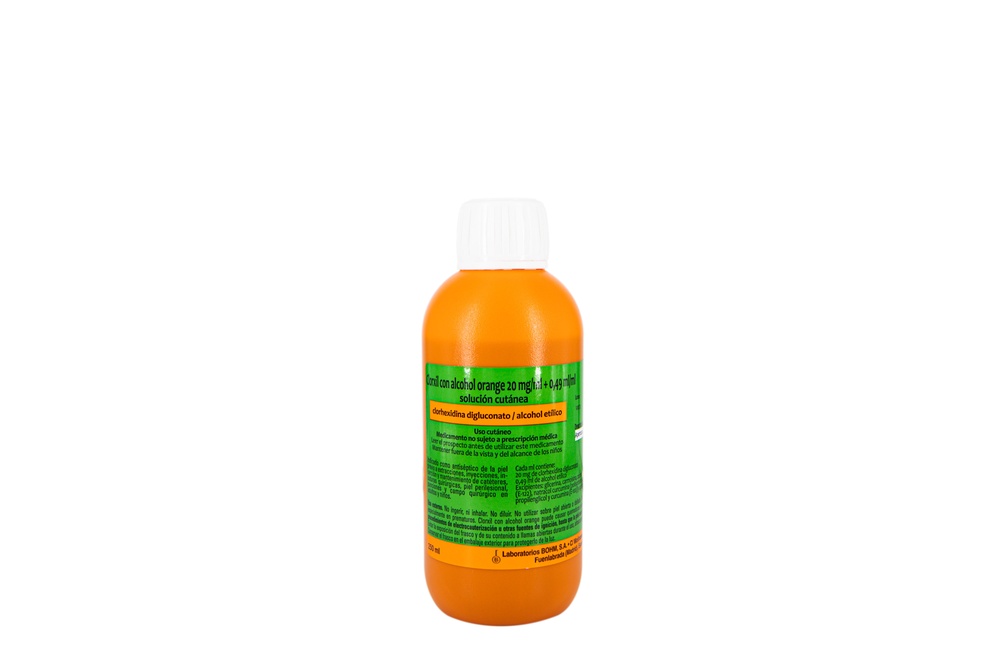
CLORXIL CON ALCOHOL ORANGE 20 mg/mL + 0,49 mL/mL SOLUCIÓN CUTÁNEA

Revisión de receta online
Un médico revisará tu caso y determinará si la prescripción es médicamente apropiada.

Habla con un médico sobre este medicamento
Comenta tus síntomas y las opciones de tratamiento en una consulta online.



Cómo usar CLORXIL CON ALCOHOL ORANGE 20 MG/ML + 0,49 ML/ML SOLUCIÓN CUTÁNEA
Contenido del prospecto
- Introducción
- Qué es Clorxil con alcohol orange y para qué se utiliza
- Qué necesita saber antes de empezar a usar Clorxil con alcohol orange
- Cómo usar Clorxil con alcohol orange
- Posibles efectos adversos
- Conservación de Clorxil con alcohol orange
- Contenido del envase e información adicional
Introducción
Prospecto:información para el usuario
Clorxil con alcohol orange 20 mg/ml + 0,49 ml/ml solución cutánea
clorhexidina digluconato/alcohol etílico
Lea todo el prospecto detenidamente antes de empezar a usar este medicamento,porque contiene información importante para usted.
- Conserve este prospecto, ya que puede tener que volver a leerlo.
- Si necesita consejo o más información, consulte a su farmacéutico.
- Si experimenta efectos adversos, consulte a su médico o enfermero, incluso si se trata de efectos adversos que no aparecen en este prospecto. Ver sección 4.
- Debe consultar a un médico si empeora o si no mejora.
Contenido del prospecto
- Qué es Clorxil con alcohol orange y para qué se utiliza
- Qué necesita saber antes de empezar a usar Clorxil con alcohol orange
- Cómo usar Clorxil con alcohol orange
- Posibles efectos adversos
5 Conservación de Clorxil con alcohol orange
- Contenido del envase e información adicional
1. Qué es Clorxil con alcohol orange y para qué se utiliza
Clorxil con alcohol orange contiene clorhexidina digluconato y alcohol etílico, utilizado como antiséptico cutáneo.
Está indicado como antiséptico de la piel previo a extracciones, inyecciones, inserción y mantenimiento de catéteres, suturas quirúrgicas, piel perilesional, punciones y campo quirúrgico en adultos y niños.

¿No estás seguro de si este medicamento es adecuado para ti?
Comenta tus síntomas y tratamiento con un médico online.
2. Qué necesita saber antes de empezar a usar Clorxil con alcohol orange
No use Clorxil con alcohol orange
Si es alérgico (hipersensible) a la clorhexidina digluconato, al alcohol etílico, o a cualquiera de los demás componentes de este medicamento (incluidos en la sección 6).
Advertencias y precauciones
Consulte a su médico o farmacéutico antes de empezar a usar Clorxil con alcohol.
Este medicamento es sólo para uso externo. No ingerir, ni inhalar.
La solución es inflamable.
El riesgo de incendio es alto cuando se usa una fuente de ignición (unidades electroquirúrgicas, láseres, fuentes de luz de fibra óptica, brocas/fresas de alta velocidad…) en combinación con el uso de una fuente de combustión (como paños, toallas…) y el uso de un oxidante (oxígeno, aire, óxido nitroso…).
Para reducir el riesgo de incendio:
- No utilizar procedimientos de electrocauterización u otras fuentes de ignición hasta que la piel esté completamente seca.
- Retirar cualquier material empapado, gasas o batas antes de comenzar con la intervención.
- No usar cantidades excesivas y evitar que la solución se acumule en los pliegues de la piel, bajo el paciente o que empape las sábanas u otro material en contacto directo con el paciente. No deje que la solución se estanque.
- Cuando se aplique vendaje oclusivo a las zonas previamente expuestas a Clorxil con alcohol orange, se debe de tener especial cuidado de que no haya exceso de producto antes de colocar el vendaje.
- Reducir el aporte de oxígeno o cualquier otro oxidante al mínimo necesario. Aquellos procedimientos que se realicen en la cabeza, cuello y la parte superior del pecho (por encima de T5) y el uso de una fuente de ignición cerca de un oxidante ponen al paciente en riesgo de sufrir un incendio quirúrgico.
Este medicamento puede, en raras ocasiones, causar reacciones alérgicas graves llevando a una disminución en la presión arterial e incluso a una pérdida de consciencia. Los primeros síntomas de una reacción alérgica grave pueden ser erupción cutánea o asma. Si nota estos síntomas, deje de usar este medicamento y contacte con su médico lo antes posible (vea sección 4: “Posibles efectos adversos”).
Evite el contacto prolongado con la piel.
Este medicamento no debe aplicarse:
- Cerca de zonas sensibles (membranas mucosas), ya que puede provocar irritación, dolor, enrojecimiento y quemaduras químicas. En caso de contacto accidental con los ojos o las mucosas de las vías de entrada al cuerpo, se debe lavar inmediatamente el área afectada con abundante agua.
- Clorxil con alcohol orange no debe entrar en contacto con los ojos debido al riesgo de lesiones visuales. Si entra en contacto con los ojos, lávese inmediata y abundantemente con agua. En caso de irritación, enrojecimiento o dolor en los ojos, o alteraciones visuales, consulte a un médico inmediatamente.
Se han notificado casos graves de lesión persistente de la córnea (lesión de la superficie del ojo) que podría llegar a requerir un trasplante de córnea cuando productos similares han entrado accidentalmente en contacto con los ojos durante intervenciones quirúrgicas, en pacientes con anestesia general (sueño profundo inducido indoloro).
- Sobre heridas abiertas.
- Sobre la parte interna de la oreja (oído medio).
- En contacto directo con el tejido neural (por ejemplo, el cerebro y la médula espinal).
- Las ropas que hayan estado en contacto con Clorxil con alcohol no deben lavarse con lejía ni otros hipocloritos, pues se produciría una coloración parduzca en los tejidos, sino con detergentes domésticos a base de perborato sódico.
Este medicamento solo debe aplicarse sobre la piel suavemente. Si la solución se aplica de forma demasiado vigorosa sobre piel frágil o sensible, o tras un uso repetido, puede producirse una reacción cutánea local con eritema, inflamación, picor, piel seca y/o descamada y dolor localizado en la zona de administración. Ante el primer signo de cualquiera de estas reacciones debe parar la administración de este medicamento.
Niños
Utilizar con cuidado en neonatos, especialmente en prematuros. Clorxil con alchohol puede causar quemaduras químicas en la piel.
Este medicamento sólo debe utilizarse bajo prescripción facultativa en niños menores de 30 meses.
Otros medicamentos y Clorxil con alcohol orange
Informe a su médico o farmacéutico si está utilizando, ha utilizado recientemente o pudiera tener que utilizar cualquier otro medicamento.
Comunique a su médico o enfermero si recientemente le han administrado una vacuna o una inyección para una prueba cutánea (pruebas epicutáneas para detectar alergias).
Debe evitarse el empleo simultáneo o sucesivo de otros antisépticos para minimizar el riesgo de posibles interferencias entre ellos
El producto es incompatible con los derivados aniónicos (jabones) por lo que debe aclararse bien la piel después de limpiarla.
Embarazo,lactanciay fertilidad
Si está embarazada o en periodo de lactancia, cree que podría estar embarazada o tiene intención de quedarse embarazada, consulte a su médico antes de utilizar este medicamento.
Se desconoce si la clorhexidina digluconato o el alcohol etílico se excretan en la leche materna. Debido a que muchos medicamentos se excretan en la leche materna, se debe tener precaución cuando se administre Clorxil con alcohol orange a mujeres lactantes.
Conducción y uso de máquinas
Clorxil con alcohol orange no altera la capacidad de conducir o manejar máquinas.
3. Cómo usar Clorxil con alcohol orange
Aplicar el producto suavemente sobre la zona de la piel que necesite ser preparada. Aplicar las veces que sea necesario en función del procedimiento médico. No diluir.
Se debe aplicar el producto directamente sobre el área a tratar y dejar secar antes de cualquier procedimiento.
En caso de duda pregunte a su médico o enfermero.
Si usa más Clorxil con alcohol orange del que debe
En caso de sobredosis o ingestión accidental, consulte inmediatamente a su médico o farmacéutico o llame al Servicio de Información Toxicológica, teléfono: 91 562 0420, indicando el medicamento y la cantidad ingerida.

¿Has empezado a tomar el medicamento y tienes preguntas?
Comenta tus síntomas y tratamiento con un médico online.
4. Posibles efectos adversos
Al igual que todos los medicamentos, este medicamento puede producir efectos adversos, aunque no todas las personas los sufran.
Los efectos adversos muy raros (menos de 1 de cada 10.000 personas) observados en la piel y el tejido subcutáneo son:
Irritación cutánea, incluyendo: eritema, erupción, urticaria, prurito y ampollas o vesículas en la zona de administración. Otros síntomas locales pueden ser: sensación de quemazón en la piel, dolor e inflamación.
Otros efectos adversos con una frecuencia no conocida (no puede estimarse la frecuencia a partir de los datos disponibles) son:
-Reacciones alérgicas incluyendo shock anafiláctico.
-Lesión corneal (lesión en la superficie del ojo) y lesión ocular permanente, incluido deterioro visual permanente (tras la exposición ocular accidental durante las intervenciones quirúrgicas en la cabeza, la cara y el cuello) en pacientes bajo anestesia general (sueño profundo inducido indoloro).
-Dolor, hiperemia y quemaduras químicas en casos de contacto accidental.
-Dermatitis, eczema, urticaria, irritación de la piel, ampollas
-Quemaduras químicas en neonatos.
Deje de usar Clorxil y busque atención médica inmediata si experimenta cualquiera de las siguientes reacciones: hinchazón de la cara, labios, lengua o garganta; erupción cutánea de color rojo y con picor; respiración con silbidos o dificultad para respirar; sensación de desmayo y mareos; sabor metálico extraño en la boca; colapso. Puede estar teniendo una reacción alérgica.
Comunicación de efectos adversos
Si experimenta cualquier tipo de efecto adverso, consulte a su médico o farmacéutico, incluso si se trata de posibles efectos adversos que no aparecen en este prospecto. También puede comunicarlos directamente a través del Sistema Español de Farmacovigilancia de Medicamentos de Uso Humano http://www.notificaram.es. Mediante la comunicación de efectos adversos usted puede contribuir a proporcionar más información sobre la seguridad de este medicamento.
5. Conservación de Clorxil con alcohol orange
Este medicamento es inflamable. Evitar la exposición del frasco y de su contenido a llamas abiertas durante el uso, almacenamiento y eliminación del producto.
Mantener este medicamento fuera de la vista y del alcance de los niños.
Mantener el frasco perfectamente cerrado para protegerlo de la luz.
No utilice este medicamento después de la fecha de caducidad que aparece en la etiqueta después de CAD. La fecha de caducidad es el último día del mes que se indica.
Los medicamentos no se deben tirar por los desagües ni a la basura. Pregunte a su farmacéutico cómo deshacerse de los envases y de los medicamentos que ya no necesita. De esta forma, ayudará a proteger el medio ambiente.
6. Contenido del envase e información adicional
Composición de Clorxil con alcohol orange solución cutánea
Los principios activos son: clorhexidina digluconato y alcohol etílico
Los demás componentes (excipientes) son: glicerina, carmoisina, azorrubina (E-122)
natracol curcumina (polisorbato 80, propilenglicol y curcumina (E-100)) y agua purificada
Cada ml de solución contiene: 20 mg de clorhexidina digluconato y 0,49 ml de alcohol etílico.
Aspecto del producto y contenido del envaseSolución transparente de color rojizo que se presenta en frascos de plástico (HDPE/LDPE o HDPE) de color naranja con tapón obturador blanco de HDPE/LDPE.
Se presenta en:
- Envase clínico de 100 frascos de 10 ml.
- Envase clínico de 100 frascos de 20 ml
- Envase clínico de 50 frascos de 100 ml
- Envase clínico de 50 frascos de 250 ml.
- Envase clínico de 20 frascos de 500 ml.
Titular de la autorización de comercialización y responsable de la fabricación
LABORATORIOS BOHM, S.A.
C/ Molinaseca 23-25. Polígono Industrial Cobo Calleja.
28947 Fuenlabrada (Madrid)
Teléfono: 91 642 18 18
Fax: 91 642 0572
Email: [email protected]
Fecha de la última revisión de esteprospecto: Mayo 2024
Otras fuentes de información
La información detallada de este medicamento está disponible en la página web de la Agencia Española de Medicamentos y Productos Sanitarios (AEMPS) http://www.aemps.gob.es/)
- País de registro
- Forma farmacéuticaLIQUIDO USO TOPICO, 20 mg/ml + 0,49 ml/ml
- Código ATCD08AC52
- Principio activo
- Requiere recetaNo
- Fabricante
- ComposiciónGLICEROL (E 422) (75 mg/ml mg), CARMOISINA, AZORRUBINA (CI=14720,E-122) (0,02 mg/ml mg)
- Esta información es de carácter general y no sustituye la consulta con un profesional sanitario.
- Alternativas a CLORXIL CON ALCOHOL ORANGE 20 MG/ML + 0,49 ML/ML SOLUCIÓN CUTÁNEAForma farmacéutica: LIQUIDO USO TOPICO, 20 mg/ml + 0,70 ml/mlPrincipio activo: chlorhexidine, combinationsFabricante: Vesismin S.L.U.No requiere recetaForma farmacéutica: LIQUIDO USO TOPICO, 20 mg/ml + 0.70 ml/mlPrincipio activo: chlorhexidine, combinationsFabricante: Vesismin S.L.U.No requiere recetaForma farmacéutica: LIQUIDO USO TOPICO, 20 mg/ml + 0,7 ml/mlPrincipio activo: chlorhexidine, combinationsFabricante: Becton Dickinson FranceNo requiere receta
Médicos online para CLORXIL CON ALCOHOL ORANGE 20 MG/ML + 0,49 ML/ML SOLUCIÓN CUTÁNEA
Comenta la dosis, los posibles efectos secundarios, interacciones, contraindicaciones o la revisión de receta de CLORXIL CON ALCOHOL ORANGE 20 MG/ML + 0,49 ML/ML SOLUCIÓN CUTÁNEA, sujeto a valoración médica y a la normativa local.









Obtén una receta de CLORXIL CON ALCOHOL ORANGE 20 MG/ML + 0,49 ML/ML SOLUCIÓN CUTÁNEA online
Rellena un formulario de 2 minutos
Cuéntanos tus síntomas, historial y el medicamento que necesitas.
Elige un médico o nosotros te asignamos uno
Escoge un especialista o te conectamos con el próximo médico disponible.
El médico revisa tu caso
Normalmente en 30 minutos. Puede hacerte preguntas adicionales por chat.
Recógela en cualquier farmacia
Receta electrónica enviada a tu correo, válida en toda España.
Preguntas frecuentes
CLORXIL CON ALCOHOL ORANGE 20 MG/ML + 0,49 ML/ML SOLUCIÓN CUTÁNEA no requiere receta en España. Puedes confirmarlo con un médico online según tu caso.
El principio activo de CLORXIL CON ALCOHOL ORANGE 20 MG/ML + 0,49 ML/ML SOLUCIÓN CUTÁNEA es chlorhexidine, combinations. Esta información ayuda a identificar medicamentos con la misma composición pero con diferentes nombres comerciales.
CLORXIL CON ALCOHOL ORANGE 20 MG/ML + 0,49 ML/ML SOLUCIÓN CUTÁNEA es fabricado por Laboratorios Bohm S.A.. La marca y el envase pueden variar según el distribuidor.
Los Médicos de familia, Psiquiatras, Dermatólogos, Cardiólogos, Endocrinólogos, Gastroenterólogos, Neumólogos, Nefrólogos, Reumatólogos, Hematólogos, Infectólogos, Alergólogos, Geriatras, Pediatras, Oncólogos pueden valorar la prescripción de CLORXIL CON ALCOHOL ORANGE 20 MG/ML + 0,49 ML/ML SOLUCIÓN CUTÁNEA cuando esté clínicamente indicado. Puedes reservar una videoconsulta para comentar tu caso y las opciones de tratamiento.
España cuenta con una infraestructura sanitaria bien desarrollada en ciudades principales como Madrid, Barcelona, Valencia y Sevilla. Las farmacias están ampliamente disponibles y operan bajo estrictas regulaciones, garantizando el acceso a medicamentos con receta.
Puedes comprar CLORXIL CON ALCOHOL ORANGE 20 MG/ML + 0,49 ML/ML SOLUCIÓN CUTÁNEA en Madrid, Barcelona, Sevilla o Valencia en cualquier farmacia local con una receta válida.
Para obtener una receta, puedes utilizar Oladoctor:
Otros medicamentos con el mismo principio activo (chlorhexidine, combinations) incluyen BACTISEPTIC PHARMA 20 MG/ML + 0,70 ML/ML SOLUCIÓN CUTÁNEA, BACTISEPTIC PHARMA ORANGE 20 MG/ML + 0,70 ML/ML SOLUCIÓN CUTÁNEA, CHLORAPREP ANARANJADO 20MG/ML + 0,70 ML/ML SOLUCION CUTANEA. Pueden tener diferentes nombres comerciales o formulaciones, pero contienen el mismo componente terapéutico. Consulta siempre con un médico antes de cambiar o iniciar un nuevo medicamento.
