



CAPENON 40 mg/5 mg Comprimidos Recubiertos Con Película

Revisión de receta online
Un médico revisará tu caso y determinará si la prescripción es médicamente apropiada.

Habla con un médico sobre este medicamento
Comenta tus síntomas y las opciones de tratamiento en una consulta online.



Cómo usar CAPENON 40 mg/5 mg COMPRIMIDOS RECUBIERTOS CON PELICULA
Contenido del prospecto
- Introducción
- Qué es Capenon y para qué se utiliza
- Qué necesita saber antes de empezar a tomar Capenon
- Cómo tomar Capenon
- Posibles efectos adversos
- Conservación de Capenon
- Contenido del envase e información adicional
Introducción
Prospecto: Información para el usuario
Capenon 40 mg/5 mg comprimidos recubiertos con película
Olmesartán medoxomilo/Amlodipino
Lea todo el prospecto detenidamente antes de empezar a tomar este medicamento, porque contiene información importante para usted.
- Conserve este prospecto, ya que puede tener que volver a leerlo.
- Si tiene alguna duda, consulte a su médico o farmacéutico.
- Este medicamento se le ha recetado solamente a usted, y no debe dárselo a otras personas aunque tengan los mismos síntomas que usted, ya que puede perjudicarles.
- Si experimenta efectos adversos, consulte a su médico o farmacéutico, incluso si se trata de efectos adversos que no aparecen en este prospecto. Ver sección 4.l
Contenido del prospecto
- Qué es Capenon y para qué se utiliza
- Qué necesita saber antes de empezar a tomar Capenon
- Cómo tomar Capenon
- Posibles efectos adversos
- Conservación de Capenon
- Contenido del envase e información adicional
1. Qué es Capenon y para qué se utiliza
Capenon contiene dos sustancias llamadas olmesartán medoxomilo y amlodipino (como amlodipino besilato). Las dos sustancias ayudan a controlar la presión arterial alta.
- Olmesartán medoxomilo pertenece a un grupo de medicamentos llamados “antagonistas de los receptores de la angiotensina II”, los cuales disminuyen la presión arterial relajando los vasos sanguíneos.
- Amlodipino pertenece a un grupo de medicamentos llamados “bloqueantes de los canales de calcio”. Amlodipino evita que el calcio penetre en la pared del vaso sanguíneo, lo que impide el estrechamiento de los vasos sanguíneos, de manera que también disminuye la presión arterial.
La acción de ambas sustancias contribuye a frenar el estrechamiento de los vasos sanguíneos, de manera que éstos se relajan y la presión arterial disminuye.
Capenon se utiliza para tratar la presión arterial alta en pacientes cuya presión arterial no se controla adecuadamente con olmesartán medoxomilo o amlodipino solos.

¿No estás seguro de si este medicamento es adecuado para ti?
Comenta tus síntomas y tratamiento con un médico online.
2. Qué necesita saber antes de empezar a tomar Capenon
No tome Capenon:
- Si es alérgico a olmesartán medoxomilo, o a amlodipino, o a un grupo especial de bloqueantes de los canales de calcio, llamados dihidropiridinas, o a cualquiera de los demás componentes de este medicamento (incluidos en la sección 6).
Si cree que puede ser alérgico, informe a su médico antes de tomar Capenon.
- Si está embarazada de más de 3 meses. Es mejor evitar Capenon al inicio del embarazo (ver sección “Embarazo y lactancia”).
- Si tiene diabetes o insuficiencia renal y le están tratando con un medicamento para bajar la presión arterial que contiene aliskirén.
- Si tiene problemas graves de hígado, si la secreción de bilis está alterada, o su liberación por la vesícula biliar está bloqueada (por ejemplo, por cálculos biliares), o si tiene ictericia (piel y ojos amarillentos).
- Si tiene la presión arterial muy baja.
- Si tiene un aporte insuficiente de sangre en los tejidos, con síntomas como presión arterial baja, pulso débil, ritmo rápido del corazón (shock, incluyendo shock cardiogénico). El shock cardiogénico significa un shock debido a problemas cardiacos graves.
- Si el flujo sanguíneo de su corazón está bloqueado (por ejemplo, debido a estrechamiento de la aorta (estenosis de la aorta)).
- Si padece un bajo rendimiento cardiaco (produciendo dificultad para respirar, o hinchazón periférica) después de un ataque al corazón (infarto agudo de miocardio).
Advertencias y precauciones
Consulte a su médico o farmacéutico antes de empezar a usar Capenon.
Dígale a su médicosi está tomando alguno de los siguientes medicamentos utilizados para tratar la presión arterial alta (hipertensión):
- un inhibidor de la enzima convertidora de angiotensina (IECA) (por ejemplo enalapril, lisinopril, ramipril), en particular si sufre problemas renales relacionados con la diabetes.
- aliskirén.
Puede que su médico le controle la función renal, la presión arterial y los niveles de electrolitos en la sangre (por ejemplo, potasio), a intervalos regulares.
Ver también la información bajo el encabezado “No tome Capenon”.
Dígale a su médicosi tiene alguno de los siguientes problemas de salud:
- Problemas de riñón o un trasplante de riñón.
- Enfermedad del hígado.
- Insuficiencia cardiaca o problemas con las válvulas cardiacas o del músculo cardiaco.
- Vómitos intensos, diarrea, tratamiento con dosis elevadas de medicamentos que aumentan la eliminación de orina (diuréticos), o si está tomando una dieta baja en sal.
- Niveles elevados de potasio en sangre.
- Problemas con las glándulas suprarrenales (glándulas productoras de hormonas situadas sobre los riñones).
Contacte con su médico si sufre una diarrea grave, persistente y que le cause una pérdida de peso importante. Su médico evaluará sus síntomas y decidirá cómo seguir con su tratamiento para la presión arterial.
Consulte a su médico si presenta dolor abdominal, náuseas, vómitos o diarrea después de tomar Capenon. Su médico decidirá si continuar con el tratamiento. No deje de tomar Capenon por su cuenta.
Al igual que ocurre con cualquier otro medicamento que reduzca la presión arterial, una disminución excesiva de la presión arterial en pacientes con alteraciones del flujo sanguíneo en el corazón o en el cerebro, puede producir un ataque cardiaco o un accidente cerebrovascular. Por eso su médico controlará cuidadosamente su presión arterial.
Debe informar a su médico si está embarazada o piensa que pudiera estarlo. No se recomienda el uso de Capenon al inicio del embarazo, y no se debe tomar si usted está embarazada de más de 3 meses, ya que puede causar daños graves a su bebé si lo toma en esta etapa (ver sección “Embarazo y lactancia”).
Niños y adolescentes (menores de 18 años)
Capenon no está recomendado para niños y adolescentes menores de 18 años.
Uso de Capenon con otros medicamentos
Informe a su médico o farmacéutico si está tomando, ha tomado recientemente o pudiera tener que tomar cualquiera de los siguientes medicamentos:
- Otros medicamentos reductores de la presión arterial,porque pueden incrementar el efecto de Capenon.
Puede que su médico deba modificar su dosis y/o tomar otras precauciones:
Si está tomando un inhibidor de la enzima convertidora de angiotensina (IECA) o aliskirén (ver también la información bajo los encabezados “No tome Capenon” y “Advertencias y precauciones”).
- Suplementos de potasio, sustitutos de la sal que contengan potasio, medicamentos que aumentan la eliminación de orina(diuréticos), o heparina(para fluidificar la sangre y la prevención de coágulos de sangre). El uso de estos medicamentos al mismo tiempo que Capenon puede elevar los niveles de potasio en sangre.
- El litio(medicamento utilizado para tratar los cambios de estado de ánimo y algunos tipos de depresión) utilizado a la vez que Capenon puede incrementar su toxicidad. Si usted tiene que tomar litio, su médico medirá los niveles de litio en sangre.
- Los medicamentos antiinflamatorios no esteroideos(AINES, medicamentos utilizados para aliviar el dolor, hinchazón y otros síntomas de la inflamación, incluyendo artritis) utilizados a la vez que Capenon pueden incrementar el riesgo de insuficiencia renal. El efecto de Capenon se puede disminuir por los AINES.
- Colesevelam hidrocloruro, un medicamento que disminuye el nivel de colesterol en sangre, ya que puede disminuir el efecto de Capenon. Puede ser que su médico le aconseje tomar Capenon al menos 4 horas antes de colesevelam hidrocloruro.
- Ciertos antiácidos(remedios para la indigestión y la acidez), ya que pueden disminuir ligeramente el efecto de Capenon.
- Medicamentos utilizados para el VIH/SIDA(por ejemplo, ritonavir, indinavir, nelfinavir) o para el tratamiento de infecciones por hongos(por ejemplo, ketoconazol, itraconazol).
- Diltiazem, verapamilo(medicamentos utilizados para problemas del ritmo del corazón y de presión arterial alta).
- Rifampicina, eritromicina, claritromicina(antibióticos),medicamentos utilizados para la tuberculosis u otras infecciones.
- Hierba de San Juan(Hypericum perforatum), remedio a base de plantas.
- Dantroleno(en perfusión para anomalías graves de la temperatura corporal).
- Simvastatina, un medicamento utilizado para disminuir los niveles de colesterol y grasas (triglicéridos) en la sangre.
- Tacrolimus, sirolimus, temsirolimus, everolimus y ciclosporina,utilizados para controlar la respuesta inmune del cuerpo, lo que hace posible que su cuerpo acepte el órgano trasplantado.
Comunique a su médico o farmacéutico si está tomando, ha tomado recientemente o podría tener que tomar cualquier otro medicamento.
Toma de Capenon con los alimentos y bebidas:
Capenon se puede tomar con o sin alimentos. Tome los comprimidos con un poco de líquido (como un vaso de agua). Si es posible, tome la dosis diaria a la misma hora cada día, por ejemplo, a la hora del desayuno.
Las personas que están tomando Capenon no deben consumir pomelo, ni zumo de pomelo. Esto se debe a que el pomelo y el zumo de pomelo pueden dar lugar a un aumento de los niveles en sangre del ingrediente activo amlodipino, que puede causar un aumento imprevisible en el efecto de bajar la presión arterial de Capenon.
Pacientes de edad avanzada
Si usted tiene más de 65 años, su médico le controlará regularmente la presión arterial cada vez que le aumente la dosis, para asegurarse de que no disminuya demasiado.
Pacientes de raza negra
Como sucede con otros medicamentos similares, el efecto reductor de la presión arterial de Capenon es algo menor en pacientes de raza negra.
Embarazo y lactancia
Embarazo
Debe informar a su médico si está embarazada, o si piensa que pudiera estarlo.
Su médico le aconsejará que deje de tomar Capenon antes de quedarse embarazada o tan pronto como usted sepa que está embarazada, y le aconsejará que tome otro medicamento en lugar de Capenon. No se recomienda el uso de Capenon al inicio del embarazo, y no se debe tomar cuando se está embarazada de más de 3 meses, ya que puede causar daños graves a su bebé si se utiliza a partir del tercer mes del embarazo.
Si se queda embarazada mientras está en tratamiento con Capenon, informe y acuda a su médico inmediatamente.
Lactancia
Informe a su médico si está en periodo de lactancia o a punto de iniciar la lactancia. Se ha demostrado que amlodipino pasa a la leche materna en pequeñas cantidades. No se recomienda Capenon en madres que estén en periodo de lactancia, y su médico puede elegir otro tratamiento si usted desea dar lactancia, especialmente si su bebé es recién nacido o ha nacido prematuro.
Si está embarazada o en periodo de lactancia, cree que podría estar embarazada o tiene intención de quedarse embarazada, consulte a su médico o farmacéutico antes de utilizar este medicamento.
Conducción y uso de máquinas
Durante el tratamiento de la presión arterial alta, puede tener sueño, sentirse enfermo o mareado, o tener dolor de cabeza. Si esto ocurre, no conduzca ni utilice máquinas hasta que los síntomas hayan desaparecido. Consulte a su médico.
Este medicamento contiene menos de 1 mmol de sodio (23 mg) por comprimido recubierto con película; esto es, esencialmente “exento de sodio”.
3. Cómo tomar Capenon
Siga exactamente las instrucciones de administración de este medicamento indicadas por su médico o farmacéutico. En caso de duda, consulte de nuevo a su médico o farmacéutico.
- La dosis recomendada de Capenon es de un comprimido al día.
- Los comprimidos se pueden tomar con o sin alimentos. Tome los comprimidos con un poco de líquido (como un vaso de agua). No se debe masticar el comprimido. No tome Capenon con zumo de pomelo.
- Si es posible, tome su dosis diaria a la misma hora cada día, por ejemplo a la hora del desayuno.
Si toma más Capenon del que debe
Si toma más comprimidos de los que debe tomar, probablemente sufrirá una bajada de la presión arterial, acompañada de síntomas como mareo, y latido rápido o lento del corazón.
Si toma más comprimidos de los que debe tomar o un niño ingiere accidentalmente algunos comprimidos, contacte inmediatamente con el médico o vaya al centro de urgencias más próximo y lleve con usted el envase del medicamento o este prospecto.
El exceso de líquido puede acumularse en los pulmones (edema pulmonar) causando dificultad para respirar que puede desarrollarse hasta 24-48 horas después de la ingesta.
En caso de sobredosis o ingestión accidental, consulte al Servicio de Información Toxicológica. Teléfono 91 562 04 20.
Si olvidó tomar Capenon:
Si olvidó tomar una dosis, tome la dosis habitual al día siguiente. Notome una dosis doble para compensar las dosis olvidadas.
Si interrumpe el tratamiento con Capenon:
Es importante continuar tomando Capenon, salvo que su médico le diga que interrumpa el tratamiento.
Si tiene cualquier otra duda sobre el uso de este medicamento, pregunte a su médico o farmacéutico.

¿Has empezado a tomar el medicamento y tienes preguntas?
Comenta tus síntomas y tratamiento con un médico online.
4. Posibles efectos adversos
Al igual que todos los medicamentos, este medicamento puede producir efectos adversos, aunque no todas las personas los sufran. Si éstos se producen, son a menudo leves y no requieren interrumpir el tratamiento.
Los siguientes efectos adversos pueden ser graves, aunque afecten sólo a un grupo reducido de personas:
Durante el tratamiento con Capenon se pueden producir reacciones alérgicas, que pueden afectar a todo el cuerpo, con inflamación de la cara, boca y/o laringe (cuerdas vocales), junto con prurito y erupción de la piel. Si esto le sucede, deje de tomar Capenon y consulte inmediatamente con su médico.
Capenon puede producir un descenso pronunciado de la presión arterial, en pacientes susceptibles, o como resultado de una reacción alérgica. Esto puede producir desvanecimiento o aturdimiento grave. Si esto le sucede, deje de tomar Capenon, consulte inmediatamente con su médico y permanezca tumbado en posición horizontal.
Frecuencia no conocida: Si experimenta coloración amarillenta del blanco de los ojos, orina oscura, picor de la piel, incluso si comenzó el tratamiento con Capenon hace tiempo, póngase en contacto con su médico inmediatamentequien evaluará sus síntomas y decidirá cómo continuar con el tratamiento para la presión arterial.
Otros posibles efectos adversos con Capenon:
Frecuentes (pueden afectar hasta 1 de cada 10 personas):
Mareo; dolor de cabeza; hinchazón de los tobillos, pies, piernas, manos o brazos; cansancio.
Poco frecuentes (pueden afectar hasta 1 de cada 100 personas):
Mareo al levantarse; falta de energía; hormigueo o entumecimiento de las manos o los pies; vértigo; notar los latidos del corazón; latidos rápidos del corazón; presión arterial baja con síntomas como mareo, aturdimiento; dificultad al respirar; tos; náuseas; vómitos; indigestión; diarrea; estreñimiento; sequedad de boca; dolor en la parte superior del abdomen; erupción cutánea; calambres; dolor de brazos y piernas; dolor de espalda; sensación de urgencia de orinar; inactividad sexual; incapacidad de tener o mantener una erección; debilidad.
También se han observado algunos cambios en los resultados de ciertas pruebas analíticas en sangre:
Aumento, así como disminución de los niveles de potasio en sangre, aumento de los niveles de creatinina en sangre, aumento de los niveles de ácido úrico, incremento en los valores de las pruebas de la función hepática (niveles de la gamma glutamil transferasa).
Raros (pueden afectar hasta 1 de cada 1.000 personas):
Hipersensibilidad al medicamento; desmayo; enrojecimiento y sensación de calor en la cara; ronchas rojas con picor (urticaria); inflamación de la cara.
Efectos adversos notificados con el uso de olmesartán medoxomilo o amlodipino solos, pero no con Capenon, o con una frecuencia mayor:
Olmesartán medoxomilo
Frecuentes (pueden afectar hasta 1 de cada 10 personas):
Bronquitis; dolor de garganta; congestión y secreción nasal; tos; dolor en el abdomen; gastroenteritis por virus; diarrea; indigestión; náusea; dolor en las articulaciones y de los huesos; dolor de espalda; sangre en la orina; infección del tracto urinario; dolor en el pecho; síntomas parecidos a los de la gripe; dolor. Cambios en los resultados de pruebas analíticas en sangre, como aumento de los niveles de un tipo de grasas (hipertrigliceridemia); aumento de ácido úrico y de urea en sangre e incremento en los valores de las pruebas de la función hepática y muscular.
Poco frecuentes (pueden afectar hasta 1 de cada 100 personas):
Reducción del número de un tipo de células de la sangre, llamadas plaquetas, lo que puede provocar fácilmente hematomas o prolongar el tiempo de sangrado; reacciones alérgicas rápidas, que pueden afectar a todo el cuerpo y que pueden causar problemas respiratorios, así como bajada rápida de la presión arterial, que pueden incluso producir desmayo (reacciones anafilácticas); angina (dolor o sensación de malestar en el pecho, conocido como angina de pecho); picor; erupción de la piel; erupción cutánea alérgica; erupción con urticaria; hinchazón de la cara; dolor muscular; malestar.
Raros (pueden afectar hasta 1 de cada 1.000 personas):
Inflamación de la cara, boca y/o laringe (cuerdas vocales); fallo renal agudo e insuficiencia renal; letargia; angioedema intestinal: hinchazón en el intestino que cursa con síntomas como dolor abdominal, náuseas, vómitos y diarrea.
Amlodipino
Muy frecuentes (pueden afectar a más de 1 de cada 10 personas):
Edema (retención de líquidos).
Frecuentes (pueden afectar hasta 1 de cada 10 personas):
Dolor abdominal; náusea; hinchazón de tobillos; sensación de sueño; enrojecimiento y sensación de calor en la cara, alteraciones visuales (incluyendo visión doble y visión borrosa), notar los latidos del corazón, diarrea, estreñimiento, indigestión, calambres, debilidad, dificultad al respirar.
Poco frecuentes (pueden afectar hasta 1 de cada 100 personas):
Dificultad para dormir; trastornos del sueño; cambios de humor incluyendo ansiedad; depresión; irritabilidad; temblor; alteraciones del gusto; desmayos;pitidos en los oídos (tinnitus); empeoramiento de la angina de pecho (dolor o sensación de malestar en el pecho); latido irregular del corazón; secreción o congestión nasal; pérdida de pelo; manchas de color púrpura o manchas en la piel debido a pequeñas hemorragias (púrpura); decoloración de la piel; sudoración excesiva; erupción de la piel; picor; ronchas rojas con picor (urticaria); dolor de las articulaciones o de los músculos; problemas para orinar; necesidad de orinar durante la noche; mayor necesidad de orinar, aumento del tamaño de las mamas en el hombre, dolor de pecho; dolor; sensación de malestar; aumento o disminución de peso.
Raros (pueden afectar hasta 1 de cada 1.000 personas):
Confusión.
Muy raros (pueden afectar hasta 1 de cada 10.000 personas):
Reducción del número de glóbulos blancos, lo que podría aumentar el riesgo de infecciones; reducción del número de un tipo de células de la sangre conocidas como plaquetas, que podría dar lugar a la aparición de hematomas y a la prolongación del tiempo de sangrado; aumento de la glucosa en sangre; aumento de la tensión de los músculos o una mayor resistencia al movimiento pasivo (hipertonía); hormigueo o entumecimiento de las manos o los pies; ataque al corazón; inflamación de los vasos sanguíneos; inflamación del hígado o del páncreas; inflamación de la pared del estómago; engrosamiento de las encías; enzimas hepáticas elevadas; piel y ojos amarillentos; aumento de la sensibilidad de la piel a la luz; reacciones alérgicas: picor, erupción, inflamación de la cara, boca y/o laringe (cuerdas vocales), junto con picor y erupción, reacciones cutáneas graves, incluyendo erupción intensa de la piel, urticaria, enrojecimiento de la piel del cuerpo, picor grave, ampollas, descamación e inflamación de la piel, inflamación de las membranas mucosas (síndrome de Stevens Johnson, necrólisis epidérmica tóxica) algunas veces muy graves.
Frecuencia no conocida (no puede estimarse a partir de los datos disponibles):
Temblores, postura rígida, cara de máscara, movimientos lentos y marcha desequilibrada arrastrando los pies.
Comunicación de efectos adversos
Si experimenta cualquier tipo de efecto adverso, consulte a su médico o farmacéutico, incluso si se trata de posibles efectos adversos que no aparecen en este prospecto. También puede comunicarlos directamente a través del Sistema Español de Farmacovigilancia de Medicamentos de Uso Humano: https://www.notificaram.es. Mediante la comunicación de efectos adversos usted puede contribuir a proporcionar más información sobre la seguridad de este medicamento.
5. Conservación de Capenon
Mantener este medicamento fuera de la vista y del alcance de los niños.
No utilice este medicamento después de la fecha de caducidad que aparece en el envase después de “CAD.:”. La fecha de caducidad es el último día del mes que se indica.
No requiere condiciones especiales de conservación.
Los medicamentos no se deben tirar por los desagües ni a la basura. Deposite los envases y los medicamentos que no necesita en el Punto SIGRE de la farmacia. En caso de duda pregunte a su farmacéutico cómo deshacerse de los envases y de los medicamentos que no necesita. De esta forma ayudará a proteger el medio ambiente.
6. Contenido del envase e información adicional
Composición de Capenon:
Los principios activos son olmesartán medoxomilo y amlodipino (como besilato).
Cada comprimido contiene 40 mg de olmesartán medoxomilo y 5 mg de amlodipino (como besilato).
Los demás componentes son:
Núcleo del comprimido: Almidón de maíz pregelatinizado, celulosa microcristalina silificada, croscarmelosa sódica y estearato de magnesio.
Recubrimiento del comprimido: Poli (alcohol vinílico), macrogol 3350, talco, dióxido de titanio (E-171) y óxido de hierro (III) (E-172).
Aspecto del producto y contenido del envase
Capenon 40 mg/5 mg comprimidos recubiertos con película son comprimidos de color crema, redondos, con la inscripción C75 en una cara.
Capenon comprimidos recubiertos con película está disponible en envases de 28, 56, 98 y 10 x 28 comprimidos recubiertos con película, y en envases con blisters precortados unidosis de 50 y 500 comprimidos recubiertos con película.
No todos los envases están comercializados.
Titular de la autorización de comercialización
Daiichi Sankyo España, S.A.
Paseo del Club Deportivo nº1,
Edificio 14, Planta baja izquierda
28223 Pozuelo de Alarcón - Madrid
Responsable de la fabricación
Daiichi Sankyo Europe GmbH
Luitpoldstrasse 1
85276 Pfaffenhofen
Alemania
o
BERLIN-CHEMIE AG
Glienicker Weg 125,
12489 Berlín
Alemania
o
Laboratorios Menarini, S.A.
Alfons XII, 587
08918 Badalona (Barcelona),
España
Este medicamento está autorizado en los estados miembros del Espacio Económico Europeo con los siguientes nombres:
Italia: Giant 40 mg/5 mg
Holanda: Capenon 40 mg/5 mg
España: Capenon 40 mg/5 mg
Fecha de la última revisión de este prospecto: enero 2025.
Otras fuentes de información
La información detallada y actualizada de este medicamento está disponible en la página Web de la Agencia Española de Medicamentos y Productos Sanitarios (AEMPS) http://www.aemps.gob.es./
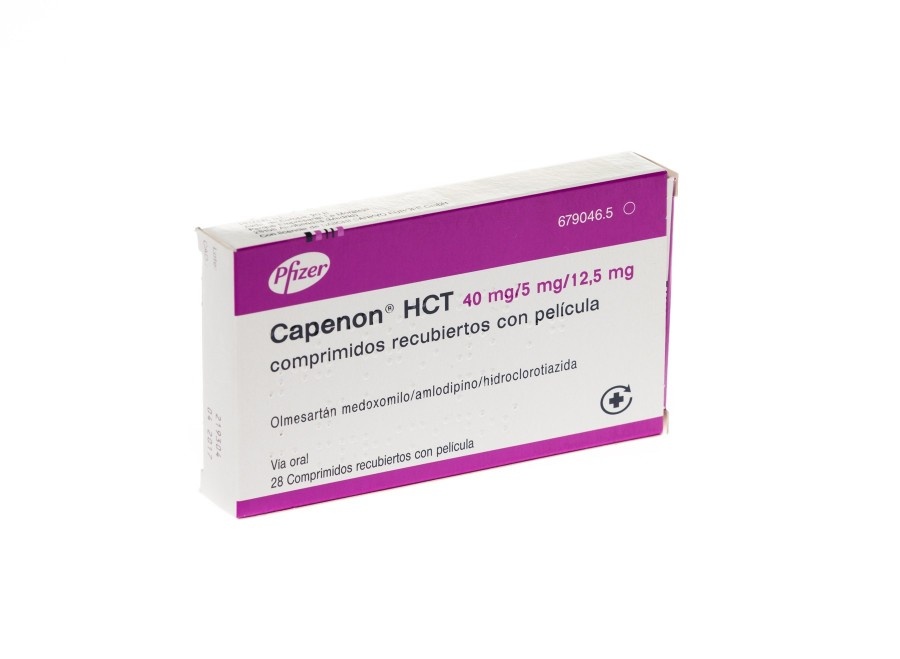
- País de registro
- Forma farmacéuticaCOMPRIMIDO, 40/5 mg/mg
- Código ATCC09DB02
- Precio medio en farmacia21.43 EUR
- Principio activo
- Requiere recetaSí
- Fabricante
- ComposiciónCROSCARMELOSA SODICA (10,000 mg mg)
- Esta información es de carácter general y no sustituye la consulta con un profesional sanitario.
- Alternativas a CAPENON 40 mg/5 mg COMPRIMIDOS RECUBIERTOS CON PELICULAForma farmacéutica: COMPRIMIDO, 20 mg/5 mgPrincipio activo: olmesartan medoxomil and amlodipineFabricante: Laboratorios Alter S.A.Requiere recetaForma farmacéutica: COMPRIMIDO, 40 mg/10 mgPrincipio activo: olmesartan medoxomil and amlodipineFabricante: Laboratorios Alter S.A.Requiere recetaForma farmacéutica: COMPRIMIDO, 40 mg/5 mgPrincipio activo: olmesartan medoxomil and amlodipineFabricante: Laboratorios Alter S.A.Requiere receta
Médicos online para CAPENON 40 mg/5 mg COMPRIMIDOS RECUBIERTOS CON PELICULA
Comenta la dosis, los posibles efectos secundarios, interacciones, contraindicaciones o la revisión de receta de CAPENON 40 mg/5 mg COMPRIMIDOS RECUBIERTOS CON PELICULA, sujeto a valoración médica y a la normativa local.
Obtén una receta de CAPENON 40 mg/5 mg COMPRIMIDOS RECUBIERTOS CON PELICULA online
Rellena un formulario de 2 minutos
Cuéntanos tus síntomas, historial y el medicamento que necesitas.
Elige un médico o nosotros te asignamos uno
Escoge un especialista o te conectamos con el próximo médico disponible.
El médico revisa tu caso
Normalmente en 30 minutos. Puede hacerte preguntas adicionales por chat.
Recógela en cualquier farmacia
Receta electrónica enviada a tu correo, válida en toda España.
Preguntas frecuentes
CAPENON 40 mg/5 mg COMPRIMIDOS RECUBIERTOS CON PELICULA requiere receta en España. Puedes confirmarlo con un médico online según tu caso.
El principio activo de CAPENON 40 mg/5 mg COMPRIMIDOS RECUBIERTOS CON PELICULA es olmesartan medoxomil and amlodipine. Esta información ayuda a identificar medicamentos con la misma composición pero con diferentes nombres comerciales.
El precio medio en farmacia de CAPENON 40 mg/5 mg COMPRIMIDOS RECUBIERTOS CON PELICULA es de aproximadamente 21.43 EUR. Puede variar según el fabricante y la forma farmacéutica.
CAPENON 40 mg/5 mg COMPRIMIDOS RECUBIERTOS CON PELICULA es fabricado por Daiichi Sankyo Espana S.A.. La marca y el envase pueden variar según el distribuidor.
Los Médicos de familia, Psiquiatras, Dermatólogos, Cardiólogos, Endocrinólogos, Gastroenterólogos, Neumólogos, Nefrólogos, Reumatólogos, Hematólogos, Infectólogos, Alergólogos, Geriatras, Pediatras, Oncólogos pueden valorar la prescripción de CAPENON 40 mg/5 mg COMPRIMIDOS RECUBIERTOS CON PELICULA cuando esté clínicamente indicado. Puedes reservar una videoconsulta para comentar tu caso y las opciones de tratamiento.
España cuenta con una infraestructura sanitaria bien desarrollada en ciudades principales como Madrid, Barcelona, Valencia y Sevilla. Las farmacias están ampliamente disponibles y operan bajo estrictas regulaciones, garantizando el acceso a medicamentos con receta.
Puedes comprar CAPENON 40 mg/5 mg COMPRIMIDOS RECUBIERTOS CON PELICULA en Madrid, Barcelona, Sevilla o Valencia en cualquier farmacia local con una receta válida.
Para obtener una receta, puedes utilizar Oladoctor:
Otros medicamentos con el mismo principio activo (olmesartan medoxomil and amlodipine) incluyen ALBIS 20 MG/5 MG COMPRIMIDOS RECUBIERTOS CON PELICULA EFG, ALBIS 40 MG/10 MG COMPRIMIDOS RECUBIERTOS CON PELICULA EFG, ALBIS 40 MG/5 MG COMPRIMIDOS RECUBIERTOS CON PELICULA EFG. Pueden tener diferentes nombres comerciales o formulaciones, pero contienen el mismo componente terapéutico. Consulta siempre con un médico antes de cambiar o iniciar un nuevo medicamento.
