


Calquence 100 mg comprimidos recubiertos con película





Cómo usar CALQUENCE 100 MG COMPRIMIDOS RECUBIERTOS CON PELICULA
Contenido del prospecto
- Introducción
- Qué es Calquence y para qué se utiliza
- Qué necesita saber antes de empezar a tomar Calquence
- Cómo tomar Calquence
- Posibles efectos adversos
- Conservación de Calquence
- Contenido del envase e información adicional
Introducción
Prospecto: información para el paciente
Calquence 100 mg comprimidos recubiertos con películaacalabrutinib
Lea todo el prospecto detenidamente antes de empezar a tomar este medicamento, porque contiene información importante para usted.
- Conserve este prospecto, ya que puede tener que volver a leerlo.
- Si tiene alguna duda, consulte a su médico, farmacéutico o enfermero.
- Este medicamento se le ha recetado solamente a usted y no debe dárselo a otras personas aunque tengan los mismos síntomas, ya que puede perjudicarles.
- Si experimenta efectos adversos, consulte a su médico, farmacéutico o enfermero, incluso si se trata de posibles efectos adversos que no aparecen en este prospecto. Ver sección 4.
Contenido del prospecto:
- Qué es Calquence y para qué se utiliza
- Qué necesita saber antes de empezar a tomar Calquence
- Cómo tomar Calquence
- Posibles efectos adversos
- Conservación de Calquence
- Contenido del envase e información adicional
1. Qué es Calquence y para qué se utiliza
Qué es Calquence
- Calquence contiene el principio activo acalabrutinib.
- Pertenece a un grupo de medicamentos denominados inhibidores de la tirosina‑quinasa de Bruton (BTK).
Para qué se utiliza Calquence
Calquence se utiliza para tratar a adultos con leucemia linfocítica crónica (LLC).
La LLC es un cáncer de los glóbulos blancos de la sangre llamados linfocitos B (o células B). Estas células forman parte del sistema inmune (las defensas del cuerpo).
Calquence se utiliza para tratar a adultos con linfoma de células del manto (LCM).
El LCM es un tipo de cáncer de la sangre que afecta a los ganglios linfáticos.
Cómo funciona Calquence
Calquence actúa bloqueando la BTK, una proteína del cuerpo que ayuda a estas células cancerosas a crecer y sobrevivir. Al bloquear la BTK, Calquence ayuda a matar y puede reducir el número de células cancerosas lo que puede frenar el empeoramiento de la enfermedad.
Si tiene alguna pregunta sobre cómo actúa Calquence o por qué se le ha recetado este medicamento, consulte a su médico, farmacéutico o enfermero.

¿No estás seguro de si este medicamento es adecuado para ti?
Comenta tus síntomas y tratamiento con un médico online.
2. Qué necesita saber antes de empezar a tomar Calquence
No tome Calquence:
- si es alérgico al acalabrutinib o a alguno de los demás componentes de este medicamento (incluidos en la sección 6).
Si tiene dudas, consulte a su médico, farmacéutico o enfermero antes de empezar a tomar Calquence.
Advertencias y precauciones
Consulte a su médico, farmacéutico o enfermero antes de empezar a tomar Calquence si usted:
- ha tenido alguna vez hematomas o hemorragias anormales o está tomando algún medicamento que aumente el riesgo de hemorragia, (ver sección 4 “Posibles efectos adversos”).
- tiene una infección (ver sección 4 “Posibles efectos adversos”).
- se ha sometido recientemente a una intervención quirúrgica o está a punto de hacerlo. Su médico podrá interrumpir el tratamiento con Calquence antes y después de un procedimiento médico, quirúrgico o dental.
- alguna vez ha tenido hepatitis B (una infección del hígado) – esto es porque Calquence podría volver a activar la hepatitis B, por lo que su médico buscará signos de reaparición de esta infección (ver sección 4 “Posibles efectos adversos”).
- tiene o ha tenido alguna vez un latido cardíaco irregular (ver sección 4 “Posibles efectos adversos”).
Consulte a su médico si desarrolla una nueva lesión o cualquier cambio en la apariencia de un área de la piel, ya que tiene un alto riesgo de desarrollar cáncer de piel, ver sección 4. Use protección solar y realice examen regular de la piel.
Durante el tratamiento, su médico le hará análisis de sangre para comprobar el recuento de células sanguíneas cuando sea necesario.
Niños y adolescentes
No administre este medicamento a niños o adolescentes menores de 18 años. Esto es porque no se ha estudiado en este grupo de edad.
Otros medicamentos y Calquence
Informe a su médico, farmacéutico o enfermero si está tomando, ha tomado recientemente o pudiera tener que tomar cualquier otro medicamento, especialmente si está tomando cualquiera de los siguientes:
- antibióticos para infecciones bacterianas – como claritromicina
- medicamentos para las infecciones por hongos – como posaconazol, itraconazol o voriconazol
- ketoconazol – un medicamento para cuando el organismo produce demasiado cortisol (síndrome de Cushing)
- medicamentos para la infección por el VIH – como indinavir y ritonavir
- medicamentos para la hepatitis C – como telaprevir
- rifampicina – un antibiótico para las infecciones bacterianas (tuberculosis)
- ergotamina – un medicamento para las migrañas
- conivaptán – un medicamento para los niveles bajos de sodio en sangre
- metformina – un medicamento para los niveles elevados de azúcar en la sangre
- ciclosporina – un medicamento para prevenir el rechazo de órganos
- medicamentos para las convulsiones o la epilepsia – como carbamazepina o fenitoína
- pimozida – un medicamento utilizado para el sindrome de Tourette (afección que causa movimientos incontrolados y emisiones repentinas de palabras y sonidos)
- hipérico (hierba de San Juan) – un medicamento a base de plantas que se utiliza para la depresión
- teofilina – un medicamento utilizado para los pitidos en la respiración, la dificultad para respirar y la opresión en el pecho
- metotrexato – un medicamento para enfermedades como la artritis reumatoide, psoriasis y colitis ulcerosa, que son causadas cuando hay problemas en el sistema inmune.
- Este medicamento se debe tomar al menos 6 horas antes o después de Calquence.
Puede tomar medicamentos reductores del ácido del estómago como antiácidos (carbonato de calcio), antagonistas del receptor de histamina‑2 (ranitidina y famotidina) e inhibidores de la bomba de protones (omeprazol) con los comprimidos de Calquence.
Medicamentos que aumentan el riesgo de hemorragia
Calquence puede hacer que sangre más fácilmente. Informe a su médico, farmacéutico o enfermero si toma otros medicamentos que aumentan el riesgo de hemorragia:
- Antiplaquetarios (que impiden la formación de coágulos) como el ácido acetilsalicílico y el clopidogrel
- Anticoagulantes (diluyentes de la sangre) como la warfarina o la enoxaparina
Embarazo
Si está embarazada, cree que podría estar embarazada o tiene intención de quedarse embarazada, consulte a su médico antes de utilizar este medicamento. Esto es porque este medicamento puede dañar al feto.
Lactancia
No dé el pecho durante el tratamiento con Calquence y hasta 2 días después de que haya recibido la última dosis de Calquence. No se sabe si Calquence se excreta en la leche materna
Conducción y uso de máquinas
Es poco probable que Calquence afecte a la capacidad para conducir y utilizar máquinas. Sin embargo, si se siente mareado, débil o cansado mientras toma Calquence, no debe conducir o utilizar máquinas.
Calquence contiene sodio
Este medicamento contiene menos de 1 mmol de sodio (23 mg) por dosis, esto es, esencialmente ”exento de sodio”.
3. Cómo tomar Calquence
Calquence solo se lo recetará un médico con experiencia en el uso de medicamentos para el cáncer. Siga exactamente las instrucciones de administración de Calquence indicadas por su médico. En caso de duda, consulte de nuevo a su médico, farmacéutico o enfermero.
Dependiendo del tipo de cáncer que tenga, Calquence se puede administrar en combinación con otros medicamentos contra el cáncer.
Qué cantidad debe tomar
- La dosis habitual es de un comprimido (100 mg) dos veces al día. Tome las dosis con unas 12 horas de diferencia.
Cómo tomar Calquence
- Trague el comprimido entero con agua, aproximadamente a la misma hora todos los días.
- No mastique, triture, disuelva o divida los comprimidos.
- Puede tomar Calquence con alimentos o entre las comidas.
- Puede comprobar cuándo tomó por última vez un comprimido de Calquence mirando el blíster. Las imágenes en el blíster le ayudarán a tomar su dosis en el momento adecuado – el sol para la dosis de la mañana y la luna para la dosis de la noche.
Si toma más Calquence del que debe
Si ha tomado más Calquence del que debe, consulte a un médico o acuda inmediatamente al hospital más cercano. Lleve consigo los comprimidos y este prospecto.
Si olvidó tomar Calquence
- Si han pasado menos de 3 horas de la hora habitual de la toma, tome la dosis olvidada inmediatamente. Tome la dosis siguiente a la hora habitual.
- Si han pasado más de 3 horas de la hora habitual de la toma, sáltese la dosis olvidada. Tome la dosis siguiente a la hora habitual.
- No tome una dosis doble de Calquence para compensar la dosis olvidada.
Si tiene cualquier otra duda sobre el uso de este medicamento, pregunte a su médico, farmacéutico o enfermero.

¿Has empezado a tomar el medicamento y tienes preguntas?
Comenta tus síntomas y tratamiento con un médico online.
4. Posibles efectos adversos
Al igual que todos los medicamentos, este medicamento puede producir efectos adversos, aunque no todas las personas los sufran.
Deje de tomar Calquence y contacte con su médico o acuda a urgencias inmediatamente si nota cualquiera de los siguientes efectos adversos:
Efectos adversos graves muy frecuentes(pueden afectar a más de 1 de cada 10 personas):
- Hemorragias en diferentes lugares, incluidos la piel, el intestino y el cerebro. Los signos pueden ser deposiciones negras o con sangre, orina de color rosa o marrón, hemorragias nasales, hematomas, hemorragias inesperadas, vómitos o tos con sangre, mareo, debilidad, confusión.
- Infecciones: Los signos pueden incluir fiebre, escalofríos, sensación de debilidad o confusión, tos, dificultad para respirar [Neumonía, un efecto adverso muy frecuente(puede afectar a más de 1 de cada 10 personas) o infecciones por Aspergillus, un efecto adverso poco frecuente(puede afectar hasta a 1 de cada 100 personas)].
Efectos adversos graves frecuentes(pueden afectar hasta a 1 de cada 10 personas):
- frecuencia cardíaca rápida, latidos cardíacos perdidos, pulso débil o irregular, mareo, sensación de desmayo, molestias en el pecho o dificultad para respirar (signos de problemas del ritmo cardíaco, conocidos como fibrilación o aleteo auricular).
- fiebre, escalofríos, náuseas, vómitos, confusión, dificultad para respirar, convulsiones, latidos cardíacos irregulares, orina oscura o turbia, cansancio inusual o dolor muscular o articular. Esto puede ser signo de un síndrome de lisis tumoral (SLT) – una afección causada por la rápida descomposición de las células cancerosas.
Otros efectos adversos
Muy frecuentes(pueden afectar a más de 1 de cada 10 personas):
- dolor muscular o articular
- dolor de cabeza
- erupción cutánea
- sensación de cansancio (fatiga), debilidad o falta de energía
- sensación de malestar en el estómago (náuseas), vómitos, dolor de estómago, estreñimiento (heces poco frecuentes o difíciles de evacuar), diarrea (heces frecuentes o sueltas)
- disminución del número de glóbulos rojos en sangre, disminución del número de neutrófilos (un tipo de glóbulos blancos de la sangre) o disminución del número de células que ayudan a coagular la sangre (plaquetas)
- presión sanguínea alta
- mareo
- dolor de cabeza, presión en los ojos, nariz o zona de las mejillas (sinusitis)
- dolor de garganta y moqueo nasal (nasofaringitis)
- infección del tracto respiratorio superior
- infección del tracto urinario (dolor o sensación de ardor al orinar)
- nuevos cánceres, incluido cánceres de la piel, pueden aparecer durante el tratamiento con Calquence (ver sección 2. “Qué necesita saber antes de empezar a tomar Calquence”)
- herpes
Frecuentes(pueden afectar hasta a 1 de cada 10 personas):
- niveles elevados de enzimas hepáticas (aspartato aminotransferasa y alanina aminotransferasa) en los análisis de sangre [cuando se usa en combinación con ciertos medicamentos para tratar el linfoma de células del manto (LCM)]
- bronquitis
- fiebre, escalofríos, debilidad, confusión, malestar y coloración amarillenta de la piel o los ojos (ictericia) – estos pueden ser signos de que la hepatitis B (una infección hepática) se ha vuelto a activar
- inflamación de los pulmones (neumonitis)
Efectos adversos poco frecuentes(pueden afectar hasta a 1 de cada 100 personas):
- pérdida de memoria, problemas para pensar, dificultad para caminar o pérdida de la vista – estos pueden ser signos de una grave infección cerebral, (Leucoencefalopatía Multifocal Progresiva o LMP)
- linfocitosis (aumento del nivel normal de los linfocitos, un tipo de glóbulos blancos de la sangre)
Comunicación de efectos adversos
Si experimenta cualquier tipo de efecto adverso, consulte a su médico, incluso si se trata de posibles efectos adversos que no aparecen en este prospecto. También puede comunicarlos directamente a través del sistema nacional de notificación incluido en el Apéndice V. Mediante la comunicación de efectos adversos usted puede contribuir a proporcionar más información sobre la seguridad de este medicamento.
5. Conservación de Calquence
Mantener este medicamento fuera de la vista y del alcance de los niños.
No utilice este medicamento después de la fecha de caducidad que aparece en el blíster y en la caja después de CAD. La fecha de caducidad es el último día del mes que se indica.
Este medicamento no requiere condiciones especiales de conservación.
Los medicamentos no se deben tirar por los desagües ni a la basura. Pregunte a su farmacéutico cómo deshacerse de los envases y de los medicamentos que ya no necesita. De esta forma, ayudará a proteger el medio ambiente.
6. Contenido del envase e información adicional
Composición de Calquence
El principio activo es acalabrutinib. Cada comprimido recubierto con película contiene 100 mg de acalabrutinib (como maleato de acalabrutinib).
Los demás componentes son:
- Núcleo del comprimido: manitol (E421), celulosa microcristalina (E460), hidroxipropilcelulosa de baja sustitución (E463) y estearilfumarato de sodio (ver sección 2 “Calquence contiene sodio”).
- Recubrimiento del comprimido: hipromelosa (E464), copovidona, dióxido de titanio (E171), macrogol, triglicéridos de cadena media, óxido de hierro amarillo (E172) y óxido de hierro rojo (E172)
Aspecto del producto y contenido del envase
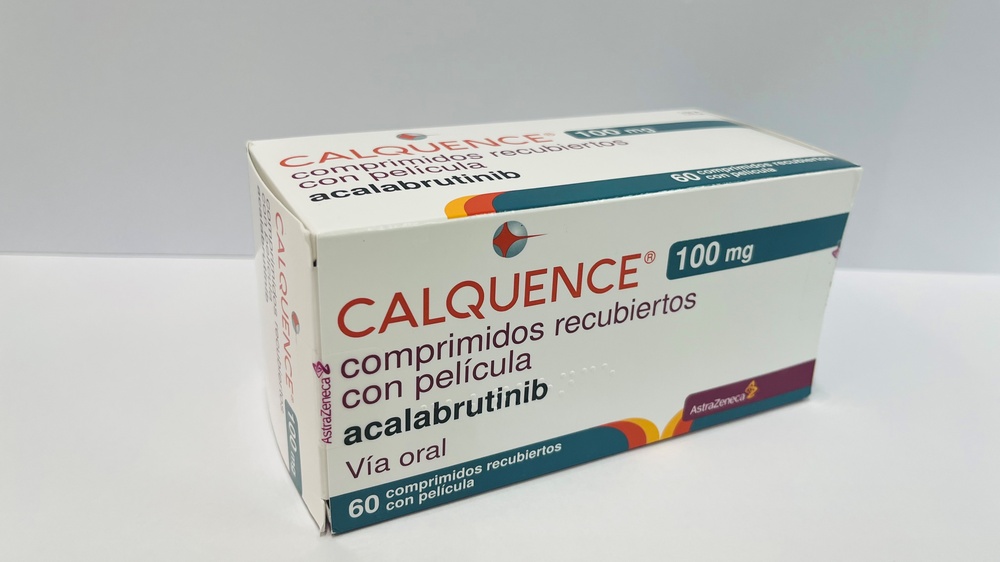
Calquence es un comprimido naranja, de 7,5 x 13 mm, ovalado, biconvexo, grabado con “ACA 100” en un lado y liso en el reverso.
Calquence se presenta en blísteres de aluminio que contienen 8 o 10 comprimidos recubiertos con película. En cada blíster hay símbolos de un sol/luna para ayudarlo a tomar su dosis en el momento adecuado — el sol para la dosis de la mañana y la luna para la dosis de la tarde. Tanto los blísteres con sol como los de la luna contienen la misma medicina. Cada caja contiene 56 o 60 comprimidos recubiertos con película.
Puede que solamente estén comercializados algunos tamaños de envases.
Titular de la autorización de comercialización
AstraZeneca AB
SE‑151 85 Södertälje
Suecia
Responsable de la fabricación
AstraZeneca AB
Gärtunavägen
SE‑152 57 Södertälje
Suecia
Pueden solicitar más información respecto a este medicamento dirigiéndose al representante local del titular de la autorización de comercialización:
België/Belgique/Belgien AstraZeneca S.A./N.V. Tel: +32 2 370 48 11 | Lietuva UAB AstraZeneca Lietuva Tel: +370 5 2660550 |
| Luxembourg/Luxemburg AstraZeneca S.A./N.V. Tél/Tel: +32 2 370 48 11 |
Ceská republika AstraZeneca Czech Republic s.r.o. Tel: +420 222 807 111 | Magyarország AstraZeneca Kft. Tel: +36 1 883 6500 |
Danmark AstraZeneca A/S Tlf.: +45 43 66 64 62 | Malta Associated Drug Co. Ltd Tel: +356 2277 8000 |
Deutschland AstraZeneca GmbH Tel: +49 40 809034100 | Nederland AstraZeneca BV Tel: +31 85 808 9900 |
Eesti AstraZeneca Tel: +372 6549 600 | Norge AstraZeneca AS Tlf: +47 21 00 64 00 |
Ελλáδα AstraZeneca A.E. Τηλ: +30 210 6871500 | Österreich AstraZeneca Österreich GmbH Tel: +43 1 711 31 0 |
España AstraZeneca Farmacéutica Spain, S.A. Tel: +34 91 301 91 00 | Polska AstraZeneca Pharma Poland Sp. z o.o. Tel: +48 22 245 73 00 |
Francia AstraZeneca Tél: +33 1 41 29 40 00 | Portugal AstraZeneca Produtos Farmacêuticos, Lda. Tel: +351 21 434 61 00 |
Hrvatska AstraZeneca d.o.o. Tel: +385 1 4628 000 | România AstraZeneca Pharma SRL Tel: +40 21 317 60 41 |
Ireland AstraZeneca Pharmaceuticals (Ireland) DAC Tel: +353 1609 7100 | Slovenija AstraZeneca UK Limited Tel: +386 1 51 35 600 |
Ísland Vistor hf. Sími: +354 535 7000 | Slovenská republika AstraZeneca AB, o.z. Tel: +421 2 5737 7777 |
Italia AstraZeneca S.p.A. Tel: +39 02 00704500 | Suomi/Finland AstraZeneca Oy Puh/Tel: +358 10 23 010 |
Κúπρος Αλ?κτωρ Φαρµακευτικ? Λτδ Τηλ: +357 22490305 | Sverige AstraZeneca AB Tel: +46 8 553 26 000 |
Latvija SIA AstraZeneca Latvija Tel: +371 67377100 |
Fecha de la última revisión de este prospecto:
Otras fuentesde información
La información detallada de este medicamento está disponible en la página web de la Agencia Europea de Medicamentos: https://www.ema.europa.eu.
- País de registro
- Forma farmacéuticaCOMPRIMIDO, 100 MG
- Código ATCL01EL02
- Principio activo
- Requiere recetaSí
- Fabricante
- ComposiciónMANITOL (E-421) (132,0 mg mg), FUMARATO DE ESTEARILO Y SODIO (10,0 mg mg)
- Esta información es de carácter general y no sustituye la consulta con un profesional sanitario.
- Alternativas a CALQUENCE 100 MG COMPRIMIDOS RECUBIERTOS CON PELICULAForma farmacéutica: CAPSULA, 100 mgPrincipio activo: acalabrutinibFabricante: Astrazeneca AbRequiere recetaForma farmacéutica: CAPSULA, 80 mgPrincipio activo: ZanubrutinibFabricante: Beigene Ireland LimitedRequiere recetaForma farmacéutica: CAPSULA, 140 mgPrincipio activo: IbrutinibFabricante: Janssen-Cilag International N.VRequiere receta
Médicos online para CALQUENCE 100 MG COMPRIMIDOS RECUBIERTOS CON PELICULA
Comenta la dosis, los posibles efectos secundarios, interacciones, contraindicaciones o si una receta es apropiada para CALQUENCE 100 MG COMPRIMIDOS RECUBIERTOS CON PELICULA, sujeto a valoración médica y a la normativa local.
Preguntas frecuentes
CALQUENCE 100 MG COMPRIMIDOS RECUBIERTOS CON PELICULA requiere receta en España. Puedes confirmarlo con un médico online según tu caso.
El principio activo de CALQUENCE 100 MG COMPRIMIDOS RECUBIERTOS CON PELICULA es acalabrutinib. Esta información ayuda a identificar medicamentos con la misma composición pero con diferentes nombres comerciales.
CALQUENCE 100 MG COMPRIMIDOS RECUBIERTOS CON PELICULA es fabricado por Astrazeneca Ab. La marca y el envase pueden variar según el distribuidor.
Los Médicos de familia, Psiquiatras, Dermatólogos, Cardiólogos, Endocrinólogos, Gastroenterólogos, Neumólogos, Nefrólogos, Reumatólogos, Hematólogos, Infectólogos, Alergólogos, Geriatras, Pediatras, Oncólogos pueden valorar la prescripción de CALQUENCE 100 MG COMPRIMIDOS RECUBIERTOS CON PELICULA cuando esté clínicamente indicado. Puedes reservar una videoconsulta para comentar tu caso y las opciones de tratamiento.
La receta la emite un médico tras valorar tu estado de salud. En España, CALQUENCE 100 MG COMPRIMIDOS RECUBIERTOS CON PELICULA se dispensa en las farmacias con esa receta médica. Una consulta online no garantiza su emisión: la decisión corresponde siempre al médico.
Para solicitar una valoración puedes usar Oladoctor:
Otros medicamentos con el mismo principio activo (acalabrutinib) incluyen CALQUENCE 100 MG CAPSULAS DURAS, BRUKINSA 80 MG CAPSULAS DURAS, IMBRUVICA 140 MG CAPSULAS DURAS. Pueden tener diferentes nombres comerciales o formulaciones, pero contienen el mismo componente terapéutico. Consulta siempre con un médico antes de cambiar o iniciar un nuevo medicamento.
