



CALCITONINA ALMIRALL 100 UI SOLUCIÓN INYECTABLE

Revisión de receta online
Un médico revisará tu caso y determinará si la prescripción es médicamente apropiada.

Habla con un médico sobre este medicamento
Comenta tus síntomas y las opciones de tratamiento en una consulta online.



Cómo usar CALCITONINA ALMIRALL 100 UI SOLUCION INYECTABLE
Contenido del prospecto
- Introducción
- Qué es Calcitonina Almirall y para qué se utiliza
- Qué necesita saber antes de empezar a usar Calcitonina Almirall
- Cómo usar Calcitonina Almirall
- Posibles efectos adversos
- Conservación de Calcitonina Almirall
- Contenido del envase e información adicional
Introducción
Prospecto: información para el usuario
Calcitonina Almirall 100 UI/ml solución inyectable
Calcitonina sintética de salmón
Lea todo el prospecto detenidamente antes de empezar a usar este medicamento, porque contiene información importante para usted.
- Conserve este prospecto, ya que puede tener que volver a leerlo.
Si tiene alguna duda, consulte a su médico o farmacéutico.
- Este medicamento se le ha recetado solamente a usted, y no debe dárselo a otras personas, aunque tengan los mismos síntomas que usted, ya que puede perjudicarles.
- Si experimenta efectos adversos, consulte a su médico o farmacéutico, incluso si se trata de efectos adversos que no aparecen en este prospecto. Ver sección 4.
Contenido del prospecto
- Qué es Calcitonina Almirall y para qué se utiliza
- Qué necesita saber antes de empezar a usar Calcitonina Almirall
- Cómo usar Calcitonina Almirall
- Posibles efectos adversos
- Conservación de Calcitonina Almirall
- Contenido del envase e información adicional
1. Qué es Calcitonina Almirall y para qué se utiliza
Calcitonina Almirall se puede administrar en los casos siguientes:
- Prevención de la pérdida del hueso en situaciones de inmovilización repentina. Por ejemplo, pacientes que deben guardar cama debido a una fractura.
- Enfermedad de Paget del hueso en personas que no pueden recibir otros tratamientos para esta enfermedad, como es el caso de los pacientes con problemas graves de riñón. La enfermedad de Paget es una afección de progresión lenta que puede provocar un cambio en el tamaño y la forma de ciertos huesos.
- Tratamiento de los niveles elevados de calcio en sangre (hipercalcemia) debido al cáncer.

¿No estás seguro de si este medicamento es adecuado para ti?
Comenta tus síntomas y tratamiento con un médico online.
2. Qué necesita saber antes de empezar a usar Calcitonina Almirall
No use Calcitonina Almirall:
- si es alérgico a la calcitonina o a cualquiera de los demás componentes de este medicamento (incluidos en la sección 6).
- si tiene hipocalcemia (bajo nivel de calcio en la sangre).
Advertencias y precauciones
Consulte a su médico o farmacéutico antes de empezar a usar Calcitonina.
Pueden aparecer reacciones de tipo alérgico debidas al tratamiento con Calcitonina Almirall, incluyendo casos de reacciones alérgicas graves (shock anafiláctico). Sin embargo, el enrojecimiento generalizado o local es una reacción habitual debida a calcitonina y no es una reacción alérgica.
En caso de sospecha de alergia a la calcitonina, su médico puede decidir realizar una prueba de sensibilidad antes de iniciar el tratamiento.
Consulte a su médico si le han diagnosticado un cáncer. En los ensayos clínicos, los pacientes tratados con calcitonina para la osteoporosis y artrosis han mostrado un aumento del riesgo de desarrollar cáncer con los tratamientos de larga duración. Su médico decidirá si la calcitonina es un tratamiento adecuado para usted y durante cuánto tiempo debe seguirlo.
Uso en niños y adolescentes
El uso de Calcitonina Almirall no se recomienda en pacientes menores de 18 años de edad.
Uso de Calcitonina Almirall con otros medicamentos
Comunique a su médico o farmacéutico si está utilizando, ha utilizado recientemente o podría tener que utilizar cualquier otro medicamento, incluso los adquiridos sin receta.
Ciertos medicamentos pueden interaccionar con Calcitonina Almirall; en estos casos puede ser necesario cambiar la dosis o interrumpir el tratamiento con alguno de ellos.
Es importante que informe a su médico si está tomando o ha tomado recientemente alguno de los siguientes medicamentos:
- Glucósidos cardiotónicos y bloqueantes del canal de calcio (medicamentos para tratar problemas del corazón o la tensión arterial elevada).
- Bisfosfonatos (para el tratamiento de varias enfermedades relacionadas con el hueso o el metabolismo de calcio).
Embarazo, lactancia y fertilidad
Si está embarazada o en periodo de lactancia, cree que podría estar embarazada o tiene intención de quedarse embarazada, consulte a su médico o farmacéutico antes de utilizar este medicamento.
Embarazo
Se desconoce si es segura la utilización de Calcitonina Almirall en mujeres embarazadas, por lo tanto Calcitonina Almirall debe ser únicamente utilizada durante el embarazo cuando, a criterio de su médico, los beneficios terapéuticos esperados lo justifiquen.
Lactancia
No utilice Calcitonina Almirall si se encuentra en periodo de lactancia.
Conducción y uso de máquinas
Calcitonina Almirall puede provocar vértigo de forma transitoria. En caso de sufrir esta reacción adversa no deberá conducir ni utilizar máquinas.
Advertencias sobre excipientes
Este medicamento contiene menos de 1 mmol (23 mg) de sodio por ampolla, por lo que se considera esencialmente "exento de sodio".
3. Cómo usar Calcitonina Almirall
Siga exactamente las instrucciones de administración de este medicamento indicadas por su médico o farmacéutico. En caso de duda, consulte de nuevo a su médico o farmacéutico.
Recuerde utilizar su medicamento.
Su médico decidirá la dosis correcta y durante cuánto tiempo debe seguir el tratamiento con calcitonina.
Posología
Uso en adultos mayores de 18 años
- Para la prevención de la pérdida de hueso:
Se recomienda una dosis de 100 UI al día o 50 UI dos veces al día de 2 a 4 semanas.
- En la enfermedad de Paget:
Se recomienda una dosis de 100 UI al día, normalmente durante un máximo de 3 meses. En ciertos casos, el médico puede decidir aumentar la duración del tratamiento hasta los 6 meses.
- Para el tratamiento de los niveles de calcio altos:
Se recomienda una dosis de 100 UI cada 6 a 8 horas.
Forma de administración
Calcitonina Almirall se puede administrar por vía subcutánea o intramuscular.
Puede administrarse antes de acostarse para reducir las náuseas o vómitos que pueden aparecer, especialmente al inicio del tratamiento.
Si usa más Calcitonina Almirall de la que debe
Contacte inmediatamente con su médico o farmacéutico. Las reacciones que cabe esperar en caso de sobredosis son náuseas, vómitos, enrojecimiento y vértigo.
En caso de sobredosis o ingestión accidental, también puede consultar al Servicio de Información Toxicológica. Teléfono 915 620 420.

¿Has empezado a tomar el medicamento y tienes preguntas?
Comenta tus síntomas y tratamiento con un médico online.
4. Posibles efectos adversos
Al igual que todos los medicamentos, este medicamento puede producir efectos adversos, aunque no todas las personas los sufran.
Las reacciones adversas observadas más frecuentemente (en más de uno de cada 10 pacientes) con Calcitonina Almirall son náuseas (con o sin vómitos), que aparecen en un 10% de los pacientes y que tienden a disminuir o desaparecer con el tiempo de tratamiento o bien reduciendo la dosis.
Aparece también enrojecimiento de la piel (en la cara o parte superior del cuerpo). Esta no es una reacción alérgica sino que es debida al efecto del medicamento y aparece generalmente a los 10-20 minutos de la administración.
Reacciones adversas frecuentes (pueden afectar hasta 1 de cada 10 pacientes): cáncer (después de tratamientos de larga duración).
Las reacciones adversas poco frecuentes (pueden afectar hasta 1 de cada 100 pacientes) son: diarrea, reacciones inflamatorias en el lugar de inyección subcutánea o intramuscular, erupción en la piel, sabor metálico en la boca, vértigo y aumento de producción de orina.
Reacciones adversas raras (pueden afectar hasta 1 de cada 1.000 pacientes) son: disminución transitoria del calcio en la sangre 4-6 horas después de la administración (en pacientes con enfermedad de Paget y pacientes jóvenes) y desarrollo de anticuerpos neutralizadores de calcitonina.
De forma muy rara (pueden afectar hasta 1 de cada 10.000 pacientes) pueden aparecer reacciones alérgicas graves, tales como broncoespasmo (espasmo de los bronquios), hinchazón de la lengua y garganta y en casos aislados anafilaxis (reacción alérgica general grave).
Comunicación de efectos adversos
Si experimenta cualquier tipo de efecto adverso, consulte a su médico o farmacéutico, incluso si se trata de posibles efectos adversos que no aparecen en este prospecto. También puede comunicarlos directamente a través del Sistema Español de Farmacovigilancia de Medicamentos de Uso Humano: www.notificaRAM.es. Mediante la comunicación de efectos adversos usted puede contribuir a proporcionar más información sobre la seguridad de este medicamento.
5. Conservación de Calcitonina Almirall
Mantener este medicamento fuera de la vista y del alcance de los niños.
Conservar en nevera (entre 2ºC y 8ºC). No congelar.
No utilice este medicamento después de la fecha de caducidad que aparece en el embalaje y cartón exterior después de CAD. La fecha de caducidad es el último día del mes que se indica.
Los medicamentos no se deben tirar por los desagües ni a la basura. Deposite los envases y los medicamentos que no necesita en el Punto SIGRE de la farmacia. En caso de duda pregunte a su farmacéutico cómo deshacerse de los envases y de los medicamentos que no necesita. De esta forma ayudará a proteger el medio ambiente.
6. Contenido del envase e información adicional
Composición de Calcitonina Almirall
- El principio activo es calcitonina sintética de salmón. Una ampolla (1 ml) contiene 100 UI de calcitonina sintética de salmón
- Los demás componentes son: acetato de sodio trihidrato (E-262i), ácido acético glacial (E- 260), cloruro de sodio y agua para preparaciones inyectables.
Aspecto del producto y contenido del envase
Calcitonina Almirall se presenta en forma de solución inyectable, transparente e incolora. Cada envase contiene 10 ampollas de vidrio incoloro de 100 U.I.
Titular de la autorización de comercialización y responsable de la fabricación
Titular de la autorización de comercialización
Almirall, S.A. General Mitre, nº 151 08022 – Barcelona (España).
Responsable de la fabricación
Famar Health Care Services Madrid, S.A.U. Avda. Leganés, 62 28925 Alcorcón – Madrid (España).
Fecha de la última revisión de este prospecto: Marzo 2013
La información detallada y actualizada de este medicamento está disponible en la página Web de la Agencia Española de Medicamentos y Productos Sanitarios (AEMPS) http://www.aemps.gob.es/
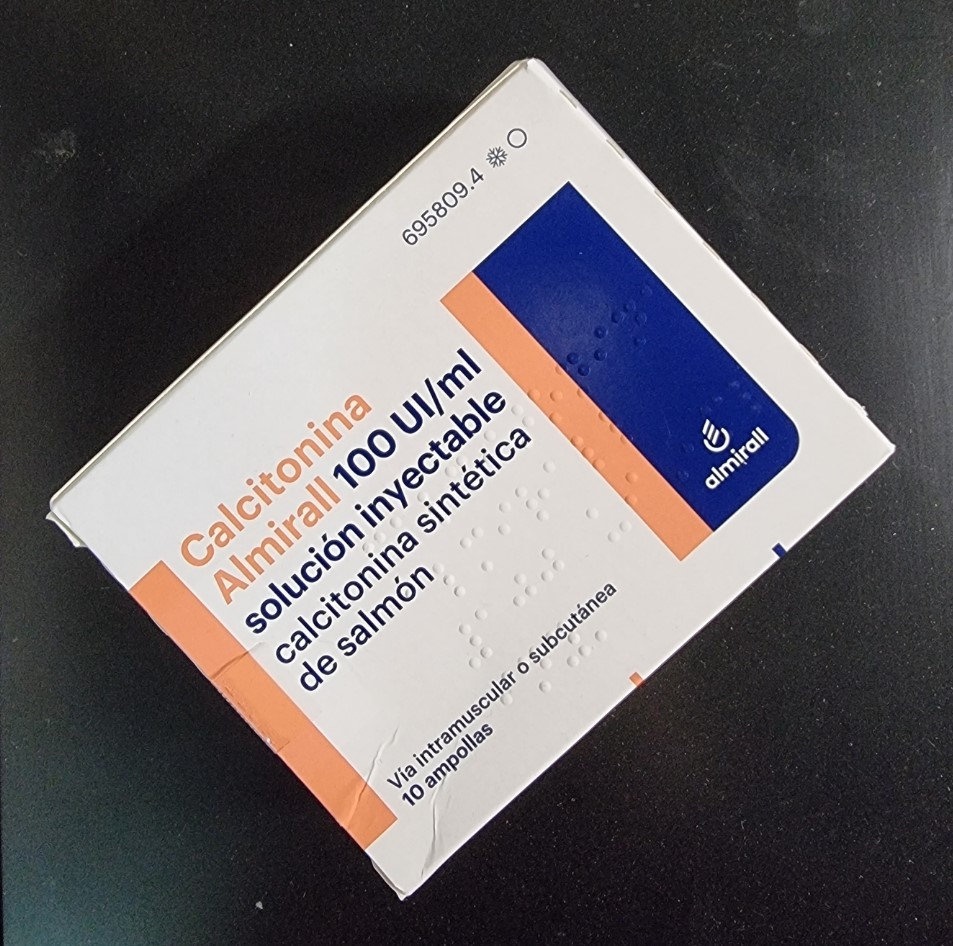
- País de registro
- Forma farmacéuticaINYECTABLE, 100 UI calcitonina síntetica de sálmon / ampolla
- Código ATCH05BA01
- Precio medio en farmacia29.54 EUR
- Principio activo
- Requiere recetaSí
- Fabricante
- ComposiciónACETATO DE SODIO TRIHIDRATO (2 mg mg), CLORURO DE SODIO (7,5 mg mg)
- Esta información es de carácter general y no sustituye la consulta con un profesional sanitario.
- Alternativas a CALCITONINA ALMIRALL 100 UI SOLUCION INYECTABLEForma farmacéutica: COMPRIMIDO, 30 mgPrincipio activo: cinacalcetFabricante: Accord Healthcare S.L.U.Requiere recetaForma farmacéutica: COMPRIMIDO, 60 mgPrincipio activo: cinacalcetFabricante: Accord Healthcare S.L.U.Requiere recetaForma farmacéutica: COMPRIMIDO, 90 mgPrincipio activo: cinacalcetFabricante: Accord Healthcare S.L.U.Requiere receta
Médicos online para CALCITONINA ALMIRALL 100 UI SOLUCION INYECTABLE
Comenta la dosis, los posibles efectos secundarios, interacciones, contraindicaciones o la revisión de receta de CALCITONINA ALMIRALL 100 UI SOLUCION INYECTABLE, sujeto a valoración médica y a la normativa local.

Obtén una receta de CALCITONINA ALMIRALL 100 UI SOLUCION INYECTABLE online
Rellena un formulario de 2 minutos
Cuéntanos tus síntomas, historial y el medicamento que necesitas.
Elige un médico o nosotros te asignamos uno
Escoge un especialista o te conectamos con el próximo médico disponible.
El médico revisa tu caso
Normalmente en 30 minutos. Puede hacerte preguntas adicionales por chat.
Recógela en cualquier farmacia
Receta electrónica enviada a tu correo, válida en toda España.
Preguntas frecuentes
CALCITONINA ALMIRALL 100 UI SOLUCION INYECTABLE requiere receta en España. Puedes confirmarlo con un médico online según tu caso.
El principio activo de CALCITONINA ALMIRALL 100 UI SOLUCION INYECTABLE es calcitonin (salmon synthetic). Esta información ayuda a identificar medicamentos con la misma composición pero con diferentes nombres comerciales.
El precio medio en farmacia de CALCITONINA ALMIRALL 100 UI SOLUCION INYECTABLE es de aproximadamente 29.54 EUR. Puede variar según el fabricante y la forma farmacéutica.
CALCITONINA ALMIRALL 100 UI SOLUCION INYECTABLE es fabricado por Almirall S.A.. La marca y el envase pueden variar según el distribuidor.
Los Médicos de familia, Psiquiatras, Dermatólogos, Cardiólogos, Endocrinólogos, Gastroenterólogos, Neumólogos, Nefrólogos, Reumatólogos, Hematólogos, Infectólogos, Alergólogos, Geriatras, Pediatras, Oncólogos pueden valorar la prescripción de CALCITONINA ALMIRALL 100 UI SOLUCION INYECTABLE cuando esté clínicamente indicado. Puedes reservar una videoconsulta para comentar tu caso y las opciones de tratamiento.
España cuenta con una infraestructura sanitaria bien desarrollada en ciudades principales como Madrid, Barcelona, Valencia y Sevilla. Las farmacias están ampliamente disponibles y operan bajo estrictas regulaciones, garantizando el acceso a medicamentos con receta.
Puedes comprar CALCITONINA ALMIRALL 100 UI SOLUCION INYECTABLE en Madrid, Barcelona, Sevilla o Valencia en cualquier farmacia local con una receta válida.
Para obtener una receta, puedes utilizar Oladoctor:
Otros medicamentos con el mismo principio activo (calcitonin (salmon synthetic)) incluyen CINACALCET ACCORDPHARMA 30 MG COMPRIMIDOS RECUBIERTOS CON PELICULA EFG, CINACALCET ACCORDPHARMA 60 MG COMPRIMIDOS RECUBIERTOS CON PELICULA EFG, CINACALCET ACCORDPHARMA 90 MG COMPRIMIDOS RECUBIERTOS CON PELICULA EFG. Pueden tener diferentes nombres comerciales o formulaciones, pero contienen el mismo componente terapéutico. Consulta siempre con un médico antes de cambiar o iniciar un nuevo medicamento.
