


Bisoprolol Teva 2,5 mg comprimidos

Solicitud de receta online
Un médico revisará tu caso y determinará si la prescripción es médicamente apropiada.

Habla con un médico sobre este medicamento
Comenta tus síntomas y las opciones de tratamiento en una consulta online.



Cómo usar BISOPROLOL TEVA 2,5 MG COMPRIMIDOS EFG
Contenido del prospecto
- Introducción
- Qué es Bisoprolol Teva y para qué se utiliza
- Qué necesita saber antes de empezar a tomar Bisoprolol Teva
- Cómo tomar Bisoprolol Teva
- Posibles efectos adversos
- Conservación de Bisoprolol Teva
- Conservación del envase e información adicional
Introducción
Prospecto: información para el usuario
Bisoprolol Teva 2,5mg comprimidos EFG
bisoprolol fumarato
Lea todo el prospecto detenidamente antes de empezar a tomar este medicamento, porque contiene información importante para usted.
|
Contenido del prospecto
- Qué es Bisoprolol Teva y para qué se utiliza
- Qué necesita saber antes de empezar a tomar Bisoprolol Teva
- Cómo tomar Bisoprolol Teva
- Posibles efectos adversos
- Conservación de Bisoprolol Teva
- Contenido del envase e información adicional
1. Qué es Bisoprolol Teva y para qué se utiliza
Bisoprolol Teva contiene el principio activo bisoprolol fumarato. Bisoprolol pertenece a un grupo de medicamentos llamados betabloqueantes. Bisoprolol impide latidos irregulares del corazón (arritmia) durante el estrés y disminuyen la carga de trabajo cardiovascular. Bisoprolol también dilata los vasos sanguíneos y por lo tanto, facilita el flujo sanguíneo.
Bisoprolol se utiliza para:
- Tratar la tensión arterial elevada (hipertensión).
- Tratar la enfermedad coronaria y el dolor en el pecho (angina de pecho) causados por la falta de oxígeno en el músculo cardiaco.
- Tratar la insuficiencia cardiaca concomitantemente con otros medicamentos. La insuficiencia cardiaca es la incapacidad del corazón para bombear suficiente sangre para atender las necesidades del organismo, causando hinchazón (edema) de las extremidades y dificultad para respirar.

¿No estás seguro de si este medicamento es adecuado para ti?
Comenta tus síntomas y tratamiento con un médico online.
2. Qué necesita saber antes de empezar a tomar Bisoprolol Teva
No tome Bisoprolol Teva
- si es alérgico a bisoprolol o a cualquiera de los demás componentes de este medicamento (incluidos en la sección 6),
- si sufre insuficiencia cardiaca, que acaba de ocurrir o ha empeorado recientemente, o está recibiendo tratamiento para el shock circulatorio debido a insuficiencia cardiaca aguda por goteo intravenoso para ayudar a trabajar a su corazón,
- si tiene la tensión arterial muy baja o una frecuencia cardíaca lenta debido a un mal funcionamiento cardiaco grave (también llamado shock cardiogénico),
- si padece alteraciones del ritmo del corazón, como el síndrome de disfunción sinusal, bloqueo sinoauricular o bloqueo de segundo o tercer grado atrioventricular,
- si tiene la frecuencia del corazón lenta,
- si tiene la tensión arterial muy baja,
- si tiene un tumor no tratado que puede aumentar la tensión arterial (también llamado feocromocitoma),
- si padece formas graves de asma,
- si padece problemas de circulación sanguínea graves en las extremidades, como claudicación intermitente (dolor fácilmente provocado en las piernas al caminar) o síndrome de Raynaud (color blanquecino, azulado y finalmente rojizo en los dedos de las manos o los dedos de los pies asociado con dolor),
- si tiene acidosis metabólica que es una alteración del equilibrio ácido-base como en los pacientes diabéticos cuando el nivel de glucosa en sangre se eleva demasiado.
Advertencias y precauciones
Informe a su médico o farmacéutico antes de tomar este medicamento, puede querer tomar precauciones especiales (por ejemplo proporcionar tratamiento adicional o realizar exámenes más frecuentemente):
- si sufre una asintomática y bien tratada insuficiencia cardiaca,
- problemas del riñón o del hígado,
- si tiene problemas con las válvulas de su corazón o tiene una condición cardiaca congénita.
- si ha sufrido un ataque al corazón durante los tres últimos meses,
- si tiene una enfermedad pulmonar obstructiva crónica o asma menos grave (si utiliza broncodilatadores, puede ser necesario ajustar las dosis y tener que vigilar su función pulmonar),
- si va a someterse a cirugía u otro procedimiento bajo sedación o anestesia espinal (debe informar al anestesista que está tomando bisoprolol),
- si padece diabetes mellitus y sus valores de glucosa en sangre varían mucho, bisoprolol puede enmascarar los síntomas de hipoglucemia y desacelerar la recuperación de los niveles de glucosa en sangre,
- si está siguiendo una dieta estricta,
- si padece hiperactividad de glándula tiroidea, bisoprolol puede enmascarar los síntomas de hipertiroidismo,
- si recibe tratamiento de desensibilización, bisoprolol puede reforzar las reacciones alérgicas y pueden ser necesario más medicamentos para tratar la reacción alérgica.
- si padece un leve trastorno en la conducción del corazón (bloqueo de primer grado atrio ventricular),
- si tiene un dolor en el pecho causado por calambres de las arterias coronarias (también llamado angina de Prinzmetal),
- si usa lentes de contacto, (bisoprolol puede reducir la excreción de líquido lagrimal y causar sequedad de ojos),
- antecedentes de una erupción escamosa en la piel (psoriasis).
Si sufre enfermedad pulmonar crónica o asma menos grave, informe a su médico inmediatamente si empieza a notar dificultades para respirar, tos, sibilancias tras el ejercicio, etc., mientras utiliza bisoprolol.
Niños y adolescentes
No se recomienda la administración de este medicamento en niños o adolescentes.
Otros medicamentos y Bisoprolol Teva
Informe a su médico o farmacéutico si está tomando, ha tomado recientemente o podría tener que tomar cualquier otro medicamento.
No tome los siguientes medicamentos con Bisoprolol Teva sin consejo especial de su médico:
- Quinidina, disopiramida, lidocaína, fenitoína; flecainida, propafenona (utilizado para tratar el latido cardiaco irregular o anormal)
- Verapamilo, diltiazem (utilizado para tratar el latido cardiaco irregular y la presión arterial)
- Clonidina, metildopa, guanfacina, moxonidina y rilmedina (para tratar la tensión sanguínea y algunas enfermedades neurológicas)
Sin embargo, no deje de tomar estos medicamentossin consultarlo primero con su médico.
Consulte con su médico antes de tomar los siguientes medicamentos con Bisoprolol Teva; puede que su médico necesite controlar su estado más frecuentemente:
- nifedipino, felodipino y amlodipino (utilizados para tratar la presión arterial alta o angina o el latido cardiaco anormal),
- amiodarona (utilizados para tratar el latido cardiaco irregular o anormal),
- beta-bloqueantes, incluyendo los beta-bloqueantes contenidos en las gotas oculares como timolol para el tratamiento del glaucoma,
- digitálicos, utilizados para tratar la insuficiencia cardiaca,
- donepezilo o tacrina (para tratar la demencia),
- neostrigmina o pridostigmina (para tratar la miastenia gravis, una enfermedad que causa debilidad muscular,
- fisostigmina para tratar la elevada tensión ocular, glaucoma,
- los llamados alcaloides ergotamínicos (para tratar la migraña o la tensión arterial alta),
- otros fármacos antihipertensivos,
- otros fármacos que pueden disminuir la presión arterial como los antidepresivos tricíclicos (como imipramina o amitriptilina), fenotiazinas (como levomepromazina (para tratar la psicosis) o barbitúricos como el fenobarbital (parar tratar la epilepsia),
- adrenalina para tratar las reacciones alérgicas,
- baclofeno y tizanidina (relajantes musculares),
- amifosfatina (una substancia protectora durante ciertos tratamientos de cáncer),
- mefloquina (para tratar la malaria),
- rifampicina (un antibiótico),
- insulinas y otras preparaciones para tratar la diabetes mellitus,
- agentes anestésicos (utilizados durante cirugía),
- cortisona oral o intravenosa,
- los llamados inhibidores de la monoamino oxidasa, es decir IMAO (excepto los inhibidores de MAO-B) como moclobenida o feneizina (para la depresión).
Medicamentos anti-inflamatorios no esteroideos como el ácido acetilsalicílico, diclofenaco, ibuprofeno, ketoprofeno, naproxeno, celecoxib o etoricoxib (especialmente si se usan a largo plazo o regularmente) pueden debilitar la eficacia de bisoprolol en el tratamiento de la hipertensión. Sin embargo, pequeñas dosis diarias de ácido acetilsalicílico, por ejemplo 100 mg, se pueden utilizar con seguridad de forma concomitante con bisoprolol para prevenir coágulos de sangre.
Embarazo y lactancia
Si está embarazada o en periodo de lactancia, cree que podría estar embarazada o tiene intención de quedarse embarazada, consulte a su médico o farmacéutico antes de utilizar este medicamento.
Bisoprolol no debe utilizarse durante el embarazo a menos que sea claramente necesario. Si usted está embarazada o planea quedarse embarazada, durante el tratamiento con bisoprolol, informe a su médico para que le aconseje acerca de un tratamiento adecuado.
Se desconoce si bisoprolol se excreta en la leche materna. Por lo tanto no está recomendada la lactancia durante el uso de este medicamento.
Conducción y uso de máquinas
Bisoprolol posee un impacto mínimo o inexistente sobre la capacidad de conducir. Los efectos adversos relacionados con la caída de la presión arterial pueden incluir mareo, cefalea, fatiga u otros efectos adversos (ver sección 4) que puedan alterar la capacidad para conducir o utilizar máquinas. Si usted sufre estos efectos adversos, no maneje vehículos y/o máquinas que requieran su completa atención. En particular se requiere atención al inicio del tratamiento y después de aumentar la dosis. Bisoprolol normalmente no afecta a la capacidad para conducir si el tratamiento está bien equilibrado.
Bisoprolol Teva contiene sodio
Este medicamento contiene menos de 1 mmol de sodio (23 mg) por comprimido; esto es, esencialmente “exento de sodio”.
3. Cómo tomar Bisoprolol Teva
Siga exactamente las instrucciones de administración de este medicamento indicadas por su médico. En caso de duda consulte de nuevo a su médico o farmacéutico.
La dosis recomendada es
Adultos:
Para tratar hipertensión y angina de pecho
- La dosis inicial es 5 mg una vez al día.
- El médico puede aumentar en pequeños incrementos (normalmente cada pocas semanas) a 10 mg o hasta 20 mg como máximo si es necesario
Para tratar la insuficiencia cardíaca crónica estable
El tratamiento con bisoprolol se debe iniciar a una dosis baja e incrementarla gradualmente. Su médico decidirá cómo aumentar la dosis, y esto se realizará normalmente del siguiente modo:
- 1,25 mg de bisoprolol una vez al día durante una semana.
- 2,5 mg de bisoprolol una vez al día durante una semana.
- 3,75 mg de bisoprolol una vez al día durante una semana.
- 5 mg de bisoprolol una vez al día durante cuatro semanas.
- 7,5 mg de bisoprolol una vez al día durante cuatro semanas.
- 10 mg de bisoprolol una vez al día como terapia de mantenimiento (continua)
La dosis máxima diaria recomendada es de 10 mg de bisoprolol.
Dependiendo de lo bien que tolere el medicamento, su médico puede decidir también prolongar el tiempo entre aumentos de dosis. Si su estado empeora o ya no tolera el medicamento, puede ser necesario reducir de nuevo la dosis o interrumpir el tratamiento. En algunos pacientes, una dosis de mantenimiento inferior a 10 mg de bisoprolol puede ser suficiente. Su médico le dirá qué hacer. Normalmente, si tiene que interrumpir el tratamiento por completo, su médico le aconsejará que reduzca la dosis de forma gradual, puesto que de otro modo su estado puede empeorar.
Pacientes de edad avanzada
No es necesario el ajuste de dosis en ancianos a menos que padezca insuficiencia renal o hepática, ver más abajo.
Pacientes que sufren insuficiencia renal o hepática
La dosis debe aumentarse gradualmente y con precaución en pacientes con problemas hepáticos o renales graves. La dosis no debe superar los 10 mg una vez al día en pacientes con problemas renales o hepáticos graves.
Método de administración
Trague los comprimidos con suficiente cantidad de líquido (p.e., un vaso de agua) habitualmente una vez al día por la mañana. Los comprimidos no se deben masticar. Los alimentos no afectan a la absorción del medicamento.
El comprimido puede dividirse en dosis iguales. Divida los comprimidos como se indica a continuación: coloque los comprimidos con la línea de rotura hacia arriba sobre una superficie plana y dura (por ejemplo, una mesa) y divida los comprimidos presionando con los dedos índices de ambas manos a derecha e izquierda de la línea de rotura de la parte exterior del comprimido hacia la superficie.
Si toma más Bisoprolol Teva del que debe
Si ha tomado una sobredosis de Bisoprolol Teva, consulte inmediatamente con su médico o un hospital.
En caso de náusea o mareos, colocar al paciente en la posición de acostado y solicitar asistencia médica. Un paciente inconsciente debe ser colocado en posición de recuperación sin embargo las piernas pueden elevarse.
En caso de sobredosis o ingestión accidental, consultar al Servicio de Información Toxicológica. Teléfono 91 562 04 20, indicando el medicamento y la cantidad tomada. Se recomendará llevar el envase y el prospecto del medicamento al profesional sanitario.
Si olvidó tomar Bisoprolol Teva
Tome el siguiente comprimido normalmente cuando sea el momento de tomarlo. No tome una dosis doble o mayor para compensar las dosis olvidadas.
Si interrumpe el tratamiento con Bisoprolol Teva
El tratamiento no debe suspenderse bruscamente, en particular, cuando el paciente posee enfermedad isquémica del corazón. La dosis debe reducirse lentamente, por ejemplo durante 1-2 semanas. De lo contrario los síntomas de la enfermedad cardiaca pueden empeorar.
Si tiene cualquier otra duda sobre el uso de este medicamento, pregunte a su médico o farmacéutico.

¿Has empezado a tomar el medicamento y tienes preguntas?
Comenta tus síntomas y tratamiento con un médico online.
4. Posibles efectos adversos
Al igual que todos los medicamentos, este medicamento puede producir efectos adversos, aunque no todas las personas los sufran.
Para prevenir reacciones adversas graves, hable con un médico inmediatamente si un efecto adverso es grave, se produce de repente o empeora rápidamente.
Los efectos adversos más graves están relacionados con la función cardiaca, entre ellos, los efectos adversos más comunes han sido el enlentecimiento del latido del corazón, una disminución excesiva de la tensión arterial, mareos y fatiga.
Más abajo se mencionan otros efectos adversos de acuerdo a su frecuencia de posible aparición:
Muy frecuentes (pueden afectar a más de 1 de cada 10 personas)
- Enlentecimiento del latido del corazón (en pacientes con insuficiencia cardiaca)
Frecuentes (pueden afectar hasta 1 de cada 10 personas)
- Mareos, dolor de cabeza.
- Empeoramiento de los síntomas de insuficiencia cardiaca (en pacientes con insuficiencia cardiaca preexistente)
- Sensación de frío o entumecimiento en las extremidades
- Tensión Presión arterial demasiado baja (en pacientes con insuficiencia cardiaca)
- Problemas del estómago o intestinales tales como náuseas, vómito, diarrea o estreñimiento
- Astenia (en pacientes con insuficiencia cardiaca), fatiga
Poco frecuentes (pueden afectar hasta 1 de cada 100 personas)
- Depresión, alteraciones del sueño
- Bloqueo del corazón (trastornos de la conducción del corazón)
- Excesiva ralentización de la frecuencia cardiaca (en pacientes con hipertensión o enfermedad cardíaca coronaria)
- Broncoespasmo (sibilancias en pacientes con asma o enfermedad pulmonar obstructiva crónica
- Debilidad muscular, calambres musculares
- Astenia (en pacientes con hipertensión o angina de pecho)
- Tensión arterial baja en posición vertical (hipotensión ortostática)
Raros (pueden afectar hasta 1 de cada 1.000 personas)
- Pesadillas, alucinaciones
- Desmayos (síncope)
- Reducción de la producción de lágrimas (tenerlo en cuenta si usa lentes de contacto)
- Trastornos de audición
- Hepatitis (causando dolor abdominal superior)
- Reacciones de hipersensibilidad, como picazón, rubor o erupción. Debe acudir a su médico inmediatamente si experimenta reacciones alérgicas más graves, que pueden incluir hinchazón de la cara, el cuello, la lengua, la boca o la garganta, o dificultad para respirar.
- Trastornos de la potencia sexual
- Niveles elevados de las enzimas hepáticas (pruebas de laboratorio (ALAT o ASAT)
- Rinitis alérgica (secreción nasal, bloqueada y picor)
Muy raros (pueden afectar hasta 1 de cada 10.000 personas):
- Conjuntivitis (inflamación de los ojos)
- Pérdida del cabello (alopecia), empeoramiento de psoriasis o psoriasis con erupción
Comunicación de efectos adversos
Si experimenta cualquier tipo de efecto adverso, consulte a su médico o farmacéutico, incluso si se trata de efectos adversos que no aparecen en este prospecto. También puede comunicarlos directamente a través del Sistema Español de Farmacovigilancia de Medicamentos de Uso Humano:https:// www.notificaram.es. Mediante la comunicación de efectos adversos usted puede contribuir a proporcionar más informacicón sobre la seguridad de este medicamento.
5. Conservación de Bisoprolol Teva
Mantener este medicamento fuera de la vista y del alcance de los niños.
Este medicamento no requiere condiciones especiales de conservación
No utilice este medicamento después de la fecha de caducidad que aparece en el envase y en el blíster después de “CAD”. La fecha de caducidad es el último día del mes que se indica.
Este medicamento no requiere condiciones especiales de conservación.
Los medicamentos no se deben tirar por los desagües ni a la basura. Deposite los envases y los medicamentos que no necesita en el Punto SIGRE de la farmacia. En caso de duda pregunte a su farmacéutico cómo deshacerse de los envases y de los medicamentos que no necesita. De esta forma ayudará a proteger el medio ambiente.
6. Conservación del envase e información adicional
Composición de Bisoprolol Teva 2,5 mg comprimidos
El principio activo es bisoprolol fumarato
Cada Bisoprolol Teva 2,5 mg comprimidos contiene 2,5 mg de bisoprolol fumarato.
Los demás componentes son: celulosa microcristalina (E 460), sílice coloidal anhidra, croscarmelosa de sodio, carboximetilalmidón sódico tipo A (procedente de patata) y estearato de magnesio (E 572).
Aspecto del producto y contenido del envase
Bisoprolol Teva 2,5 mg comprimidos son comprimidos de color blanco a blanquecino, redondos, biconvexos y con una ranura en una de las caras.
Los envases incluyen 20, 21, 28, 30, 50, 56, 60, 90 ó 100 comprimidos
Puede que no todos los tamaños de envase estén comercializados.
Titular de la autorización de comercialización y responsable de la fabricación
Titular de la autorización de comercialización
Teva Pharma, S.L.U.
C/ Anabel Segura 11, Edificio Albatros B, 1ª planta
28108 Alcobendas. Madrid
Responsable de la fabricación:
Chanelle Medical Unlimited Company
Dublín Road, Loughrea, H62 FH90,
Irlanda
Ó
Merckle GmbH
Ludwig-Merckle-Straße 3
89143 Blaubeuren
Alemania
Este medicamento está autorizado en los Estados Miembros del Espacio Económico Europeo y en Reinto Unido (Irlanda del Norte) con los siguientes nombres
Alemania: Bisoprolol AbZ 2,5 mg Tabletten
Bélgica : Bisoprolol Teva 2.5 mg tabletten
España: Bisoprolol Teva 2,5 mg comprimidos EFG
Holanda: Bisoprololfumaraat 2,5 mg Teva, tabletten
Italia: Bisoprololo Doc 2,5 mg compressa
Suecia: Bisoprolol Teva 2,5 mg tabletter
Reino Unido (Irlanda de Norte):Bisoprolol Fumarate 2.5 mg tablets
Fecha de la última revisión de este prospecto: mayo 2024
La información detallada y actualizada de este medicamento está disponible en la página Web de la Agencia Española de Medicamentos y Productos Sanitarios (AEMPS) http: //www.aemps.gob.es/
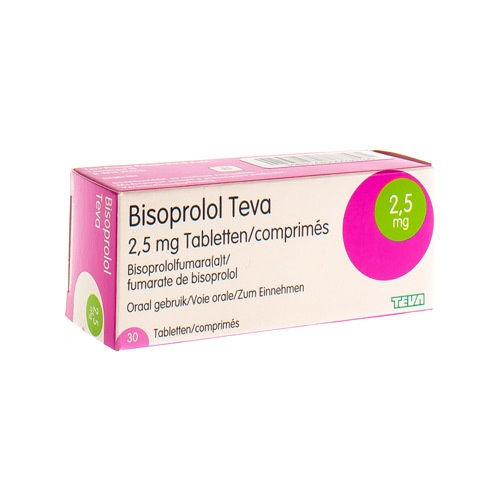
- País de registro
- Forma farmacéuticaCOMPRIMIDO, 2,5 MG
- Código ATCC07AB07
- Precio medio en farmacia2.4 EUR
- Principio activo
- Requiere recetaSí
- Fabricante
- ComposiciónCROSCARMELOSA SODICA (1,692 mg mg), CARBOXIMETILALMIDON SODICO (4,250 mg mg)
- Esta información es de carácter general y no sustituye la consulta con un profesional sanitario.
- Alternativas a BISOPROLOL TEVA 2,5 MG COMPRIMIDOS EFGForma farmacéutica: COMPRIMIDO, 10 mgPrincipio activo: bisoprololFabricante: Aurovitas Spain, S.A.U.Requiere recetaForma farmacéutica: COMPRIMIDO, 2,5 mgPrincipio activo: bisoprololFabricante: Aurovitas Spain, S.A.U.Requiere recetaForma farmacéutica: COMPRIMIDO, 5 mgPrincipio activo: bisoprololFabricante: Aurovitas Spain, S.A.U.Requiere receta
Médicos online para BISOPROLOL TEVA 2,5 MG COMPRIMIDOS EFG
Comenta la dosis, los posibles efectos secundarios, interacciones, contraindicaciones o si una receta es apropiada para BISOPROLOL TEVA 2,5 MG COMPRIMIDOS EFG, sujeto a valoración médica y a la normativa local.
Preguntas frecuentes
BISOPROLOL TEVA 2,5 MG COMPRIMIDOS EFG requiere receta en España. Puedes confirmarlo con un médico online según tu caso.
El principio activo de BISOPROLOL TEVA 2,5 MG COMPRIMIDOS EFG es bisoprolol. Esta información ayuda a identificar medicamentos con la misma composición pero con diferentes nombres comerciales.
El precio medio en farmacia de BISOPROLOL TEVA 2,5 MG COMPRIMIDOS EFG es de aproximadamente 2.4 EUR. Puede variar según el fabricante y la forma farmacéutica.
BISOPROLOL TEVA 2,5 MG COMPRIMIDOS EFG es fabricado por Teva Pharma S.L.U.. La marca y el envase pueden variar según el distribuidor.
Los Médicos de familia, Psiquiatras, Dermatólogos, Cardiólogos, Endocrinólogos, Gastroenterólogos, Neumólogos, Nefrólogos, Reumatólogos, Hematólogos, Infectólogos, Alergólogos, Geriatras, Pediatras, Oncólogos pueden valorar la prescripción de BISOPROLOL TEVA 2,5 MG COMPRIMIDOS EFG cuando esté clínicamente indicado. Puedes reservar una videoconsulta para comentar tu caso y las opciones de tratamiento.
La receta la emite un médico tras valorar tu estado de salud. En España, BISOPROLOL TEVA 2,5 MG COMPRIMIDOS EFG se dispensa en las farmacias con esa receta médica. Una consulta online no garantiza su emisión: la decisión corresponde siempre al médico.
Para solicitar una valoración puedes usar Oladoctor:
Otros medicamentos con el mismo principio activo (bisoprolol) incluyen BISOPROLOL AUROVITAS 10 MG COMPRIMIDOS RECUBIERTOS CON PELICULA EFG, BISOPROLOL AUROVITAS 2,5 MG COMPRIMIDOS RECUBIERTOS CON PELICULA EFG, BISOPROLOL AUROVITAS 5 MG COMPRIMIDOS RECUBIERTOS CON PELICULA EFG. Pueden tener diferentes nombres comerciales o formulaciones, pero contienen el mismo componente terapéutico. Consulta siempre con un médico antes de cambiar o iniciar un nuevo medicamento.
