



ATROPINA SULFATO SERRA PAMIES 1 mg/mL SOLUCIÓN INYECTABLE

Revisión de receta online
Un médico revisará tu caso y determinará si la prescripción es médicamente apropiada.

Habla con un médico sobre este medicamento
Comenta tus síntomas y las opciones de tratamiento en una consulta online.



Cómo usar ATROPINA SULFATO SERRA PAMIES 1 MG/ML SOLUCIÓN INYECTABLE
Contenido del prospecto
- Introducción
- Qué es Atropina sulfato Serra Pamies y para qué se utiliza
- Qué necesita saber antes de empezar a usar Atropina sulfato Serra Pamies
- Cómo usar Atropina sulfato Serra Pamies
- Posibles efectos adversos
- Conservación de Atropina sulfato Serra Pamies
- Contenido del envase e información adicional
Introducción
Prospecto: información para el usuario
Atropina sulfato Serra Pamies 1 mg/ml solución inyectable
Lea todo el prospecto detenidamente antes de empezar a usar este medicamento, porque contiene información importante para usted.
- Conserve este prospecto, ya que puede tener que volver a leerlo.
- Si tiene alguna duda, consulte a su médico, farmacéutico o enfermero.
- Este medicamento se le ha recetado solamente a usted, y no debe dárselo a otras personas aunque tengan los mismos síntomas que usted, ya que puede perjudicarles.
- Si experimenta efectos adversos, consulte a su médico, farmacéutico o enfermero, incluso si se trata de efectos adversos que no aparecen en este prospecto. Ver sección 4.
Contenido del prospecto
- Qué es Atropina sulfato Serra Pamies y para qué se utiliza
- Qué necesita saber antes de empezar a usar Atropina sulfato Serra Pamies
- Cómo usar Atropina sulfato Serra Pamies
- Posibles efectos adversos
- Conservación de Atropina sulfato Serra Pamies
- Contenido del envase e información adicional
1. Qué es Atropina sulfato Serra Pamies y para qué se utiliza
El principio activo es atropina sulfato. Pertenece al grupo de los medicamentos denominados alcaloides de la Belladona, aminas terciarias.
Este medicamento se utiliza como:
- Preanestésico: medicación utilizada antes de la anestesia general.
- Espasmolítico: en cólicos de hígado y riñón. Se utiliza para ayudar a tratar el síndrome
del intestino irritable (colon irritable, colitis mucosa y colon espástico).

¿No estás seguro de si este medicamento es adecuado para ti?
Comenta tus síntomas y tratamiento con un médico online.
2. Qué necesita saber antes de empezar a usar Atropina sulfato Serra Pamies
No use Atropina sulfato Serra Pamies
- si es alérgico a la atropina sulfato o a alguno de los demás componentes de este medicamento (incluidos en la sección 6).
- en pacientes con glaucoma de ángulo estrecho
- en pacientes con hipertrofia prostática, en los cuales puede causar retención urinaria.
- en pacientes con obstrucción píloro-duodenal.
- en pacientes con trastornos del funcionamiento del corazón.
Advertencias y precauciones
Consulte a su médico,farmacéutico o enfermero antes de empezar a usar atropina sulfato:
- si sus riñones no funcionan bien.
- si su corazón late más deprisa del ritmo normal.
- si padece trastornos en el funcionamiento del corazón.
- si padece colitis ulcerosa.
- si padece esofagitis por reflujo.
- en pacientes de edad avanzada y niños.
Niños
- Los lactantes y niños pequeños son especialmente sensibles a los efectos tóxicos de este tipo de medicamentos.
- Se recomienda estricta supervisión de la medicación en lactantes y niños.
- Cuando se administran este tipo de medicamentos a niños en lugares donde la temperatura ambiente es elevada, existe el riesgo de que aumente rápidamente la temperatura corporal.
- En niños que toman dosis elevadas de este tipo de medicamentos se puede producir una reacción inusual caracterizada por hiperexcitabilidad.
Uso en pacientes de edad avanzada
- Pueden responder a las dosis habituales de este tipo de medicamentos con excitación, inquietud, agitación, somnolencia o confusión.
- Además, son especialmente sensibles a los efectos secundarios de este tipo de medicamentos (estreñimiento, sequedad de boca y retención urinaria).
- Estos fármacos también pueden precipitar glaucoma no diagnosticado y deteriorar la memoria en pacientes geriátricos.
Otros medicamentos y Atropina sulfato Serra Pamies
Informe a su médico o farmacéutico si está utilizando, ha utilizado recientemente o pudiera tener que utilizar cualquier otro medicamento.
La administración de atropina sulfato junto con los siguientes medicamentos puede hacer necesario modificar la dosis de alguno de ellos o la interrupción del tratamiento.
- Alcohol etílico:posible potenciación de la toxicidad del alcohol.
- Anticolinérgicos:los fármacos con efectos anticolinérgicos (amantadina, antidepresivos tricíclicos, disopiramida, etc.) pueden potenciar la acción y/o toxicidad de este medicamento.
- Fenilefrina:posible potenciación de la toxicidad de fenilefrina, con aparición de hipertensión.
- Metoclopramida:posible inhibición del efecto procinético de metoclopramida por antagonismo con la atropina, al bloquear esta la estimulación colinérgica indirecta causada por la metoclopramida.
- Verapamilo:posible potenciación de la taquicardia inducida por atropina, por aumentar los anticolinérgicos los efectos del verapamilo sobre el ritmo cardiaco.
- Acidificantes urinarios: aumentan la eliminación de atropina por orina y por tanto disminuyen su acción, por lo que son incompatibles.
- Alcalinizantes urinarios: disminuyen la eliminación de atropina por orina y por tanto potencian su acción, por lo que son incompatibles.
- Antihistamínicos:potencian la acción de la atropina y sus efectos tóxicos.
- Fenotiazinas:potencian la acción de la atropina y sus efectos tóxicos.
- Corticoesteroides:potencian la acción de la atropina y sus efectos tóxicos.
- Inhibidores de la monoamino-oxidasa:potencian la acción de la atropina y sus efectos tóxicos.
- Ritodrina:se cree que existen efectos aditivos entre ambos fármacos, provoca aumento del latido cardíaco.
Uso de atropina sulfato con alimentos, bebidas y alcohol
No se conocen interacciones con alimentos y bebidas.
El uso de atropina con alcohol puede potenciar la toxicidad del alcohol.
Embarazo y lactancia
Si está embarazada o en periodo de lactancia, cree que podría estar embarazada o tiene intención de quedarse embarazada, consulte a su médico o farmacéutico antes de utilizar este medicamento.
Embarazo:
Su médico debe valorar los beneficios frente a los riesgos de este tipo de medicación.
Lactancia:
Su médico debe valorar los beneficios frente a los riesgos de este tipo de medicación, ya que aparecen trazas en la leche materna.
Este tipo de medicamentos, en general, pueden inhibir la lactancia.
Conducción y uso de máquinas
La administración de atropina puede producir efectos adversos tales como confusión, visión borrosa, sueño, etc. que pueden afectar la capacidad para conducir y utilizar máquinas. Si nota estos efectos, no conduzca ni maneje máquinas.
Atropina sulfato Serra Pamies contiene:
- Metabisulfito de sodio (E-223): este medicamento puede producir reacciones alérgicas graves y broncoespasmo (sensación repentina de ahogo) porque contiene metabisulfito de sodio (E-223).
- Sodio: este medicamento contiene menos de 23 mg (1 mmol) de sodio por ml; esto es, esencialmente “exento de sodio”.
3. Cómo usar Atropina sulfato Serra Pamies
Siga exactamente las instrucciones de administración de este medicamento indicadas por su médico o farmacéutico. En caso de duda, consulte de nuevo a su médico o farmacéutico.
Se administra por vía subcutánea, intramuscular o intravenosa.
La administración por vía intravenosa debe efectuarse diluyendo con un volumen mínimo de 10 ml de suero fisiológico y administrando lentamente.
La dosis recomendada es:
- Como medicación preanestésica: se administra por vía subcutánea o intramuscular aproximadamente una hora antes de la anestesia, o bien por vía intravenosa inmediatamente antes de la anestesia.
Adultos:pueden administrarse de 0,3 a 0,6 mg de atropina sulfato. La dosis máxima en adultos es de 3 mg en 24 horas.
Niños: las dosis se calcularán a razón de 0,02 mg por Kg de peso corporal.
- Como medicación espasmolítica: adultos de 0,4 a 0,6 mg a intervalos de 4-6 h.
Si usa más Atropina sulfato Serra Pamiesde la que debe
Pueden presentarse:
- sequedad de boca con dificultad para tragar y al hablar
- sed
- midriasis (dilatación de las pupilas)
- parálisis en la acomodación visual (capacidad de enfocar la vista) y fotofobia (sensibilidad a la luz)
- aumento de la presión intraocular
- sequedad de la piel
- disminución del ritmo cardíaco seguida de aumento del ritmo cardíaco con palpitaciones y alteraciones en el ritmo cardíaco
- estreñimiento
- dificultad para orinar
- ocasionalmente vómitos.
En caso de sobredosificación, los efectos periféricos pueden llegar a ser más acusados y podrían producirse otros síntomas como hipertermia, hipertensión, aumento de la frecuencia respiratoria, náuseas y vómitos. Puede aparecer un exantema en la cara o en la parte superior del tronco. Las dosis tóxicas también causan estimulación del SNC, caracterizada por inquietud, confusión, excitación, dificultad de movimientos, descoordinación, paranoia (imaginar cosas que no existen) y reacciones psicótico-maniáticas, alucinaciones y delirio, y ocasionalmente rigidez. Sin embargo en la intoxicación grave, la estimulación central puede conducir a depresión del SNC, coma, insuficiencias circulatoria y respiratoria y muerte.
Los efectos tóxicos centrales y periféricos de la atropina pueden controlarse con salicilato de fisostigmina 1-2 mg, inyectados por vía subcutánea, intramuscular o intravenosa; debido a su corta duración de acción, puede repetirse la inyección cada 1-2 horas si es necesario.
La inyección subcutánea o intramuscular de neostigmina metilsulfato solo controla los efectos periféricos. La excitación puede ser controlada con pequeñas dosis de barbitúricos de corta acción tales como la tiopentona sódica (100 mg).
El tratamiento de una intoxicación por atropina puede requerir respiración asistida y oxígeno, bolsas de hielo para la hiperpirexia (especialmente en niños), cateterización y la administración de fluidos.
En caso de sobredosis o administración accidental, consulte inmediatamente a su médico o farmacéutico o llame al servicio de información toxicológica, teléfono: 91 562 04 20, indicando el medicamento y la cantidad utilizada. Se recomienda llevar el envase y el prospecto del medicamento al profesional sanitario.
Si olvidó usar Atropina sulfato Serra Pamies
No use una dosis doble para compensar las dosis olvidadas.
Si interrumpe el tratamiento con Atropina sulfato Serra Pamies
Su médico le indicará la duración de su tratamiento. No suspenda el tratamiento antes, ya que pudiera no alcanzarse el efecto terapéutico esperado.
No se han descrito efectos de abstinencia.

¿Has empezado a tomar el medicamento y tienes preguntas?
Comenta tus síntomas y tratamiento con un médico online.
4. Posibles efectos adversos
Al igual que todos los medicamentos, este medicamento puede producir efectos adversos, aunque no todas las personas los sufran.
Los efectos adversos de la atropina son, en general, frecuentes aunque leves y transitorios. En la mayor parte de los casos, los efectos adversos son una prolongación de la acción farmacológica y afectan principalmente al aparato digestivo.
Los efectos adversos más característicos son:
Efectos adversos muy frecuentes (pueden afectar a más de 1 de cada 10 pacientes):
- Visión borrosa
- Sequedad de boca
Efectos adversos frecuentes (pueden afectar a hasta 1 de cada 10 pacientes):
- Reacción anafiláctica (reacción alérgica grave)
- Dolor de cabeza
- Confusión mental
- Excitación (especialmente en pacientes de edad avanzada)
- Somnolencia
- Trastornos de la acomodación (dificultad para enfocar)
- Midriasis (dilatación de la pupila)
- Fotofobia (sensibilidad a la luz)
- Glaucoma (aumento de la presión en el ojo)
- Palpitaciones
- Bradicardia (disminución del ritmo del corazón) después de dosis bajas
- Taquicardia (aumento del ritmo del corazón) después de dosis altas
- Alteraciones del gusto
- Náuseas
- Vómitos
- Disfagia (dificultad para tragar)
- Estreñimiento
- Íleo paralítico (oclusión aguda del intestino por parálisis de los movimientos intestinales)
- Retención de orina
Efectos adversos poco frecuentes (pueden afectar a hasta 1 de cada 100 pacientes):
- Mareos
- Insomnio
- Congestión nasal
- Impotencia
Comunicación de efectos adversos
Si experimenta cualquier tipo de efecto adverso, consulte a su médico o farmacéutico, incluso si se trata de posibles efectos adversos que no aparecen en este prospecto. También puede comunicarlos directamente a través del Sistema Español de Farmacovigilancia de medicamentos de Uso Humano: https://www.notificaram.es. Mediante la comunicación de efectos adversos usted puede contribuir a proporcionar más información sobre la seguridad de este medicamento.
5. Conservación de Atropina sulfato Serra Pamies
Mantener este medicamento fuera de la vista y del alcance de los niños.
Este medicamento no requiere condiciones especiales de conservación. Conservar en el embalaje original para protegerlo de la luz.
Utilizar inmediatamente una vez abierto el envase y desechar las soluciones sobrantes.
No utilice este medicamento después de la fecha de caducidad que aparece en la etiqueta después de CAD. La fecha de caducidad es el último día del mes que se indica.
Los medicamentos no se deben tirar por los desagües ni a la basura. Deposite los envases y los medicamentos que no necesita en el Punto SIGRE de la farmacia. En caso de duda pregunte a su farmacéutico cómo deshacerse de los envases y de los medicamentos que no necesita. De esta forma, ayudará a proteger el medio ambiente.
6. Contenido del envase e información adicional
Composición de Atropina sulfato Serra Pamies
- El principio activo es atropina sulfato. Cada ampolla de 1 ml contiene 1 mg de atropina sulfato.
- Los demás componentes (excipientes) son: cloruro de sodio, metabisulfito de sodio (E-223) y agua para preparaciones inyectables.
Aspecto del producto y contenido del envase
Atropina sulfato Serra Pamies es una solución transparente, limpia y estéril.
Se presenta en ampollas de vidrio de color ámbar que contienen 1 ml de la solución inyectable.
Cada envase contiene 1 o 100 ampollas (envase clínico) de 1 ml de solución.
Titular de la autorización de comercialización y responsable de fabricación
Laboratorios Serra Pamies, S.A.
Ctra. Castellvell, 24
43206 REUS (Tarragona)
Fecha de la última revisión de este prospecto:julio 2019
Otras fuentes de información
La información detallada de este medicamento está disponible en la página web de la Agencia Española de Medicamentos y Productos Sanitarios (AEMPS) http://www.aemps.gob.es/
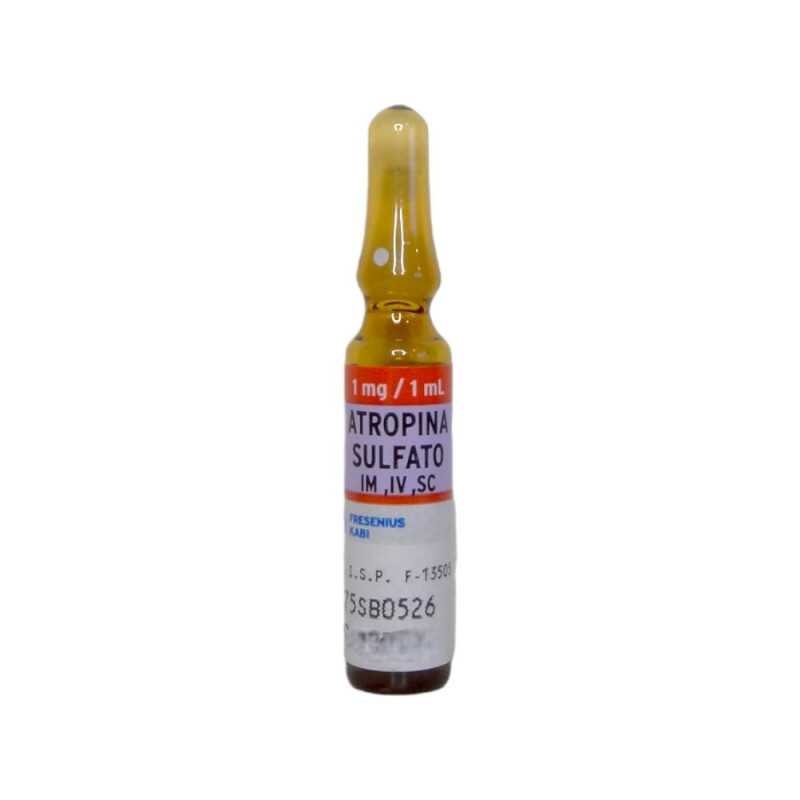
- País de registro
- Forma farmacéuticaINYECTABLE, 1 mg
- Código ATCA03BA01
- Precio medio en farmacia0.5 EUR
- Principio activo
- Requiere recetaSí
- Fabricante
- ComposiciónSODIO, METABISULFITO DE (E 223) (0,5 mg mg), CLORURO DE SODIO (8 mg mg)
- Esta información es de carácter general y no sustituye la consulta con un profesional sanitario.
- Alternativas a ATROPINA SULFATO SERRA PAMIES 1 MG/ML SOLUCIÓN INYECTABLEForma farmacéutica: INYECTABLE, 0,1 mg/mlPrincipio activo: atropineFabricante: Accord Healthcare S.L.U.Requiere recetaForma farmacéutica: INYECTABLE, 0,5 mg inyectable 5 mlPrincipio activo: atropineFabricante: Laboratoire AguettantRequiere recetaForma farmacéutica: INYECTABLE, 0.2 mg/mlPrincipio activo: atropineFabricante: Laboratoire AguettantRequiere receta
Médicos online para ATROPINA SULFATO SERRA PAMIES 1 MG/ML SOLUCIÓN INYECTABLE
Comenta la dosis, los posibles efectos secundarios, interacciones, contraindicaciones o la revisión de receta de ATROPINA SULFATO SERRA PAMIES 1 MG/ML SOLUCIÓN INYECTABLE, sujeto a valoración médica y a la normativa local.









Obtén una receta de ATROPINA SULFATO SERRA PAMIES 1 MG/ML SOLUCIÓN INYECTABLE online
Rellena un formulario de 2 minutos
Cuéntanos tus síntomas, historial y el medicamento que necesitas.
Elige un médico o nosotros te asignamos uno
Escoge un especialista o te conectamos con el próximo médico disponible.
El médico revisa tu caso
Normalmente en 30 minutos. Puede hacerte preguntas adicionales por chat.
Recógela en cualquier farmacia
Receta electrónica enviada a tu correo, válida en toda España.
Preguntas frecuentes
ATROPINA SULFATO SERRA PAMIES 1 MG/ML SOLUCIÓN INYECTABLE requiere receta en España. Puedes confirmarlo con un médico online según tu caso.
El principio activo de ATROPINA SULFATO SERRA PAMIES 1 MG/ML SOLUCIÓN INYECTABLE es atropine. Esta información ayuda a identificar medicamentos con la misma composición pero con diferentes nombres comerciales.
El precio medio en farmacia de ATROPINA SULFATO SERRA PAMIES 1 MG/ML SOLUCIÓN INYECTABLE es de aproximadamente 0.5 EUR. Puede variar según el fabricante y la forma farmacéutica.
ATROPINA SULFATO SERRA PAMIES 1 MG/ML SOLUCIÓN INYECTABLE es fabricado por Laboratorios Serra Pamies S.A.. La marca y el envase pueden variar según el distribuidor.
Los Médicos de familia, Psiquiatras, Dermatólogos, Cardiólogos, Endocrinólogos, Gastroenterólogos, Neumólogos, Nefrólogos, Reumatólogos, Hematólogos, Infectólogos, Alergólogos, Geriatras, Pediatras, Oncólogos pueden valorar la prescripción de ATROPINA SULFATO SERRA PAMIES 1 MG/ML SOLUCIÓN INYECTABLE cuando esté clínicamente indicado. Puedes reservar una videoconsulta para comentar tu caso y las opciones de tratamiento.
España cuenta con una infraestructura sanitaria bien desarrollada en ciudades principales como Madrid, Barcelona, Valencia y Sevilla. Las farmacias están ampliamente disponibles y operan bajo estrictas regulaciones, garantizando el acceso a medicamentos con receta.
Puedes comprar ATROPINA SULFATO SERRA PAMIES 1 MG/ML SOLUCIÓN INYECTABLE en Madrid, Barcelona, Sevilla o Valencia en cualquier farmacia local con una receta válida.
Para obtener una receta, puedes utilizar Oladoctor:
Otros medicamentos con el mismo principio activo (atropine) incluyen ATROPINA ACCORD 0,1 MG/ML SOLUCION INYECTABLE EN JERINGA PRECARGADA, ATROPINA AGUETTANT 0,1 MG/ML SOLUCION INYECTABLE EN JERINGA PRECARGADA, ATROPINA AGUETTANT 0,2 MG/ML SOLUCION INYECTABLE EN JERINGA PRECARGADA. Pueden tener diferentes nombres comerciales o formulaciones, pero contienen el mismo componente terapéutico. Consulta siempre con un médico antes de cambiar o iniciar un nuevo medicamento.
