



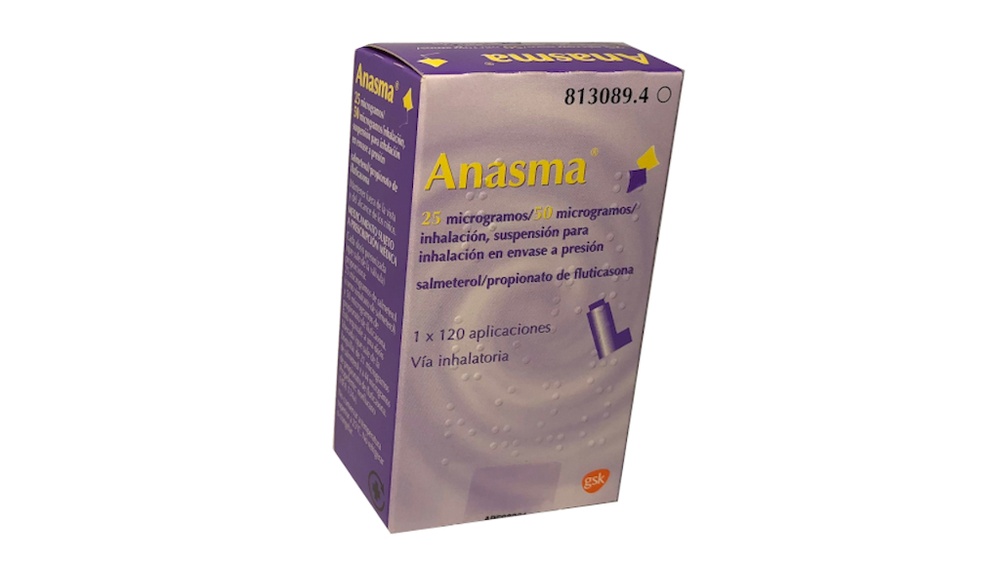
ANASMA 25 MICROGRAMOS/50 MICROGRAMOS Inhalación Pulmonar

Revisión de receta online
Un médico revisará tu caso y determinará si la prescripción es médicamente apropiada.

Habla con un médico sobre este medicamento
Comenta tus síntomas y las opciones de tratamiento en una consulta online.



Cómo usar ANASMA 25 MICROGRAMOS/50 MICROGRAMOS/INHALACION, SUSPENSION PARA INHALACION EN ENVASE A PRESION
Contenido del prospecto
- Introducción
- Qué es Anasma y para qué se utiliza
- Qué necesita saber antes de empezar a usar Anasma
- Cómo usar Anasma
- Posibles efectos adversos
- Conservación de Anasma
- Contenido del envase e información adicional
Introducción
Prospecto: información para el usuario
Anasma 25 microgramos/50 microgramos/inhalación, suspensión para inhalación en envase a presión
salmeterol/propionato de fluticasona
Lea todo el prospecto detenidamente antes de empezar a usar este medicamento, porque contiene información importante para usted.
- Conserve este prospecto, ya que puede tener que volver a leerlo.
- Si tiene alguna duda, consulte a su médico o farmacéutico.
- Este medicamento se le ha recetado solamente a usted, y no debe dárselo a otras personas aunque tengan los mismos síntomas que usted, ya que puede perjudicarles.
- Si experimenta efectos adversos, consulte a su médico o farmacéutico, incluso si se trata de efectos adversos que no aparecen en este prospecto. Ver sección 4.
Contenido del prospecto
- Qué es Anasma y para qué se utiliza
- Qué necesita saber antes de empezar a usar Anasma
- Cómo usar Anasma
- Posibles efectos adversos
- Conservación de Anasma
- Contenido del envase e información adicional
1. Qué es Anasma y para qué se utiliza
Anasma contiene dos principios activos, salmeterol y propionato de fluticasona:
- Salmeterol es un broncodilatador de larga duración. Los broncodilatadores ayudan a mantener abiertas las vías respiratorias en el pulmón, haciendo más fácil la entrada y salida de aire. Los efectos duran al menos 12 horas.
- Propionato de fluticasona es un corticosteroide que disminuye la inflamación e irritación de los pulmones.
El médico le ha prescrito este medicamento para ayudar a prevenir los problemas respiratorios tales como el asma.
Usted debe utilizar Anasma cada día como le ha recomendado su médico. Esto asegurará que la medicación actúe correctamente en el control de su asma.
Anasma ayuda a impedir la falta de aliento y sibilancias. Sin embargo, Anasma no se debe utilizar para aliviar un ataque repentino de ahogo o sibilancias. En tal caso, usted tiene que utilizar su medicación de “rescate” de acción rápida, como salbutamol. Debe llevar consigo en todo momento su medicación de rescate de acción rápida.

¿No estás seguro de si este medicamento es adecuado para ti?
Comenta tus síntomas y tratamiento con un médico online.
2. Qué necesita saber antes de empezar a usar Anasma
No use Anasma
- si es alérgico al salmeterol, al propionato de fluticasona o al otro componente, norflurano (HFA 134a).
Advertencias y precauciones
Consulte a su médico antes de empezar a usar Anasma si tiene:
- Alteraciones cardiacas, incluyendo latido cardiaco rápido o irregular.
- Hiperactividad tiroidea.
- Tensión arterial elevada.
- Diabetes mellitus (Anasma puede aumentar los niveles de azúcar en sangre).
- Niveles bajos de potasio en sangre.
- Tuberculosis (TB) a día de hoy o en el pasado u otras infecciones del pulmón.
Póngase en contacto con su médico si presenta visión borrosa u otras alteraciones visuales.
Otros medicamentos y Anasma
Informe a su médico o farmacéutico si está utilizando, ha utilizado recientemente o pudiera tener que utilizar cualquier otro medicamento, incluyendo aquellos medicamentos para el asma o los adquiridos sin receta. La razón es que, en algunos casos, Anasma no debe ser administrado junto con otros medicamentos.
Informe a su médico si usted toma alguno de los siguientes medicamentos, antes de empezar a utilizar Anasma:
- β-bloqueantes (tales como atenolol, propranolol y sotalol). Los β-bloqueantes son utilizados en su mayor parte para tratar la hipertensión u otras afecciones cardiacas.
- Medicamentos para tratar infecciones (como ketoconazol, itraconazol y eritromicina) incluyendo algunos medicamentos para el VIH (como ritonavir, cobicistat). Algunos de estos medicamentos pueden aumentar la cantidad de propionato de fluticasona o de salmeterol en su organismo. Esto puede aumentar su riesgo de padecer efectos adversos con Anasma, incluyendo latidos del corazón irregulares, o pueden empeorar los efectos adversos. Por lo que su médico podría hacerle controles minuciosos si está tomando estos medicamentos.
- Corticosteroides (orales o inyectables). Si usted ha tomado estos medicamentos recientemente, puede aumentar el riesgo de que este medicamento afecte a su glándula suprarrenal.
- Diuréticos, también conocidos como medicamentos para orinar, usados para tratar la tensión arterial alta.
- Otros broncodilatadores (como salbutamol).
- Medicamentos que contienen xantina. Se usan a menudo para tratar el asma.
Embarazo y lactancia
Si está embarazada o en periodo de lactancia, cree que podría estar embarazada o tiene intención de quedarse embarazada, consulte a su médico o farmacéutico antes de utilizar este medicamento.
Conducción y uso de máquinas
No es probable que Anasma afecte a la capacidad de conducir o usar máquinas.
3. Cómo usar Anasma
Siga exactamente las instrucciones de administración de este medicamento indicadas por su médico o farmacéutico. En caso de duda, consulte de nuevo a su médico o farmacéutico.
- Utilice Anasma todos los días, hasta que su médico le indique que deje de hacerlo. No tome más de la dosis recomendada. En caso de duda, consulte a su médico o farmacéutico.
- No deje de tomar Anasma ni reduzca su dosis sin hablar antes con su médico.
- Anasma debe inhalarse a través de la boca hasta los pulmones.
Adultos y adolescentes de 12 años en adelante
- Anasma 25/50 microgramos 2 aplicaciones dos veces al día
- Anasma 25/125 microgramos 2 aplicaciones dos veces al día
- Anasma 25/250 microgramos 2 aplicaciones dos veces al día
Niños de 4 a 12 años de edad
- Anasma 25/50 microgramos 2 aplicaciones dos veces al día
Anasma no está recomendado para uso en niños menores de 4 años de edad.
Sus síntomas pueden llegar a estar bien controlados usando Anasma dos veces al día. Si es así, su médico podrá decidir disminuir su dosis a una vez al día. La dosis puede cambiar a:
- una vez por la noche si tiene síntomas nocturnos,
- una vez por la mañana si tiene síntomas diurnos.
Es muy importante que siga las instrucciones de su médico sobre cuántas aplicaciones y con qué frecuencia debe administrarlas.
Si está utilizando Anasma para tratar el asma, su médico querrá vigilar regularmente sus síntomas. Si su asma empeora o tiene mayor dificultad para respirar, acuda a su médico enseguida. Puede notar más pitos, o sensación de ahogo más a menudo, o que tenga que utilizar su medicación de rescate de acción rápida con más frecuencia. Si le ocurre cualquiera de estas cosas, debe continuar utilizando Anasma, pero no aumente el número de aplicaciones. Su enfermedad respiratoria puede empeorar y enfermar gravemente. Acuda a su médico, puesto que puede que necesite un tratamiento adicional.
Instrucciones de uso
- Su médico, enfermero o farmacéutico deberán enseñarle cómo utilizar su inhalador. Periódicamente deberían verificar cómo lo utiliza. El no utilizar Anasma inhalador apropiadamente ni como se le ha prescrito, puede tener como resultado que su asma no mejore como debiera.
- El medicamento se encuentra en un cartucho a presión dentro de una carcasa de plástico con una boquilla.
- El inhalador posee un contador en su parte trasera que informa de cuántas aplicaciones quedan. Cada vez que usted accione el inhalador, se liberará una aplicación y el contador restará una unidad.
- Tenga cuidado de no dejar caer el inhalador, ya que puede provocar que el contador disminuya alguna unidad.
Comprobación del inhalador
- Si usa por primera vez su inhalador, compruebe que funciona bien. Quite el protector del aplicador bucal o boquilla apretando suavemente por los lados con su pulgar e índice y retirar.

- Para asegurarse que funciona, agite bien el inhalador, dirija la boquilla lejos de usted y presione el cartucho hacia abajo para liberar una aplicación al aire. Repita estos pasos, agitar el inhalador antes de liberar cada aplicación, hasta que el contador de aplicaciones marque 120. Si no ha utilizado su inhalador durante una semana o más tiempo, libere dos aplicaciones del medicamento al aire.
Uso del inhalador
Es importante comenzar a inspirar tan despacio como sea posible justo antes de usar su inhalador.
- Es recomendable que esté de pie o sentado erguido mientras usa el inhalador.
- Quitar el protector de la boquilla (como se muestra en la figura). Comprobar por dentro y por fuera que la boquilla está limpia y que no hay ninguna partícula extraña.
- Agitar el inhalador 4 o 5 veces para asegurar la eliminación de cualquier partícula extraña y que el contenido del inhalador se mezcla adecuadamente.

- Sujetar el inhalador en posición vertical con su dedo pulgar en la base del inhalador, por debajo de la boquilla. Expulse tanto aire como le sea posible.

- Colocar la boquilla en la boca, entre los dientes. Cierre los labios alrededor de la boquilla. No lo muerda.

- Tomar aire por la boca lenta y profundamente. Inmediatamente después de comenzar a tomar aire, presione firmemente la parte superior del inhalador para liberar el medicamento. Realizar esto mientras continúa tomando aire profunda y constantemente.

- Contener la respiración, retirar el inhalador de la boca quitando el dedo de la parte superior del inhalador. Continuar conteniendo la respiración unos segundos, tanto como se pueda.

- Esperar aproximadamente medio minuto entre cada aplicación del medicamento y después repetir los pasos del 3 al 7.
- Después, enjuagar su boca con agua y escupirla y/o cepillarse los dientes. Esto le ayudará a prevenir la aparición de ulceraciones en la boca y ronquera.
- Después de utilizarlo, vuelva siempre a colocar el protector de la boquilla inmediatamente, para preservarlo del polvo. Cuando el protector de la boquilla es colocado correctamente hará un “clic”. Si no hace “clic”, gire el protector de la boquilla, póngalo al revés y pruebe otra vez. No emplear excesiva fuerza.
Tómese su tiempo en los pasos 4, 5, 6 y 7. Es importante que justamente antes de utilizar el inhalador, espire tan lentamente como le sea posible. Las primeras veces que utilice el inhalador, debería utilizarlo enfrente de un espejo. Si ve “niebla” saliendo de la parte superior del inhalador o de los lados de su boca, debe empezar otra vez desde el punto 3.
Al igual que en todos los inhaladores, los cuidadores se deben asegurar de que los niños que estén usando Anasma Inhalador usen correctamente la técnica de inhalación descrita anteriormente.
Si a usted o a su hijo les resulta difícil utilizar el inhalador, su médico, enfermero u otro profesional sanitario podría recomendar el uso del inhalador con la cámara de inhalación Volumatic. Su médico, enfermero, farmacéutico u otro profesional sanitario debería mostrarle cómo utilizar la cámara de inhalación con su inhalador, cómo conservar su cámara de inhalación y contestar a cualquier pregunta que pueda tener. Si está utilizando la cámara de inhalación con su inhalador, es importante que no deje de utilizarla sin consultar antes a su médico o enfermero. También es importante que no cambie el tipo de cámara de inhalación que está utilizando sin consultarlo con su médico. Si deja de utilizar la cámara de inhalación o cambia el tipo de cámara de inhalación su médico podría necesitar cambiar la dosis de medicamento necesaria para controlar su asma. Consulte siempre con su médico antes de hacer cualquier cambio en su tratamiento para el asma.
A algunos niños o personas que tengan poca fuerza en las manos les puede resultar más sencillo coger el inhalador con ambas manos. Colocar los dos índices en la parte superior del inhalador y ambos pulgares en la base, debajo de la boquilla.
Debe conseguir un inhalador de repuesto cuando el marcador indique 020. Dejar de usar el inhalador cuando el marcador indique 000, ya que las aplicaciones que queden en el cartucho puede que no sean suficientes para completar una dosis. Nunca intente modificar la numeración del marcador o desprender el marcador del cartucho metálico.
Limpieza del inhalador
Para prevenir el bloqueo de su inhalador, es importante limpiarlo al menos una vez a la semana.
Para limpiar su inhalador:
- Quite el protector de la boquilla.
- No saque el cartucho metálico de la carcasa de plástico en ningún momento.
- Limpie el interior y exterior de la boquilla y la carcasa de plástico con un pañuelo seco.
- Vuelva a colocar el protector de la boquilla. Sonará un “clic” cuando haya quedado colocado correctamente. Si no suena, gire el protector de la boquilla, póngalo al revés y pruebe otra vez. No emplear excesiva fuerza.
No introduzca el cartucho metálico en agua.
Si usa más Anasma del que debe
Es muy importante usar el inhalador tal y como le han indicado. Si accidentalmente usted ha tomado una dosis mayor de la recomendada, consulte a su médico o farmacéutico. Puede notar que su corazón late más rápido de lo normal y sentir temblores. También puede tener dolor de cabeza, mareo, debilidad muscular y dolor en las articulaciones.
Si usted ha utilizado grandes dosis durante largos periodos de tiempo, usted debe pedir consejo a su médico o farmacéutico. Esto es porque altas concentraciones de Anasma pueden reducir la cantidad de hormonas esteroideas producidas por la glándula suprarrenal.
En caso de sobredosis consulte inmediatamente a su médico o farmacéutico o llame al Servicio de Información Toxicológica, teléfono: 91 562 04 20, indicando el medicamento y la cantidad administrada.
Si olvidó usar Anasma
No tome una dosis doble para compensar las dosis olvidadas. Tome la siguiente dosis a la hora habitual.
Si interrumpe el tratamiento con Anasma
Es muy importante que utilice Anasma todos los días tal como se le ha indicado. Siga tomándolo hasta que su médico le indique que finalice el tratamiento. No interrumpa bruscamente su tratamiento con Anasma.Esto podría hacer que su respiración empeore.
Además, si deja de tomar Anasma de forma repentina o reduce su dosis, podría (muy raramente) causarle problemas en la glándula suprarrenal (insuficiencia suprarrenal), que algunas veces causa efectos adversos.
Estos efectos adversos pueden incluir cualquiera de los siguientes:
- Dolor de estómago.
- Cansancio y pérdida del apetito, sensación de malestar.
- Malestar y diarrea.
- Pérdida de peso.
- Dolor de cabeza o somnolencia.
- Bajos niveles de azúcar en su sangre.
- Hipotensión y convulsiones (ataques).
Cuando su cuerpo se encuentra bajo situaciones de estrés, tales como fiebre, traumatismo (p.ej., accidente de tráfico), infección o cirugía, la insuficiencia suprarrenal puede empeorar y podría tener cualquiera de los efectos adversos listados anteriormente.
Si tiene cualquier efecto adverso consulte a su médico o farmacéutico. Para prevenir estos síntomas, su médico puede prescribirle una dosis adicional de corticosteroides en comprimidos durante ese tiempo (como prednisolona).
Si tiene cualquier otra duda sobre el uso de este medicamento, pregunte a su médico, enfermero o farmacéutico.

¿Has empezado a tomar el medicamento y tienes preguntas?
Comenta tus síntomas y tratamiento con un médico online.
4. Posibles efectos adversos
Al igual que todos los medicamentos, este medicamento puede producir efectos adversos, aunque no todas las personas los sufran. Para reducir la aparición de efectos adversos, su médico le prescribirá la menor dosis de Anasma que controle su asma.
Reacciones alérgicas: puede notar que su respiración, de repente, empeora inmediatamente después de utilizar Anasma.Puede sufrir pitos y tos o falta de aliento. También puede notar picor, erupción (urticaria) e hinchazón (generalmente de la cara, labios, lengua o garganta). También puede sentir, de repente, que su corazón late muy rápido, sentir que pierde el conocimiento y mareo (que puede llevar al colapso o pérdida de la conciencia). Si sufre cualquiera de estos efectos o si aparecen de repente después de utilizar Anasma, deje de tomar Anasma y avise a su médico enseguida. Las reacciones alérgicas a Anasma son poco frecuentes (afectan a menos de 1 de cada 100 personas).
A continuación se enumeran otros efectos adversos:
Muy frecuentes(pueden afectar a más de 1 de cada 10 personas)
- Dolor de cabeza, normalmente mejora al continuar con el tratamiento.
- Se ha notificado un aumento del número de resfriados en pacientes con EPOC.
Frecuentes(pueden afectar a menos de 1 de cada 10 personas)
- Candidiasis (picor, aparición de úlceras de color amarillo-crema) en la boca y la garganta. También dolor en la lengua, voz ronca e irritación de garganta. Enjuagar la boca con agua y escupirla y/o cepillarse los dientes inmediatamente después de cada dosis de medicamento puede ayudarle. Para el tratamiento de la candidiasis, su médico puede prescribirle medicación antifúngica (para el tratamiento de infecciones por hongos).
- Dolor, inflamación en las articulaciones y dolor muscular.
- Calambres musculares.
Los siguientes efectos adversos se han notificado en pacientes con Enfermedad Pulmonar Obstructiva Crónica (EPOC):
- Neumonía y bronquitis (infección pulmonar). Informe a su médico si nota alguno de los siguientes síntomas: aumento de la producción de esputo, cambio en el color del esputo, fiebre, escalofríos, aumento de la tos, aumento de la dificultad respiratoria.
- Cardenales y fracturas.
- Inflamación de los senos (sensación de tensión o congestión en la nariz, mejillas y detrás de los ojos, a veces con un dolor pulsátil).
- Reducción de los niveles de potasio en sangre (puede sentir latidos del corazón irregulares, debilidad muscular, calambres).
Poco frecuentes (pueden afectar a menos de 1 de cada 100 personas)
- Aumento de los niveles de azúcar (glucosa) en sangre (hiperglucemia). Si padece diabetes, será necesario controlar sus niveles de azúcar en sangre con mayor frecuencia y ajustar su tratamiento diabético habitual en caso de necesidad.
- Cataratas (opacidad del cristalino del ojo).
- Ritmo cardiaco muy rápido (taquicardia).
- Sentir temblores y un ritmo cardiaco rápido o irregular (palpitaciones). Estos efectos adversos son habitualmente inofensivos y disminuyen cuando se continúa con el tratamiento.
- Dolor en el pecho.
- Sensación de preocupación (ocurre principalmente en niños).
- Trastornos del sueño.
- Erupción cutánea.
- Erupción alérgica en la piel.
Raros (pueden afectar a menos de 1 de cada 1.000 personas)
- Dificultades respiratorias o sibilancia que empeoran justo después de utilizar Anasma. Si esto sucede, deje de utilizar Anasma. Utilice su inhalador de “rescate” de acción rápida para mejorar su respiración y avise a su médico enseguida.
- Anasma puede aumentar la producción normal de hormonas esteroideas, particularmente si ha estado tomando altas dosis durante largos periodos de tiempo. Los efectos incluyen:
- Retraso en el crecimiento en niños y adolescentes.
- Disminución de la densidad mineral ósea.
- Glaucoma.
- Aumento de peso.
- Cara redondeada (en forma de luna llena) (síndrome de Cushing).
Su médico vigilará regularmente cualquiera de estos efectos adversos y se cerciorará de que está tomando la dosis más baja de Anasma para controlar su asma.
- Cambios en el comportamiento, tales como hiperactividad e irritabilidad (estos efectos ocurren fundamentalmente en niños).
- Latidos del corazón irregulares o que el corazón tenga latidos extra (arritmias). Consulte a su médico, pero no deje de tomar Anasma a menos que su médico le diga que lo haga.
- Infección causada por hongos en el esófago (garganta), que puede causar dificultad para tragar.
Frecuencia no conocida, pero que también pueden aparecer:
- Depresión o agresividad. Es más probable que estos efectos aparezcan en niños.
- Visión borrosa.
Comunicación de efectos adversos
Si experimenta cualquier tipo de efecto adverso, consulte a su médico o farmacéutico, incluso si se trata de posibles efectos adversos que no aparecen en este prospecto. También puede comunicarlos directamente a través del Sistema Español de Farmacovigilancia de Medicamentos de Uso Humano: www.notificaRAM.es. Mediante la comunicación de efectos adversos usted puede contribuir a proporcionar más información sobre la seguridad de este medicamento.
5. Conservación de Anasma
Mantener este medicamento fuera de la vista y del alcance de los niños.
No utilice este medicamento después de la fecha de caducidad que aparece en la etiqueta y en el estuche después de CAD. La fecha de caducidad es el último día del mes que se indica.
No conservar a temperatura superior a 25 ºC. No refrigerar o congelar.
Como ocurre con la mayoría de los inhaladores en envase a presión, el efecto terapéutico del medicamento puede disminuir cuando el cartucho está frío.
El cartucho contiene un líquido a presión. No exponer a temperaturas superiores a 50 ºC, proteger de la luz solar directa. No perforar, romper o quemar el cartucho aunque aparentemente esté vacío.
Los medicamentos no se deben tirar por los desagües ni a la basura. Deposite los envases y los medicamentos que no necesite en el Punto SIGRE de la farmacia. En caso de duda pregunte a su farmacéutico cómo deshacerse de los envases y de los medicamentos que no necesita. De esta forma, ayudará a proteger el medio ambiente.
6. Contenido del envase e información adicional
Composición de Anasma
- Cada dosis presurizada contiene: 25 microgramos de salmeterol (como xinafoato de salmeterol) y 50 microgramos de propionato de fluticasona.
- El otro componente es un propelente: norflurano (HFA 134a).
Este medicamento contiene gases fluorados de efecto invernadero.
Cada inhalador contiene 12 g de HFC-134a (también conocido como norflurano o HFA 134a) que corresponden a 0,0172 toneladas de CO2 equivalente (potencial de calentamiento global PCG = 1 430).
Aspecto del producto y contenido del envase
- Anasma Inhalador se presenta en un envase a presión con contador, que libera el medicamento en forma de suspensión para su inhalación a través de la boca hasta los pulmones.
- El cartucho contiene una suspensión para inhalación de color blanco a blanquecino.
- Los cartuchos se encuentran dentro de un dispositivo de plástico que incorpora una boquilla y un protector para la misma.
Los dispositivos se encuentran en envases de 1 inhalador.
Titular de la autorización de comercialización y responsable de la fabricación
Titular de la autorización de comercialización:
GlaxoSmithKline, S.A.
P.T.M. C/ Severo Ochoa, 2
28760 Tres Cantos (Madrid)
Tel: +34 900 202 700
Responsable de la fabricación:
Glaxo Wellcome, S.A.
Avenida de Extremadura, 3 - 09400 Aranda de Duero (Burgos), España
o
Glaxo Wellcome Production
Zone Industrielle No.2, 23 Rue Lavoisier, La Madeleine, 27000 Evreux, Francia
Tel: +33 2 3223 5500; Fax: +33 2 3223 5558
o
Aspen Bad Oldesloe GmbH
Industriestrasse 32-36, D-23843 Bad Oldesloe, Alemania.
Fecha de la última revisión de este prospecto:01/2025
La información detallada y actualizada de este medicamento está disponible en la página Web de la Agencia Española de Medicamentos y Productos Sanitarios (AEMPS) http://www.aemps.gob.es/
- País de registro
- Forma farmacéuticaINHALACIÓN PULMONAR, 25 mcg salmeterol/50 mcg propionato fluticasona
- Código ATCR03AK06
- Precio medio en farmacia41.28 EUR
- Principio activo
- Requiere recetaSí
- Fabricante
- Esta información es de carácter general y no sustituye la consulta con un profesional sanitario.
- Alternativas a ANASMA 25 MICROGRAMOS/50 MICROGRAMOS/INHALACION, SUSPENSION PARA INHALACION EN ENVASE A PRESIONForma farmacéutica: INHALACIÓN PULMONAR, 50 microgramos/250 microgramosPrincipio activo: salmeterol and fluticasoneFabricante: Sandoz Farmaceutica S.A.Requiere recetaForma farmacéutica: INHALACIÓN PULMONAR, 50 microgramos/500 microgramosPrincipio activo: salmeterol and fluticasoneFabricante: Sandoz Farmaceutica S.A.Requiere recetaForma farmacéutica: INHALACIÓN PULMONAR, 50 microgramos /100 microgramosPrincipio activo: salmeterol and fluticasoneFabricante: Zentiva K.S.Requiere receta
Médicos online para ANASMA 25 MICROGRAMOS/50 MICROGRAMOS/INHALACION, SUSPENSION PARA INHALACION EN ENVASE A PRESION
Comenta la dosis, los posibles efectos secundarios, interacciones, contraindicaciones o la revisión de receta de ANASMA 25 MICROGRAMOS/50 MICROGRAMOS/INHALACION, SUSPENSION PARA INHALACION EN ENVASE A PRESION, sujeto a valoración médica y a la normativa local.









Obtén una receta de ANASMA 25 MICROGRAMOS/50 MICROGRAMOS/INHALACION, SUSPENSION PARA INHALACION EN ENVASE A PRESION online
Rellena un formulario de 2 minutos
Cuéntanos tus síntomas, historial y el medicamento que necesitas.
Elige un médico o nosotros te asignamos uno
Escoge un especialista o te conectamos con el próximo médico disponible.
El médico revisa tu caso
Normalmente en 30 minutos. Puede hacerte preguntas adicionales por chat.
Recógela en cualquier farmacia
Receta electrónica enviada a tu correo, válida en toda España.
Preguntas frecuentes
ANASMA 25 MICROGRAMOS/50 MICROGRAMOS/INHALACION, SUSPENSION PARA INHALACION EN ENVASE A PRESION requiere receta en España. Puedes confirmarlo con un médico online según tu caso.
El principio activo de ANASMA 25 MICROGRAMOS/50 MICROGRAMOS/INHALACION, SUSPENSION PARA INHALACION EN ENVASE A PRESION es salmeterol and fluticasone. Esta información ayuda a identificar medicamentos con la misma composición pero con diferentes nombres comerciales.
El precio medio en farmacia de ANASMA 25 MICROGRAMOS/50 MICROGRAMOS/INHALACION, SUSPENSION PARA INHALACION EN ENVASE A PRESION es de aproximadamente 41.28 EUR. Puede variar según el fabricante y la forma farmacéutica.
ANASMA 25 MICROGRAMOS/50 MICROGRAMOS/INHALACION, SUSPENSION PARA INHALACION EN ENVASE A PRESION es fabricado por Glaxosmithkline S.A.. La marca y el envase pueden variar según el distribuidor.
Los Médicos de familia, Psiquiatras, Dermatólogos, Cardiólogos, Endocrinólogos, Gastroenterólogos, Neumólogos, Nefrólogos, Reumatólogos, Hematólogos, Infectólogos, Alergólogos, Geriatras, Pediatras, Oncólogos pueden valorar la prescripción de ANASMA 25 MICROGRAMOS/50 MICROGRAMOS/INHALACION, SUSPENSION PARA INHALACION EN ENVASE A PRESION cuando esté clínicamente indicado. Puedes reservar una videoconsulta para comentar tu caso y las opciones de tratamiento.
España cuenta con una infraestructura sanitaria bien desarrollada en ciudades principales como Madrid, Barcelona, Valencia y Sevilla. Las farmacias están ampliamente disponibles y operan bajo estrictas regulaciones, garantizando el acceso a medicamentos con receta.
Puedes comprar ANASMA 25 MICROGRAMOS/50 MICROGRAMOS/INHALACION, SUSPENSION PARA INHALACION EN ENVASE A PRESION en Madrid, Barcelona, Sevilla o Valencia en cualquier farmacia local con una receta válida.
Para obtener una receta, puedes utilizar Oladoctor:
Otros medicamentos con el mismo principio activo (salmeterol and fluticasone) incluyen AIRFLUSAL FORSPIRO 50 MICROGRAMOS/250 MICROGRAMOS/INHALACION POLVO PARA INHALACION (UNIDOSIS), AIRFLUSAL FORSPIRO 50 MICROGRAMOS/500 MICROGRAMOS/INHALACION POLVO PARA INHALACION (UNIDOSIS), AMAIRA 50 MICROGRAMOS/100 MICROGRAMOS/INHALACION, POLVO PARA INHALACION (UNIDOSIS). Pueden tener diferentes nombres comerciales o formulaciones, pero contienen el mismo componente terapéutico. Consulta siempre con un médico antes de cambiar o iniciar un nuevo medicamento.
