


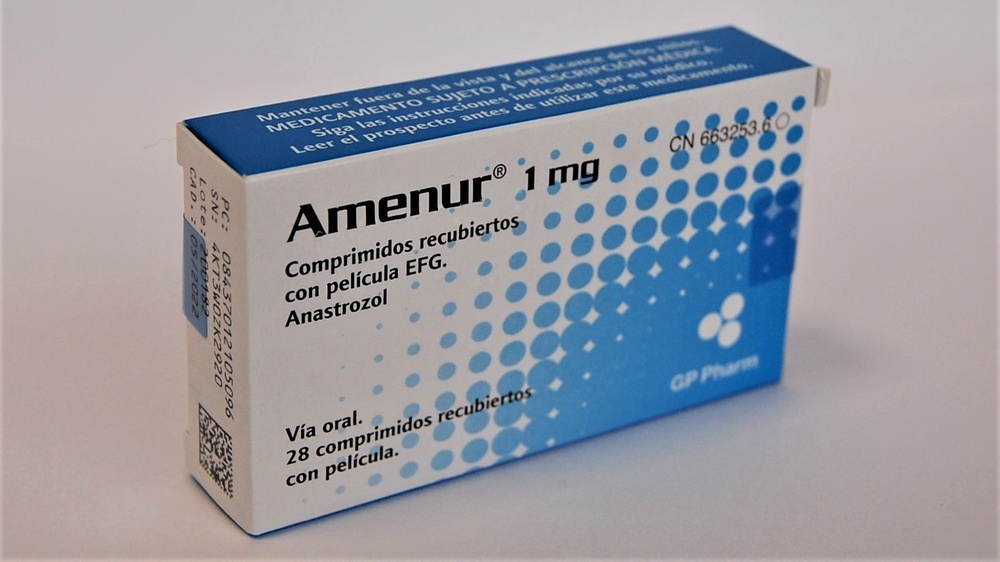
Amenur 1 mg comprimidos recubiertos con película

Revisión de receta online
Un médico revisará tu caso y determinará si la prescripción es médicamente apropiada.

Habla con un médico sobre este medicamento
Comenta tus síntomas y las opciones de tratamiento en una consulta online.



Cómo usar AMENUR 1 mg COMPRIMIDOS RECUBIERTOS CON PELICULA EFG
Contenido del prospecto
- Introducción
- Qué es Amenur y para qué se utiliza
- Qué necesita saber antes de empezar a tomar Amenur
- Cómo tomar Amenur
- Posibles efectos adversos
- Conservación de Amenur
- Contenido del envase e información adicional
Introducción
PROSPECTO: INFORMACION PARA EL USUARIOAMENUR 1 mg comprimidos recubiertos con películaEFG
Anastrozol
Lea todo el prospecto detenidamente antes de empezar a tomar este medicamento, porque contiene información importante para usted.
- Conserve este prospecto, ya que puede tener que volver a leerlo.
- Si tiene alguna duda, consulte a su médico o farmacéutico.
- Este medicamento se le ha recetado solamente a usted, y no debe dárselo a otras personas aunque tengan los mismos síntomas que usted, ya que puede perjudicarles.
- Si experimenta efectos adversos, consulte a su médico o farmacéutico, incluso si se trata de efectos adversos que no aparecen en este prospecto. Ver sección 4.
Contenido del prospecto:
- Qué es Amenur y para qué se utiliza2. Qué necesita saber antes de empezar a tomar Amenur3. Cómo tomar Amenur4. Posibles efectos adversos5. Conservación de Amenur6. Contenido del envase e información adicional
1. Qué es Amenur y para qué se utiliza
Amenur contiene una sustancia llamada anastrozol y pertenece a un grupo de medicamentos denominados “inhibidores de la aromatasa”. Anastrozol se utiliza para tratar el cáncer de mama en mujeres que se encuentran en la menopausia.
Anastrozol actúa reduciendo la cantidad de hormonas denominadas estrógenos que son producidas por su organismo, mediante el bloqueo de una sustancia corporal natural (una enzima) llamada “aromatasa”.

¿No estás seguro de si este medicamento es adecuado para ti?
Comenta tus síntomas y tratamiento con un médico online.
2. Qué necesita saber antes de empezar a tomar Amenur
No tome Amenur
- Si es alérgica (hipersensible) a anastrozol o a alguno de los demás componentes de este medicamento (incluidos en la sección 6).
- Si está embarazada o en periodo de lactancia (ver la sección llamada “Embarazo y lactancia”).
No tome anastrozol si se encuentra en cualquiera de las situaciones descritas anteriormente. Si no está segura, consulte a su médico o farmacéutico antes de tomar anastrozol.
Tenga especial cuidado con Amenur
Antes de tomar Amenur, compruebe con su médico o farmacéutico
- Si todavía tiene los periodos menstruales y no presenta la menopausia.
- Si está tomando un medicamento que contiene tamoxifeno o medicamentos que contengan estrógeno (ver la sección llamada “Otros medicamentos y Amenur”).
- Si alguna vez ha padecido alguna alteración que afecte a la fortaleza de sus huesos (osteoporosis).
- Si padece algún problema de hígado o de riñones.
Si no está segura de si algo de esto le afecta a usted, consulte a su médico o farmacéutico antes de tomar anastrozol.
En caso de ingresar en el hospital, comunique al personal sanitario que está tomando anastrozol.
Otros medicamentos y Amenur
Informe a su médico o farmacéutico si está utilizando, ha utilizado recientemente o pudiera tener que utilizar cualquier otro medicamento, incluso los adquiridos sin receta y plantas medicinales. Esto se debe a que anastrozol puede afectar a la actividad de otros medicamentos, y algunos medicamentos pueden presentar un efecto sobre anastrozol.
No tome anastrozol si ya está en tratamiento con cualquiera de los siguientes medicamentos:
- Ciertos medicamentos empleados para tratar el cáncer de mama (moduladores selectivos del receptor estrogénico), por ejemplo, medicamentos que contienen tamoxifeno. Esto se debe a que estos medicamentos pueden hacer que anastrozol deje de actuar adecuadamente.
- Medicamentos que contengan estrógenos, como la terapia hormonal de sustitución (THS).
Si se encuentra en alguna de estas situaciones, pida consejo a su médico o farmacéutico.
Consulte a su médico o farmacéutico si está tomando lo siguiente:
- Un medicamento conocido como un “análogo LHRH”. Esto incluye gonadorelina, buserelina, goserelina, leuprorelina y triptorelina. Estos medicamentos se utilizan para tratar el cáncer de mama, algunas alteraciones de salud femeninas (ginecológicas) y la infertilidad.
Embarazo y lactancia
No tome anastrozol si está embarazada o en periodo de lactancia. Interrumpa el tratamiento con anastrozol si se queda embarazada y consulte a su médico.
Consulte a su médico o farmacéutico antes de utilizar cualquier medicamento.
Conducción y uso de máquinas
Es improbable que anastrozol afecte a su capacidad para conducir o utilizar cualquier herramienta o máquina. Sin embargo, ocasionalmente algunas pacientes pueden sentir debilidad o somnolencia mientras toman anastrozol. Si esto le ocurriera, pida consejo a su médico o farmacéutico.
Información importante sobre algunos de los componentes de Amenur
Amenur contiene lactosa
Este medicamento contiene lactosa. Si su médico le ha indicado que padece una intolerancia a ciertos azúcares, consulte con él antes de tomar este medicamento.
Amenur contiene sodio
Este medicamento contiene menos de 23mg de sodio (1mmol) por comprimido; esto es, esencialmente “exento de sodio”.
3. Cómo tomar Amenur
Siga exactamente las instrucciones de administración de este medicamento indicadas por su médico. En caso de duda, consulte de nuevo a su médico o farmacéutico.
- La dosis recomendada es un comprimido diario.
- Intente tomar el comprimido a la misma hora cada día.
- Trague el comprimido entero con ayuda de agua.
- Puede tomar anastrozol antes, durante o después de las comidas.
Siga tomando anastrozol durante el tiempo que le indique su médico. Se trata de un tratamiento a largo plazo y puede que necesite tomarlo durante varios años.
Uso en niños y adolescentes
Anastrozol no debe administrarse a niños y adolescentes.
Si toma más Amenur del que debe
Si toma más anastrozol del que debiera, contacte inmediatamente con su médico.
En caso de sobredosis o ingestión accidental, consulte inmediatamente a su médico o farmacéutico o llame al Servicio de Información Toxicológica teléfono 91 562 04 20, indicando el medicamento y la cantidad ingerida.
Si olvidó tomar Amenur
Si olvida tomar una dosis, simplemente tome la próxima dosis normalmente.
No tome una dosis doble (dos dosis al mismo tiempo) para compensar una dosis olvidada.
Si interrumpe el tratamiento con Amenur
No deje de tomar sus comprimidos a menos que se lo indique su médico.
Si tiene cualquier otra duda sobre el uso de este medicamento, pregunte a su médico o farmacéutico.

¿Has empezado a tomar el medicamento y tienes preguntas?
Comenta tus síntomas y tratamiento con un médico online.
4. Posibles efectos adversos
Al igual que todos los medicamentos, este medicamento puede producir efectos adversos, aunque no todas las personas los sufran.
Deje de tomar Amenur y busque urgentemente tratamiento médico, si experimenta alguno de los siguientes efectos secundarios graves pero muy raros:
- Una reacción cutánea extremadamente grave con úlceras o ampollas en la piel. Esto se conoce como “síndrome de Stevens-Johnson”.
- Reacciones alérgicas (hipersensibilidad) con hinchazón de la garganta que puede causar dificultad al tragar o respirar. Esto se conoce como “angioedema”.
Efectos adversos muy frecuentes(pueden afectar a más de 1 de cada 10 personas)
- Dolor de cabeza.
- Sofocos.
- Sensación de mareo (náuseas).
- Erupción cutánea.
- Dolor o rigidez en las articulaciones.
- Inflamación de las articulaciones (artritis).
- Debilidad.
- Pérdida ósea (osteoporosis).
- Depresión.
Efectos adversos frecuentes (pueden afectar hasta 1 de cada 10 personas)
- Pérdida de apetito.
- Aumento o elevados niveles de un compuesto graso en sangre conocido como colesterol, que sería observado en un análisis de sangre.
- Somnolencia.
- Síndrome del túnel carpiano (hormigueo, dolor, sensación de frío, debilidad en zonas de la mano).
- Cosquilleo, hormigueo o entumecimiento de la piel, pérdida /falta de gusto.
- Diarrea.
- Vómitos.
- Cambios en las pruebas sanguíneas que muestran en qué medida su hígado está funcionando de forma adecuada.
- Debilitamiento del pelo (pérdida de cabello).
- Reacciones alérgicas (hipersensibilidad) incluyendo cara, labios o lengua.
- Dolor óseo.
- Sequedad vaginal.
- Hemorragia vaginal (normalmente en las primeras semanas de tratamiento - si la hemorragia continúa, hable con su médico).
- Dolor muscular.
Efectos adversos poco frecuentes(pueden afectar hasta 1 de cada 100 personas)
- Cambios en pruebas sanguíneas especiales que muestran cómo está funcionando su hígado (gamma‑GT y bilirrubina).
- Inflamación del hígado (hepatitis).
- Urticaria o habones.
- Dedo en resorte (alteración en la que uno de los dedos de la mano se queda en posición doblada).
- Aumento en la cantidad de calcio en la sangre. Si usted experimenta náuseas, vómitos y sed, informe a su médico, o farmacéutico o enfermero ya que usted puede necesitar un análisis de sangre.
Efectos adversos raros(pueden afectar hasta 1 de cada 1.000 personas)
- Inflamación rara de la piel que puede incluir manchas rojas o ampollas.
- Erupción cutánea provocada por hipersensibidlidad (esto puede ser debido a una reacción alérgica o anafilactoide).
- Inflamación de los vasos sanguíneos pequeños provocando coloración roja o púrpura de la piel.
- Muy raramente pueden tener lugar síntomas de dolor articular, de estómago y de riñones; esto se conoce como “púrpura de Henoch-Schönlein”.
Efectos adversos con frecuencia no conocida (la frecuencia no puede estimarse a partir de los datos disponibles)
- Ojo seco.
- Erupción liquenoide (pequeños bultos rojos o violáceos con picazón en la piel).
- Inflamación de un tendón o tendinitis (tejidos conectivos que unen los músculos a los huesos).
- Rotura de un tendón (tejidos conectivos que unen los músculos a los huesos).
- Deterioro de la memoria.
Efectos sobre sus huesos
Anastrozol disminuye los niveles de las hormonas denominadas estrógenos presentes en su organismo. Esto puede reducir el contenido mineral de sus huesos. Estos pueden ser menos fuertes y hacer que las fracturas sean más probables. Su médico controlará estos riesgos según las directrices de tratamiento del estado de los huesos en mujeres postmenopáusicas. Debe hablar con su médico sobre los riesgos y opciones de tratamiento.
Comunicación de efectos adversos
Si experimenta cualquier tipo de efecto adverso, consulte a su médico, farmacéutico o enfermero, incluso si se trata de posibles efectos adversos que no aparecen en este prospecto. También puede comunicarlos directamente a través del Sistema Español de Farmacovigilancia de Medicamentos de Uso Humano, www.notificaram.es. Mediante la comunicación de efectos adversos usted puede contribuir a proporcionar más información sobre la seguridad de este medicamento.
5. Conservación de Amenur
Mantener este medicamento fuera de la vista y del alcance de los niños. Guarde los comprimidos en un lugar seguro donde los niños no los vean ni los alcancen. Sus comprimidos podrían perjudicarles.
No utilice este medicamento después de la fecha de caducidad que aparece en el envase después de CAD.La fecha de caducidad es el último día del mes que se indica.
No requiere condiciones especiales de conservación.
Conservar en el embalaje exterior.
Los medicamentos no se deben tirar por los desagües ni a la basura. Deposite los envases y los medicamentos que no necesita en el Punto SIGRE de la farmacia. En caso de duda pregunte a su farmacéutico cómo deshacerse de los envases y de los medicamentos que no necesita. De esta forma, ayudará a proteger el medio ambiente.
6. Contenido del envase e información adicional
Composición de Amenur
El principio activo es anastrozol. Cada comprimido recubierto con película contiene 1 mg de anastrozol.
Los demás componentes (excipientes) del núcleo son: lactosa monohidrato (lactosa), povidona (E1201), almidón glicolato sódico de patata (almidón de patata), estearato de magnesio (E572); los componentes (excipientes) del recubrimiento son: hipromelosa (E464), macrogol 6000, dióxido de titanio (E171) y talco.
Aspecto del producto y contenido del envase
Comprimido recubierto redondo, biconvexo, blanco o casi blanco.
Amenur se presenta en blister, en envases que contienen 28 comprimidos.
Titular de la autorización de comercialización y responsable de la fabricación
Titular de la autorización
GP-Pharm , S.A.
Pol. Ind. Els Vinyets – Els Fogars C244, Km 22
08777 Sant Quintí de Mediona (Barcelona)
ESPAÑA
Responsable de la fabricación
Genepharm S.A.
18 Km Marathon Avenue
15351 Pallini
Grecia
Fecha de la última revisión de esteprospecto: Mayo 2025
La información detallada y actualizada de este medicamento está disponible en la página Web de la Agencia Española de Medicamentos y Productos Sanitarios (AEMPS) http://www.aemps.gob.es/
- País de registro
- Forma farmacéuticaCOMPRIMIDO, 1 mg
- Código ATCL02BG03
- Precio medio en farmacia60.09 EUR
- Principio activo
- Requiere recetaSí
- Fabricante
- ComposiciónLACTOSA MONOHIDRATO (91,0 mg mg), CARBOXIMETILALMIDON SODICO (5,0 mg mg)
- Esta información es de carácter general y no sustituye la consulta con un profesional sanitario.
- Alternativas a AMENUR 1 mg COMPRIMIDOS RECUBIERTOS CON PELICULA EFGForma farmacéutica: COMPRIMIDO, 1 mgPrincipio activo: anastrozolFabricante: Accord Healthcare S.L.U.Requiere recetaForma farmacéutica: COMPRIMIDO, 1 mgPrincipio activo: anastrozolFabricante: Eugia Pharma (Malta) LimitedRequiere recetaForma farmacéutica: COMPRIMIDO, 1 mgPrincipio activo: anastrozolFabricante: Laboratorios Cinfa S.A.Requiere receta
Médicos online para AMENUR 1 mg COMPRIMIDOS RECUBIERTOS CON PELICULA EFG
Comenta la dosis, los posibles efectos secundarios, interacciones, contraindicaciones o la revisión de receta de AMENUR 1 mg COMPRIMIDOS RECUBIERTOS CON PELICULA EFG, sujeto a valoración médica y a la normativa local.


Preguntas frecuentes
AMENUR 1 mg COMPRIMIDOS RECUBIERTOS CON PELICULA EFG requiere receta en España. Puedes confirmarlo con un médico online según tu caso.
El principio activo de AMENUR 1 mg COMPRIMIDOS RECUBIERTOS CON PELICULA EFG es anastrozol. Esta información ayuda a identificar medicamentos con la misma composición pero con diferentes nombres comerciales.
El precio medio en farmacia de AMENUR 1 mg COMPRIMIDOS RECUBIERTOS CON PELICULA EFG es de aproximadamente 60.09 EUR. Puede variar según el fabricante y la forma farmacéutica.
AMENUR 1 mg COMPRIMIDOS RECUBIERTOS CON PELICULA EFG es fabricado por Gp Pharm S.A.. La marca y el envase pueden variar según el distribuidor.
Los Médicos de familia, Psiquiatras, Dermatólogos, Cardiólogos, Endocrinólogos, Gastroenterólogos, Neumólogos, Nefrólogos, Reumatólogos, Hematólogos, Infectólogos, Alergólogos, Geriatras, Pediatras, Oncólogos pueden valorar la prescripción de AMENUR 1 mg COMPRIMIDOS RECUBIERTOS CON PELICULA EFG cuando esté clínicamente indicado. Puedes reservar una videoconsulta para comentar tu caso y las opciones de tratamiento.
La receta la emite un médico tras valorar tu estado de salud. En España, AMENUR 1 mg COMPRIMIDOS RECUBIERTOS CON PELICULA EFG se dispensa en las farmacias con esa receta médica. Una consulta online no garantiza su emisión: la decisión corresponde siempre al médico.
Para solicitar una valoración puedes usar Oladoctor:
Otros medicamentos con el mismo principio activo (anastrozol) incluyen ANASTROZOL ACCORD 1 mg COMPRIMIDOS RECUBIERTOS CON PELICULA EFG, ANASTROZOL AUROVITAS 1 MG COMPRIMIDOS RECUBIERTOS CON PELICULA EFG, ANASTROZOL CINFA 1 mg COMPRIMIDOS RECUBIERTOS CON PELICULA EFG. Pueden tener diferentes nombres comerciales o formulaciones, pero contienen el mismo componente terapéutico. Consulta siempre con un médico antes de cambiar o iniciar un nuevo medicamento.
