



ALPROSTADIL 20 MICROGRAMOS INYECTABLE PERFUSION

Revisión de receta online
Un médico revisará tu caso y determinará si la prescripción es médicamente apropiada.

Habla con un médico sobre este medicamento
Comenta tus síntomas y las opciones de tratamiento en una consulta online.



Cómo usar ALPROSTADIL ALTAN 20 MICROGRAMOS POLVO PARA SOLUCION PARA PERFUSION EFG
Contenido del prospecto
- Introducción
- Qué es Alprostadil Altan y para qué se utiliza
- Que necesita saber antes de usar Alprostadil Altan
- Cómo usar Alprostadil Altan
- Posibles efectos adversos
- Conservación de Alprostadil Altan
- Contenido del envase e información adicional
Introducción
Prospecto: información para el usuario
Alprostadil Altan 20 microgramos polvo para solución para perfusiónEFG
Lea todo el prospecto detenidamente antes de empezar a usar este medicamento, porque contiene información importante para usted.
- Conserve este prospecto, ya que puede tener que volver a leerlo
- Si tiene alguna duda, consulte a su médico, farmacéutico o enfermero.
- Este medicamento se le ha recetado solamente a usted, y no debe dárselo a otras personas aunque tengan los mismos síntomas que usted, ya que puede perjudicarles.
- Si experimenta efectos adversos, consulte a su médico o farmacéutico, incluso si se trata de efectos adversos que no aparecen en este prospecto. Ver sección 4.
Contenido del prospecto
- Qué es Alprostadil Altan y para qué se utiliz
- Qué necesita saber antes de empezar a usar Alprostadil Altan
- Cómo usar Alprostadil Altan
- Posibles efectos adversos
- Conservación de Alprostadil Altan
- Contenido del envase e información adicional
1. Qué es Alprostadil Altan y para qué se utiliza
El principio activo de este medicamento es la prostaglandina E1 (alprostadil) cuyas propiedades hemodinámicas y acción antiagregante plaquetaria fundamentan su uso en el tratamiento de la enfermedad vascular periférica severa.
Este medicamento está indicado para el tratamiento de la arteriopatía oclusiva arterioesclerótica de miembros inferiores en estadios III y IV de Leriche-Fontaine, excluyendo los pacientes candidatos a amputación.

¿No estás seguro de si este medicamento es adecuado para ti?
Comenta tus síntomas y tratamiento con un médico online.
2. Que necesita saber antes de usar Alprostadil Altan
No use Alprostadil Altan
- Si es alérgico al alprostadil o a cualquiera de los demás componentes de este medicamento (incluidos en la sección 6)
- Pacientes con deterioro de la función cardiaca, tales como pacientes con un grado III y IV de insuficiencia cardiaca según la clasificación de la New York Heart Association (NYHA), arritmia hemodinamicamente relevante, enfermedad coronaria mal controlada, estenosis y/o insuficiencia de la válvula mitral y/o aórtica. Antecedentes de infarto de miocardio en los últimos seis meses.
- Hipotensión severa (presión sanguínea disminuida)
- Edema pulmonar agudo (acúmulo de líquido en los pulmones) o historia de edema pulmonar en pacientes en pacientes con insuficiencia cardíaca.
- Enfermedad pulmonar obstructiva crónica severa (EPOC) (limitación crónica del flujo de aire) o enfermedad veno-oclusiva pulmonar (EPVO) (obstrucción de las venas pulmonares)
- Infiltración pulmonar diseminada.
- Tendencia a sufrir hemorragias, tales como pacientes con úlcera aguda erosiva o hemorragia gástrica y/o duodenal.
- Antecedentes de accidente cerebrovascular en los últimos seis meses.
- Pacientes con disfunción renal (oligoanuria)
- Pacientes con signos de insuficiencia hepática aguda (transaminasas o gamma GT elevadas) o coninsuficiencia hepática severa conocida (incluyendo antecedentes de la primera)
- Contraindicación general para el tratamiento con una infusión (como insuficiencia cardíaca congestiva, edema pulmonar o cerebral e hiperhidratación)
- Pacientes en los que se pueda esperar complicaciones por sangrado (e.j. úlcera gastrointestinal reciente, politraumatismo)
- Estenosis y/o insuficiencia de la válvula aórtica o mitral
- Periodo postparto
- Pre- Intra y Post operatorio
- Mujeres embarazadas, en periodo de lactancia o que puedan quedarse embarazadas
- Niños y adolescentes
Deben tomarse precauciones cuando el producto se administre a pacientes de riesgo (ver apartado "Advertencias y precauciones").
Advertencias y precauciones:
Consulte a su médico, farmacéutico o enfermero antes de empezar a usar Alprostadil Altan.
Precauciones generales
Este medicamento debe ser administrado únicamente por indicaciones del médico, bajo estricto control médico especializado, en centros con un equipamiento adecuado que permita la monitorización cardiovascular del paciente.
Administración con precauciones
Los pacientes que reciben alprostadil deben ser estrechamente monitorizados durante cada dosis. Se deben realizar controles frecuentes de la función cardiovascular, incluyendo la monitorización de la presión arterial, la frecuencia cardiaca, y el balance hidrolítico. Antes de dar el alta a un paciente, este debe de tener una condición cardiovascular estable.
Los pacientes con insuficiencia renal deben ser estrechamente monitorizados (por ejemplo, balance hidrico y tests de función renal).
Los pacientes que, por motivos de edad, puedan tener tendencia a desarrollar una insuficiencia cardíaca, o bien con edemas periféricos o insuficiencia renal (creatinina > 1,5 mg/dL), deben permanecer ingresados bajo vigilancia médica durante y hasta un día después del tratamiento con este medicamento.
Alprostadil sólo debe ser administrado por médicos con experiencia en el tratamiento de la enfermedad oclusiva arterial periférica y que estén familiarizados con la monitorización de las funciones cardiovasculares, en unas instalaciones adecuadas. Alprostadil no debe ser administrado por inyección en bolo.Alprostadil no debe ser administrado a mujeres que puedan quedarse embarazadas.
No se recomienda el uso de Alprostadil en la población pediátrica
El uso de Alprostadil Altan en pacientes con insuficiencia hepática severa está contraindicado.
Niños y adolescentes
Alprostadil Altan está contraindicado en niños y adolescentes.
Uso de Alprostadil Altan con otros medicamentos
Comunique a su médico o farmacéutico si está utilizando, ha utilizado recientemente o podría tener que utilizar cualquier otro medicamento.
Como alprostadil tiene propiedades vasodilatadoras y es, in vitro, un inhibidor débil de la agregación plaquetaria, se deben adoptar precauciones en pacientes que reciben otros vasodilatadores o anticoagulantes de forma concomitante. Como alprostadil puede incrementar el efecto de los fármacos reductores de la presión arterial (como antihipertensivos, vasodilatatores), se debe realizar un control exhaustivo de la presión arterial en los pacientes que reciben estos fármacos.
El tratamiento con Alprostadil Altan puede potenciar el efecto de los medicamentos hipotensores (antihipertensivos), vasodilatadores y de los medicamentos utilizados para tratar la cardiopatía isquémica.
Los pacientes que reciban dichos tratamientos y Alprostadil Altan concomitantemente requieren una monitorización cardiovascular estricta.
La administración concomitante de Alprostadil Altan y medicamentos anticoagulantes y antiagregantes plaquetarios puede incrementar el riesgo hemorrágico.
En la mayoría de ensayos clínicos realizados, se ha suspendido la administración de antiagregante durante el tratamiento con Alprostadil Altan con objeto de facilitar la valoración más precisa de su eficacia. En consecuencia, no se dispone de datos suficientes sobre el uso concomitante de ambas medicaciones y su administración conjunta debe, por tanto, excluirse.
Embarazo y fertilidad
Si está embarazada o en periodo de lactancia, cree que podría estar embarazada o tiene intención de quedarse embarazada, consulte a su médico o farmacéutico antes de utilizar este medicamento.
Alprostadil Altan no debe ser administrado a mujeres que puedan quedarse embarazadas, estar embarazadas o en perido de lactancia.Las mujeres en edad fértil que se traten con Alprostadil deben utilizar métodos anticonceptivos eficaces durante el tratamiento.Se han realizado estudios pre-clínicos de fertilidad y a la dosis clínica recomendada de alprostadil, no se preveen efectos sobre la fertilidad.
Conducción y uso de máquinas
Alprostadil Altan puede causar disminución de la presión arterial sistólica y por lo tanto puede tener una influencia moderada sobre la capacidad para conducir y utilizar máquinas. Los pacientes deben ser advertidos de esta posibilidad y mencionarles la necesidad de ser precavidos al conducir un vehículo o manejar maquinaria.
3. Cómo usar Alprostadil Altan
Siga exactamente las instrucciones de administración del medicamento contenidas en este prospecto o las indicadas por su médico, farmacéutico o enfermero. En caso de duda, pregunte a su médico, farmacéutico o enfermero.
La dosis recomendada es 40 microgramos/12 horas o 60 microgramos/24 horas mediante infusión intravenosa.
Dosis inicial: Los tratamientos se iniciarán a dosis de 40 microgramos/12 horas por infusión IV.
Cuando la respuesta al tratamiento permita el alta hospitalaria, la dosis pasará a ser de 60 microgramos/24 horas por infusión IV.
40 microgramos/12 horas: Disolver el contenido de 2 viales de Alprostadil Altan (equivalentes a 40 microgramos de alprostadil) en 50-250 ml de solución salina fisiológica e infundir la solución resultante por vía intravenosa durante un periodo de al menos 2 horas.
60 microgramos/24 horas: Disolver el contenido de 3 viales de Alprostadil Altan (equivalentes a 60 microgramos de alprostadil) en 50-250 ml de solución salina fisiológica e infundir la solución resultante por vía intravenosa durante un periodo de 3 horas.
Insuficiencia renal:
En pacientes con insuficiencia renal (creatinina > 1,5 mg/dL) el tratamiento debe iniciarse con un vial de Alprostadil Altan (equivalente a 20 microgramos de alprostadil) por vía intravenosa durante 2-3 horas, dos veces al día. Trascurridos 2-3 días, dependiendo de la condición clínica general, la dosis puede incrementarse hasta la dosis normal. En pacientes con insuficiencia renal así como en pacientes con insuficiencia cardiaca el volumen total de infusión no debe exceder los 50-100 ml/día.
Insuficiencia hepática:
El uso de Alprostadil Altan en pacientes con insuficiencia hepática severa está contraindicado.
Pacientes de edad avanzada:
Se recomienda utilizar la dosis habitual.
Uso en niños y adolescentes
Alprostadil Altan está contraindicado en niños y adolescentes.
Normas de administración
Ver apartado NORMAS DE ADMINISTRACIÓN PARA EL PROFESIONAL SANITARIO.
Si usa más Alprostadil Altan del que debe
Dada su forma de administración, es improbable que se produzca intoxicación. Pero en caso de sobredosis accidental consulte con el Servicio de Información Toxicológica, teléfono: 91 562 04 20, indicando el medicamento y la cantidad administrada.
Síntomas de sobredosis
En caso de sobredosis, debido a los efectos vasodilatadores, puede producirse hipotensión (presión sanguínea disminuida) y taquicardia refleja (frecuencia cardiaca rápida). Además, pueden ocurrir los siguientes síntomas sistémicos: reacciones vasovagales (estímulos desde el nervio vago en los vasos sanguíneos) con palidez, sudoración, náuseas y vómitos, insuficiencia cardiaca e isquemia miocárdica (insuficiente aporte de sangre al tejido muscular del corazón). Localmente en el lugar de infusión se puede producir dolor, hinchazón y enrojecimiento.
Tratamiento de la sobredosis
Al comienzo de los síntomas de sobredosis (dolor severo, presión sanguínea disminuida) la dosis de Alprostadil Altan debe reducirse o la infusión debe interrumpirse inmediatamente. En caso de hipotensión se debe elevar las piernas del paciente. Si los síntomas persisten, se debe realizar otras pruebas diagnósticas cardiacas y se debe considerar el uso de simpatomiméticos.
Si olvidó usar Alprostadil Altan
No tome una dosis doble para compensar las dosis olvidadas.
Si tiene cualquier otra duda sobre el uso de este medicamento, pregunte a su médico, farmacéutico o enfermero.

¿Has empezado a tomar el medicamento y tienes preguntas?
Comenta tus síntomas y tratamiento con un médico online.
4. Posibles efectos adversos
Al igual que todos los medicamentos, este medicamento puede producir efectos adversos, aunque no todas las personas los sufran.
La frecuencia de los posibles efectos adversos enumerados a continuación se define utilizando la siguiente clasificación:
Muy frecuentes: pueden afectar a más de 1 de cada 10 personas
Frecuentes:pueden afectar hasta de cada 10 personas
Poco frecuentes: pueden afectar hasta 1 de cada 100 personas
Raras: pueden afectar hasta 1 de cada 1,000 personas
Muy raras: pueden afectar hasta 1 de cada 10,000 personas
Desconocidas: la frecuencia no se puede estimar con los datos disponibles.
- Trastornos de la sangre y del sistema linfático
- Poco frecuentes: aumento de la PCR (Proteína C reactiva) que está normalmente presente en trazas en el suero sanguíneo pero que se eleva durante episodios de inflamación aguda
- Raras: variaciones en el recuento leucocitario (leucopenia o leucocitosis), trombocitopenia (disminución de la cantidad de plaquetas circulantes).
- Trastornos del sistema nervioso
- Frecuentes: dolor de cabeza.
- Poco frecuentes: mareos, debilidad, cansancio.
- Raras: estados confusionales, convulsiones de origen cerebral
- No conocida: accidente cerebrovascular
- Trastornos cardiacos y vasculares
- Poco frecuentes: disminución de la tensión arterial sistólica, taquicardia (latido del corazón excesivamente rápido), angina de pecho, palpitaciones..
- Raras: arritmias, insuficiencia cardiaca biventricular.
- No conocidas: infarto de miocardio.
- Trastornos respiratorios, torácicos y mediastínicos
- Frecuentes: apnea (incapacidad temporal para respirar)
- Raras: edema pulmonar, bradipnea (respiración anormalmente lenta), hipercapnia, (cantidades excesivas de dióxido de carbono en la sangre)
- No conocida: disnea (dificultad para respirar o respiración lenta)
- Trastornos gastrointestinales
- Poco frecuentes: reacciones gastrointestinales (naúseas, vómitos, diarrea, dolor abdominal); propiedades deacelaración de alprostadil (diarrea, náuseas y vómitos).
- Raras: hiperplasia de la mucosa del antro, posible obstrucción pilórica
- No conocida: Sangrado del estómago y/o intestino.
- Trastornos generales
- Muy frecuentes: dolor, dolor de cabeza, eritema o edema del miembro infundido
- Frecuentes: dolor, después de una administración intraarterial: sensación de calor, sensación de hinchazón, edema localizado, parestesias (sensación anormal de la sensibilidad general que se traduce por una sensación de hormigueo, adormecimiento, acorchamiento, etc.).
- Poco frecuentes: después de una administración intravenosa: sensación de calor, sensación de hinchazón, edema localizado, parestesias; fiebre, sudoración, fiebre intermitente.
- Muy raras: reacciones anafilácticas/anafilactoides (reacciones alérgicas generalizadas),
- Frecuencia no conocida: flebitis en la zona de inyección (inflamación de la pared de una vena en la zona de inyección), trombosis en el punto de inserción del catéter, hemorragia localizada.
- Trastornos hepatobiliares
- Raras: alteraciones de las enzimas hepáticas.
- Trastornos musculoesqueléticos y del tejido conjuntivo
- Poco frecuentes: dolor de articulaciones
- Muy raras: en un número muy reducido de pacientes tratados durante un período superior a 4 semanas, se ha podido observar hiperostosis reversible de huesos largos.
- Trastornos de la piel y del tejido subcutáneo
- Frecuentes: eritema, edema, enrojecimiento y rubor.
- Poco frecuentes: reacciones alérgicas cutáneas como rash (erupción cutánea), molestias en articulaciones, reacciones febriles, sudoración y escalofríos).
Comunicación de efectos adversos
Si experimenta cualquier tipo de efecto adverso, consulte a su médico, farmacéutico o enfermero, incluso si se trata de posibles efectos adversos que no aparecen en este prospecto. También puede comunicarlos directamente a través del Sistema Español de Farmacovigilancia de Medicamentos de Uso Humano: www.notificaRAM.es. Mediante la comunicación de efectos adversos usted puede contribuir a proporcionar más información sobre la seguridad de este medicamento.
5. Conservación de Alprostadil Altan
Mantener este medicamento fuera de la vista y del alcance de los niños.
No utilice este medicamento después de la fecha de caducidad que aparece en el envase. La fecha de caducidad es el último día del mes que se indica.
Conservar los viales en el embalaje exterior para protegerlo de la luz. No conservar a temperatura superior a 25°C.
La solución reconstituida debe prepararse inmediatamente antes de su uso.
En solución de cloruro sódico 0,9%, Alprostadil Altan es estable a 2-8ºC durante 24 horas.
6. Contenido del envase e información adicional
Composición de Alprostadil Altan
- El principio activo es alprostadil 20 microgramos
- Los demás componentes son alfa-ciclodextrina y lactosa monohidrato
Aspecto del producto y contenido del envase
Polvo blanco o casi blanco
Alprostadil Altan 20 microgramos, polvo para solución para perfusión se empaqueta en cajas conteniendo 1, 28 ó 50 (envase clínico) viales de vidrio transparente tipo I de 8 ml de capacidad, tapón de goma bromobutilo.
Puede que solamente estén comercializados algunos tamaños de envase.
Titular de la autorización de comercialización y responsable de la fabricación
Titular de la autorización de comercialización
Altan Pharmaceuticals S.A.
C/Colquide, Nº 6, Portal 2, 1ª planta, Oficina F. Edificio Prisma
28230 Las Rozas (Madrid)
España
Responsable de la fabricación
Altan Pharmaceuticals S.A.
Avda. de la Constitución 198-199, P.I. Monte Boyal,
45950 Casarrubios del Monte (Toledo), España
Este medicamento está autorizado en los estados miembros del Espacio Económico Europeo conlos siguientes nombres:
Austria: Alprostadil Altan 20μg, Pulver zur Herstellung einer Infusionslösung
Fecha de la última revisión de este prospecto: marzo 2018.
--------------------------------------------------------------------------------------------------------------------
Esta información está destinada únicamente a profesionales del sector sanitario:
INFORMACIÓN PARA EL PROFESIONAL SANITARIO
Tras 3 semanas de tratamiento, se debe decidir si la continuación del mismo es beneficiosa para el paciente. Si no ha habido respuesta terapéutica, debe interrumpirse el tratamiento.
El período de tratamiento no debe exceder de 4 semanas en total.
La solución debe prepararse inmediatamente antes de la infusión. La solución reconstituida es estable durante 24 horas a 2-8ºC.
Precauciones para la utilización
Ante la aparición de efectos secundarios, reducir la velocidad de infusión o suspender la administración rápidamente.
Cuando se utilice una bomba de infusión, poner el máximo cuidado para que no entren burbujas de aire en la bolsa o en la jeringa.
La información detallada y actualizada de este medicamento está disponible en la página Web de la Agencia Española de Medicamentos y Productos Sanitarios (AEMPS) http://www.aemps.gob.es/.
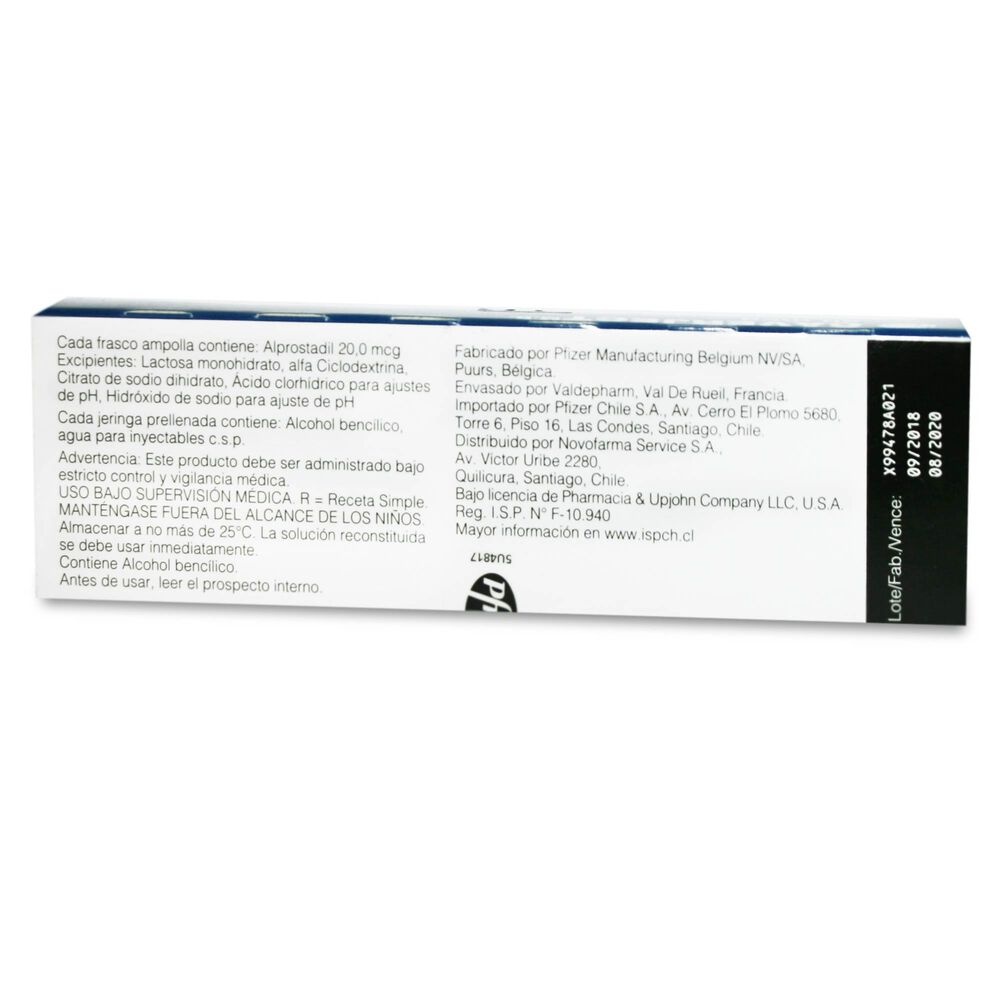
- País de registro
- Forma farmacéuticaINYECTABLE PERFUSION, 20µg
- Código ATCC01EA01
- Principio activo
- Requiere recetaSí
- Fabricante
- ComposiciónLACTOSA MONOHIDRATO (47.50 mg mg), ALFACICLODEXTRINA (646.70 µg mg)
- Esta información es de carácter general y no sustituye la consulta con un profesional sanitario.
- Alternativas a ALPROSTADIL ALTAN 20 MICROGRAMOS POLVO PARA SOLUCION PARA PERFUSION EFGForma farmacéutica: INYECTABLE PERFUSION, 500 mcg/mlPrincipio activo: AlprostadilFabricante: Pfizer S.L.Requiere recetaForma farmacéutica: INYECTABLE PERFUSION, 0,02 mg/mlPrincipio activo: AlprostadilFabricante: Kevelt AsRequiere recetaForma farmacéutica: INYECTABLE, 6 mg adenosina/2 mlPrincipio activo: AdenosinaFabricante: Sanofi Aventis S.A.Requiere receta
Médicos online para ALPROSTADIL ALTAN 20 MICROGRAMOS POLVO PARA SOLUCION PARA PERFUSION EFG
Comenta la dosis, los posibles efectos secundarios, interacciones, contraindicaciones o la revisión de receta de ALPROSTADIL ALTAN 20 MICROGRAMOS POLVO PARA SOLUCION PARA PERFUSION EFG, sujeto a valoración médica y a la normativa local.
Obtén una receta de ALPROSTADIL ALTAN 20 MICROGRAMOS POLVO PARA SOLUCION PARA PERFUSION EFG online
Rellena un formulario de 2 minutos
Cuéntanos tus síntomas, historial y el medicamento que necesitas.
Elige un médico o nosotros te asignamos uno
Escoge un especialista o te conectamos con el próximo médico disponible.
El médico revisa tu caso
Normalmente en 30 minutos. Puede hacerte preguntas adicionales por chat.
Recógela en cualquier farmacia
Receta electrónica enviada a tu correo, válida en toda España.
Preguntas frecuentes
ALPROSTADIL ALTAN 20 MICROGRAMOS POLVO PARA SOLUCION PARA PERFUSION EFG requiere receta en España. Puedes confirmarlo con un médico online según tu caso.
El principio activo de ALPROSTADIL ALTAN 20 MICROGRAMOS POLVO PARA SOLUCION PARA PERFUSION EFG es Alprostadil. Esta información ayuda a identificar medicamentos con la misma composición pero con diferentes nombres comerciales.
ALPROSTADIL ALTAN 20 MICROGRAMOS POLVO PARA SOLUCION PARA PERFUSION EFG es fabricado por Altan Pharmaceuticals Sa. La marca y el envase pueden variar según el distribuidor.
Los Médicos de familia, Psiquiatras, Dermatólogos, Cardiólogos, Endocrinólogos, Gastroenterólogos, Neumólogos, Nefrólogos, Reumatólogos, Hematólogos, Infectólogos, Alergólogos, Geriatras, Pediatras, Oncólogos pueden valorar la prescripción de ALPROSTADIL ALTAN 20 MICROGRAMOS POLVO PARA SOLUCION PARA PERFUSION EFG cuando esté clínicamente indicado. Puedes reservar una videoconsulta para comentar tu caso y las opciones de tratamiento.
España cuenta con una infraestructura sanitaria bien desarrollada en ciudades principales como Madrid, Barcelona, Valencia y Sevilla. Las farmacias están ampliamente disponibles y operan bajo estrictas regulaciones, garantizando el acceso a medicamentos con receta.
Puedes comprar ALPROSTADIL ALTAN 20 MICROGRAMOS POLVO PARA SOLUCION PARA PERFUSION EFG en Madrid, Barcelona, Sevilla o Valencia en cualquier farmacia local con una receta válida.
Para obtener una receta, puedes utilizar Oladoctor:
Otros medicamentos con el mismo principio activo (Alprostadil) incluyen ALPROSTADIL PFIZER 0,5 mg/ml SOLUCION INYECTABLE, VAZOSTENON 20 MICROGRAMOS/ML CONCENTRADO PARA SOLUCION PARA PERFUSION, ADENOCOR 6 mg/2 ml SOLUCION INYECTABLE. Pueden tener diferentes nombres comerciales o formulaciones, pero contienen el mismo componente terapéutico. Consulta siempre con un médico antes de cambiar o iniciar un nuevo medicamento.
