



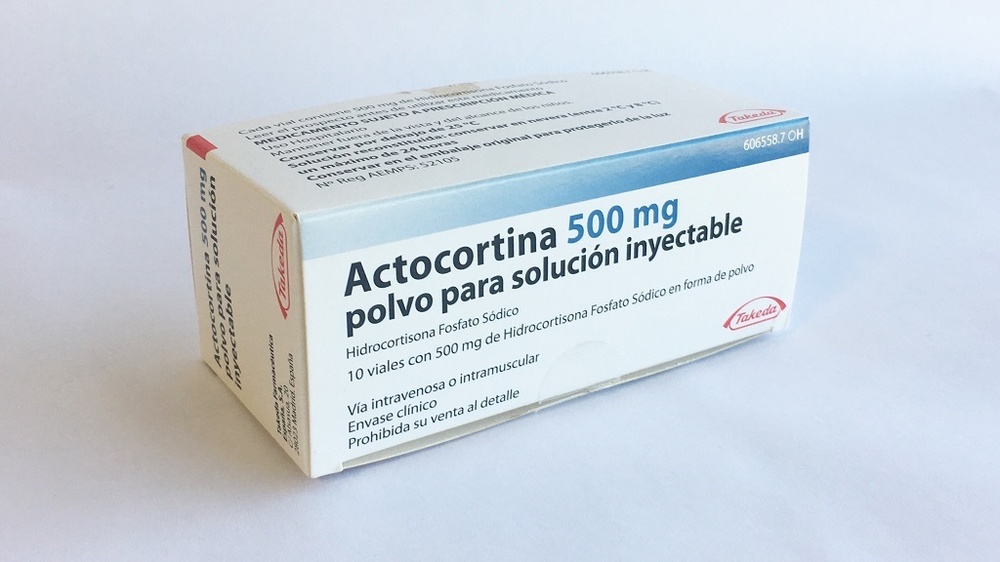
ACTOCORTINA 373 mg Solución Inyectable

Revisión de receta online
Un médico revisará tu caso y determinará si la prescripción es médicamente apropiada.

Habla con un médico sobre este medicamento
Comenta tus síntomas y las opciones de tratamiento en una consulta online.



Cómo usar ACTOCORTINA 373 mg POLVO PARA SOLUCIÓN INYECTABLE
Contenido del prospecto
- Introducción
- Qué es Actocortina y para qué se utiliza
- Qué necesita saber antes de empezar a usar Actocortina
- Cómo usar Actocortina
- Posibles efectos adversos
- Conservación de Actocortina
- Contenido del envase e información adicional
Introducción
Prospecto: información para el usuario
Actocortina 373 mg polvo para solución inyectable
hidrocortisona
Lea todo el prospecto detenidamente antes de empezar a usar el medicamento, porque contiene información importante para usted.
|
Contenido del prospecto
- Qué es Actocortina y para qué se utiliza
- Qué necesita saber antes de empezar a usar Actocortina
- Cómo usar Actocortina
- Posibles efectos adversos
5 Conservación de Actocortina
- Contenido del envase e información adicional
1. Qué es Actocortina y para qué se utiliza
Actocortina pertenece a un grupo de preparados hormonales denominado
corticoesteroides sistémicos y que actúan como potentes antiinflamatorios.
Actocortina sirve para el tratamiento de:
- exacerbaciones agudas de asma
- shock anafiláctico y reacciones agudas de hipersensibilidad inmediata que constituyan un peligro para la vida del paciente (Ej. angioedema, edema laríngeo)
- insuficiencia suprarrenal aguda
- tratamiento del rechazo agudo del trasplante de órganos
- coma hipotiroideo
- vasculitis necrosante
- artritis reumatoide
tenosinovitis y bursitis

¿No estás seguro de si este medicamento es adecuado para ti?
Comenta tus síntomas y tratamiento con un médico online.
2. Qué necesita saber antes de empezar a usar Actocortina
No use Actocortina
- si es alérgico al principio activo, otros esteroides o a cualquiera de los demás componentes de este medicamento (incluidos en la sección 6).
Exceptuando casos de urgencia, este medicamento no debe utilizarse en los siguiente casos por haber riesgo de empeoramiento. Esta decisión debe ser tomada por su médico:
- úlceras gástricas o duodenales
- enfermedades psiquiátricas conocidas, inestabilidad emocional, psicosis
- glaucoma
- queratitis herpética
- linfadenopatia consecutiva a la vacuna de tuberculosis
- infección por amebas u hongos
- poliomielitis
- enfermedades virales como varicela, herpes simple, herpes zoster
- tuberculosis latente o manifiesta
- durante el periodo pre y post-vacunal con vacunas de virus o bacterias vivas atenuadas (aproximadamente 8 semanas antes y 2 semanas después de la vacunación)
Advertencias y precauciones
Consulte a su médico o farmacéutico antes de empezar a usar Actocortina.
Deberá informar a su médico en caso de que sufra o haya sufrido alguno de los trastornos siguientes:
- insuficiencia renal
- insuficiencia cardíaca
- diabetes mellitus
- osteoporosis
- hipertensión
- glaucoma
- epilepsia
- patología psiquiátrica severa
- lesión muscular causada por tratamientos con esteroides
- enfermedades gastrointestinales como úlcera digestiva, colitis ulcerativa, ileitis, diverticulitis
- miastenia gravis
- poliomielitis
- insuficiencia hepática
- infección grave por hongos
- tuberculosis
- infección conocida o sospechada (vírica, bacteriana o amebiana).
- tumores linfoides preexistentes
- hiperparatiroidismo
- si tiene hiperactividad de la glándula tiroides (hipertiroidismo)
- hipotiroidismo
- malaria cerebral
Póngase en contacto con su médico si presenta visión borrosa u otras alteraciones visuales.
La inyección intravenosa rápida de altas dosis de Actocortina puede causar a veces problemas cardiacos agudos, por lo que las inyecciones deben ser administradas lentamente o mediante infusión.
Este medicamento produce un aumento del riesgo de sufrir infecciones y aumentar la gravedad de las mismas. Se recomienda descartar antes del inicio del tratamiento infecciones como varicela o sarampión. También puede aumentar el riesgo de infecciones oculares.
No deben administrarse vacunas de cepas vivas a pacientes en tratamiento con corticoides, y la respuesta a otro tipo de vacunas puede verse disminuida.
La terapia sistémica a largo plazo con Actocortina puede causar insuficiencia adrenal, síndrome de Cushing o niveles de azúcar desequilibrados en su cuerpo.
Actocortina puede causar trastornos mentales que incluyen euforia, insomnio, cambios de humor, cambios de personalidad, depresión y tendencias psicóticas. Esto puede ocurrir durante el inicio del tratamiento y durante los ajustes de dosis. Los riesgos pueden ser mayores cuando se administran dosis altas. La mayoría de las reacciones se resuelven después de la reducción de la dosis.
El tratamiento con altas dosis de Actocortina puede causar “diabetes esteroidea” benigna. Esto es reversible cuando se detiene la terapia. En los diabéticos, el tratamiento suele provocar una desregulación, que puede compensarse ajustando la dosis de insulina.
Póngase en contacto con su médico de inmediato si experimenta debilidad muscular, dolor muscular, calambres y rigidez mientras utiliza hidrocortisona. Pueden ser síntomas de una afección llamada parálisis periódica tirotóxica, que puede ocurrir en pacientes con hiperactividad de la glándula tiroides (hipertiroidismo) tratados con hidrocortisona. Puede que necesite un tratamiento adicional para aliviar esta afección.
Niños y adolescentes
Puede producir un retraso del crecimiento en la infancia y adolescencia que puede ser irreversible.
En prematuros puede provocar una cardiomiopatía hipertrófica. Si se administra hidrocortisona a un recién nacido prematuro, puede ser necesario controlar la función y la estructura del corazón.
Pacientes de edad avanzada
Este medicamento puede producir mayores consecuencias en este tipo de pacientes, como osteoporosis, hipertensión, hipocalemia, diabetes, mayor riesgo de infecciones, adelgazamiento de la piel. Se necesita mayor supervisión médica estrecha para evitar reacciones graves.
Otros medicamentos y Actocortina
Informe a su médico si está tomando/utilizando, ha tomado/utilizado recientemente o pudiera tener que tomar/utilizar cualquier otro medicamento.
Los siguientes medicamentos reducen el efecto terapéutico de Actocortina:
- rifampicina y rifabutina (fármacos utilizados en el tratamiento de infecciones por micobacterias como la tuberculosis)
- carbamacepina (fármaco utilizado en el tratamiento de trastornos maniaco-depresivos), barbitúricos (fenobarbital, fármaco utilizado en el tratamiento de la epilepsia)
- fenitoína (fármaco utilizado en el tratamiento de las convulsiones y crisis convulsivas)
- efedrina (fármaco con efecto broncodilatador)
- aminoglutetimida (fármaco utilizado en el tratamiento de tumores de la corteza suprarrenal)
- colestiramina y colestipol (fármacos utilizados para tratar la hipercolesterolemia)
- inductores de la CYP3A4 (p. ej. rifampicina, carbamazepina, fenitoina, dexametasona)
Los siguientes medicamentos pueden aumentar el efecto terapéutico de Actocortina:
- ciclosporina (medicamento para la inmunosupresión)
- anticonceptivos orales (p. ej. estrógenos)
- medicamentos para el tratamiento del VIH (ritonavir, cobicistat)
Actocortina reduce los efectos de los siguientes medicamentos:
- hipoglucemiantes (medicamentos utilizados en el tratamiento de la diabetes, incluida insulina)
- antihipertensivos (medicamentos utilizados para tratar la presión arterial elevada)
- diuréticos (medicamentos para aumentar la producción de orina)
- anticolinesterásicos (medicamentos utilizados para tratar la debilidad muscular y para diagnosticar cálculos biliares)
Actocortina puede aumentar los efectos de los siguientes medicamentos:
- acetazolamida, diuréticos del asa, anfotericina B y carbenoxolona (el tratamiento concomitante puede producir arritmias cardíacas subsecuentes)
- anticoagulantes cumarínicos (el tratamiento concomitante requiere una monitorización con objeto de evitar sangrado espontáneo)
- ciclosporina (medicamentos inmunosupresores)
Otras interacciones con medicamentos
Actocortina puede interaccionar con otros medicamentos, por lo que su médico le hará controles minuciosos si está tomando estos medicamentos.
Actocortina aumenta la toxicidad de los glucósidos digitálicos (p. ej. digoxina) y el riesgo de sangrado gastrointestinal y ulceración por el uso concomitante de medicamentos como la aspirina y antiinflamatorios no esteroideos (AINEs).
El uso concomitante de Actocortina con fluoroquinolonas (fármacos para tratar las infecciones bacterianas) pueden aumentar el riesgo de rotura de tendones.
Los corticosteroides pueden reducir los efectos de ciertos tipos de vacunas.
Uso de Actocortina con alimentos
El regaliz puede aumentar el riesgo de efectos secundarios de Actocortina.
Embarazo, lactancia y fertilidad
Si está embarazada o en periodo de lactancia, cree que podría estar embarazada o tiene intención de quedarse embarazada, consulte a su médico antes de utilizar este medicamento.
Embarazo
No se recomienda utilizar Actocortina durante el embarazo, ni en mujeres en edad fértil que no estén utilizando métodos anticonceptivos.
Lactancia
Actocortina se excreta en la leche materna. No se puede excluir un riesgo para el recién nacido o el lactante.
Su médico debe decidir si es necesario interrumpir la lactancia o interrumpir el tratamiento.
Conducción y uso de máquinas
No se han realizado estudios de los efectos sobre la capacidad para conducir y utilizar máquinas.
Análisis de drogas/control antidopaje
Se informa a los deportistas que este medicamento contiene un componente que puede establecer un resultado analítico de control del dopaje como positivo.
Actocortina contiene sodio
Este medicamento contiene 47,29 mg de sodio (componente principal de la sal de mesa/para cocinar) en cada vial. Esto equivale al 2,4% de la ingesta diaria máxima de sodio recomendada para un adulto.
3. Cómo usar Actocortina
Su médico decidirá el lugar de la inyección, la cantidad de medicamento y el número de inyecciones que se le ha de administrar dependiendo de la enfermedad a tratar y su gravedad. Su médico le administrará la dosis más baja durante el menor tiempo posible necesario para aliviar los síntomas.
Su médico u otro profesional sanitario le administrarán el tratamiento. El contenido del vial debe disolverse con agua de inyección, y se administrará mediante inyección intramuscular, intravenosa lenta, gota a gota o en perfusión continua.
La dosis recomendada es la siguiente:
Adultos
- Intravenosa o intramuscular:
En general el rango de la dosis única recomendada, aunque no está limitado, varía desde una fracción del contenido del vial (menos de 74,53 mg de hidrocortisona) hasta aproximadamente 372,65 mg de hidrocortisona administrada por inyección intravenosa lenta, durante un periodo de 1 a 10 minutos (para dosis de 372,65 mg o superiores). Esta dosis se puede repetir a intervalos de 2, 4 o 6 horas, dependiendo de la enfermedad a tratar y de la respuesta del paciente. Alternativamente, este medicamento se puede administrar como una perfusión intravenosa. Se observa un efecto clínico en dos a cuatro horas y persiste hasta ocho horas después de la inyección intravenosa. La misma dosis se puede administrar por inyección intramuscular, pero es probable que la respuesta sea menos rápida, especialmente en shock. No deben sobrepasarse los 6 g/día.
- Intraarticular y tejidos blandos (infiltración cuando se limita a una o dos localizaciones):La cantidad administrada depende del lugar de aplicación (articulaciones grandes: 19 mg; articulaciones pequeñas: 7,5 mg; bursas serosas, incluidos hallux valgus: 19-28 mg; vainas tendinosas: 4-9 mg; infiltración en tejidos blandos: 19-37,5 mg; gangliones: 9-19 mg).
Uso en niños
Aunque la dosis de Actocortina puede reducirse para lactantes y niños, se rige más por la gravedad del estado y la respuesta que por la edad o el peso corporal, pero no debe ser inferior a 25 mg diarios.
Pacientes de edad avanzada
Si usted usa Actocortina durante un tiempo prolongado tendrá un aumento del riesgo de diabetes, hipertensión, insuficiencia cardiaca congestiva, osteoporosis y depresión.
Se precisa una supervisión clínica estrecha con objeto de evitar reacciones que amenacen la vida.
Pacientes con función renal alterada
Si tiene problemas renales graves, el médico puede monotorizarle y puede ser necesario que ajuste la dosis.
Pacientes con función hepática alterada
Usted es más propenso a sufrir efectos no deseados graves. Pueden ser necesarios ajustes de las dosis.
Si usa más Actocortina del que debe
En tratamientos prolongados puede producirse un aumento en los niveles de cortisol en sangre que cede en algunos días con la supresión de la medicación.
No se han descrito casos de sobredosis. En caso de sobredosis o ingestión accidental consulte a su médico y/u hospital.
Si olvidó usar Actocortina
No tome una dosis doble para compensar las dosis olvidadas.
Si interrumpe el tratamiento con Actocortina
Su médico le indicará la duración de su tratamiento con Actocortina.
El tratamiento no debe suspenderse de forma brusca. Su médico le indicará como hacerlo ya que la retirada rápida de Actocortina tras un tratamiento prolongado puede dar lugar a complicaciones importantes como insuficiencia adrenal aguda, hipotensión, alteraciones hormonales o muerte.
Puede producirse también un “síndrome de abstinencia”, incluyendo fiebre, mialgia, artralgia, rinitis, conjuntivitis, nódulos cutáneos dolorosos /pruriginosos y pérdida de peso.

¿Has empezado a tomar el medicamento y tienes preguntas?
Comenta tus síntomas y tratamiento con un médico online.
4. Posibles efectos adversos
Al igual que todos los medicamentos, este medicamento puede producir efectos adversos, aunque no todas las personas los sufran.
Los efectos adversos de Actocortina dependen de la dosis, del momento de la administración y de la duración del tratamiento. Las reacciones adversas pueden ser minimizadas mediante el uso de la dosis efectiva más baja durante el menor tiempo posible.
Se han notificado las siguientes reacciones adversas de fármacos con hidrocortisona administrados a altas dosis o en indicaciones distintas de la terapia de reemplazo en insuficiencia suprarrenal, aunque se desconoce la frecuencia.
Órganos/ Sistemas | Frecuencia | Efecto adverso |
Infecciones e infestaciones | No conocida | aumento del riesgo de infecciones, infección por hongos de cándida, empeoramiento de infecciones de los ojos |
Trastornos de la sangre y del sistema linfático | No conocida | aumento de glóbulos blancos |
Trastornos del sistema inmunológico | No conocida | reacciones alérgicas |
Trastornos endocrinos | No conocida | síndrome de abstinencia (dolor de cabeza, náuseas, mareo, disminución del apetito, debilidad, cambios emocionales, alteración del nivel de consciencia y reacciones inapropiadas a situaciones de estrés), retraso en el crecimiento en niños, síndrome de Cushing principalmente caracterizado por una alteración en la disposición de la grasa (cara de luna, obesidad central, joroba de búfalo), trastorno de tiroides, manifestación de hiperparatiroidismo latente |
Trastornos del metabolismo y de la nutrición | No conocida | aumento del apetito, disminución del nivel de potasio y sodio, aumento de los cuerpos cetónicos en sangre, estado hiperglicémico hiperosmolar, síndrome de lisis del tumor, equilibrio ácido-base alterado en el cuerpo |
Trastornos psiquiátricos | No conocida | euforia, depresión, trastorno psicótico inducido por corticosteroides, insomnio, cambios del estado de ánimo, cambio de personalidad, manía |
Trastornos del sistema nervioso | No conocida | deposición de grasa alrededor de la médula espinal, aumento de la presión dentro del cráneo en niños con papiledema (más frecuente al retirar el medicamento), empeoramiento de epilepsia, tras la administración intravenosa puede aparecer sensación de hormigueo en algunas zonas del cuerpo que suele desaparecer en algunos minutos |
Trastornos oculares | No conocida | catarata, glaucoma, edema de la papila, cataratas subcapsulares posteriores, estrechamiento de la córnea o esclerótica, coriorretinopatía serosa central, visión borrosa |
Trastornos cardiacos | No conocida | empeoramiento de la insuficiencia cardiaca congestiva, trastorno del miocardio, arritmia, engrosamiento del músculo cardiaco (miocardiopatía hipertrófica) en recién nacidos prematuros |
Trastornos vasculares | No conocida | tromboembolismo, hipertensión, trombosis |
Trastornos gastrointestinales | No conocida | sensación de pesadez tras las comidas, úlcera gástrica o duodenal, inflamación de páncreas, inflamación de la mucosa gástrica, dolor en la parte superior del abdomen, malestar abdominal, nauseas |
Trastornos de la piel y del tejido subcutáneo | No conocida | atrofia de la piel, hematomas, aumento del vello, estrías, acné, dermatitis, aumento de la sudoración, descamación en una zona extensa de la piel mayor al 30% de la superficie del cuerpo (necrólisis epidérmica tóxica), erupción diseminada con ampollas y descamación de la piel que ocurre especialmente alrededor de la boca, nariz, ojos y genitales (síndrome de Steven-Johnson), enrojecimiento y picores |
Trastornos musculoesqueléticos y del tejido conjuntivo | No conocida | osteoporosis, fracturas de huesos, trastornos musculares, muerte del hueso, rotura e inflamación de tendones |
Trastornos renales y urinarios | No conocida | necesidad de orinar por la noche, piedras en el riñón |
Trastornos del aparato reproductor y de la mama | No conocida | irregularidades menstruales, incluyendo su ausencia |
Trastornos generales y alteraciones en el lugar de administración | No conocida | alteraciones en la cicatrización |
Exploraciones complementarias | No conocida | aumento de peso, disminución de las células de la sangre (eosinófilos y linfocitos), aumento de las células de la sangre (plaquetas), colesterol elevado en sangre, triglicéridos elevados en sangre, aumento de lipoproteínas, aumento de la presión ocular, alteraciones en el control de la diabetes |
Comunicación de efectos adversos
Si experimenta cualquier tipo de efecto adverso, consulte a su médico, incluso si se trata de posibles efectos adversos que no aparecen en este prospecto. También puede comunicarlos directamente a través del Sistema Español de Farmacovigilancia de Medicamentos de Uso Humano: https://www.notificaRAM.es. Mediante la comunicación de efectos adversos usted puede contribuir a proporcionar más información sobre la seguridad de este medicamento.
5. Conservación de Actocortina
Mantener fuera de la vista y del alcance de los niños.
No utilice este medicamento después de la fecha de caducidad que aparece en la etiqueta y la caja. La fecha de caducidad es el último día del mes que se indica.
Conservar por debajo de 25ºC. Conservar en el embalaje original para protegerlo de la luz.
Una vez reconstituida la disolución, deberá conservarse en el frigorífico (entre 2ºC y 8ºC) y no podrá utilizarse pasadas 24 horas desde la reconstitución.
Los medicamentos no se deben tirar por los desagües ni a la basura. Deposite los envases y los medicamentos que no necesita en el Punto SIGRE de la farmacia. En caso de duda pregunte a su farmacéutico cómo deshacerse de los envases y de los medicamentos que no necesita. De esta forma ayudará a proteger el medio ambiente.
6. Contenido del envase e información adicional
Composición de Actocortina
El principio activo es hidrocortisona fosfato sódico. Cada vial contiene 372,65 mg de hidrocortisona (equivalente a 500 mg de hidrocortisona fosfato sódico).
Aspecto de Actocortinay contenido del envase
Polvo de color blanco a color hueso. El polvo estéril se acondiciona en un vial de 10 ml de vidrio tipo I incoloro.
Cada envase contiene 10 viales
Titular de la autorización de comercialización
CHEPLAPHARM Arzneimittel GmbH
Ziegelhof 24
17489 Greifswald
Alemania
Responsable de la fabricación
B.BRAUN MEDICAL, S.A.
Ronda de los Olivares
Polígono Industrial Los Olivares
Parcela 11. 23009; Jaén
España
Representante local
Laboratorios Rubió, S.A.
Industria, 29 - Pol. Ind. Comte de Sert
08755 Castellbisbal (Barcelona)
España
Fecha de la última revisión de este prospecto:Agosto 2025
Otras fuentes de información
La información detallada y actualizada de este medicamento está disponible en la página Web de la Agencia Española de Medicamentos y Productos Sanitarios (AEMPS) http://www.aemps.gob.es
------------------------------------------------------------------------------------------------------------------
Esta información está destinada únicamente a profesionales sanitarios:
Disolver el contenido del vial con agua para inyección y administrar en inyección intramuscular, intravenosa lenta, gota a gota o en perfusión continua:
- Actocortina 373 mg con 5 ml de agua para inyección
En ausencia de estudios de compatibilidad, este medicamento no debe mezclarse con otros.
- País de registro
- Forma farmacéuticaINYECTABLE, 373 MG
- Código ATCH02AB09
- Principio activo
- Requiere recetaSí
- Fabricante
- Esta información es de carácter general y no sustituye la consulta con un profesional sanitario.
- Alternativas a ACTOCORTINA 373 mg POLVO PARA SOLUCIÓN INYECTABLEForma farmacéutica: INYECTABLE, 75 MGPrincipio activo: HidrocortisonaFabricante: Cheplapharm Arzneimittel GmbhRequiere recetaForma farmacéutica: CAPSULA, 0,5 mgPrincipio activo: HidrocortisonaFabricante: Diurnal Europe B.V.Requiere recetaForma farmacéutica: CAPSULA, 1 mgPrincipio activo: HidrocortisonaFabricante: Diurnal Europe B.V.Requiere receta
Médicos online para ACTOCORTINA 373 mg POLVO PARA SOLUCIÓN INYECTABLE
Comenta la dosis, los posibles efectos secundarios, interacciones, contraindicaciones o la revisión de receta de ACTOCORTINA 373 mg POLVO PARA SOLUCIÓN INYECTABLE, sujeto a valoración médica y a la normativa local.

Obtén una receta de ACTOCORTINA 373 mg POLVO PARA SOLUCIÓN INYECTABLE online
Rellena un formulario de 2 minutos
Cuéntanos tus síntomas, historial y el medicamento que necesitas.
Elige un médico o nosotros te asignamos uno
Escoge un especialista o te conectamos con el próximo médico disponible.
El médico revisa tu caso
Normalmente en 30 minutos. Puede hacerte preguntas adicionales por chat.
Recógela en cualquier farmacia
Receta electrónica enviada a tu correo, válida en toda España.
Preguntas frecuentes
ACTOCORTINA 373 mg POLVO PARA SOLUCIÓN INYECTABLE requiere receta en España. Puedes confirmarlo con un médico online según tu caso.
El principio activo de ACTOCORTINA 373 mg POLVO PARA SOLUCIÓN INYECTABLE es Hidrocortisona. Esta información ayuda a identificar medicamentos con la misma composición pero con diferentes nombres comerciales.
ACTOCORTINA 373 mg POLVO PARA SOLUCIÓN INYECTABLE es fabricado por Cheplapharm Arzneimittel Gmbh. La marca y el envase pueden variar según el distribuidor.
Los Médicos de familia, Psiquiatras, Dermatólogos, Cardiólogos, Endocrinólogos, Gastroenterólogos, Neumólogos, Nefrólogos, Reumatólogos, Hematólogos, Infectólogos, Alergólogos, Geriatras, Pediatras, Oncólogos pueden valorar la prescripción de ACTOCORTINA 373 mg POLVO PARA SOLUCIÓN INYECTABLE cuando esté clínicamente indicado. Puedes reservar una videoconsulta para comentar tu caso y las opciones de tratamiento.
España cuenta con una infraestructura sanitaria bien desarrollada en ciudades principales como Madrid, Barcelona, Valencia y Sevilla. Las farmacias están ampliamente disponibles y operan bajo estrictas regulaciones, garantizando el acceso a medicamentos con receta.
Puedes comprar ACTOCORTINA 373 mg POLVO PARA SOLUCIÓN INYECTABLE en Madrid, Barcelona, Sevilla o Valencia en cualquier farmacia local con una receta válida.
Para obtener una receta, puedes utilizar Oladoctor:
Otros medicamentos con el mismo principio activo (Hidrocortisona) incluyen ACTOCORTINA 75 MG POLVO Y DISOLVENTE PARA SOLUCION INYECTABLE, ALKINDI 0,5 MG GRANULADO EN CAPSULAS PARA ABRIR, ALKINDI 1 MG GRANULADO EN CAPSULAS PARA ABRIR. Pueden tener diferentes nombres comerciales o formulaciones, pero contienen el mismo componente terapéutico. Consulta siempre con un médico antes de cambiar o iniciar un nuevo medicamento.
