


Xenpozyme 4 mg injectable perfusión

Prescription review online
A doctor will review your case and decide whether a prescription is medically appropriate.

Talk to a doctor about this medicine
Discuss your symptoms and possible next steps in a quick online consultation.



How to use XENPOZYME 4 mg POWDER FOR CONCENTRATE FOR INFUSION SOLUTION
Contents of the leaflet
- Introduction
- What is Xenpozyme and what is it used for
- What you need to know before you are given Xenpozyme
- How Xenpozyme is given
- Possible side effects
- Storage of Xenpozyme
- Container Contents and Additional Information
Introduction
Package Leaflet: Information for the Patient
Xenpozyme 4mg powder for concentrate for solution for infusion
Xenpozyme 20mg powder for concentrate for solution for infusion
olipudase alfa
This medicine is subject to additional monitoring, which will allow for quicker identification of new safety information. You can help by reporting any side effects you may get. The last section of this leaflet includes information on how to report side effects.
Read all of this leaflet carefully before you start using this medicine because it contains important information for you.
- Keep this leaflet, you may need to read it again.
- If you have any further questions, ask your doctor or nurse.
- If you get any side effects, talk to your doctor or nurse. This includes any possible side effects not listed in this leaflet. See section 4.
Contents of the pack
- What is Xenpozyme and what is it used for
- What you need to know before you are given Xenpozyme
- How Xenpozyme is given
- Possible side effects
- Storage of Xenpozyme
- Contents of the pack and further information
1. What is Xenpozyme and what is it used for
What is Xenpozyme
Xenpozyme contains an enzyme called olipudase alfa.
What is Xenpozyme used for
Xenpozyme is used to treat a rare inherited disorder called acid sphingomyelinase deficiency (ASMD). It is used in children and adults with ASMD type A/B or B to treat the signs and symptoms of ASMD that are not related to the brain.
How Xenpozyme works
Patients with ASMD lack a working version of the enzyme acid sphingomyelinase. This leads to the build-up of a substance called sphingomyelin, which damages organs such as the spleen, liver, heart, lungs, and blood. Olipudase alfa works in the same way as the natural enzyme, acting as a substitute, reducing the build-up of sphingomyelin in organs and treating the signs and symptoms.

Not sure if this medicine is right for you?
Discuss your symptoms and treatment with a doctor online.
2. What you need to know before you are given Xenpozyme
Xenpozyme must not be given to you:
- If you have had a life-threatening allergic reaction (anaphylactic reaction) to olipudase alfa (see section “Warnings and precautions” below) or to any of the other ingredients of this medicine (listed in section 6).
Warnings and precautions
You may have side effects called infusion-associated reactions (IARs) that can be caused by the infusion (drip) of the medicine. These can occur while you are being given Xenpozyme or in the 24 hours after the infusion.
These can include allergic reactions (see section 4) and symptoms such as headache, raised and itchy rash (hives), fever, nausea, vomiting, and itchy skin.
If you think you are having an IAR, tell your doctor immediately.
If you have a severe allergic reaction during the infusion, your doctor will stop the infusion and give you the appropriate medical treatment. Your doctor will decide on the risks and benefits of giving you more doses of Xenpozyme.
If you have a mild or moderate IAR, your doctor or nurse may temporarily stop the infusion, reduce the infusion rate and/or reduce the dose.
Your doctor may also give you (or have given you) other medicines to prevent or control allergic reactions.
Your doctor will ask for blood tests to check how your liver is working (by measuring your liver enzyme levels) before starting treatment and then at regular intervals as the doses are adjusted (see section 3).
Other medicines and Xenpozyme
Tell your doctor or nurse if you are using, have recently used or might use any other medicines.
Pregnancy and breastfeeding
If you are pregnant or breastfeeding, think you may be pregnant or are planning to have a baby, ask your doctor or nurse for advice before using this medicine.
There is limited experience with the use of Xenpozyme in pregnant women. Xenpozyme may harm the unborn baby if taken by a pregnant woman. Xenpozyme should only be used during pregnancy if clearly necessary. Women who may become pregnant should use effective contraceptive methods during treatment and for 14 days after the last dose if Xenpozyme is interrupted.
It is not known whether Xenpozyme passes into human breast milk. Xenpozyme was detected in animal milk. If you are breastfeeding or plan to breastfeed, tell your doctor. Your doctor will then help you decide whether you must stop breastfeeding or stop Xenpozyme, considering the benefit of breastfeeding to the child and the benefit of Xenpozyme to the mother.
Driving and using machines
Xenpozyme may have a minor influence on your ability to drive and use machines, as you may experience a drop in blood pressure (which can make you feel dizzy).
Xenpozyme contains sodium
This medicine contains 0.60 mg of sodium (a major component of cooking/table salt) per 4 mg vial or 3.02 mg of sodium per 20 mg vial. This is equivalent to 0.03% and 0.15%, respectively, of the maximum recommended daily sodium intake for an adult or adolescent and < 0.08% and < 0.38%, respectively, of the maximum acceptable daily sodium intake for children under 16 years of age.
3. How Xenpozyme is given
Xenpozyme will be given to you as an infusion (drip) under the supervision of a healthcare professional with experience in the treatment of ASMD or other metabolic disorders.
The dose you receive is based on your body weight and will be given every 2 weeks.
Treatment starts with a low dose of the medicine, which is gradually increased.
The infusion usually lasts around 3 to 4 hours; but can be shorter or longer depending on your doctor's decision, and can be shorter during the period when your dose is being increased.
Adult patients
The recommended initial dose of Xenpozyme is 0.1 mg per kg of body weight. This is increased in a planned way with each subsequent dose, up to the recommended dose of 3 mg per kg of body weight every 2 weeks. It usually takes up to 14 weeks to reach the recommended dose, but this time may be longer depending on your doctor's decision.
Children
The recommended initial dose of Xenpozyme is 0.03 mg per kg of body weight. Subsequent doses should be increased in a planned way up to the recommended dose of 3 mg per kg of body weight every 2 weeks. It usually takes up to 16 weeks to reach the recommended dose, but this time may be longer depending on your doctor's decision.
Home infusion
Your doctor may consider infusing Xenpozyme at home if you are receiving a stable dose and are tolerating your infusions well. The decision to switch to home infusion should be made after evaluation and recommendation by your doctor. If you have a side effect during a Xenpozyme infusion, the person administering your infusion at home may stop the infusion and start the appropriate medical treatment.
Instructions for proper use
Xenpozyme is given by intravenous infusion (a drip into a vein). It is supplied as a powder that will be mixed with sterile water before administration.
If you are given too much Xenpozyme
Tell your doctor immediately if you suspect a change in your usual infusion.
If you miss an infusion of Xenpozyme
It is important that you receive your infusion every 2 weeks. You are considered to have missed an infusion if it is not given within 3 days after the scheduled infusion. Depending on the number of missed doses, your doctor may need to start again from a lower dose.
If you have missed an infusion or cannot attend a scheduled appointment, contact your doctor immediately.
If you have any further questions on the use of this medicine, ask your doctor or nurse.

Started taking the medicine and have questions?
Discuss your symptoms and treatment with a doctor online.
4. Possible side effects
Like all medicines, this medicine can cause side effects, although not everybody gets them.
Infusion-associated reactions (IARs) have been seen in patients while they were receiving the medicine or in the 24 hours after the infusion.
The most serious side effects can include severe allergic reactions, raised and itchy rash (hives), rash, increased liver enzymes, and irregular heartbeats.
You should tell your doctor immediately if you experience an IAR or an allergic reaction.
If you have an infusion reaction, you may be given additional medicines to treat or help prevent future reactions. If the infusion reaction is severe, your doctor may stop the Xenpozyme infusion and start appropriate medical treatment.
Very common (may affect more than 1 in 10 people):
- Headache
- Raised and itchy rash (hives)
- Fever - high body temperature Nausea
- Abdominal pain (stomach)
- Vomiting
- Itchy skin
- Muscle pain
- Rash
- Blood tests with increased values due to inflammation
- Pain in the upper abdomen
- Redness of the skin
Common (may affect up to 1 in 10 people):
- Red or itchy eyes
- Joint pain
- Fatigue
- Abnormal blood tests due to liver function
- Diarrhea
- Low blood pressure
- Breathing difficulties
- Abdominal discomfort
- Rash (different types of rash sometimes with itching)
- Back pain
- Pain
- Chills
- Feeling too hot
- Wheezing (breathing difficulties) Irritation of the throat and larynx
- Liver pain
- Skin lesions (such as raised or flat red-colored solid lesions)
- Bone pain
- Weakness
- Severe allergic reactions
- Eye discomfort
- Fast heartbeats
- Strong and fast or irregular heartbeats
- Throat and larynx constriction and swelling, rapid swelling under the skin in areas such as the face, throat, arms, and legs, which can be life-threatening if the swelling of the throat blocks the airways
- Reactions at the infusion site, including pain, itching, or swelling
- Abnormal blood tests due to inflammation
Reporting of side effects
If you experience any side effects, talk to your doctor or nurse. This includes any possible side effects not listed in this leaflet. You can also report side effects directly via the national reporting system listed in Appendix V. By reporting side effects, you can help provide more information on the safety of this medicine.
5. Storage of Xenpozyme
Keep this medicine out of the sight and reach of children.
Do not use Xenpozyme after the expiry date which is stated on the label and carton. The expiry date is the last day of the month stated.
Store in a refrigerator (2°C to 8°C).
After dilution, it is recommended to use immediately.
If not used immediately, the reconstituted solution can be stored for up to 24 hours at a temperature between 2°C and 8°C.
After dilution, the solution can be stored for up to 24 hours at a temperature between 2°C and 8°C, followed by 12 hours (including infusion time) at room temperature.
Medicines should not be disposed of via wastewater or household waste. Ask your doctor or nurse how to dispose of the packaging and any unused medicine. This will help protect the environment.
6. Container Contents and Additional Information
Xenpozyme Composition
The active ingredient is olipudase alfa. One vial contains 4 mg or 20 mg of olipudase alfa.
The other components are:
- L-methionine
- Sodium phosphate dibasic heptahydrate
- Sodium phosphate monobasic monohydrate
- Sucrose
See section 2 Xenpozyme contains sodium
Product Appearance and Container Contents
Xenpozyme is a powder for concentrate for solution for infusion in a vial (4 or 20 mg/vial).
The powder is a white to off-white lyophilized powder.
After mixing with sterile water, it is a clear and colorless solution. The solution should be further diluted before infusion.
Marketing Authorization Holder
Sanofi B.V., Paasheuvelweg 25, 1105 BP Amsterdam, Netherlands
Manufacturer
Genzyme Ireland Limited, IDA Industrial Park, Old Kilmeaden Road, Waterford, Ireland
For further information on this medicinal product, please contact the local representative of the marketing authorization holder:
Belgium/Belgique/Belgien Sanofi Belgium Tel: +32 (0)2 710 54 00 | Lithuania Swixx Biopharma UAB Tel: +370 5 236 91 40 |
Bulgaria Swixx Biopharma EOOD Tel: +359 (0)2 4942 480 | Luxembourg/Luxemburg Sanofi Belgium Tel: +32 (0)2 710 54 00 (Belgique/Belgien) |
Czech Republic sanofi-aventis, s.r.o. Tel: +420 233 086 111 | Hungary SANOFI-AVENTIS Zrt. Tel: +36 1 505 0050 |
Denmark Sanofi A/S Tel: +45 45 16 70 00 | Malta Sanofi S.r.l. Tel: +39 02 39394275 |
Germany Sanofi-Aventis Deutschland GmbH Tel: 0800 04 36 996 Tel from abroad: +49 69 305 70 13 | Netherlands Sanofi B.V. Tel: +31 20 245 4000 |
Estonia Swixx Biopharma OÜ Tel: +372 640 10 30 | Norway sanofi-aventis Norge AS Tel: +47 67 10 71 00 |
Greece Sanofi-Aventis Μονοπρ?σωπη AEBE Tel: +30 210 900 16 00 | Austria sanofi-aventis GmbH Tel: +43 1 80 185 – 0 |
Spain sanofi-aventis, S.A. Tel: +34 93 485 94 00 | Poland sanofi-aventis Sp. z o.o. Tel: +48 22 280 00 00 |
France Sanofi Winthrop Industrie Tel: 0 800 222 555 Call from abroad: +33 1 57 63 23 23 | Portugal Sanofi - Produtos Farmacêuticos, Lda Tel: +351 21 35 89 400 |
Croatia Swixx Biopharma d.o.o. Tel: +385 1 2078 500 | Romania Sanofi Romania SRL Tel: +40 (0) 21 317 31 36 |
Ireland sanofi-aventis Ireland Ltd. T/A SANOFI Tel: +353 (0) 1 403 56 00 | Slovenia Swixx Biopharma d.o.o. Tel: +386 1 235 51 00 |
Iceland Vistor ehf. Tel: +354 535 7000 | Slovakia Swixx Biopharma s.r.o. Tel: +421 2 208 33 600 |
Italy Sanofi S.r.l. Tel: 800 536389 | Finland Sanofi Oy Tel: +358 (0) 201 200 300 |
Cyprus C.A. Papaellinas Ltd. Tel: +357 22 741741 | Sweden Sanofi AB Tel: +46 (0)8 634 50 00 |
Latvia Swixx Biopharma SIA Tel: +371 6 616 47 50 |
Date of Last Revision of this Leaflet:
Other Sources of Information
Detailed information on this medicinal product is available on the European Medicines Agency website: http://www.ema.europa.eu. There are also links to other websites on rare diseases and orphan medicines.
This leaflet can be found in all languages of the European Union/European Economic Area on the European Medicines Agency website and on the website: www.xenpozyme.info.sanofi, or by scanning the QR code included below (also included on the outer packaging) with a smartphone.
<------------------------------------------------------------------------------------------------------------------------>
This information is intended only for healthcare professionals:
Preparation of the Solution for Administration
The powder for concentrate for solution for infusion should be reconstituted with sterile water for injections, diluted with sodium chloride 9 mg/ml (0.9%) solution for injection, and then administered by intravenous infusion.
The reconstitution and dilution steps should be completed under aseptic conditions. Filters should not be used at any time during the preparation of the infusion solution. Avoid foam formation during the reconstitution and dilution steps.
- Determine the number of vials to be reconstituted based on the individual patient's weight and prescribed dose.
Patient weight (kg) x dose (mg/kg) = patient dose (in mg). For example, when using 20 mg vials, patient dose (in mg) divided by 20 mg/vial = number of vials to reconstitute. If the number of vials includes a fraction, round up to the next whole number.
- Remove the required number of vials from the refrigerator and wait for approximately 20 to 30 minutes to allow them to reach room temperature.
- Reconstitute each vial by injecting:
1.1 ml of sterile water for injections into the 4 mg vial
5.1 ml of sterile water for injections into the 20 mg vial
using a slow drop-by-drop technique on the inner wall of the vial.
- Gently tilt and rotate each vial. Each vial should result in a clear and colorless solution of 4 mg/ml.
- Visually inspect the reconstituted solution in the vials for particles or discoloration. The Xenpozyme solution should be clear and colorless. Do not use any vial that shows opaque particles or discoloration.
- Withdraw the volume of reconstituted solution corresponding to the prescribed dose from the appropriate number of vials and dilute with sodium chloride 9 mg/ml (0.9%) solution for injection in a syringe or infusion bag, depending on the infusion volume (see Table 1 for the recommended total infusion volume based on patient age and/or weight).
Table 1: Recommended Infusion Volumes
Body weight ≥ 3 kg to <10 kg< p> | Body weight ≥ 10 kg to <20 kg< p> | Body weight ≥ 20 kg (pediatric patients <18 years)< p> | Adult patients (≥ 18 years) | |
Dose (mg/kg) | Total infusion volume (ml) | Total infusion volume (ml) | Total infusion volume (ml) | Total infusion volume (ml) |
0.03 | The variable volume will vary based on body weight | The variable volume will vary based on body weight | 5 | NP |
0.1 | The variable volume will vary based on body weight | 5 | 10 | 20 |
0.3 | 5 | 10 | 20 | 100 |
0.6 | 10 | 20 | 50 | 100 |
1.0 | 20 | 50 | 100 | 100 |
2.0 | 50 | 75 | 200 | 100 |
3.0 | 50 | 100 | 250 | 100 |
- For variable final infusion volumes based on body weight in pediatric patients (see Table 1):
- Prepare an infusion solution at 0.1 mg/ml by adding 0.25 ml (1 mg) of the reconstituted solution prepared in step 3) and 9.75 ml of sodium chloride 9 mg/ml (0.9%) solution for injection in an empty 10 ml syringe.
- Calculate the volume (ml) needed to achieve the patient dose (mg).
Example: 0.3 mg ÷ 0.1 mg/ml = 3 ml
- Dilution instructions for 5 ml ≤ total volume ≤ 20 ml using a syringe:
- Slowly inject the required volume of the reconstituted solution into the empty syringe.
- Slowly add sufficient sodium chloride 9 mg/ml (0.9%) solution for injection to achieve the required total infusion volume (avoid foam formation inside the syringe).
- Dilution instructions for a total volume ≥ 50 ml using an infusion bag:
- Empty infusion bag:
- Slowly inject the required volume of the reconstituted solution from step 3) into the sterile infusion bag of suitable size.
- Slowly add sufficient sodium chloride 9 mg/ml (0.9%) solution for injection to achieve the required total infusion volume (avoid foam formation inside the bag).
- Pre-filled infusion bag:
- Withdraw from the pre-filled infusion bag with sodium chloride 9 mg/ml (0.9%) solution for injection the volume of normal saline solution to achieve a final volume as specified in Table 1.
- Slowly add the required volume of the reconstituted solution from step 3) into the infusion bag (avoid foam formation inside the bag).
- Gently invert the syringe or infusion bag to mix. Do not shake. As this is a protein solution, occasional slight flocculation (described as thin translucent fibers) may occur after dilution.
- The diluted solution should be filtered through a 0.2 μm low protein-binding filter in-line during administration.
After completion of the infusion, the infusion line should be flushed with sodium chloride 9 mg/ml (0.9%) solution for injection using the same infusion rate as used in the last part of the infusion.
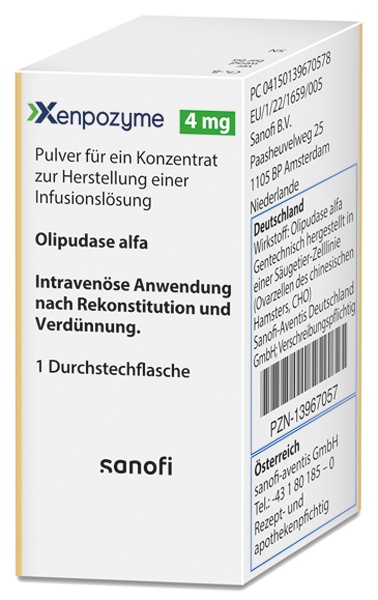
- Country of registration
- Dosage formINJECTABLE PERFUSION, 4 mg
- ATC codeA16AB25
- Active substance
- Prescription requiredYes
- Manufacturer
- CompositionHIDROGENOFOSFATO DE SODIO HEPTAHIDRATO (1,69 mg mg), DIHIDROGENO FOSFATO DE SODIO (1,88 mg mg), SACAROSA (50 mg mg)
- This information is for reference only and does not constitute medical advice. Always consult a doctor before taking any medication. Oladoctor is not responsible for medical decisions based on this content.
- Alternatives to XENPOZYME 4 mg POWDER FOR CONCENTRATE FOR INFUSION SOLUTIONDosage form: INJECTABLE PERFUSION, 20 mgActive substance: olipudase alfaManufacturer: Sanofi B.V.Prescription requiredDosage form: INJECTABLE INFUSION, 100 UActive substance: laronidaseManufacturer: Sanofi B.V.Prescription requiredDosage form: INJECTABLE PERFUSION, 30 mg/mlActive substance: cerliponase alfaManufacturer: Biomarin International LimitedPrescription required
Online doctors for XENPOZYME 4 mg POWDER FOR CONCENTRATE FOR INFUSION SOLUTION
Discuss questions about XENPOZYME 4 mg POWDER FOR CONCENTRATE FOR INFUSION SOLUTION, including use, safety considerations and prescription review, subject to medical assessment and local regulations.









Frequently Asked Questions
XENPOZYME 4 mg POWDER FOR CONCENTRATE FOR INFUSION SOLUTION requires a prescription in Spain. You can check with a doctor online whether this medicine may be appropriate for your situation.
The active ingredient in XENPOZYME 4 mg POWDER FOR CONCENTRATE FOR INFUSION SOLUTION is olipudase alfa. This information helps identify medicines with the same composition but different brand names.
XENPOZYME 4 mg POWDER FOR CONCENTRATE FOR INFUSION SOLUTION is manufactured by Sanofi B.V.. Pharmacy brands and packaging may differ depending on the distributor.
Doctors such as Family doctors, Psychiatrists, Dermatologists, Cardiologists, Endocrinologists, Gastroenterologists, Pulmonologists, Nephrologists, Rheumatologists, Hematologists, Infectious disease physicians, Allergists, Geriatricians, Paediatricians, Oncologists may assess whether XENPOZYME 4 mg POWDER FOR CONCENTRATE FOR INFUSION SOLUTION is appropriate, depending on your situation and local regulations. You can book an online consultation to discuss your symptoms and possible next steps.
The prescription is issued by a doctor after assessing your health. In Spain, XENPOZYME 4 mg POWDER FOR CONCENTRATE FOR INFUSION SOLUTION is then dispensed in pharmacies with that prescription. An online consultation does not guarantee that a prescription will be issued: the decision always rests with the doctor.
To request a review, you can use Oladoctor:
Other medicines with the same active substance (olipudase alfa) include XENPOZYME 20 mg POWDER FOR CONCENTRATE FOR INFUSION SOLUTION, ALDURAZYME, 100 U/mL Concentrate for Infusion Solution, BRINEURA 150 MG SOLUTION FOR INFUSION. These may have different brand names or formulations but contain the same therapeutic ingredient. Always consult a doctor before switching or starting a new medicine.
