


Tysabri 300 mg concentrate for infusion solution

Prescription request online
A doctor will review your case and decide whether a prescription is medically appropriate.

Talk to a doctor about this medicine
Discuss your symptoms and possible next steps in a quick online consultation.



How to use TYSABRI 300 mg CONCENTRATE FOR INFUSION SOLUTION
Contents of the leaflet
- Introduction
- What is Tysabri and what is it used for
- What you need to know before you receive Tysabri
- How Tysabri is administered
- Possible side effects
- Storage of Tysabri
- Package contents and additional information
Introduction
Package Leaflet: Information for the Patient
Tysabri 300mg concentrate for solution for infusion
Natalizumab
Read all of this leaflet carefully before you start using this medicine because it contains important information for you.
In addition to this leaflet, you will be given a patient information card. This contains important safety information that you should be aware of before you receive and during treatment with Tysabri.
- Keep this leaflet and the patient information card, as you may need to read them again. Keep the leaflet and the patient information card with you during treatment and for six months after the last dose of this medicine, as side effects can occur even after treatment has been stopped.
- If you have any further questions, ask your doctor.
- If you experience side effects, consult your doctor, even if they are not listed in this leaflet. See section 4.
Contents of the package leaflet:
- What is Tysabri and what is it used for
- What you need to know before you receive Tysabri
- How Tysabri is administered
- Possible side effects
- Storage of Tysabri
- Contents of the pack and further information
1. What is Tysabri and what is it used for
Tysabri is used to treat multiple sclerosis (MS). It contains the active substance natalizumab. It is what is called a monoclonal antibody.
MS causes inflammation in the brain that damages nerve cells. This inflammation occurs when white blood cells enter the brain and spinal cord. This medicine prevents white blood cells from entering the brain. This reduces nerve damage caused by MS.
Symptoms of multiple sclerosis
The symptoms of MS can vary from person to person; you may experience some or none.
They may include: problems with walking, tingling in the face, arms, or legs; vision problems; fatigue; feeling unsteady or dizzy; bladder and bowel problems; difficulty thinking and concentrating; depression; acute or chronic pain; sexual problems; muscle stiffness and spasms.
When symptoms worsen, it is called a relapse(also exacerbation or flare-up). When a relapse occurs, you may notice symptoms suddenly, within hours, or with a slow progression over several days. Symptoms usually improve gradually (this is called remission).
How Tysabri can help
In trials, this medicine reduced the increase in disability caused by MS by about half and reduced the number of MS relapses by about two-thirds. While you are being treated with this medicine, you may not notice any improvement, but it can continue to work to prevent MS from getting worse.

Not sure if this medicine is right for you?
Discuss your symptoms and treatment with a doctor online.
2. What you need to know before you receive Tysabri
Before starting treatment with this medicine, it is important that you and your doctor have discussed the benefits you can expect from this treatment and the risks associated with it.
Tysabri must not be administered to you
- If you are allergic to natalizumab or to any of the other ingredients of this medicine (listed in section 6).
- If you have been diagnosed with progressive multifocal leukoencephalopathy (PML). PML is a rare brain disease.
- If your immune systemhas a serious problem. This can be due to a disease (such as HIV infection) or medicines you are taking or have taken in the past (see below).
- If you are taking medicines that affect the immune system, including certain medicines used to treat MS. These medicines must not be used with Tysabri.
- If you have cancer(unless it is a type of skin cancer called basal cell carcinoma).
Warnings and precautions
Consult your doctorif Tysabri is the right treatment for you. Do this before starting to use Tysabri and when you have been receiving it for more than two years.
Possible brain infection (PML)
Some people who receive this medicine (less than 1 in 100) have had a rare brain infection called PML (progressive multifocal leukoencephalopathy). PML can cause severe disability or death.
- Before starting treatment, your doctor will perform a blood test on all patientsto detect JC virus infection. The JC virus is a common virus that usually does not make you sick. However, PML is associated with an increase in JC virus in the brain. The reason for this increase in some patients treated with Tysabri is not clear. Before and during treatment, your doctor will perform a blood test to check if you have antibodies against the JC virus (anti-JCV antibodies), which are a sign that you have been infected with the JC virus.
- Your doctor will perform an MRI scan, which will be repeated during treatment to rule out PML.
- Symptoms of PMLcan be similar to those of an MS relapse (see section 4, Possible side effects). You can also develop PML up to 6 months after stopping treatment with Tysabri.
Tell your doctor as soon as possibleif you notice that your MS is getting worse or if you notice any new symptoms while you are being treated with Tysabri or up to 6 months after.
- Tell your partner or caregiverswhat to look out for (see also section 4, Possible side effects). Some symptoms can be difficult to detect by yourself, such as mood or behavior changes, confusion, speech and communication difficulties. If you experience any of these, you may need to have more tests. Be aware of symptoms during the 6 months after stopping Tysabri.
- Keep the patient information card that your doctor has given you. It includes this information. Show it to your partner or caregivers.
Three things can increase the risk of PMLwith Tysabri. If you have two or more of these risk factors, the risk increases even more:
- If you have anti-JCV antibodiesin your blood. They are a sign that the virus is in your body. You will have tests before and during treatment with Tysabri.
- If you are receiving long-term treatmentwith Tysabri, especially if it is for more than two years.
- If you have taken a medicine known as animmunosuppressant, which reduces the activity of your immune system.
The JC virus also causes another condition, called JCV granule cell neuronopathy (JCV GCN), which has occurred in some patients receiving treatment with Tysabri. The symptoms of JCV GCN are similar to those of PML.
In the case of patients with a lower risk of PML, your doctor may repeat tests periodically to check:
- If you still do not have anti-JCV antibodies in your blood.
- If you have received treatment for more than 2 years, if you still have a lower level of anti-JCV antibodies in your blood.
If someone develops PML
PML can be treated and treatment with Tysabri will be stopped. However, some people develop a reaction when Tysabri is removed from the body. This reaction (known as IRIS or immune reconstitution inflammatory syndrome) can make your condition worse, including worsening of brain function.
Be aware of other infections
Some infections other than PML can also be serious and can be caused by viruses, bacteria, and other causes.
Tell your doctor or nurse immediatelyif you think you have an infection (see also section 4, Possible side effects).
Changes in platelet count in the blood
Natalizumab may reduce the number of platelets in the blood, which are responsible for blood clotting. This can lead to a disorder called thrombocytopenia (see section 4) by which your blood may not clot quickly enough to stop bleeding. This can cause bruising, as well as more serious problems such as excessive bleeding. Tell your doctor immediately if you have unexplained bruising, red or purple spots on the skin (called petechiae), bleeding from cuts in the skin that do not stop, prolonged bleeding from the gums or nose, blood in the urine or stool, or bleeding in the white part of the eyes.
Children and adolescents
Do not give this medicine to children or adolescents under 18 years of age.
Other medicines and Tysabri
Tell your doctor if you are using, have recently used, or might use any other medicines.
- You must notbe given this medicine if you are currently being treated with medicines that affect your immune system, including certain medicines for the treatment of MS.
- You may not be able to use this medicine if you have everreceived a medicine that affects the immune system.
Pregnancy and breastfeeding
- Do not use this medicine if you are pregnant, unless you have discussed it with your doctor. If you are pregnant, think you may be pregnant, or plan to become pregnant, tell your doctor immediately.
- Do not breastfeed while using Tysabri. Your doctor will help you decide whether to stop breastfeeding or stop using the medicine.
If you are pregnant or breastfeeding, think you may be pregnant, or plan to become pregnant, consult your doctor before using this medicine. Your doctor will consider the risk to the baby and the benefit to the mother.
Driving and using machines
Dizziness is a very common side effect. If you experience this symptom, do not drive or use machines.
Tysabri contains sodium
Each vial of this medicine contains 2.3 mmol (52 mg) of sodium. After dilution before use, the medicine contains 17.7 mmol (406 mg) of sodium per dose. You should take this into account if you are on a low-sodium diet.
3. How Tysabri is administered
Tysabri i.v. infusion should be administered to you by a doctor who has experience in the treatment of MS. Your doctor may switch you directly to Tysabri if no problems are seen with your previous treatment.
- Your doctor will request blood teststo detect anti-JCV antibodies and other possible problems.
- Your doctor will perform an MRI scan, which will be repeated during treatment.
- To switch from some MS medicines, your doctor may recommend that you wait for a certain time to make sure that most of the previous medicine has been removed from your body.
- The recommended dose for adults is 300 mg every four weeks.
- Tysabri must be diluted before it is administered to you. It is given through a drip into a vein (by intravenous infusion), usually in the arm. Administration takes about 1 hour.
- At the end of the leaflet, information is provided on how to prepare and administer the medicine intended for healthcare professionals.
If you stop treatment with Tysabri
It is important to continue administering Tysabri, especially during the first months of treatment. It is important that you continue treatment while you and your doctor decide that it is helping you. Patients who received one or two doses of Tysabri and then took a break in treatment of three months or more had a higher chance of having an allergic reaction when treatment was restarted.
Checking for allergic reactions
Some patients have had an allergic reaction to this medicine. Your doctor may check for allergic reactions during and 1 hour after the infusion. See also section 4, Possible side effects.
If you miss a dose of Tysabri
If you did not receive your usual dose of Tysabri, talk to your doctor to have it administered as soon as possible. After that, you can continue receiving Tysabri every four weeks.
Will Tysabri always work?
In some patients who receive Tysabri, the body's natural defenses can prevent the medicine from working properly over time as the body produces antibodies against the medicine. Your doctor may decide if this medicine is not working properly for you based on your blood tests and stop treatment if necessary.
If you have any other questions about the use of Tysabri, ask your doctor. Follow the instructions for administration of the medicine contained in this leaflet or given by your doctor. If you are unsure, ask your doctor.

Started taking the medicine and have questions?
Discuss your symptoms and treatment with a doctor online.
4. Possible side effects
Like all medicines, this medicine can cause side effects, although not everybody gets them.
Tell your doctor or nurse immediatelyif you notice any of the following symptoms.
Signs of brain infection
- Changes in personality and behavior such as confusion, delirium, or loss of consciousness
- Seizures (epileptic fits)
- Headache
- Nausea/vomiting
- Stiff neck
- Extreme sensitivity to light
- Fever
- Rash (on any part of the body)
These symptoms can be due to a brain infection (encephalitis or PML) or the lining that surrounds it (meningitis).
Signs of other serious infections
- Unexplained fever
- Severe diarrhea
- Shortness of breath
- Prolonged dizziness
- Headache
- Weight loss
- Lack of energy
- Changes in vision
- Pain or redness of the eye(s)
Signs of allergic reaction
- Hives (itchy rash)
- Swelling of the face, lips, or tongue
- Difficulty breathing
- Chest pain or discomfort
- Increased or decreased blood pressure (your doctor or nurse will notice if they are checking your blood pressure)
These are more likely to occur during or soon after the infusion.
Signs of possible liver problems
- Yellowing of the skin or the whites of the eyes
- Unusual darkening of the urine
- Abnormal liver function test
If you experience any of the side effects described above or if you think you have an infection, consult your doctor or nurse immediately. Show your patient information cardand this leaflet to any doctor or nurse who treats you, not just your neurologist.
Other side effects
Very common(may affect more than 1 in 10 people)
- Urinary tract infection
- Sore throat and congested or runny nose
- Headache
- Dizziness
- Feeling sick (nausea)
- Joint pain
- Fatigue
- Dizziness, feeling sick (nausea), itching, and chills during or soon after the infusion
Common(may affect up to 1 in 10 people)
- Anemia (reduced number of red blood cells that can make your skin pale and make you feel short of breath or lacking in energy)
- Allergic reaction (hypersensitivity)
- Chills
- Hives (itchy rash)
- Vomiting
- Fever
- Difficulty breathing (dyspnea)
- Redness of the face or body (flushing)
- Herpes virus infections
- Discomfort around the infusion site. You may have bruising, redness, pain, itching, or swelling
Uncommon(may affect up to 1 in 100 people)
- Severe allergic reaction (anaphylactic reaction)
- Progressive multifocal leukoencephalopathy (PML)
- Inflammatory disorder after stopping the medicine
- Swelling of the face
- Increased number of white blood cells (eosinophilia)
- Reduced number of platelets
- Easy bruising (purpura)
Rare(may affect up to 1 in 1,000 people)
- Herpes virus infection in the eye
- Severe anemia (reduced number of red blood cells that can make your skin pale and make you feel short of breath or lacking in energy)
- Severe swelling under the skin
- High levels of bilirubin in the blood (hyperbilirubinemia)that can cause symptoms such as yellowing of the eyes or skin, fever, and fatigue
Frequency not known(cannot be estimated from the available data)
- Rare infections (so-called "opportunistic infections")
- Liver damage
Tell your doctor as soon as possibleif you think you have an infection.
You will also find this information on the patient information card that your doctor has given you.
Reporting of side effects
If you experience any side effects, consult your doctor, even if they are not listed in this leaflet. You can also report side effects directly through the national reporting system listed in Appendix V. By reporting side effects, you can help provide more information on the safety of this medicine.
5. Storage of Tysabri
Keep this medicine out of the sight and reach of children.
Do not use this medicine after the expiry date which is stated on the label and carton. The expiry date is the last day of the month stated.
Unopened vial:
Store in a refrigerator.
Do not freeze.
Keep the vial in the outer packaging to protect it from light.
Diluted solution:
It is recommended to use the product immediately after dilution. If not, the diluted solution should be stored between 2°C and 8°C and infused within 24 hours after dilution.
Do not use this medicine if you notice particles or color changes in the liquid.
6. Package contents and additional information
Composition of Tysabri
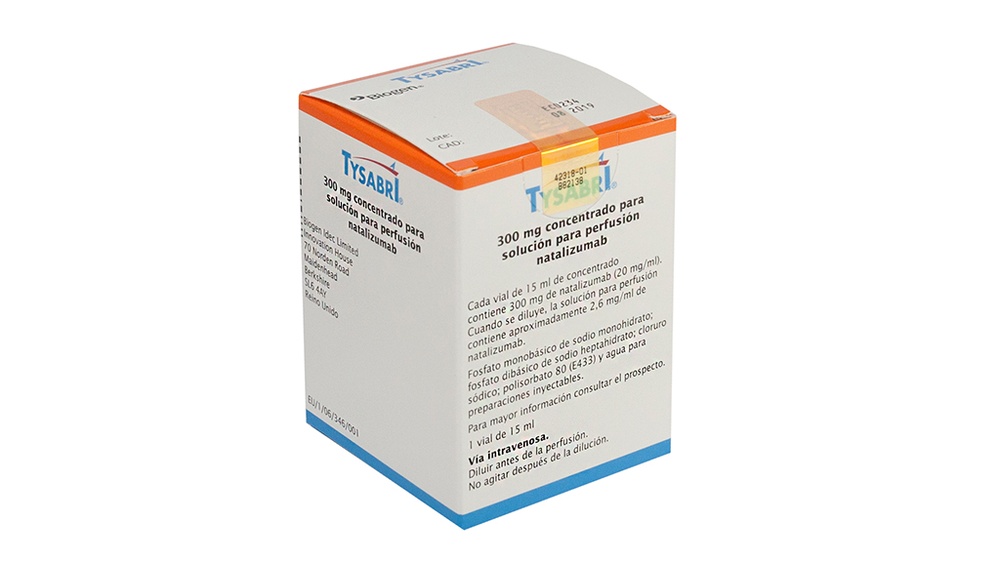
The active substance is natalizumab. Each 15 ml vial of concentrate contains 300 mg of natalizumab (20 mg/ml). When diluted, the solution for infusion contains approximately 2.6 mg per ml of natalizumab.
The other ingredients are:
Sodium monobasic phosphate monohydrate
Sodium dibasic phosphate heptahydrate
Sodium chloride (see section 2 “Tysabri contains sodium”)
Polysorbate 80 (E 433)
Water for injections
Appearance and package contents of the product
Tysabri is a clear or slightly turbid, colorless liquid.
Each carton contains one glass vial.
Marketing authorisation holder and manufacturer
Biogen Netherlands B.V.
Prins Mauritslaan 13
1171 LP Badhoevedorp
Netherlands
For further information about this medicine, please contact the local representative of the marketing authorisation holder:
België/Belgique/Belgien Biogen Belgium N.V./S.A. Tél/Tel: +32 2 219 12 18 | Lietuva Biogen Lithuania UAB Tel: +370 5 259 6176 |
| Luxembourg/Luxemburg Biogen Belgium N.V./S.A. Tél/Tel: +352 2 219 12 18 |
Ceská republika Biogen (Czech Republic) s.r.o. Tel: +420 255 706 200 | Magyarország Biogen Hungary Kft. Tel.: +36 (1) 899 9883 |
Danmark Biogen (Denmark) A/S Tlf.: +45 77 41 57 57 | Malta Pharma MT limited Tel: +356 213 37008/9 |
Deutschland Biogen GmbH Tel: +49 (0) 89 99 6170 | Nederland Biogen Netherlands B.V. Tel: +31 20 542 2000 |
Eesti Biogen Estonia OÜ Tel: +372 618 9551 | Norge Biogen Norway AS Tlf: +47 23 40 01 00 |
Ελλáδα Genesis Pharma SA Τηλ: +30 210 8771500 | Österreich Biogen Austria GmbH Tel: +43 1 484 46 13 |
España Biogen Spain SL Tel: +34 91 310 7110 | Polska Biogen Poland Sp. z o.o. Tel.: +48 22 351 51 00 |
France Biogen France SAS Tél: +33 (0)1 41 37 95 95 | Portugal Biogen Portugal Sociedade Farmacêutica Unipessoal, Lda Tel: +351 21 318 8450 |
Hrvatska Biogen Pharma d.o.o. Tel: +358 (0) 1 775 73 22 | România Johnson & Johnson Romania S.R.L. Tel: +40 21 207 18 00 |
Ireland Biogen Idec (Ireland) Ltd. Tel: +353 (0)1 463 7799 | Slovenija Biogen Pharma d.o.o. Tel: +386 1 511 02 90 |
Ísland Icepharma hf Sími: +354 540 8000 | Slovenská republika Biogen Slovakia s.r.o. Tel: +421 2 323 340 08 |
Italia Biogen Italia s.r.l. Tel: +39 02 584 9901 | Suomi/Finland Biogen Finland Oy Puh/Tel: +358 207 401 200 |
Κúπρος Genesis Pharma (Cyprus) Ltd Τηλ: +357 22 76 57 15 | Sverige Biogen Sweden AB Tel: +46 8 594 113 60 |
Latvija Biogen Latvia SIA Tel: +371 68 688 158 |
Date of last revision of this leaflet:09/2024
Other sources of information
Detailed information on this medicine is available on the European Medicines Agency website: https://www.ema.europa.eu.
──────────────────────
This information is intended only for healthcare professionals:
- Inspect the Tysabri vial for the absence of particles before dilution and administration. If particles are observed or if the liquid is not colorless and transparent or slightly opalescent, the vial should not be used.
- Use an aseptic technique to prepare the medicine. Remove the flip-off cap from the vial. Insert the needle of the syringe into the vial, through the center of the stopper, and aspirate 15 ml of concentrate for solution for infusion.
- Add the 15 ml of concentrate for solution for infusion to 100 ml of sodium chloride 9 mg/ml (0.9%) injection solution. Gently invert the solution to mix completely. Do not shake.
- Tysabri should not be mixed with other medicines or diluents.
- Visually inspect the diluted medicine for the absence of particles or color changes before administration. The diluted product should not be used if particles or color changes are observed.
- The diluted medicine should be used as soon as possible and within 24 hours after dilution. If the diluted medicine is stored between 2°C and 8°C (do not freeze), it should be allowed to reach room temperature before infusion.
- The diluted solution is intended for intravenous infusion over 1 hour, at an approximate rate of 2 ml per minute.
- After completion of the infusion, the intravenous infusion sets are flushed with sodium chloride 9 mg/ml (0.9%) injection solution.
- The vials are for single use.
- In order to improve the traceability of biological medicinal products, the name (Tysabri) and batch number of the administered product should be clearly recorded.
- Disposal of unused medicine and all materials that have come into contact with it should be done in accordance with local regulations.
- Country of registration
- Dosage formINJECTABLE PERFUSION, 20 mg
- ATC codeL04AG03
- Active substance
- Prescription requiredYes
- Manufacturer
- CompositionCLORURO DE SODIO (0 - mg), HIDROGENOFOSFATO DE SODIO HEPTAHIDRATO (0 - mg), FOSFATO DE SODIO MONOBASICO MONOHIDRATADO (0 - mg), POLISORBATO 80 (0 - mg)
- This information is for reference only and does not constitute medical advice. Always consult a doctor before taking any medication. Oladoctor is not responsible for medical decisions based on this content.
- Alternatives to TYSABRI 300 mg CONCENTRATE FOR INFUSION SOLUTIONDosage form: INJECTABLE PERFUSION, 300 mgActive substance: natalizumabManufacturer: Sandoz GmbhPrescription requiredDosage form: INJECTABLE, 150 mgActive substance: natalizumabManufacturer: Biogen Netherlands B.V.Prescription requiredDosage form: INJECTABLE PERFUSION, 120 mg (80 mg/kg) belimumabActive substance: belimumabManufacturer: Glaxosmithkline (Ireland) LimitedPrescription required
Online doctors for TYSABRI 300 mg CONCENTRATE FOR INFUSION SOLUTION
Discuss questions about TYSABRI 300 mg CONCENTRATE FOR INFUSION SOLUTION, including use, safety considerations and whether a prescription is appropriate, subject to medical assessment and local regulations.
Frequently Asked Questions
TYSABRI 300 mg CONCENTRATE FOR INFUSION SOLUTION requires a prescription in Spain. You can check with a doctor online whether this medicine may be appropriate for your situation.
The active ingredient in TYSABRI 300 mg CONCENTRATE FOR INFUSION SOLUTION is natalizumab. This information helps identify medicines with the same composition but different brand names.
TYSABRI 300 mg CONCENTRATE FOR INFUSION SOLUTION is manufactured by Biogen Netherlands B.V.. Pharmacy brands and packaging may differ depending on the distributor.
Doctors such as Family doctors, Psychiatrists, Dermatologists, Cardiologists, Endocrinologists, Gastroenterologists, Pulmonologists, Nephrologists, Rheumatologists, Hematologists, Infectious disease physicians, Allergists, Geriatricians, Paediatricians, Oncologists may assess whether TYSABRI 300 mg CONCENTRATE FOR INFUSION SOLUTION is appropriate, depending on your situation and local regulations. You can book an online consultation to discuss your symptoms and possible next steps.
The prescription is issued by a doctor after assessing your health. In Spain, TYSABRI 300 mg CONCENTRATE FOR INFUSION SOLUTION is then dispensed in pharmacies with that prescription. An online consultation does not guarantee that a prescription will be issued: the decision always rests with the doctor.
To request an assessment, you can use Oladoctor:
Other medicines with the same active substance (natalizumab) include TYRUKO 300 MG CONCENTRATE FOR INFUSION SOLUTION, TYSABRI 150 mg Injectable Solution in Pre-filled Syringe, BENLYSTA 120 mg POWDER FOR CONCENTRATE FOR SOLUTION FOR INFUSION. These may have different brand names or formulations but contain the same therapeutic ingredient. Always consult a doctor before switching or starting a new medicine.
