



TYGACIL 50 mg Powder For Solution For Infusion

Prescription review online
A doctor will review your case and decide whether a prescription is medically appropriate.

Talk to a doctor about this medicine
Discuss your symptoms and possible next steps in a quick online consultation.



How to use TYGACIL 50 mg POWDER FOR SOLUTION FOR INFUSION
Contents of the leaflet
- Introduction
- What Tygacil is and what it is used for
- What you need to know before you are given Tygacil
- How Tygacil is given
- Possible side effects
- Storage of Tygacil
- Contents of the pack and other information
Introduction
Package Leaflet: Information for the User
Tygacil 50mg powder for solution for infusion
tigecycline
Read all of this leaflet carefully before you are given this medicine because it contains important information for you or your child.
- Keep this leaflet, you may need to read it again.
- If you have any further questions, ask your doctor or nurse.
- If you get any side effects, talk to your doctor or nurse. This includes any possible side effects not listed in this leaflet. See section 4.
Contents of the pack
- What Tygacil is and what it is used for
- What you need to know before you are given Tygacil
- How Tygacil is given
- Possible side effects
- Storage of Tygacil
- Contents of the pack and other information
1. What Tygacil is and what it is used for
Tygacil is an antibiotic of the glycylcycline group that works by blocking the growth of the bacteria that causes the infection.
Your doctor has prescribed Tygacil for you or your child because you or your child is at least 8 years old and has one of the following severe types of infections:
- Complicated skin and soft tissue infections (the tissue under the skin), excluding diabetic foot infections.
- Complicated intra-abdominal infections.
Tygacil is only used when your doctor considers that other alternative antibiotics are not suitable.

Not sure if this medicine is right for you?
Discuss your symptoms and treatment with a doctor online.
2. What you need to know before you are given Tygacil
Do not use Tygacil
- If you are allergic to tigecycline or any of the other ingredients of this medicine (listed in section 6). If you are allergic to antibiotics of the tetracycline group (e.g. minocycline, doxycycline, etc.), you may also be allergic to tigecycline.
Warnings and precautions
Tell your doctor or nurse immediately before taking Tygacil:
- If you have poor or slow wound healing.
- If you have diarrhea before taking Tygacil. If you get diarrhea during or after treatment, tell your doctor immediately. Do not take any medicine for the treatment of diarrhea without consulting your doctor first.
- If you have or have had any side effects due to the use of antibiotics that belong to the tetracycline group (e.g. sensitivity of the skin to sunlight, staining of developing teeth, pancreatitis, and alteration of certain laboratory tests to measure if your blood clots properly).
- If you have or have had liver disorders. Depending on the condition of your liver, your doctor may reduce the dose to avoid possible side effects.
- If you have bile duct obstruction (cholestasis).
- If you have a bleeding disorder or are being treated with anticoagulant medications, as this medicine may interfere with blood clotting.
During treatment with Tygacil:
- Tell your doctor immediately if you develop symptoms of an allergic reaction.
- Tell your doctor immediately if you develop severe abdominal pain, nausea, and vomiting. These can be symptoms of acute pancreatitis (inflammation of the pancreas that can cause severe abdominal pain, nausea, and vomiting).
- In certain severe infections, your doctor may consider the need to use Tygacil in combination with other antibiotics.
- Your doctor will closely monitor you for the appearance of any other bacterial infection. If you contract another bacterial infection, your doctor may prescribe a different antibiotic, specific to the type of infection.
- Although antibiotics like Tygacil attack certain types of bacteria, other bacteria and fungi may continue to grow. This process is called overgrowth. Your doctor will closely monitor you to detect any possible infection and treat you if necessary.
Children
Tygacil should not be used in children under 8 years of age due to the lack of safety and efficacy data in this age group and because it may cause permanent dental defects, such as staining of developing teeth.
Using Tygacil with other medicines
Tell your doctor if you are using, have recently used, or might use any other medicines.
Tygacil may prolong certain tests that measure if your blood clots properly. It is important that you inform your doctor if you are taking certain medications to avoid excessive blood clotting (called anticoagulants). If so, your doctor will closely monitor you.
Tygacil may interfere with the contraceptive pill (birth control pill). Ask your doctor about the need to use an additional contraceptive method while receiving treatment with Tygacil.
Tygacil may increase the effect of medicines used to suppress the immune system (such as tacrolimus or cyclosporine). It is essential that you inform your doctor if you are taking these medicines so that you can be closely monitored.
Pregnancy and breastfeeding
Tygacil may cause harm to the fetus. If you are pregnant or breastfeeding, think you may be pregnant, or are planning to become pregnant, consult your doctor before using Tygacil.
It is not known if Tygacil passes into breast milk. Consult your doctor before starting breastfeeding.
Driving and using machines
Tygacil may cause side effects such as dizziness. This may reduce your ability to drive or use machines.
Tygacil contains sodium
This medicine contains less than 1 mmol of sodium (23 mg) per 5 ml of solution; it is essentially "sodium-free".
3. How Tygacil is given
Tygacil must be administered by a doctor or nurse.
The recommended dose of Tygacil in adults is an initial dose of 100 mg, followed by 50 mg every 12 hours. These doses are administered intravenously (directly into the bloodstream) over a period of 30 to 60 minutes.
The recommended dose in children from 8 to <12 years of age is 1.2 mg kg administered intravenously every 12 hours, up to a maximum dose 50 hours.< p>
The recommended dose for adolescents from 12 to <18 years of age is 50 mg administered every 12 hours.< p>
The normal duration of treatment is 5 to 14 days. Your doctor will decide the appropriate duration of treatment for you.
If you receive more Tygacil than you should
If you think you may have received more doses of Tygacil than you should, inform your doctor or nurse immediately.
If you miss a dose of Tygacil
If you are concerned about missing a dose, inform your doctor or nurse immediately.

Started taking the medicine and have questions?
Discuss your symptoms and treatment with a doctor online.
4. Possible side effects
Like all medicines, this product can cause side effects, although not everybody gets them.
Pseudomembranous colitis may occur with most antibiotics, including Tygacil. Pseudomembranous colitis is a severe, persistent, or bloody diarrhea associated with abdominal pain or fever, which can be a symptom of severe intestinal inflammation that can occur during or after treatment.
Very common side effects are (may affect more than 1 in 10 people):
- Nausea, vomiting, diarrhea.
Common side effects are (may affect up to 1 in 10 people):
- Abscesses (collection of pus), infections.
- Alterations in certain laboratory tests that indicate a decrease in the ability to clot blood.
- Dizziness.
- Irritation of the vein where the medicine is injected, including pain, inflammation, swelling, and clot formation.
- Abdominal pain, dyspepsia (stomach pain and feeling of indigestion), anorexia (loss of appetite).
- Increased liver enzymes, hyperbilirubinemia (excess bilirubin in the blood).
- Itching, skin rash.
- Poor or slow wound healing.
- Headache.
- Increased amylase, which is an enzyme present in the salivary glands and pancreas, increased blood urea nitrogen (BUN).
- Pneumonia.
- Low blood sugar levels.
- Sepsis (severe infection that affects the whole body and blood)/septic shock (life-threatening medical condition resulting from sepsis that can lead to multiple organ failure and death).
- Local reaction at the injection site (pain, redness, inflammation).
- Low protein levels in the blood.
Uncommon side effects are (may affect up to 1 in 100 people):
- Acute pancreatitis (inflammation of the pancreas that causes severe abdominal pain, nausea, and vomiting).
- Jaundice (yellowing of the skin), liver inflammation.
- Low platelet count in the blood (which can lead to an increased tendency to bleed and bruise).
Rare side effects are (may affect up to 1 in 1,000 people):
- Low fibrinogen levels in the blood (a protein involved in blood clotting).
Side effects of unknown frequency are (frequency cannot be estimated from the available data):
- Anaphylactic/anaphylactoid reactions (which can range from mild to severe, including a sudden and generalized allergic reaction that can lead to life-threatening shock [e.g., difficulty breathing, decreased blood pressure, rapid heartbeat]).
- Liver failure.
- Skin rash, which can lead to severe skin peeling (Stevens-Johnson syndrome).
Reporting of side effects
If you experience any side effects, talk to your doctor or nurse. This includes any possible side effects not listed in this leaflet. You can also report side effects directly to the Spanish Pharmacovigilance System for Human Use Medicines: https://www.notificaram.es. By reporting side effects, you can help provide more information on the safety of this medicine.
5. Storage of Tygacil
Keep this medicine out of the sight and reach of children.
Store below 25°C. Do not use this medicine after the expiry date stated on the vial. The expiry date is the last day of the month shown.
Storage after preparation
Once the powder has been reconstituted and diluted and is ready for use, it must be administered immediately.
The Tygacil solution should have a yellow to orange color after dissolution; if it does not, it should be discarded immediately.
Medicines should not be disposed of via wastewater or household waste. Ask your pharmacist how to dispose of medicines no longer required. This will help protect the environment.
6. Contents of the pack and other information
Composition of Tygacil
The active substance is tigecycline. Each vial contains 50 mg of tigecycline.
The other ingredients are lactose monohydrate, hydrochloric acid, and sodium hydroxide.
Appearance of Tygacil and pack contents
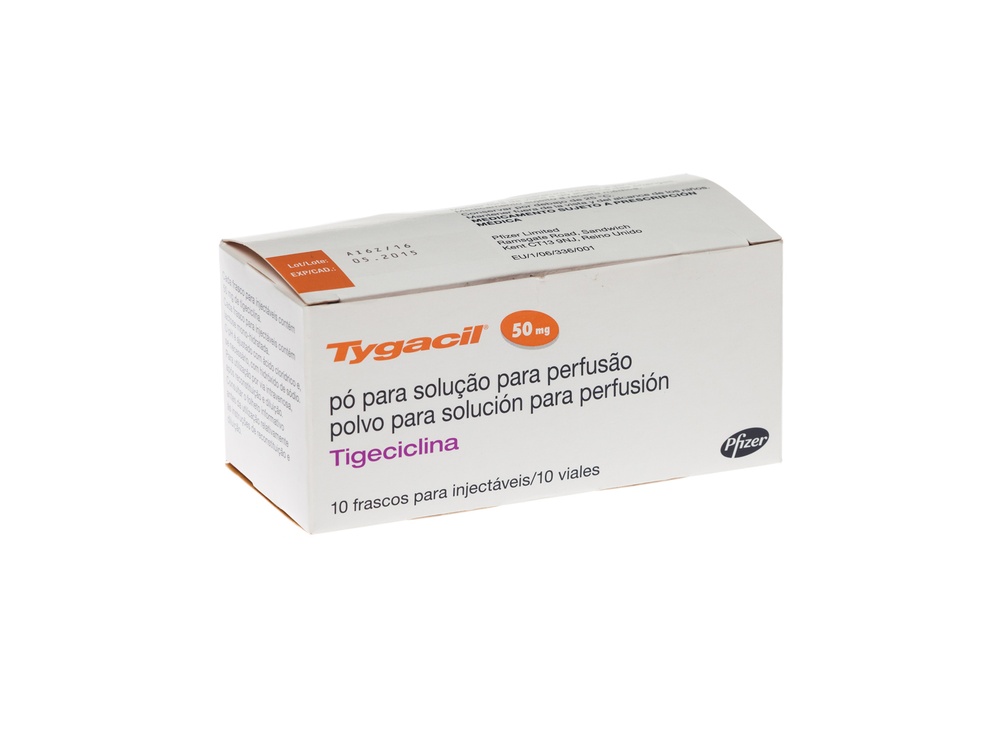
Tygacil is supplied as a powder for solution for infusion in vials containing orange powder or compact powder before dilution. Tygacil is marketed in packs of ten vials. The powder must be mixed in the vial with a small amount of solution. The vial must be gently shaken until the medicine is dissolved. Then, the solution must be immediately removed from the vial and added to a 100 ml intravenous infusion bag or other suitable hospital container for infusion.
Marketing authorisation holderManufacturer
Pfizer Europe MA EEIG Boulevard de la Plaine 17 1050 Brussels Belgium | Wyeth Lederle S.r.l. Via Franco Gorgone Z.I. 95100 Catania (CT) Italy |
You can request more information about this medicine from the local representative of the marketing authorisation holder:
Spain
Pfizer, S.L.
Tel: +34 91 490 99 00
Date of last revision of this leaflet
Detailed information on this medicine is available on the European Medicines Agency website: http://www.ema.europa.eu.
The following information is intended for healthcare professionals only:
Instructions for use and handling (see also section 3.of the leaflet "How to use Tygacil"):
The powder should be reconstituted with 5.3 ml of sodium chloride 9 mg/ml (0.9%) injection solution, dextrose 50 mg/ml (5%) injection solution, or Ringer's lactate injection solution to achieve a concentration of 10 mg/ml of tigecycline. The vial should be gently shaken until the active substance is dissolved. Then, 5 ml of the reconstituted solution should be immediately removed from the vial and added to a 100 ml intravenous infusion bag or other suitable container for infusion (e.g., glass bottle).
To obtain a dose of 100 mg, two vials should be reconstituted in a 100 ml intravenous infusion bag or other suitable container for infusion (e.g., glass bottle).
Note: The vial contains a 6% overdose. Thus, 5 ml of reconstituted solution is equivalent to 50 mg of active substance. The reconstituted solution should be yellow to orange in color; if it is not, the solution should be discarded. Parenteral products should be visually inspected for particulate matter or color change (e.g., green or black) before administration.
Tigecycline should be administered intravenously through a dedicated line or via a Y-line. If the same intravenous line is used for the sequential infusion of other active substances, the line should be flushed before and after the infusion of tigecycline with a sodium chloride 9 mg/ml (0.9%) injection solution or a dextrose 50 mg/ml (5%) injection solution. The infusion should be performed with a tigecycline-compatible infusion solution and any other medicine through this common line.
Compatible intravenous solutions include: sodium chloride 9 mg/ml (0.9%) injection solution, dextrose 50 mg/ml (5%) injection solution, and Ringer's lactate injection solution.
When administration is performed through a Y-line, the compatibility of tigecycline, diluted in sodium chloride for injection at 0.9%, has been verified with the following drugs or diluents: amikacin, dobutamine, dopamine HCl, gentamicin, haloperidol, Ringer's lactate, lidocaine HCl, metoclopramide, morphine, norepinephrine, piperacillin/tazobactam (EDTA formulation), potassium chloride, propofol, ranitidine HCl, theophylline, and tobramycin.
Tygacil should not be mixed with other medicines for which compatibility data are not available.
Once reconstituted and diluted in the bag or other suitable container for infusion (e.g., glass bottle), tigecycline should be used immediately.
This medicine should only be used for the administration of a single dose; any unused solution should be discarded.
- Country of registration
- Dosage formINJECTABLE PERFUSION, 50 mg
- ATC codeJ01AA12
- Active substance
- Prescription requiredYes
- Manufacturer
- This information is for reference only and does not constitute medical advice. Always consult a doctor before taking any medication. Oladoctor is not responsible for medical decisions based on this content.
- Alternatives to TYGACIL 50 mg POWDER FOR SOLUTION FOR INFUSIONDosage form: INJECTABLE PERFUSION, 50 mgActive substance: tigecyclineManufacturer: Accord Healthcare S.L.U.Prescription requiredDosage form: INJECTABLE PERFUSION, 50 mgActive substance: tigecyclineManufacturer: Hikma Farmaceutica (Portugal) S.A.Prescription requiredDosage form: INJECTABLE INFUSION, 50 mgActive substance: tigecyclineManufacturer: Noridem Enterprises LimitedPrescription required
Online doctors for TYGACIL 50 mg POWDER FOR SOLUTION FOR INFUSION
Discuss questions about TYGACIL 50 mg POWDER FOR SOLUTION FOR INFUSION, including use, safety considerations and prescription review, subject to medical assessment and local regulations.









Get TYGACIL 50 mg POWDER FOR SOLUTION FOR INFUSION Prescription Online
Fill in a 2-min form
Tell us your symptoms, history, and what medicine you're requesting.
Pick a doctor or let us assign
Choose a specialist or we'll match you with the next available doctor.
Doctor reviews your case
Usually within 30 minutes. They may ask follow-up questions via chat.
Collect from any pharmacy
Electronic prescription sent to your email — valid across Spain.
Frequently Asked Questions
TYGACIL 50 mg POWDER FOR SOLUTION FOR INFUSION requires a prescription in Spain. You can check with a doctor online whether this medicine may be appropriate for your situation.
The active ingredient in TYGACIL 50 mg POWDER FOR SOLUTION FOR INFUSION is tigecycline. This information helps identify medicines with the same composition but different brand names.
TYGACIL 50 mg POWDER FOR SOLUTION FOR INFUSION is manufactured by Pfizer Europe Ma Eeig. Pharmacy brands and packaging may differ depending on the distributor.
Doctors such as Family doctors, Psychiatrists, Dermatologists, Cardiologists, Endocrinologists, Gastroenterologists, Pulmonologists, Nephrologists, Rheumatologists, Hematologists, Infectious disease physicians, Allergists, Geriatricians, Paediatricians, Oncologists may assess whether TYGACIL 50 mg POWDER FOR SOLUTION FOR INFUSION is appropriate, depending on your situation and local regulations. You can book an online consultation to discuss your symptoms and possible next steps.
Spain has a well-developed healthcare infrastructure across major cities such as Madrid, Barcelona, Valencia, and Seville. Pharmacies are widely available and operate under strict regulations, ensuring access to prescribed medications.
You can buy TYGACIL 50 mg POWDER FOR SOLUTION FOR INFUSION in Madrid, Barcelona, Seville, or Valencia at any local pharmacy with a valid prescription.
To obtain a prescription, you can use Oladoctor:
Other medicines with the same active substance (tigecycline) include TIGECICLINE ACCORD 50 mg POWDER FOR SOLUTION FOR INFUSION, TIGECICLINE HIKMA 50 mg POWDER FOR SOLUTION FOR INFUSION, TIGECICLINE NORIDEM 50 mg POWDER FOR SOLUTION FOR INFUSION. These may have different brand names or formulations but contain the same therapeutic ingredient. Always consult a doctor before switching or starting a new medicine.
