



TRAZIMERA 150 mg Powder For Concentrate For Solution For Infusion

Prescription review online
A doctor will review your case and decide whether a prescription is medically appropriate.

Talk to a doctor about this medicine
Discuss your symptoms and possible next steps in a quick online consultation.



How to use TRAZIMERA 150 mg POWDER FOR CONCENTRATE FOR SOLUTION FOR INFUSION
Contents of the leaflet
- Introduction
- What is Trazimera and what is it used for
- What you need to know before you use Trazimera
- How to use Trazimera
- Possible side effects
- Storage of Trazimera
- Container Contents and Additional Information
Introduction
Package Leaflet: Information for the User
Trazimera150mg powder for concentrate for solution for infusion
Trazimera 420mg powder for concentrate for solution for infusion
trastuzumab
Read all of this leaflet carefully before you start using this medicine because it contains important information for you.
Keep this leaflet, you may need to read it again.
- Keep this leaflet, you may need to read it again.
- If you have any further questions, ask your doctor or pharmacist.
- If you get any side effects, talk to your doctor, pharmacist or nurse. This includes any possible side effects not listed in this leaflet. See section 4.
Contents of the pack
- What is Trazimera and what is it used for
- What you need to know before you use Trazimera
- How to use Trazimera
- Possible side effects
- Storage of Trazimera
- Contents of the pack and other information
1. What is Trazimera and what is it used for
Trazimera contains the active substance trastuzumab, which is a monoclonal antibody. Monoclonal antibodies recognise specific proteins or antigens. Trastuzumab is designed to bind selectively to an antigen called human epidermal growth factor receptor 2 (HER2). HER2 is found in large quantities on the surface of some cancer cells and stimulates the growth of these cells. When Trazimera binds to HER2, it stops the growth of these cells, leading to their death.
Your doctor may prescribe Trazimera for the treatment of breast or gastric cancer when:
- you have early breast cancer with high levels of a protein called HER2.
- you have metastatic breast cancer (breast cancer that has spread) with high levels of HER2. Trazimera may be prescribed in combination with chemotherapy medicines paclitaxel or docetaxel as a first treatment for metastatic breast cancer or it may be prescribed alone if other treatments have not been successful. It is also used in combination with other medicines called aromatase inhibitors in patients with high levels of HER2 and positive hormone receptor for metastatic breast cancer (cancer that is sensitive to female sex hormones).
- you have metastatic gastric cancer with high levels of HER2, and it is used in combination with other cancer medicines such as capecitabine or 5-fluorouracil and cisplatin.

Not sure if this medicine is right for you?
Discuss your symptoms and treatment with a doctor online.
2. What you need to know before you use Trazimera
Do not useTrazimeraif
- you are allergic to trastuzumab, to murine proteins (from mice) or to any of the other ingredients of this medicine (listed in section 6);
- you have severe respiratory problems at rest due to your tumour or if you need oxygen treatment.
Warnings and precautions
Your doctor will closely monitor your treatment.
Cardiac monitoring
Treatment with Trazimera alone or in combination with a taxane may affect the heart, especially if you have received an anthracycline (taxanes and anthracyclines are two types of medicines used to treat cancer) in the past. The effects can be moderate to severe and can be fatal. Therefore, you will need to have your heart function checked before, during (every 3 months) and after (for up to 2 to 5 years) treatment with Trazimera. If you develop any signs of heart failure, (the heart not pumping enough blood), your heart function will be checked more frequently (every 6 to 8 weeks), you may receive treatment for heart failure or you may need to stop treatment with Trazimera.
Tell your doctor, pharmacist or nurse before you are given Trazimera if:
- you have had heart failure, coronary artery disease, heart valve disease (heart murmur) or high blood pressure, have taken any medicine for high blood pressure or are currently taking any medicine for high blood pressure;
- you have received or are currently receiving a medicine called doxorubicin or epirubicin (medicines for treating cancer). These medicines (or any other anthracycline) can damage the heart muscle and increase the risk of having heart problems when treated with Trazimera;
- you feel short of breath, especially if you are currently receiving a taxane. Trazimera can cause difficulty breathing, especially when given for the first time. This could be more serious if you already have shortness of breath. In very rare cases, patients with severe breathing difficulties before treatment have died when given Trazimera;
- you have had any other cancer treatment in the past.
If you receive Trazimera with any other cancer medicine, such as paclitaxel, docetaxel, an aromatase inhibitor, capecitabine, 5-fluorouracil or cisplatin, you should also read the package leaflets for these medicines.
Children and adolescents
Trazimera is not recommended for children under 18 years of age.
Other medicines and Trazimera
Tell your doctor, pharmacist or nurse if you are using, have recently used or might use any other medicines.
It may take up to 7 months for Trazimera to be removed from the body. Therefore, if you are going to take any new medicine within the next 7 months after stopping treatment, you should tell your doctor, pharmacist or nurse that you have been treated with Trazimera.
Pregnancy
- If you are pregnant, think you may be pregnant or are planning to have a baby, ask your doctor, pharmacist or nurse for advice before using this medicine.
- You must use an effective method of contraception during treatment with Trazimera and for at least 7 months after finishing treatment.
- Your doctor will discuss the risks and benefits of taking Trazimera during pregnancy. In rare cases, a decrease in the fluid that surrounds the developing baby in the womb (amniotic fluid) has been seen in pregnant women given Trazimera. This can be harmful to the baby and has been associated with underdeveloped lungs, resulting in fetal death.
Breast-feeding
You must not breast-feed your baby during therapy with Trazimera and for 7 months after the last dose of Trazimera, as Trazimera may pass into your breast milk.
Ask your doctor or pharmacist for advice before taking any medicine.
Driving and using machines
Trazimera may affect your ability to drive a car or operate machines. If you experience symptoms such as dizziness, drowsiness, chills or fever during treatment, you should not drive or use machines until these symptoms have disappeared.
3. How to use Trazimera
Before starting treatment with Trazimera, your doctor will determine the amount of HER2 in your tumour. Only patients with a high amount of HER2 will be treated with Trazimera. Trazimera should only be administered by a doctor or nurse. Your doctor will prescribe a dose and treatment schedule suitable for you. The dose of Trazimera depends on your body weight.
The intravenous formulation of Trazimera is not for subcutaneous administration and should only be given by intravenous infusion.
The intravenous formulation of Trazimera is administered as an intravenous infusion directly into a vein. The first dose of your treatment is given over approximately 90 minutes and you will be observed by a healthcare professional while it is being given, in case you have any adverse reactions. If the initial dose is well tolerated, subsequent doses may be given over 30 minutes (see section 2 “Warnings and precautions”). The number of infusions you can receive depends on your response to treatment. Your doctor will discuss this with you.
To avoid medication errors, it is important to check the labels on the vials to ensure that the medicinal product being prepared and administered is Trazimera (trastuzumab) and not another product containing trastuzumab (e.g. trastuzumab emtansine or trastuzumab deruxtecan).
For early breast cancer, metastatic breast cancer and metastatic gastric cancer, Trazimera is given every 3 weeks. Trazimera may also be given once a week for metastatic breast cancer.
If you stop treatment with Trazimera
Do not stop treatment with this medicine without talking to your doctor first. All doses should be taken at the right time, every week or every 3 weeks (depending on your dosing schedule). This helps your medicine work properly.
It may take up to 7 months for Trazimera to be removed from your body. Therefore, your doctor may decide to continue checking your heart function even after you finish treatment.
If you have any further questions on the use of this product, ask your doctor, pharmacist or nurse.

Started taking the medicine and have questions?
Discuss your symptoms and treatment with a doctor online.
4. Possible side effects
Like all medicines, Trazimera can cause side effects, although not everybody gets them. Some of these side effects can be serious and may require hospitalisation.
During the infusion of Trazimera, you may experience chills, fever and other flu-like symptoms. This is very common (affects more than 1 in 10 people). Other infusion-related symptoms are: feeling sick (nausea), vomiting, pain, increased muscle tension and agitation, headache, dizziness, difficulty breathing, decreased or increased blood pressure, changes in heart rhythm (palpitations, arrhythmias or irregular heartbeat), swelling of the face and lips, rash and feeling tired. Some of these symptoms can be serious and some patients have died (see section 2 “Warnings and precautions”).
These effects usually occur during the first intravenous infusion and during the first few hours after the start of the infusion. They are usually temporary. A healthcare professional will monitor you during the infusion and for at least 6 hours after the start of the first infusion and for 2 hours after the start of subsequent infusions. If you have any reaction, the infusion may be given more slowly or the infusion may be stopped and you may be given treatment to counteract the side effects. The infusion may be continued once your symptoms have improved.
Occasionally, symptoms may start more than 6 hours after the start of the infusion. If this happens to you, contact your doctor immediately. Sometimes, symptoms may improve and then worsen later.
Serious side effects
Other side effects may occur at any time during treatment with Trazimera and not just related to the infusion. Tell your doctor or nurse if you get any of the following side effects:
- Heart problems can occur during treatment and occasionally after stopping treatment, and these can be serious. These include weakening of the heart muscle that can lead to heart failure, inflammation of the layer that surrounds the heart and changes in heart rhythm. This can cause symptoms such as shortness of breath (even when lying down), cough, fluid build-up in the legs or arms, palpitations (arrhythmias or irregular heartbeat) (see section 2 “Cardiac monitoring”)
Your doctor will regularly check your heart during and after treatment, but you should tell your doctor immediately if you notice any of the symptoms described above.
- Tumour lysis syndrome (a group of metabolic complications that occur after cancer treatment, characterised by high levels of potassium and phosphate in the blood and low levels of calcium in the blood). Symptoms can include kidney problems (weakness, shortness of breath, fatigue and confusion), heart problems (heart palpitations or a faster or slower heart rate). Seizures, vomiting or diarrhoea and tingling in the mouth, hands or feet.
If you experience any of these symptoms after your treatment with Trazimera has finished, you should contact your doctor and inform them that you have been previously treated with Trazimera.
Very common(affects more than 1 in 10 people):
- infections
- diarrhoea
- constipation
- heartburn (dyspepsia)
- fatigue
- skin rash
- chest pain
- abdominal pain
- joint pain
- low red blood cell and white blood cell counts (which help to fight infection) sometimes with fever
- muscle pain
- conjunctivitis
- tear production
- nosebleeds
- nasal discharge
- hair loss
- tremors
- hot flushes
- dizziness
- nail changes
- weight loss
- loss of appetite
- difficulty sleeping (insomnia)
- altered taste
- low platelet count
- bruising
- numbness or tingling in the fingers of the hands and feet, which can occasionally extend to the rest of the limb
- redness, swelling or ulcers in the mouth and/or throat
- pain, swelling, redness or tingling in the hands and/or feet
- difficulty breathing
- headache
- cough
- vomiting
- nausea
Common(affects up to 1 in 10 people):
- allergic reactions • dry eyes
- throat infections • sweating
- bladder and skin infections • feeling weak and unwell
lung problems • back pain
- skin rash with itching • neck pain
- feeling sleepy (somnolence) • bone pain
- haemorrhoids • acne
- itching • leg cramps
- dry mouth and skin
Uncommon(affects up to 1 in 100 people):
- deafness
- skin rash with blisters
- wheezing (whistling sound while breathing)
- inflammation/scarring of the lungs
Rare(affects up to 1 in 1,000 people):
- jaundice
- anaphylactic reactions
Frequency not known(cannot be estimated from the available data):
- abnormal blood clotting or coagulation problems
- high levels of potassium
- inflammation or bleeding in the back of the eyes
- shock
- abnormal heart rhythm
- difficulty breathing
- respiratory failure
- sudden accumulation of fluid in the lungs
- sudden narrowing of the airways
- abnormally low levels of oxygen in the blood
- difficulty breathing while lying down
- liver damage
- inflammation of the face, lips and throat
- kidney failure
- abnormally low levels of fluid surrounding the baby in the womb
- failure of the baby’s lungs to develop in the womb
- abnormal development of the baby’s kidneys in the womb
Some of the side effects you may experience may be due to your cancer. If you are given Trazimera in combination with chemotherapy, some of the side effects may also be due to the chemotherapy itself.
If you experience any side effects, tell your doctor, pharmacist or nurse.
Reporting of side effects
If you get any side effects, talk to your doctor, pharmacist or nurse. This includes any possible side effects not listed in this leaflet. You can also report side effects directly via the Spanish Medicines Monitoring System for Human Use: www.notificaRAM.es. By reporting side effects, you can help provide more information on the safety of this medicine.
5. Storage of Trazimera
Keep this medicine out of the sight and reach of children.
Do not use this medicine after the expiry date which is stated on the carton and on the label of the vial after EXP. The expiry date refers to the last day of the month shown.
Store in a refrigerator (2°C - 8°C).
Keep the vial in the outer carton in order to protect from light.
Unopened vials of Trazimera may be stored at a temperature of up to 30°C for a single period of up to 3 months. Once removed from refrigeration, Trazimera must not be returned to the refrigerator. Discard after this 3-month period or before the expiry date stated on the vial, whichever is earlier. Record the “discard after” date on the space provided on the carton.
Infusion solutions should be used immediately after dilution. Do not use this medicine if you notice any particles or discolouration before administration.
Medicines should not be disposed of via wastewater or household waste. Ask your pharmacist how to dispose of medicines no longer required. These measures will help to protect the environment.
6. Container Contents and Additional Information
CompositionofTrazimera
- The active ingredient is trastuzumab. A vial contains:
- 150 mg of trastuzumab which is dissolved in 7.2 ml of sterile water for injectable preparations, or
- 420 mg of trastuzumab which is dissolved in 20 ml of sterile water for injectable preparations.
The resulting solution contains approximately 21 mg/ml of trastuzumab.
- The other components are L-histidine hydrochloride monohydrate, L-histidine, sucrose, polysorbate 20 (E 432).
Appearance of the Product and Container Contents
Trazimera is a powder for concentrate for solution for infusion, which is presented in a glass vial with a rubber stopper containing 150 mg or 420 mg of trastuzumab. The powder is a white cake. Each container contains 1 vial of powder.
Marketing Authorization Holder
Pfizer Europe MA EEIG
Boulevard de la Plaine 17
1050 Brussels
Belgium
Manufacturer
Pfizer Manufacturing Belgium NV
Rijksweg 12
2870 Puurs-Sint-Amands
Belgium
You can request more information about this medicinal product by contacting the local representative of the marketing authorization holder.
Belgium/Belgique/Belgien Luxembourg/Luxemburg Pfizer NV/SA Tel: +32 (0)2 554 62 11 | Cyprus Pfizer Ελλάς A.E. (Cyprus Branch) Tel: +357 22817690 |
Czech Republic Pfizer, spol. s r.o. Tel: +420 283 004 111 | Hungary Pfizer Kft. Tel.: +36 1 488 37 00 |
Denmark Pfizer ApS Tlf.: +45 44 20 11 00 | Malta Drugsales Ltd Tel: +356 21419070/1/2 |
Germany PFIZER PHARMA GmbH Tel: +49 (0)30 550055-51000 | Netherlands Pfizer bv Tel: +31 (0)800 63 34 636 |
| Norway Pfizer AS Tlf: +47 67 52 61 00 |
Estonia Pfizer Luxembourg SARL Eesti filiaal Tel: +372 666 7500 | Austria Pfizer Corporation Austria Ges.m.b.H. Tel: +43 (0)1 521 15-0 |
Greece Pfizer Ελλάς A.E. Tel: +30 210 6785800 | Poland Pfizer Polska Sp. z o.o. Tel.: +48 22 335 61 00 |
Spain Pfizer, S.L. Tel: +34 91 490 99 00 | Portugal Laboratórios Pfizer, Lda. Tel: +351 21 423 5500 |
France Pfizer Tél: + 33 (0)1 58 07 34 40 | Romania Pfizer Romania S.R.L Tel: +40 (0) 21 207 28 00 |
Croatia Pfizer Croatia d.o.o. Tel: +385 1 3908 777 | Slovenia Pfizer Luxembourg SARL Pfizer, podružnica za svetovanje s podrocja farmacevtske dejavnosti, Ljubljana Tel: +386 (0)1 52 11 400 |
Ireland Pfizer Healthcare Ireland Unlimited Company Tel: +1800 633 363 (toll free) Tel: +44 (0)1304 616161 | Slovakia Pfizer Luxembourg SARL, organizacná zložka Tel: +421 2 3355 5500 |
Iceland Icepharma hf. Sími: +354 540 8000 | Finland Pfizer Oy Puh/Tel: +358 (0)9 430 040 |
Italy Pfizer S.r.l. Tel: +39 06 33 18 21 | Sweden Pfizer AB Tel: +46 (0)8 550 520 00 |
Latvia Pfizer Luxembourg SARL filiale Latvija Tel: +371 670 35 775 | |
Lithuania Pfizer Luxembourg SARL filialas Lietuvoje Tel: +370 5 251 4000 |
Date of Last Revisionof this Leaflet:12/2024
Other Sources of Information
Detailed information on this medicinal product is available on the European Medicines Agency website: https://www.ema.europa.eu
This leaflet can be found in all languages of the European Union/European Economic Area on the European Medicines Agency website.
This information is intended for healthcare professionals only:
Trazimera for intravenous use is provided in single-use sterile vials, free from preservatives and non-pyrogenic.
To avoid medication errors, it is essential to check the labels of the vials to ensure that the medicinal product being prepared and administered is Trazimera (trastuzumab) and not another product containing trastuzumab (e.g., trastuzumab emtansine or trastuzumab deruxtecan).
Always keep this medicinal product in its original closed container at a temperature of 2°C – 8°C in the refrigerator.
Unopened Trazimera vials may be stored at a temperature up to 30°C for a single period of up to 3 months. Once removed from refrigerated storage, Trazimera must not be returned to the refrigerator. Discard at the end of this 3-month period or before the expiry date stated on the vial, whichever is earlier. Record the "discard after" date in the space provided on the carton.
After aseptic dilution in sodium chloride 9 mg/ml (0.9%) injectable solution, Trazimera solutions for intravenous infusion are physically and chemically stable for up to 30 days at 2°C – 8°C and for up to 24 hours at temperatures not exceeding 30°C.
From a microbiological point of view, the reconstituted and infusion solution of Trazimera should be used immediately. If not used immediately, the storage time before use and storage conditions are the responsibility of the user and, in general, should not exceed 24 hours at 2°C – 8°C unless the reconstitution and dilution are performed under controlled and validated aseptic conditions.
Adequate aseptic methods should be used for the reconstitution and dilution procedures. Care should be taken to ensure the sterility of the prepared solutions. Since the medicinal product does not contain antimicrobial preservatives or bacteriostatic agents, aseptic technique must be used.
Storage, handling, and aseptic preparation:
Aseptic handling should be ensured when preparing the infusion. The preparation should be:
- performed under aseptic conditions by trained personnel in accordance with good practices, especially for the aseptic preparation of parenteral products.
- followed by adequate storage of the prepared intravenous infusion solution to ensure maintenance of aseptic conditions.
If the prepared solution is intended to be stored for more than 24 hours before use, then the reconstitution and dilution procedure should be performed in a laminar flow cabinet or a biological safety cabinet using standard precautions for safe handling of intravenous agents.
A vial of Trazimera reconstituted aseptically with water for injectable preparations (not supplied) is chemically and physically stable for 48 hours at 2°C – 8°C after reconstitution and should not be frozen.
Trazimera 150 mg powder for concentrate for solution for infusion
Adequate aseptic methods should be used. Each 150 mg vial of Trazimera is reconstituted with 7.2 ml of sterile water for injectable preparations (not supplied). The use of other solvents for reconstitution should be avoided. This produces a 7.4 ml single-dose solution containing approximately 21 mg/ml of trastuzumab. A 4% overfill allows the labeled dose of 150 mg to be withdrawn from each vial.
Trazimera 420 mg powder for concentrate for solution for infusion
Adequate aseptic methods should be used. Each 420 mg vial of Trazimera is reconstituted with 20 ml of sterile water for injectable preparations (not supplied). The use of other solvents for reconstitution should be avoided. This produces a 20.6 ml single-dose solution containing approximately 21 mg/ml of trastuzumab. A 5% overfill allows the labeled dose of 420 mg to be withdrawn from each vial.
Trazimera vial | Volume of sterile water for injectable preparations | Final concentration | ||
150 mg vial | + | 7.2 ml | = | 21 mg/ml |
420 mg vial | + | 20 ml | = | 21 mg/ml |
Trazimera should be handled carefully during reconstitution. If excessive foam is formed during reconstitution or the reconstituted Trazimera is shaken, it may cause problems with the amount of Trazimera that can be withdrawn from the vial.
Instructions for aseptic reconstitution:
- Using a sterile syringe, slowly inject the appropriate volume (as indicated above) of sterile water for injectable preparations into the vial containing the Trazimera lyophilized powder.
- Gently swirl in a circular motion to aid reconstitution. DO NOT SHAKE!
Formation of a slight foam after reconstitution is usual. Allow the vial to stand for approximately 5 minutes. Reconstituted Trazimera is a clear, colorless to pale yellow-brown solution and should be essentially free from visible particles.
The required volume of solution will be determined:
- based on the initial dose of 4 mg of trastuzumab/kg body weight or subsequent weekly doses of 2 mg of trastuzumab/kg body weight:
Volume(ml) = Body Weight(kg) x Dose(4mg/kg initial dose or 2mg/kg for subsequent doses)
21(mg/ml, concentration of the reconstituted solution)
- based on the initial dose of 8 mg of trastuzumab/kg body weight or doses every three weeks of 6 mg of trastuzumab/kg body weight
Volume(ml) = Body Weight(kg) x Dose(8mg/kg initial dose or 6mg/kg for subsequent doses)
21(mg/ml, concentration of the reconstituted solution)
The appropriate amount of solution should be withdrawn from the vial using a sterile needle and syringe and added to an intravenous infusion bag made of polyvinyl chloride, polyethylene, polypropylene, or ethylene-vinyl acetate, or into a glass bottle for intravenous infusion, containing 250 ml of 9 mg/ml (0.9%) sodium chloride injectable solution. It should not be used with solutions containing glucose. The bag or bottle should be inverted several times to mix the solution and avoid foam formation. Parenteral solutions should be inspected visually for particles and discoloration before administration.
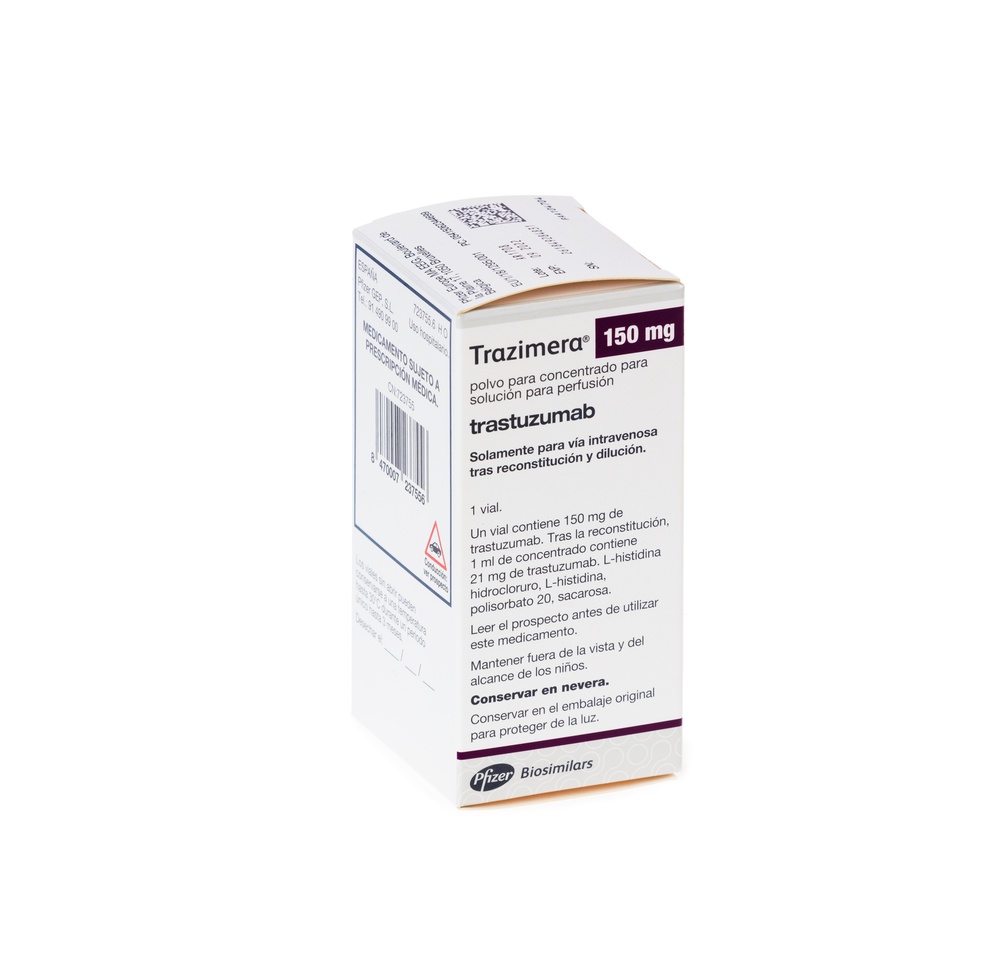
- Country of registration
- Dosage formINJECTABLE PERFUSION, 150 mg
- ATC codeL01FD01
- Active substance
- Prescription requiredYes
- Manufacturer
- CompositionPOLISORBATO 20 (0,6 mg mg), SACAROSA (138 mg mg)
- This information is for reference only and does not constitute medical advice. Always consult a doctor before taking any medication. Oladoctor is not responsible for medical decisions based on this content.
- Alternatives to TRAZIMERA 150 mg POWDER FOR CONCENTRATE FOR SOLUTION FOR INFUSIONDosage form: INJECTABLE INFUSION, UnknownActive substance: trastuzumabManufacturer: Roche Registration GmbhPrescription requiredDosage form: INJECTABLE, 600 mg/5 mlActive substance: trastuzumabManufacturer: Roche Registration GmbhPrescription requiredDosage form: INJECTABLE PERFUSION, 150 mgActive substance: trastuzumabManufacturer: Celltrion Healthcare Hungary Kft.Prescription required
Online doctors for TRAZIMERA 150 mg POWDER FOR CONCENTRATE FOR SOLUTION FOR INFUSION
Discuss questions about TRAZIMERA 150 mg POWDER FOR CONCENTRATE FOR SOLUTION FOR INFUSION, including use, safety considerations and prescription review, subject to medical assessment and local regulations.
Get TRAZIMERA 150 mg POWDER FOR CONCENTRATE FOR SOLUTION FOR INFUSION Prescription Online
Fill in a 2-min form
Tell us your symptoms, history, and what medicine you're requesting.
Pick a doctor or let us assign
Choose a specialist or we'll match you with the next available doctor.
Doctor reviews your case
Usually within 30 minutes. They may ask follow-up questions via chat.
Collect from any pharmacy
Electronic prescription sent to your email — valid across Spain.
Frequently Asked Questions
TRAZIMERA 150 mg POWDER FOR CONCENTRATE FOR SOLUTION FOR INFUSION requires a prescription in Spain. You can check with a doctor online whether this medicine may be appropriate for your situation.
The active ingredient in TRAZIMERA 150 mg POWDER FOR CONCENTRATE FOR SOLUTION FOR INFUSION is trastuzumab. This information helps identify medicines with the same composition but different brand names.
TRAZIMERA 150 mg POWDER FOR CONCENTRATE FOR SOLUTION FOR INFUSION is manufactured by Pfizer Europe Ma Eeig. Pharmacy brands and packaging may differ depending on the distributor.
Doctors such as Family doctors, Psychiatrists, Dermatologists, Cardiologists, Endocrinologists, Gastroenterologists, Pulmonologists, Nephrologists, Rheumatologists, Hematologists, Infectious disease physicians, Allergists, Geriatricians, Paediatricians, Oncologists may assess whether TRAZIMERA 150 mg POWDER FOR CONCENTRATE FOR SOLUTION FOR INFUSION is appropriate, depending on your situation and local regulations. You can book an online consultation to discuss your symptoms and possible next steps.
Spain has a well-developed healthcare infrastructure across major cities such as Madrid, Barcelona, Valencia, and Seville. Pharmacies are widely available and operate under strict regulations, ensuring access to prescribed medications.
You can buy TRAZIMERA 150 mg POWDER FOR CONCENTRATE FOR SOLUTION FOR INFUSION in Madrid, Barcelona, Seville, or Valencia at any local pharmacy with a valid prescription.
To obtain a prescription, you can use Oladoctor:
Other medicines with the same active substance (trastuzumab) include HERCEPTIN 150 mg POWDER FOR CONCENTRATE FOR SOLUTION FOR INFUSION, HERCEPTIN 600 mg INJECTABLE SOLUTION IN VIAL, HERZUMA 150 mg POWDER FOR CONCENTRATE FOR SOLUTION FOR INFUSION. These may have different brand names or formulations but contain the same therapeutic ingredient. Always consult a doctor before switching or starting a new medicine.
