



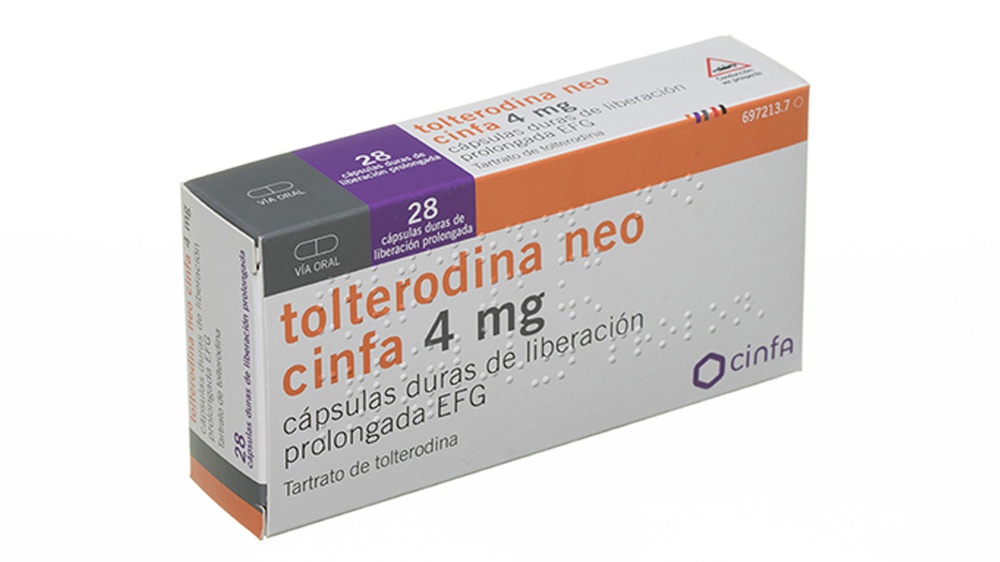
TOLTERODINA 4 mg Prolonged-Release Hard Capsules

Prescription review online
A doctor will review your case and decide whether a prescription is medically appropriate.

Talk to a doctor about this medicine
Discuss your symptoms and possible next steps in a quick online consultation.



How to use TOLTERODINE NEO CINFA 4 mg PROLONGED-RELEASE HARD CAPSULES
Contents of the leaflet
- Introduction
- What is tolterodine neo cinfa and what is it used for
- What you need to know before taking tolterodine neo cinfa
- How to take tolterodine neo cinfa
- Possible side effects
- Storage of tolterodine neo cinfa
- Package contents and additional information
Introduction
Package Leaflet: Information for the User
tolterodine neo cinfa 4 mg prolonged-release hard capsules EFG
Tolterodine tartrate
Read the entire package leaflet carefully before starting to take this medication, as it contains important information for you.
- Keep this package leaflet, as you may need to read it again.
- If you have any questions, consult your doctor or pharmacist.
- This medication has been prescribed to you only, and you should not give it to others, even if they have the same symptoms as you, as it may harm them.
- If you experience side effects, consult your doctor or pharmacist, even if they are not listed in this package leaflet. See section 4.
Contents of the Package Leaflet
- What is tolterodine neo cinfa and what is it used for
- What you need to know before taking tolterodine neo cinfa
- How to take tolterodine neo cinfa
- Possible side effects
- Storage of tolterodine neo cinfa
- Package contents and additional information
1. What is tolterodine neo cinfa and what is it used for
The active substance of tolterodine neo cinfa is tolterodine tartrate. Tolterodine is a medication that belongs to the group of medications called antimuscarinics.
Tolterodine neo cinfa is used to treat the symptoms of overactive bladder syndrome.
If you have overactive bladder syndrome, you may notice that:
- You are unable to control urination voluntarily.
- You feel a sudden and urgent need to urinate without prior warning and/or that the number of times you urinate during the day increases.

Not sure if this medicine is right for you?
Discuss your symptoms and treatment with a doctor online.
2. What you need to know before taking tolterodine neo cinfa
Do not take tolterodine neo cinfa
- If you are allergic to tolterodine tartrate or any of the other components of this medication (listed in section 6).
- If you are unable to empty your bladder (urinary retention).
- If you have uncontrolled narrow-angle glaucoma (high intraocular pressure with loss of vision, which is not being treated properly).
- If you have myasthenia gravis (excessive muscle weakness).
- If you have severe ulcerative colitis (ulceration and inflammation in the colon).
- If you have toxic megacolon (acute dilation of the colon).
Warnings and precautions
- If you have difficulty urinating and/or urinate with a weak or slow stream.
- If you have a gastrointestinal disorder that affects the passage and/or digestion of food.
- If you have kidney problems (renal insufficiency).
- If you have liver disease.
- If you have neuronal disorders that affect your blood pressure, intestinal function, or sexual function (any autonomic nervous system neuropathy).
- If you have a hiatal hernia (hernia in an abdominal organ).
- If you ever notice a decrease in bowel movements or have severe constipation (decreased gastrointestinal motility).
- If you have any relevant heart conditions, such as:
- abnormal heart rhythm (ECG)
- slow heart rate (bradycardia)
- pre-existing heart conditions, such as:
- cardiomyopathy (weakness in the heart muscle)
- myocardial ischemia (decreased blood flow to the heart)
- arrhythmia (irregular heart rhythm)
- heart failure
- If you have abnormally low blood levels of potassium (hypokalemia), calcium (hypocalcemia), or magnesium (hypomagnesemia).
Consult your doctor or pharmacist before starting to take tolterodine neo cinfa.
Taking tolterodine neo cinfa with other medications
Tolterodine tartrate, the active substance of tolterodine neo, may interact with other medications. It is not recommended to use tolterodine in combination with:
- Certain antibiotics (e.g., erythromycin and clarithromycin).
- Medications used to treat fungal infections (e.g., ketoconazole and itraconazole).
- Medications for the treatment of HIV.
Tolterodine neo should be used with caution when administered in combination with:
- Certain medications that affect food transit (e.g., metoclopramide and cisapride).
- Medications for the treatment of irregular heart rhythm (e.g., amiodarone, sotalol, quinidine, and procainamide)
- Other medications that have a similar mechanism of action to tolterodine (antimuscarinic properties) or medications that have an opposite mechanism of action to tolterodine neo (cholinergic properties). Consult your doctor if you are unsure.
Inform your doctor or pharmacist if you are taking, have recently taken, or may need to take other medications, including those obtained without a prescription.
Taking tolterodine neo cinfa with food and drinks
Tolterodine neo can be taken before, during, or after a meal.
Pregnancy and breastfeeding
If you are pregnant or breastfeeding, think you may be pregnant, or plan to become pregnant, consult your doctor or pharmacist before taking this medication.
Pregnancy
You should not use tolterodine neo if you are pregnant.
Breastfeeding
It is unknown whether tolterodine is excreted in breast milk. The use of tolterodine neo is not recommended during breastfeeding.
Consult your doctor or pharmacist before using any medication.
Driving and using machines
Tolterodine neo may make you feel dizzy, tired, or affect your vision; your ability to drive or operate machinery may be impaired.
tolterodine neo cinfa contains lactose
This medication contains lactose. If your doctor has told you that you have an intolerance to certain sugars, consult with them before taking this medication.
tolterodine neo cinfa contains sodium
This medication contains less than 23 mg of sodium (1 mmol) per capsule; it is essentially "sodium-free".
3. How to take tolterodine neo cinfa
Dose:
Follow the administration instructions for this medication exactly as indicated by your doctor. If you are unsure, consult your doctor or pharmacist again.
The recommended dose is one 4 mg capsule per day, except in patients with liver or kidney disease, or bothersome side effects, in which case your doctor may reduce your dose to 2 mg per day.
The use of tolterodine neo is not recommended in children.
Tolterodine neo is taken orally. The capsules should be swallowed whole. Do not chew the capsules.
If you take more tolterodine neo cinfa than you should
If you or anyone else takes too many prolonged-release capsules, consult your doctor or pharmacist immediately.
In case of overdose or accidental ingestion, consult your doctor or pharmacist immediately or call the Toxicology Information Service, phone 91 562 04 20, indicating the medication and the amount ingested.
If you forget to take tolterodine neo cinfa
If you forget to take a dose, take it as soon as you can. However, if it is almost time for your next dose, wait for the next dose and take it at the usual time. In this case, continue taking the capsules as directed by your doctor.
Do not take a double dose to make up for forgotten doses.
If you stop taking tolterodine neo cinfa
Your doctor will indicate the duration of your treatment with tolterodine neo. Do not stop treatment before if you do not see an immediate effect, as your bladder needs time to adapt to it. Complete the treatment with the prolonged-release capsules prescribed by your doctor. If you do not notice any effect, consult your doctor.
The benefit of treatment should be reevaluated after 2-3 months of use. Always consult your doctor if you are thinking of stopping treatment.
If you have any other questions about the use of this medication, ask your doctor or pharmacist.

Started taking the medicine and have questions?
Discuss your symptoms and treatment with a doctor online.
4. Possible side effects
Like all medications, this medication can cause side effects, although not everyone will experience them.
You should consult your doctor immediately if you notice symptoms of angioedema, such as:
- Swelling of the face, tongue, or pharynx.
- Difficulty swallowing.
- Hives and difficulty breathing.
In addition, you should seek medical attention if you experience a hypersensitivity reaction (e.g., itching, rash, hives, and difficulty breathing). This occurs rarely (may affect up to 1 in 100 patients).
Inform your doctor or pharmacist if you experience:
- Chest pain, difficulty breathing or tiredness (even at rest), difficulty breathing at night, swelling of the legs.
- These may be symptoms of heart failure. This occurs rarely (may affect up to 1 in 100 patients).
The following side effects have been observed during treatment with tolterodine, with the following frequencies:
Very common side effects(may affect more than 1 in 10 patients):
- Dry mouth
- Headache
Common side effects(may affect up to 1 in 10 patients):
- Bronchitis
- Dizziness, drowsiness, finger cramps
- Dry eyes, blurred vision
- Vertigo
- Palpitations
- Difficulty digesting (dyspepsia), constipation, abdominal pain, excessive gas in the stomach or intestines, vomiting.
- Dry skin
- Difficulty urinating, inability to empty the bladder
- Tiredness, chest pain, swelling due to fluid accumulation (e.g., in the ankles)
- Weight gain
Uncommon side effects(may affect up to 1 in 100 patients):
- Allergic reactions
- Nervousness
- Finger cramps
- Increased heart rate, heart failure, irregular heartbeat
- Heartburn
- Memory impairment
Additional reactions reported include severe allergic reactions, confusion, hallucinations, increased heart rate, red skin, and angioedema, and disorientation. Cases of worsening dementia symptoms have been reported in patients being treated for dementia.
If you consider any of the side effects you are experiencing to be serious or if you notice any side effect not mentioned in this package leaflet, inform your doctor or pharmacist.
Reporting side effects
If you experience any type of side effect, consult your doctor or pharmacist, even if it is not listed in this package leaflet. You can also report them directly through the Spanish Medication Surveillance System for Human Use: https://www.notificaram.es. By reporting side effects, you can contribute to providing more information on the safety of this medication.
5. Storage of tolterodine neo cinfa
Keep this medication out of the sight and reach of children.
Do not use this medication after the expiration date stated on the packaging after CAD. The expiration date is the last day of the month indicated.
Do not store above 25°C.
Medications should not be disposed of through wastewater or household waste. Deposit the packaging and medications you no longer need at the pharmacy's SIGRE collection point. If you are unsure, ask your pharmacist how to dispose of the packaging and medications you no longer need. This will help protect the environment.
6. Package contents and additional information
Composition of tolterodine neo cinfa
- The active substance of tolterodine neo cinfa is tolterodine tartrate. Each prolonged-release hard capsule contains 4 mg of tolterodine tartrate, equivalent to 2.74 mg of tolterodine.
- The other components are: lactose monohydrate, microcrystalline cellulose, polyvinyl acetate, povidone, anhydrous colloidal silica, sodium lauryl sulfate, sodium docusate, magnesium stearate (E-470b), and hypromellose.
Coating: Ethylcellulose, triethyl citrate, ethyl acrylate-methyl methacrylate copolymer (30% dispersion), and 1,2-propylene glycol.
Capsule composition: Indigo carmine (E-132), titanium dioxide (E-171), and gelatin.
Appearance of the product and package contents
The 4 mg prolonged-release hard capsules of tolterodine neo cinfa are light blue opaque-hard gelatin capsules that contain four white, round, and biconvex coated tablets.
Tolterodine neo cinfa 4 mg prolonged-release hard capsules are available in the following package sizes:
Blisters of 7, 14, 28, 49, 84, and 98 prolonged-release hard capsules.
Not all package sizes may be marketed.
Marketing authorization holder and manufacturer
Marketing authorization holder
Laboratorios Cinfa, S.A.
Carretera Olaz-Chipi, 10. Poligono Industrial Areta
31620 Huarte (Navarra) - Spain
Manufacturer
Pharmathen, S.A.
6, Dervenakion Str.
Pallini Attiki
15351 Greece
or
Pharmathen International, S.A.
Industrial Park Sapes,
Rodopi Prefecture, Block no. 5
Rodopi 69300
Greece
Date of the last revision of this package leaflet:August 2020
Detailed information about this medication is available on the website of the Spanish Agency for Medicines and Health Products (AEMPS) http://www.aemps.gob.es/
You can access detailed and updated information about this medication by scanning the QR code included in the package leaflet and packaging with your smartphone. You can also access this information at the following internet address: https://cima.aemps.es/cima/dochtml/p/77250/P_77250.html
QR code to: https://cima.aemps.es/cima/dochtml/p/77250/P_77250.html
- Country of registration
- Dosage formMODIFIED-RELEASE CAPSULE, 4.0 mg
- ATC codeG04BD07
- Average pharmacy price28.58 EUR
- Active substance
- Prescription requiredYes
- Manufacturer
- CompositionDOCUSATO DE SODIO (1.600 mg mg), ETANOL ANHIDRO (30.930 mg mg), PROPILENGLICOL (0.140 mg mg)
- This information is for reference only and does not constitute medical advice. Always consult a doctor before taking any medication. Oladoctor is not responsible for medical decisions based on this content.
- Alternatives to TOLTERODINE NEO CINFA 4 mg PROLONGED-RELEASE HARD CAPSULESDosage form: TABLET, 2 mgActive substance: tolterodineManufacturer: Farmasierra Laboratorios S.L.Prescription requiredDosage form: MODIFIED-RELEASE CAPSULE, 4 mgActive substance: tolterodineManufacturer: Farmasierra Laboratorios S.L.Prescription requiredDosage form: MODIFIED-RELEASE CAPSULE, 4 mgActive substance: tolterodineManufacturer: Aurovitas Spain, S.A.U.Prescription required
Online doctors for TOLTERODINE NEO CINFA 4 mg PROLONGED-RELEASE HARD CAPSULES
Discuss questions about TOLTERODINE NEO CINFA 4 mg PROLONGED-RELEASE HARD CAPSULES, including use, safety considerations and prescription review, subject to medical assessment and local regulations.

Get TOLTERODINE NEO CINFA 4 mg PROLONGED-RELEASE HARD CAPSULES Prescription Online
Fill in a 2-min form
Tell us your symptoms, history, and what medicine you're requesting.
Pick a doctor or let us assign
Choose a specialist or we'll match you with the next available doctor.
Doctor reviews your case
Usually within 30 minutes. They may ask follow-up questions via chat.
Collect from any pharmacy
Electronic prescription sent to your email — valid across Spain.
Frequently Asked Questions
TOLTERODINE NEO CINFA 4 mg PROLONGED-RELEASE HARD CAPSULES requires a prescription in Spain. You can check with a doctor online whether this medicine may be appropriate for your situation.
The active ingredient in TOLTERODINE NEO CINFA 4 mg PROLONGED-RELEASE HARD CAPSULES is tolterodine. This information helps identify medicines with the same composition but different brand names.
The average pharmacy price for TOLTERODINE NEO CINFA 4 mg PROLONGED-RELEASE HARD CAPSULES is around 28.58 EUR. Prices may vary depending on the manufacturer and dosage form.
TOLTERODINE NEO CINFA 4 mg PROLONGED-RELEASE HARD CAPSULES is manufactured by Laboratorios Cinfa S.A.. Pharmacy brands and packaging may differ depending on the distributor.
Doctors such as Family doctors, Psychiatrists, Dermatologists, Cardiologists, Endocrinologists, Gastroenterologists, Pulmonologists, Nephrologists, Rheumatologists, Hematologists, Infectious disease physicians, Allergists, Geriatricians, Paediatricians, Oncologists may assess whether TOLTERODINE NEO CINFA 4 mg PROLONGED-RELEASE HARD CAPSULES is appropriate, depending on your situation and local regulations. You can book an online consultation to discuss your symptoms and possible next steps.
Spain has a well-developed healthcare infrastructure across major cities such as Madrid, Barcelona, Valencia, and Seville. Pharmacies are widely available and operate under strict regulations, ensuring access to prescribed medications.
You can buy TOLTERODINE NEO CINFA 4 mg PROLONGED-RELEASE HARD CAPSULES in Madrid, Barcelona, Seville, or Valencia at any local pharmacy with a valid prescription.
To obtain a prescription, you can use Oladoctor:
Other medicines with the same active substance (tolterodine) include DETRUSITOL 2 mg FILM-COATED TABLETS, DETRUSITOL NEO 4 mg PROLONGED-RELEASE HARD CAPSULES, TOLTERODINE NEO AUROVITAS 4 mg PROLONGED-RELEASE HARD CAPSULES. These may have different brand names or formulations but contain the same therapeutic ingredient. Always consult a doctor before switching or starting a new medicine.
