



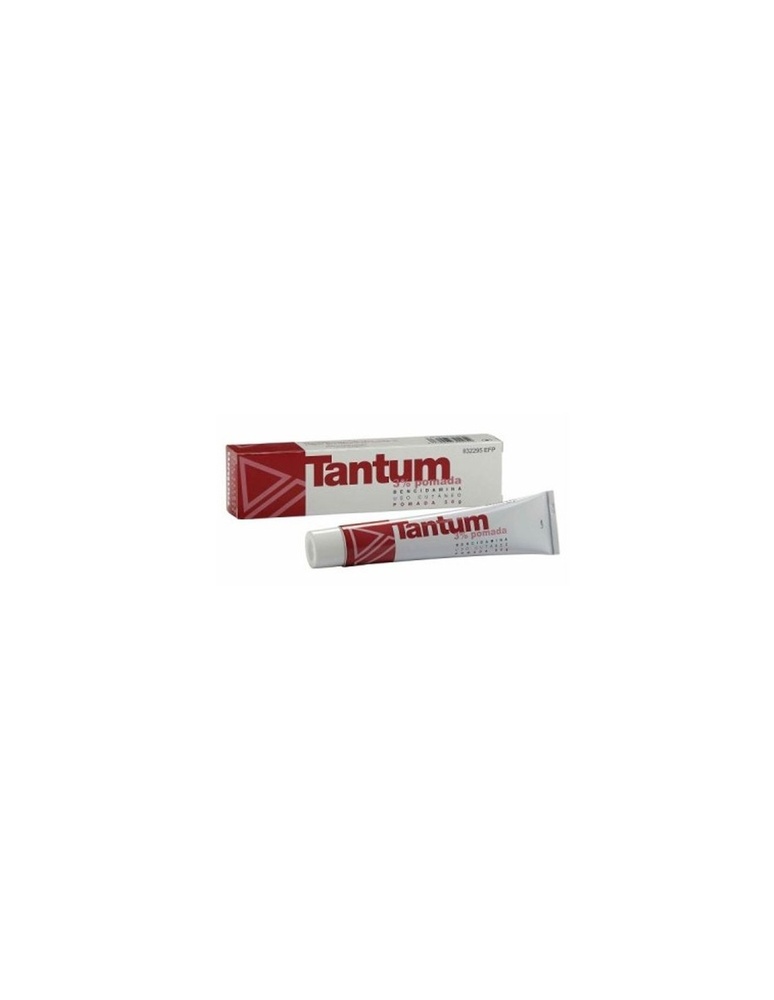
TANTUM 30 mg /G Ointment

Prescription review online
A doctor will review your case and decide whether a prescription is medically appropriate.

Talk to a doctor about this medicine
Discuss your symptoms and possible next steps in a quick online consultation.


How to use TANTUM 30 mg/g OINTMENT
Contents of the leaflet
- Introduction
- What Tantum is and what it is used for
- What you need to know before starting to use
- How to use Tantum
- Possible side effects
- Storage of Tantum
- Contents of the pack and further information
Introduction
Package Leaflet: Information for the User
Tantum 30 mg/g Ointment
Bencidamine Hydrochloride
Read the entire package leaflet carefully before starting to use this medication, as it contains important information for you.
Follow the administration instructions for the medication contained in this package leaflet or as indicated by your doctor or pharmacist exactly.
- Keep this package leaflet, as you may need to read it again.
- If you need advice or more information, consult your pharmacist.
- If you experience side effects, consult your doctor or pharmacist, even if they are side effects not listed in this package leaflet.
- You should consult a doctor if your symptoms worsen or do not improve after 7 days.
Contents of the Package Leaflet:
- What Tantum is and what it is used for
- What you need to know before starting to use Tantum
- How to use Tantum
- Possible side effects
- Storage of Tantum
- Contents of the pack and further information
1. What Tantum is and what it is used for
Tantum contains the active ingredient bencidamine hydrochloride, which belongs to the group of non-steroidal anti-inflammatory medications.
It is a medication for external use with analgesic activity.
It is used for the local symptomatic relief of muscle and joint pain caused by: bruises, blows, sprains, strains, contractures, sprains, and lumbago, in adults and adolescents over 12 years of age.
If symptoms worsen or last more than 7 days or irritation occurs, treatment should be discontinued and a doctor consulted.

Not sure if this medicine is right for you?
Discuss your symptoms and treatment with a doctor online.
2. What you need to know before starting to use
- If you are allergic to bencidamine or any of the other components of this medication (listed in section 6).
Warnings and Precautions
- Use only on intact skin, never on wounds, mucous membranes, or irritated or eczematous skin.
- Avoid contact with the eyes.
- Avoid applying heat, tight bandages, or those that do not allow ventilation of the area to be treated.
- Avoid using it for a prolonged period or on extensive areas.
- Avoid applying other external use medications simultaneously in the same area.
- The treated areas should not be exposed to the sun (even when cloudy) or to ultraviolet (UVA) lamps.
- In patients who have suffered or suffer from bronchial asthma, it can cause bronchospasm (sudden feeling of suffocation), so these patients should not use this medication.
Children
- Do not use in children under 12 years of age.
Other medications and Tantum
Tell your doctor or pharmacist if you are using, have recently used, or may need to use any other medication.
No interactions have been described, but it should not be used with other analgesics or anti-inflammatories in the same area without consulting your doctor first.
Using Tantum with food, drink, and alcohol
Food and drink do not affect the use of this medication.
Pregnancy, breastfeeding, and fertility
If you are pregnant or breastfeeding, if you think you may be pregnant, or plan to become pregnant, consult your doctor or pharmacist before using this medication.
Do not use Tantum during pregnancy unless clearly necessary and advised by your doctor. If treatment is needed, use the lowest dose for the shortest possible time.
Driving and using machines
No effect on the ability to drive vehicles and use machinery has been described for cutaneous use on the skin.
Tantum contains propylene glycol (E1520) and cetyl alcohol
This medication contains 100 mg of propylene glycol (E1520) per gram of ointment. Propylene glycol may cause skin irritation.
This medication may cause local skin reactions (such as contact dermatitis) because it contains cetyl alcohol.
3. How to use Tantum
Follow the administration instructions for the medication contained in this package leaflet or as indicated by your doctor or pharmacist exactly. In case of doubts, ask your doctor or pharmacist.
The recommended dose is:
Adults and adolescents over 12 years of age: apply a thin layer of ointment to the painful area 3 or 4 times a day.
Method of administration:
For exclusive external cutaneous use, on the skin.
The ointment should be applied with a gentle massage to facilitate penetration and absorption. Wash your hands after each application.
If symptoms worsen, last more than 7 days, or irritation occurs, discontinue treatment and consult a doctor.
Use in children
Do not use in children under 12 years of age.
If you use more Tantum than you should
Due to its external use, it is unlikely that intoxication will occur. In case of overdose or accidental ingestion, go immediately to a medical center or consult the Toxicology Information Service, telephone 91 562 04 20, indicating the medication and the amount ingested.

Started taking the medicine and have questions?
Discuss your symptoms and treatment with a doctor online.
4. Possible side effects
Like all medications, this medication can cause side effects, although not everyone will experience them.
Side effects are uncommon (may affect 1 in 100 people) and disappear when treatment is discontinued:
- Sensitivity of the skin to sunlight,
- Redness,
- Skin inflammation (dermatitis),
- Local irritation,
- Itching in the application area.
Reporting side effects
If you experience any type of side effect, consult your doctor or pharmacist, even if it is a possible side effect not listed in this package leaflet. You can also report them directly through the Spanish Medication Surveillance System for human use, https://www.notificaRAM.es. By reporting side effects, you can contribute to providing more information on the safety of this medication.
5. Storage of Tantum
No special storage conditions are required.
Keep this medication out of sight and reach of children.
Do not use this medication after the expiration date shown on the packaging after the abbreviation CAD. The expiration date is the last day of the month indicated.
Medications should not be disposed of through wastewater or household waste. Deposit the packaging and unused medications at the SIGRE point in the pharmacy. In case of doubt, ask your pharmacist how to dispose of the packaging and medications you no longer need. This will help protect the environment.
6. Contents of the pack and further information
- The active ingredient is bencidamine hydrochloride, each gram of ointment contains 30 mg of bencidamine hydrochloride.
- The other components (excipients) are: cetyl alcohol, vaseline, sorbitan stearate, polysorbate 60, propylene glycol (E1520), and purified water.
Appearance of the product and contents of the pack
Tantum is a white ointment with a characteristic aroma. It is presented in aluminum tubes of 50 grams with a white polypropylene screw cap.
Marketing authorization holder
ANGELINI PHARMA ESPAÑA, S.L.
c/ Antonio Machado, 78-80
3rd floor, module A-Australia Building
08840 Viladecans, Barcelona (Spain)
Manufacturer
A.C.R.A.F. S.p.A.,
Via Vecchia del Pinocchio, 22
60131 - Ancona, Italy
Date of the last revision of this package leaflet:September 2025
Detailed and updated information on this medication is available on the website of the Spanish Agency for Medicines and Health Products (AEMPS) http://www.aemps.gob.es/
- Country of registration
- Dosage formOINTMENT, 3 g benzydamine / 100 g
- ATC codeM02AA05
- Active substance
- Prescription requiredNo
- Manufacturer
- CompositionCETILICO, ALCOHOL (10 g mg), PROPILENGLICOL (10 g mg)
- This information is for reference only and does not constitute medical advice. Always consult a doctor before taking any medication. Oladoctor is not responsible for medical decisions based on this content.
- Alternatives to TANTUM 30 mg/g OINTMENTDosage form: Cream, 5 gActive substance: benzydamineManufacturer: Angelini Pharma Espana S.L.Prescription not requiredDosage form: CREAM, 1.5 g aceclofenac / 100 gActive substance: aceclofenacManufacturer: Almirall S.A.Prescription requiredDosage form: GEL, 50 mg/gActive substance: ibuprofenManufacturer: Arafarma Group S.A.Prescription not required
Online doctors for TANTUM 30 mg/g OINTMENT
Discuss questions about TANTUM 30 mg/g OINTMENT, including use, safety considerations and prescription review, subject to medical assessment and local regulations.
Get TANTUM 30 mg/g OINTMENT Prescription Online
Fill in a 2-min form
Tell us your symptoms, history, and what medicine you're requesting.
Pick a doctor or let us assign
Choose a specialist or we'll match you with the next available doctor.
Doctor reviews your case
Usually within 30 minutes. They may ask follow-up questions via chat.
Collect from any pharmacy
Electronic prescription sent to your email — valid across Spain.
Frequently Asked Questions
TANTUM 30 mg/g OINTMENT does not require a prescription in Spain. You can check with a doctor online whether this medicine may be appropriate for your situation.
The active ingredient in TANTUM 30 mg/g OINTMENT is benzydamine. This information helps identify medicines with the same composition but different brand names.
TANTUM 30 mg/g OINTMENT is manufactured by Angelini Pharma Espana S.L.. Pharmacy brands and packaging may differ depending on the distributor.
Doctors such as Family doctors, Psychiatrists, Dermatologists, Cardiologists, Endocrinologists, Gastroenterologists, Pulmonologists, Nephrologists, Rheumatologists, Hematologists, Infectious disease physicians, Allergists, Geriatricians, Paediatricians, Oncologists may assess whether TANTUM 30 mg/g OINTMENT is appropriate, depending on your situation and local regulations. You can book an online consultation to discuss your symptoms and possible next steps.
Spain has a well-developed healthcare infrastructure across major cities such as Madrid, Barcelona, Valencia, and Seville. Pharmacies are widely available and operate under strict regulations, ensuring access to prescribed medications.
You can buy TANTUM 30 mg/g OINTMENT in Madrid, Barcelona, Seville, or Valencia at any local pharmacy with a valid prescription.
To obtain a prescription, you can use Oladoctor:
Other medicines with the same active substance (benzydamine) include Tantum 50 mg/g crema, AIRTAL DIFUCREM 15 mg/g CREAM, ARAGEL 50 mg/g GEL. These may have different brand names or formulations but contain the same therapeutic ingredient. Always consult a doctor before switching or starting a new medicine.
