


MAGNESIUM SULFATE ALTAN 150 mg/ml INJECTABLE SOLUTION AND PERFUSION SOLUTION




How to use MAGNESIUM SULFATE ALTAN 150 mg/ml INJECTABLE SOLUTION AND PERFUSION SOLUTION
Translated with AI
This page provides general information and does not replace a doctor’s consultation. Always consult a doctor before taking any medication. Seek urgent medical care if symptoms are severe.
Show originalContents of the leaflet
Introduction
Package Leaflet: Information for the User
Magnesium Sulfate Altan 150 mg/ml Solution for Injection and Infusion EFG
Magnesium Sulfate Heptahydrate
Read all of this leaflet carefully before you start using this medicine because it contains important information for you.
- Keep this leaflet, you may need to read it again.
- If you have any further questions, ask your doctor, pharmacist, or nurse.
- This medicine has been prescribed for you only. Do not pass it on to others. It may harm them, even if their signs of illness are the same as yours.
- If you get any side effects, talk to your doctor, pharmacist, or nurse. This includes any possible side effects not listed in this leaflet. See section 4.
Contents of the pack:
- What is Magnesium Sulfate Altan and what is it used for
- What you need to know before you use Magnesium Sulfate Altan
- How to use Magnesium Sulfate Altan
- Possible side effects
- Storage of Magnesium Sulfate Altan
- Contents of the pack and other information
1. What is Magnesium Sulfate Altan and what is it used for
Magnesium Sulfate Altanis an anticonvulsant medication.
This medication is a solution that will be administered to you within a vein by injection or by infusion with a drip. It is indicated for:
- treatment of Torsades de Pointes(cardiac rhythm disorder).
- magnesium supply to balance electrolyte levels:
- treatment of hypomagnesemia (low magnesium levels in the blood)
- treatment of acute hypokalemia (low potassium levels in the blood) associated with hypomagnesemia (low magnesium levels in the blood)
- magnesium supply in parenteral nutrition.
- eclampsia.

2. What you need to know before using Magnesium Sulfate Altan
Do not use Magnesium Sulfate Altan:
- if you are allergic to magnesium sulfate or any of the other components of this medication (listed in section 6).
- if you have a kidney function disorder (severe renal insufficiency).
- if you are being treated with a quinidine-derived medication (see section “Using Magnesium Sulfate Altan with other medications”)
- if you have heart problems such as heart failure, myocardial injury, altered heart rate (tachycardia)
- if you have had a heart attack.
- if you have a liver function disorder.
Warnings and precautions
Consult your doctor, pharmacist, or nurse before starting to use this medication if:
- you have heart conduction disorders,
- you have gastrointestinal motility problems,
- you have kidney function problems (renal insufficiency),
- you have myasthenia gravis or the Eaton-Lambert syndrome, diseases characterized by muscle weakness.
Patient with magnesium deficiency, from mild to moderate, can be treated with diet or oral magnesium supplements. The administration of Magnesium Sulfate Altan by intravenous route is reserved for emergency situations.
Your doctor should interrupt treatment if:
- blood pressure decreases (hypotension),
- heart rate decreases (bradycardia),
- magnesium levels in the blood increase above normal values.
- the knee reflex disappears (deep tendon reflex).
Precautions:
- The administration of this medication should be performed in a hospital setting.
- It is recommended to monitor blood pressure during administration.
- It is recommended to monitor magnesium levels (magnesemia). Treatment should be interrupted once magnesemia has normalized.
- In cases of renal insufficiency (see section “3. How to use Magnesium Sulfate Altan”), the dose should be reduced and there should be closer monitoring of renal function, blood pressure, and magnesemia.
- Magnesium Sulfate Altan should not be administered with calcium salts (due to the antagonistic effect, see section “Using Magnesium Sulfate Altan with other medications”).
Using Magnesium Sulfate Altan with other medications
Tell your doctor or pharmacist that you are using, have recently used, or might use any other medication.
Certain medications may interact with Magnesium Sulfate Altan. In these cases, it may be necessary to change the dose or interrupt treatment with one of the medications.
It is especially important that you inform your doctor if you are being treated with any of the following medications:
- Aminoglycoside antibiotics(for the treatment of some infections).
- Curarizing agents: magnesium sulfate potentiates the effect of neuromuscular blockers such as tubocurarine, suxamethonium, and vecuronium. It may prolong neuromuscular blockade of curarizing agents with the risk of respiratory depression.
- Nifedipine(medication for the treatment of angina pectoris): potentiates the effect of magnesium sulfate.
- Quinidine derivatives(medications for the treatment of heart rhythm disorders): concomitant administration of magnesium sulfate and quinidine derivatives may increase quinidine plasma concentrations and increase the risk of overdose due to decreased renal elimination of quinidine.
- Medications that produce central nervous system depression: the effects of central nervous system depression may be potentiated when these medications are used simultaneously with magnesium sulfate.
- Digitalis glycosides(medications for the treatment of heart function problems): magnesium sulfate should be administered with extreme caution in patients being treated with digitalis glycosides, especially if calcium salts are also being used intravenously; changes in cardiac conduction and cardiac block may occur.
- Calcium: simultaneous use may neutralize the effects of magnesium sulfate by parenteral route.
Pregnancy, breastfeeding, and fertility
If you are pregnant or breastfeeding, think you may be pregnant, or plan to become pregnant, consult your doctor or pharmacist before using this medication.
Pregnancy
Treatment with Magnesium Sulfate Altan during pregnancy should only be considered if it is absolutely necessary. In these cases, it is recommended to monitor plasma magnesium levels, blood pressure, respiratory rate, and deep tendon reflexes.
Magnesium sulfate may cause fetal anomalies, such as decreased calcium levels (hypocalcemia) and bone demineralization disorders, when administered to pregnant women for more than 5-7 days.
When administered by intravenous infusion (should not be administered during the 2 hours prior to delivery) in the case of pregnancy toxemia, the newborn may show signs of magnesium toxicity, including neuromuscular depression or respiratory depression.
Breastfeeding
Magnesium sulfate is excreted in breast milk during treatment. It is recommended to suspend treatment during breastfeeding.
Driving and using machines
Not applicable
This medication contains less than 23 mg (1 mmol) of sodium per ampoule, so it is considered essentially “sodium-free”.
3. How to use Magnesium Sulfate Altan
Magnesium Sulfate Altan can be administered:
- by slow intravenous injection
- by venous infusion, diluted in a glucose or saline solution.
To consult the instructions for diluting the medication before administration, see the section “Information intended for healthcare professionals”, at the end of this leaflet.
The individual daily dose will be decided by your doctor. The following are the recommended doses that can serve as a guide.
In adults:
Ventricular tachycardia withTorsades de Pointes:
A initial dose of 2 g of magnesium sulfate by intravenous route (IV) is recommended, in 1-2 minutes, followed by an infusion of 2-4 mg/minute, or the initial dose can be repeated up to a total of 6 g, with intervals of 5-15 minutes between doses.
Hypomagnesemia:
Administration of 8-12 g of magnesium sulfate by intravenous route in the first 24 hours is recommended, followed by 4-6 g/day, for 3 or 4 days, until magnesium deposits are replenished.
In cases of severe hypomagnesemia, but not life-threatening, an alternative infusion of 1-2 g/hour of magnesium sulfate can be administered, for 3-6 hours, decreasing to 0.5-1 g/hour, as maintenance.
The maximum infusion rate should generally remain below 2 g/hour, except in cases of treatment of acute potentially life-threatening arrhythmias such as Torsades de Pointesand in eclampsia.
Parenteral nutrition:
The usual requirements are 2.4-3.6 g of magnesium sulfate (20-30 mEq of Mg)/24 hours, by intravenous infusion.
Eclampsia:
An initial dose of 4 g of magnesium sulfate IV (infusion in 5-10 minutes) should be administered; then, continuous infusion of 1-4 g/hour of magnesium sulfate should be started.
Special populations:
Elderly population:
Although adequate and well-controlled studies have not been conducted in the elderly population, to date, no age-related problems have been described. However, elderly patients often require a lower dose due to their decreased renal function.
It is recommended to use Magnesium Sulfate Altan under strict clinical supervision. Electrocardiographic monitoring is recommended in elderly patients receiving high doses of magnesium sulfate.
Patient with renal insufficiency:
In patients with renal insufficiency, the initial dose should be reduced by 25%-50% of the recommended dose for patients with normal renal function.
Pediatric population:
Ventricular tachycardia withTorsades de Pointes:
If there is no pulse, a dose of 25-50 mg of magnesium sulfate/kg of body weight by intravenous route in slow bolus is recommended.
With pulse, the same dose can be administered by infusion, over 10-20 minutes.
The maximum dose is 2 grams of magnesium sulfate.
Hypomagnesemia:
Recommended dose: 25-50 mg of magnesium sulfate/kg of body weight, by intravenous route. The dose can be repeated every 4-6 hours, up to a maximum of 3-4 doses. The maximum single dose is 2 grams of magnesium sulfate.
Daily maintenance dose: 30-60 mg/kg/24 hours of magnesium sulfate by intravenous route (0.25-0.5 mEq of Mg/kg/24 hours).
The maximum dose is 1 gram/24 hours of magnesium sulfate.
Parenteral nutrition:
Generally, it is recommended to administer 30-60 mg/kg/24 hours of magnesium sulfate by intravenous route (0.25-0.5 mEq of Mg/kg/24 hours).
The maximum dose is 1 gram/24 hours of magnesium sulfate.
If you use moreMagnesium Sulfate Altanthan you should
If you exceed the recommended doses, symptoms such as:
- nervous system disorders consisting of paralysis of the limbs, muscles that allow speaking, swallowing, up to paralysis of the respiratory muscles.
- cardiovascular manifestations consisting fundamentally of a decrease in blood pressure, accompanied by an increase in heart rate (tachycardia) or a decrease in heart rate (bradycardia).
Magnesium intoxication is manifested by a sudden drop in blood pressure and central nervous system depression that can precede respiratory paralysis. The disappearance of the knee reflex is a clinical sign that allows the detection of the onset of a magnesium overdose.
Symptoms may be: disappearance of deep tendon reflexes, drowsiness, confusion, lethargy, etc. Inform your doctor if you notice any of these symptoms.
In the event of an overdose, your doctor will administer the most appropriate treatment.
If you forget to use Magnesium Sulfate Altan
Do not use a double dose to make up for forgotten doses.
This medication will be administered to you in the hospital following the dose prescribed by your doctor.

4. Possible side effects
Like all medications, this medication can cause side effects, although not everyone gets them.
Side effects have been grouped by the following organ classification:
General disorders and administration site conditions:
pain at the injection site, decrease in temperature below normal limits (hypothermia), vasodilation with a sensation of heat
If magnesium sulfate is administered parenterally at high doses, it can cause hypermagnesemia, whose symptoms are:
Nervous system disorders:loss of reflex muscle movement to a small stimulus of contusion or blow (loss of deep tendon reflex), headache, dizziness, coma, drowsiness, confusion, central nervous system depression that can precede respiratory paralysis
Cardiac disorders:
cardiac arrest or circulatory collapse
Vascular disorders:
decrease in blood pressure (hypotension), decrease in heart rate (bradycardia), flushing
Respiratory, thoracic, and mediastinal disorders:
difficulty breathing (respiratory depression)
Gastrointestinal disorders:
nausea, vomiting
Musculoskeletal and connective tissue disorders:
muscle weakness
Other disorders:
speech problems, vision problems, excessive sweating, and thirst.
Hypermagnesemia can be potentially fatal in cases of severe kidney problems (severe renal insufficiency) or if magnesium sulfate is injected too quickly.
Post-marketing experience
There are studies and clinical cases that document fetal anomalies such as decreased calcium levels (hypocalcemia) and bone disorders.
Reporting of side effects
If you experience any side effects, talk to your doctor, pharmacist, or nurse, even if it is possible side effects not listed in this leaflet. You can also report them directly through the national pharmacovigilance system for human use medications: www.notificaRAM.es. By reporting side effects, you can contribute to providing more information on the safety of this medication.
5. Storage of Magnesium Sulfate Altan
Keep this medication out of the sight and reach of children.
Do not use this medication after the expiration date that appears on the packaging and on the label of the ampoule after Exp. The expiration date is the last day of the month indicated.
Once opened: the product should be used immediately.
No special storage conditions are required.
Medications should not be disposed of through wastewater or household waste. Ask your pharmacist how to dispose of the packaging and medications you no longer need. This will help protect the environment.
6. Container Contents and Additional Information
Composition of Magnesium Sulfate Altan
- The active ingredient is:
Magnesium sulfate heptahydrate: 150 mg/ml
A 10 ml ampoule contains 1.5 g of magnesium sulfate heptahydrate.
1 ml of solution for injection/infusion contains 150 mg of magnesium sulfate heptahydrate.
- Magnesium: 6.09 mmol (148.02 mg) / ampoule
- Sulfate: 6.09 mmol (585.02 mg) / ampoule
- The other components are: sodium hydroxide and water for injectable preparations.
Appearance of the Product and Container Contents
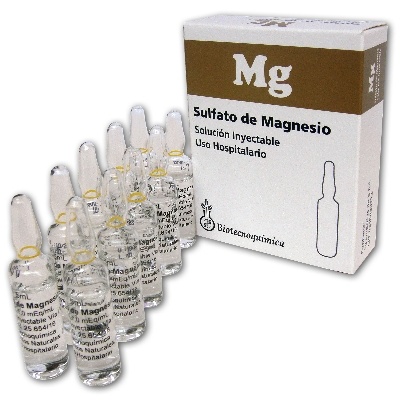
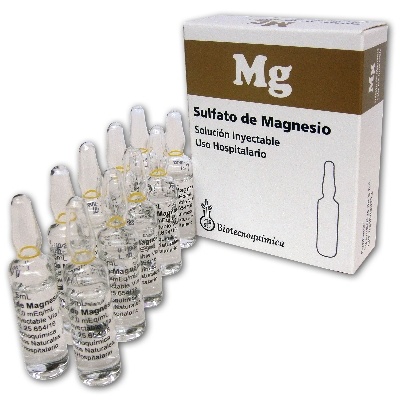
Magnesium Sulfate Altan is a clear and colorless solution for injection/infusion.
Magnesium Sulfate Altan is supplied in containers that contain 10 and 100 ampoules of 10 ml. Only some package sizes may be marketed.
Marketing Authorization Holder
Altan Pharmaceuticals, S.A.
C/Colquide, Nº 6, Portal 2, 1ª planta, Oficina F.
Edificio Prisma - Las Rozas (Madrid) -28230 – Spain
Manufacturer
Altan Pharmaceuticals, S.A.
Avda. Constitución 198-199. Pol. Industrial Monte Boyal
45950 Casarrubios del Monte (Toledo)
Date of the Last Revision of this Prospectus: August 2021
Detailed and updated information on this medication is available on the website of the Spanish Agency for Medicines and Health Products (AEMPS)http://www.aemps.gob.es
Information for Healthcare Professionals
Magnesium Sulfate Altan is a hypertonic solution for slow injection, administration will be carried out at an infusion rate that does not exceed 150 mg/minute of magnesium sulfate heptahydrate.
Preparation of the Intravenous Solution
In the case of administration by intravenous injection or intravenous infusion, the Magnesium Sulfate Altan solution may be diluted in 0.9% injectable sodium chloride.
In the case of intravenous infusion, the Magnesium Sulfate Altan solution may also be diluted in 5% glucose.
For intravenous infusion, dilute 4-5 grams in 250 ml of physiological serum or 5% glucose.
Treatment of Overdose:
Treatment consists of:
- rehydration, forced diuresis.
- intravenous injection of calcium salts: 1 g of calcium gluconate by slow intravenous administration to reverse cardiac block or respiratory depression. Artificial respiration may be necessary.
- in case of renal failure, hemodialysis or peritoneal dialysis will be required.
Hypermagnesemia in the newborn may require resuscitation and assisted ventilation by endotracheal intubation or intermittent positive pressure ventilation, as well as intravenous calcium.
Chemical and physical stability has been demonstrated during use for 24 hours at 20-25 ° C and at 5 ° C after dilution to 2% in physiological serum or 5% glucose and 0.9% injectable sodium chloride.
From a microbiological point of view, unless the opening method excludes the risk of microbial contamination, the product must be used immediately. If it is not used immediately, the storage times and conditions in use are the responsibility of the user.
- Country of registration
- Dosage formINJECTABLE, 150 mg/ml
- ATC codeB05XA05
- Active substance
- Prescription requiredYes
- Manufacturer
- This information is for reference only and does not constitute medical advice. Always consult a doctor before taking any medication. Oladoctor is not responsible for medical decisions based on this content.
- Alternatives to MAGNESIUM SULFATE ALTAN 150 mg/ml INJECTABLE SOLUTION AND PERFUSION SOLUTIONDosage form: INJECTABLE, 200 mg/mLActive substance: magnesium sulfateManufacturer: Laboratorios Basi Industria Farmaceutica S.A.Prescription requiredDosage form: INJECTABLE, 500 mg/mLActive substance: magnesium sulfateManufacturer: Laboratorios Basi Industria Farmaceutica S.A.Prescription requiredDosage form: INJECTABLE, 1500 mgActive substance: magnesium sulfateManufacturer: Desma Laboratorio Farmaceutico S.L.Prescription required

Online doctors for MAGNESIUM SULFATE ALTAN 150 mg/ml INJECTABLE SOLUTION AND PERFUSION SOLUTION
Discuss questions about MAGNESIUM SULFATE ALTAN 150 mg/ml INJECTABLE SOLUTION AND PERFUSION SOLUTION, including use, safety considerations and prescription review, subject to medical assessment and local regulations.






.jpg)




Frequently Asked Questions
