



SPIRAXIN 200 mg Film-Coated Tablets

Prescription review online
A doctor will review your case and decide whether a prescription is medically appropriate.

Talk to a doctor about this medicine
Discuss your symptoms and possible next steps in a quick online consultation.



How to use SPIRAXIN 200 mg FILM-COATED TABLETS
Contents of the leaflet
- Introduction
- What Spiraxin is and what it is used for
- What you need to know before you take Spiraxin
- How to take Spiraxin
- Possible side effects
- Storage of Spiraxin
- Contents of the pack and other information
- Composition of Spiraxin
Introduction
Package Leaflet: Information for the Patient
SPIRAXIN 200 mg film-coated tablets
Rifaximin
Read all of this leaflet carefully before you start taking this medicine because it contains important information for you.
- Keep this leaflet, you may need to read it again.
- If you have any further questions, ask your doctor or pharmacist.
- This medicine has been prescribed for you only. Do not pass it on to others. It may harm them, even if their symptoms are the same as yours.
- If you get any side effects, talk to your doctor or pharmacist. This includes any possible side effects not listed in this leaflet. See section 4.
Contents of the pack:
- What Spiraxin is and what it is used for
- What you need to know before you take Spiraxin
- How to take Spiraxin
- Possible side effects
- Storage of Spiraxin
- Contents of the pack and other information
1. What Spiraxin is and what it is used for
Spiraxin belongs to a group of medicines called intestinal anti-infectives, antibiotics.
Spiraxin is indicated in:
- Bacterial enterocolitis resistant to symptomatic treatment in patients at risk due to associated pathology, immunodepression, or advanced age.
- Pseudomembranous colitis in patients resistant to vancomycin.
- Acute diverticulitis.
- Pre- and post-operative prophylaxis in gastrointestinal tract surgery.
- Adjuvant therapy in hyperammonemia (excessive increase in blood ammonia concentration).

Not sure if this medicine is right for you?
Discuss your symptoms and treatment with a doctor online.
2. What you need to know before you take Spiraxin
Do not take Spiraxin:
- If you are allergic to the active substance, rifamycin derivatives, or any of the other components of this medicine (listed in section 6).
- If you have intestinal obstruction.
- If you have severe intestinal ulcerative lesions.
- If you have complicated diarrhea with fever or blood in the stool.
Warnings and precautions
- Consult your doctor or pharmacist before starting to take Spiraxin.
- If you have ever developed a severe skin rash or skin peeling, blisters, and/or sores in the mouth after taking rifaximin.
- During prolonged treatments at high doses, or in cases of intestinal injury, a slight absorption of the product may occur, and when eliminated, it may cause a reddish coloration of the urine, which is of no significant relevance.
- Rifaximin should be withdrawn if symptoms of diarrhea persist or worsen after 48 hours.
- As with the use of most antibiotics, during treatment with rifaximin, cases of diarrhea associated with Clostridioidesdifficile(CDAD) have been reported; therefore, the potential association of rifaximin treatment with CDAD or pseudomembranous colitis cannot be ruled out.
Be particularly careful with rifaximin:
Severe skin reactions, including Stevens-Johnson syndrome and toxic epidermal necrolysis, have been reported in association with rifaximin treatment. Most cases were reported in patients with liver disease (such as cirrhosis or hepatitis). Stop using rifaximin and seek immediate medical attention if you notice any of the symptoms related to these severe skin reactions described in section 4.
Children
The safety and efficacy of rifaximin have not been established in children under 12 years of age.
Taking Spiraxin with other medicines
- Tell your doctor or pharmacist if you are using, have recently used, or might use any other medicines.
- In case of activated charcoal administration, Spiraxin should be taken at least 2 hours after that administration.
- In case of liver failure, caution should be exercised when taking:
- Warfarin (a medicine to prevent blood clotting)
- Antiepileptics (medicines to treat epilepsy)
- Antiarrhythmics (medicines to treat abnormal heart rhythm)
- Cyclosporin (an immunosuppressant)
- Oral contraceptives
Taking Spiraxin with food
Spiraxin can be administered with or without food.
Pregnancy, breastfeeding, and fertility
If you are pregnant or breastfeeding, think you may be pregnant, or are planning to have a baby, ask your doctor or pharmacist for advice before taking this medicine.
It is not known whether rifaximin can harm the fetus. Therefore, Spiraxin should not be used during pregnancy.
It is recommended to take additional contraceptive precautions if you are taking Spiraxin with oral contraceptives (see "Taking Spiraxin with other medicines"),
It is not known whether rifaximin is excreted in breast milk. Therefore, Spiraxin should not be used during breastfeeding.
Driving and using machines
Spiraxin has a negligible influence on the ability to drive and use machines, although some cases of dizziness or drowsiness have been reported.
Spiraxin contains sodium
This medicine contains less than 23 mg of sodium (1 mmol) per tablet; this is essentially "sodium-free".
3. How to take Spiraxin
Follow exactly the administration instructions of this medicine indicated by your doctor or pharmacist. In case of doubt, consult your doctor or pharmacist again.
Spiraxin is administered orally with a glass of water.
The recommended dose is 200 mg (1 tablet) every 6 hours, until symptoms subside. This dose may be increased to 400 mg in adults every 8 hours, in those cases that, due to their complexity, may require a dose increase and always under medical criteria. It is recommended not to exceed 7 days of treatment.
No dose adjustment is necessary in patients with liver or kidney failure. Although no dose changes are expected, caution should be exercised in patients with impaired renal function.
Use in children
The safety and efficacy of rifaximin have not been established in children under 12 years of age. No dosage recommendation can be made.
If you take more Spiraxin than you should
If you have taken more Spiraxin than you should, consult your doctor or pharmacist immediately, or call the Toxicology Information Service, phone 91-562 04 20, indicating the medicine and the amount taken.
If you forget to take Spiraxin
Do not take a double dose to make up for forgotten doses.
If you stop taking Spiraxin
If you have any other questions about the use of this medicine, ask your doctor or pharmacist.

Started taking the medicine and have questions?
Discuss your symptoms and treatment with a doctor online.
4. Possible side effects
Like all medicines, this medicine can cause side effects, although not everybody gets them.
Stop using rifaximin and seek immediate medical attention if you notice any of the following symptoms:
- Reddish patches, not raised, in a target or circular shape on the trunk, often with central blisters, skin peeling, mouth ulcers, and/or sores in the mouth, throat, nose, genitals, and eyes.
These severe skin rashes can be preceded by fever and flu-like symptoms.
Similarly, many of the side effects, mainly related to the gastrointestinal tract, may be caused by the same disease that motivated the treatment.
Common side effects (at least 1 in 100 patients):
- Dizziness, headache
- Constipation, abdominal pain, abdominal distension, diarrhea, flatulence, feeling of needing to defecate, involuntary and painful or ineffective straining, nausea, vomiting
- Fever
Uncommon side effects (at least 1 in 1,000 patients):
- Increased blood pressure
- Palpitations
- Abnormal white blood cell count in the blood (increased lymphocytes and monocytes and decreased neutrophils)
- Decreased sensitivity, migraine, forehead or one-sided headache, tingling sensation, drowsiness
- Double vision
- Ear pain, sensation of the room spinning (vertigo)
- Difficulty breathing, nasal congestion, dry throat, sore throat, cough, runny nose
- Fluid accumulation in the abdomen (ascites), heavy digestion, gastrointestinal motility disorders, upper abdominal pain, blood in the stool, mucous stools, hard stools, dry lips, taste disorders
- Abnormal urine test results: glucose in the urine, increased urine output, increased frequency of urination, protein in the urine, blood in the urine
- Skin rashes and eruptions that can be sudden, sunburn
- Back pain, muscle weakness, generalized muscle pain, muscle cramps, neck pain
- Loss of appetite, dehydration
- Candidiasis (a type of fungal infection), inflammation or infection of the nose and/or throat, upper respiratory tract infection, cold sores
- Hot flashes
- Exhaustion, chills, cold sweat, pain and discomfort, swollen arm (peripheral edema), excessive sweating, flu-like symptoms
- Abnormal liver test results (increased aspartate aminotransferase)
- Prolonged and irregular menstrual periods
- Insomnia, abnormal dreams, depressed mood, nervousness
Rare side effects (frequency not known):
- Abnormal blood coagulation test results (International Normalized Ratio)
- Decreased platelet count in the blood
- Severe allergic reactions, hypersensitivity
- Fainting sensation
- Swelling of skin and mucous membranes, dermatitis, skin peeling dermatitis, eczema, erythemas, itching, red spots on the skin (purpura), hives
- Clostridium difficileinfection
- Liver function test abnormalities
Reporting of side effects
If you experience any side effects, talk to your doctor or pharmacist. This includes any possible side effects not listed in this leaflet. You can also report side effects directly through the Spanish Medicines Surveillance System for human use, https://www.notificaRAM.es. By reporting side effects, you can help provide more information on the safety of this medicine.
5. Storage of Spiraxin
No special storage conditions are required.
Keep this medicine out of the sight and reach of children.
Do not use this medicine after the expiry date which is stated on the carton after EXP. The expiry date is the last day of the month indicated.
Medicines should not be disposed of via wastewater or household waste. Place the carton and any remaining medicine in the pharmacy's SIGRE collection point. If you have any doubts, ask your pharmacist how to dispose of the carton and any remaining medicine. This will help protect the environment.
6. Contents of the pack and other information
Composition of Spiraxin
- The active substance is rifaximin. Each tablet contains 200 mg of rifaximin.
- The other components (excipients) are sodium carboxymethyl starch (type A) (potato), glycerol distearate, anhydrous colloidal silica (E-551), talc (E-553b), microcrystalline cellulose (E-460), hypromellose (E-464), titanium dioxide (E-171), disodium edetate, propylene glycol (E-1520), and red iron oxide (E-172).
Appearance of the product and pack contents
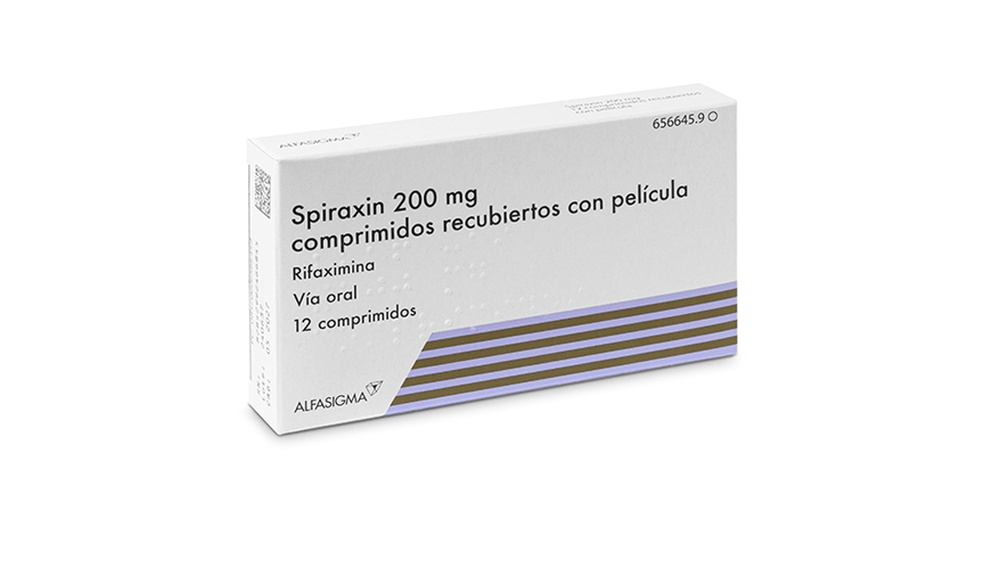
Spiraxin is a film-coated tablet, biconvex, round, and pink in color. It is available in packs of 12 and 28 tablets.
Marketing authorization holder and manufacturer
Marketing authorization holder:
Alfasigma S.p.A
Via Ragazzi Del ’99, n.5
40133 Bologna. ITALY
Manufacturer:
Alfasigma, S.p.A.
Via Enrico Fermi, 1
65020 Alanno, Pescara. ITALY
or
Alfasigma S.p.A
Via Pontina km 30.400
00071 – Pomezia, Roma. ITALY
Local representative:
Alfasigma España, S.L.
C/ Aribau 195, 4º
08021 Barcelona. España
Date of the last revision of this leaflet:April 2024
Detailed and updated information on this medicine is available on the website of the Spanish Agency for Medicines and Health Products (AEMPS) http://www.aemps.gob.es/
- Country of registration
- Dosage formTABLET, 200 mg
- ATC codeA07AA11
- Average pharmacy price9.21 EUR
- Active substance
- Prescription requiredYes
- Manufacturer
- CompositionPROPILENGLICOL (0,50 mg mg), DIESTEARATO DE GLICEROL (18,00 mg mg), EDETATO DE DISODIO (0,02 mg mg)
- This information is for reference only and does not constitute medical advice. Always consult a doctor before taking any medication. Oladoctor is not responsible for medical decisions based on this content.
- Alternatives to SPIRAXIN 200 mg FILM-COATED TABLETSDosage form: TABLET, 550 mgActive substance: rifaximinManufacturer: Alfasigma S.P.A.Prescription requiredDosage form: TABLET, 550 mgActive substance: rifaximinManufacturer: Alfasigma Espana S.L.Prescription requiredDosage form: TABLET, 200 mg fidaxomicinActive substance: fidaxomicinManufacturer: Tillotts Pharma GmbhPrescription required
Online doctors for SPIRAXIN 200 mg FILM-COATED TABLETS
Discuss questions about SPIRAXIN 200 mg FILM-COATED TABLETS, including use, safety considerations and prescription review, subject to medical assessment and local regulations.









Get SPIRAXIN 200 mg FILM-COATED TABLETS Prescription Online
Fill in a 2-min form
Tell us your symptoms, history, and what medicine you're requesting.
Pick a doctor or let us assign
Choose a specialist or we'll match you with the next available doctor.
Doctor reviews your case
Usually within 30 minutes. They may ask follow-up questions via chat.
Collect from any pharmacy
Electronic prescription sent to your email — valid across Spain.
Frequently Asked Questions
SPIRAXIN 200 mg FILM-COATED TABLETS requires a prescription in Spain. You can check with a doctor online whether this medicine may be appropriate for your situation.
The active ingredient in SPIRAXIN 200 mg FILM-COATED TABLETS is rifaximin. This information helps identify medicines with the same composition but different brand names.
The average pharmacy price for SPIRAXIN 200 mg FILM-COATED TABLETS is around 9.21 EUR. Prices may vary depending on the manufacturer and dosage form.
SPIRAXIN 200 mg FILM-COATED TABLETS is manufactured by Alfasigma S.P.A.. Pharmacy brands and packaging may differ depending on the distributor.
Doctors such as Family doctors, Psychiatrists, Dermatologists, Cardiologists, Endocrinologists, Gastroenterologists, Pulmonologists, Nephrologists, Rheumatologists, Hematologists, Infectious disease physicians, Allergists, Geriatricians, Paediatricians, Oncologists may assess whether SPIRAXIN 200 mg FILM-COATED TABLETS is appropriate, depending on your situation and local regulations. You can book an online consultation to discuss your symptoms and possible next steps.
Spain has a well-developed healthcare infrastructure across major cities such as Madrid, Barcelona, Valencia, and Seville. Pharmacies are widely available and operate under strict regulations, ensuring access to prescribed medications.
You can buy SPIRAXIN 200 mg FILM-COATED TABLETS in Madrid, Barcelona, Seville, or Valencia at any local pharmacy with a valid prescription.
To obtain a prescription, you can use Oladoctor:
Other medicines with the same active substance (rifaximin) include TIXTAR 550 MG FILM-COATED TABLETS, TIXTELLER 550 MG FILM-COATED TABLETS, DIFICLIR 200 mg FILM-COATED TABLETS. These may have different brand names or formulations but contain the same therapeutic ingredient. Always consult a doctor before switching or starting a new medicine.
