


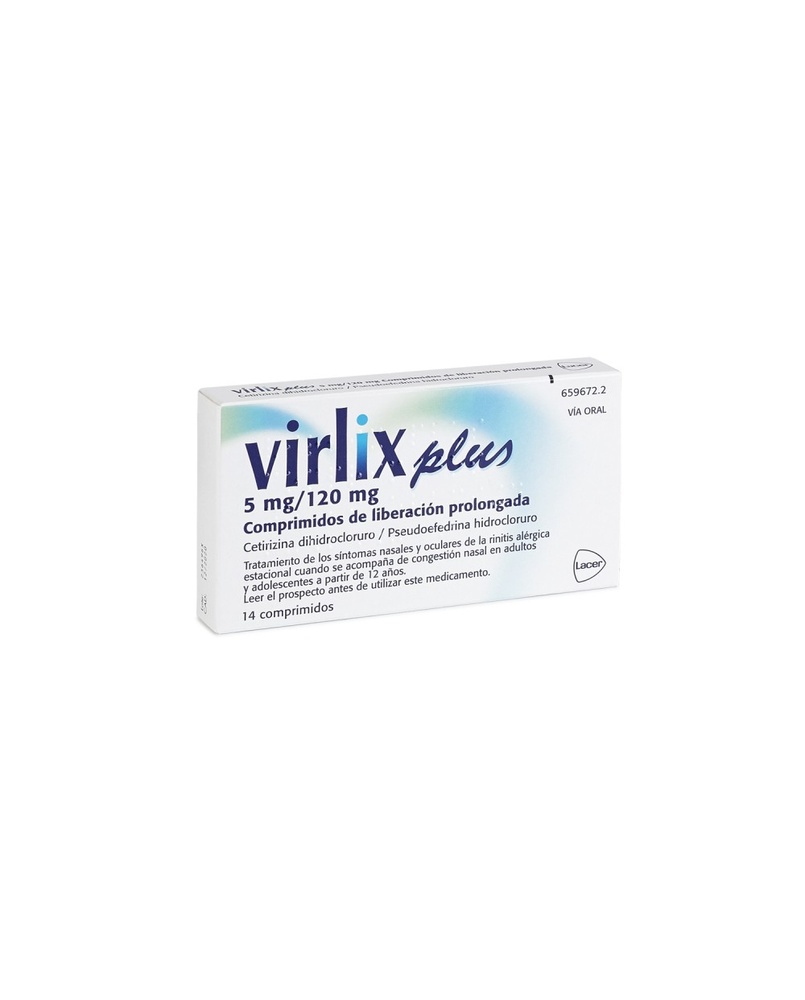
VIRLIX PLUS PROLONGED-RELEASE TABLETS



How to use VIRLIX PLUS PROLONGED-RELEASE TABLETS
Translated with AI
This page provides general information and does not replace a doctor’s consultation. Always consult a doctor before taking any medication. Seek urgent medical care if symptoms are severe.
Show originalContents of the leaflet
Introduction
Package Leaflet: Information for the User
Virlix Plus 5 mg/120 mg prolonged-release tablets
cetirizine dihydrochloride, pseudoephedrine hydrochloride
Read all of this leaflet carefully before you start taking this medicine because it contains important information for you.
Follow exactly the administration instructions of the medicine contained in this leaflet or as indicated by your doctor or pharmacist.
- Keep this leaflet, as you may need to read it again.
- If you need advice or more information, consult your pharmacist.
- If you experience side effects, consult your doctor or pharmacist, even if they are not listed in this leaflet. See section 4.
- You should consult a doctor if your symptoms worsen or do not improve after 7 days of treatment.
Contents of the package leaflet:
- What is Virlix Plus and what is it used for
- What you need to know before taking Virlix Plus
- How to take Virlix Plus
- Possible side effects
- Storage of Virlix Plus
- Package contents and further information
1. What is Virlix Plus and what is it used for
Virlix Plus is a medicine that acts as an antiallergic and nasal decongestant.
Virlix Plus is indicated for the treatment of nasal and ocular symptoms of seasonal allergic rhinitis when accompanied by nasal congestion in adults and adolescents from 12 years of age.
You should consult a doctor if your symptoms worsen or do not improve after 7 days of treatment.

2. What you need to know before taking Virlix Plus
Do not take Virlix Plus:
- If you are allergic to the active substances, to ephedrine, to any piperazine, or to any of the other components of this medicine (listed in section 6).
- If you have severe heart problems or serious cardiac rhythm irregularities (severe arrhythmias).
- If you have very high blood pressure (severe hypertension) or uncontrolled hypertension.
- If you are being treated with migraine medications containing dihydroergotamine.
- If you have uncontrolled hyperthyroidism.
- If you are being treated with antidepressants (monoamine oxidase inhibitors).
- If you have end-stage renal disease (patients with a Glomerular Filtration Rate (GFR) below 15 ml/min)
- If you have severe kidney disease, acute (sudden) or chronic (long-term), or kidney failure.
- If you have difficulty urinating (urinary retention).
- If you have narrow-angle glaucoma.
- If you have a history or high risk of stroke.
- If you have a tumor in the adrenal gland (called pheochromocytoma).
- If you are under 12 years old, as studies have not been conducted in this patient group and due to the presence of pseudoephedrine.
Warnings and precautions:
Consult your doctor or pharmacist before starting to take Virlix Plus:
- If you have diabetes, hyperthyroidism, high blood pressure, rapid palpitations, cardiac rhythm irregularities, heart problems (heart failure), liver problems, or if you are elderly.
- If you have kidney problems, a smaller dose will be administered according to the severity of the kidney problems; the dose to be taken will be indicated by your doctor.
- If you are taking sympathomimetic medications (decongestants, appetite suppressants, stimulants), tricyclic antidepressants, or cardiac glycosides (see use with other medications).
- If you consume alcohol or any other central nervous system depressant, as you may experience problems performing actions.
- If you are taking vasoconstrictor medications (bromocriptine, pergolide, lisuride, cabergoline, ergotamine) or any other decongestant used orally or nasally (phenylephrine, ephedrine).
- If you have high blood pressure and are being treated with non-steroidal anti-inflammatory drugs.
- If you have blood coagulation problems.
- Dermatological allergy tests may give false negative results if you are taking Virlix Plus during the 3 days prior to the tests, so you should inform your doctor of this circumstance before the tests are performed.
- With Virlix Plus, blood flow to the optic nerve may be reduced. If you experience sudden vision loss, stop taking Virlix Plus and contact your doctor or seek immediate medical attention. See section 4.
- Abdominal pain or rectal bleeding may occur with the use of Virlix Plus due to colon inflammation (ischemic colitis). If these gastrointestinal symptoms appear, stop taking Virlix Plus and contact your doctor or seek immediate medical attention. See section 4.
- There have been reports of posterior reversible encephalopathy syndrome (PRES) and reversible cerebral vasoconstriction syndrome (RCVS) after the use of medications containing pseudoephedrine. PRES and RCVS are rare diseases that may involve reduced blood flow to the brain. Stop using
immediately and seek immediate medical attention if you experience symptoms that may be signs of PRES or RCVS (to learn about the symptoms, see section 4 "Possible side effects").
Children
Do not use this medicine in children under 12 years old, as it is contraindicated.
Use of Virlix Plus with other medicines
Inform your doctor or pharmacist if you are using, have recently used, or may need to use any other medicine.
Certain medications may interact with Virlix Plus; in these cases, it may be necessary to change the dose or discontinue treatment with one of them.
It is essential that you inform your doctor if you are taking or have recently taken any of the following medications:
- Certain medications used to treat depression (monoamine oxidase inhibitors).
- Certain medications that lower blood pressure; antihypertensives (beta-adrenergic blockers).
- Some medications used for stomach pain (antacids).
- Certain antihypertensives (methyldopa, guanethidine, or reserpine).
- Medications used to treat heart problems (cardiac glycosides).
- Antibiotics containing linezolid.
- Certain medications used in anesthesia (halogenated anesthetics).
- Certain sympathomimetic medications (decongestants, appetite suppressants, stimulants).
- Certain vasoconstrictor medications (bromocriptine, pergolide, lisuride, cabergoline, ergotamine).
- Non-steroidal anti-inflammatory medications.
Taking Virlix Plus with food, drinks, and alcohol
Virlix Plus should be swallowed whole with the help of liquids and can be taken both on an empty stomach and with food. Do not chew or break the tablet.
It is not recommended to consume alcohol or fatty foods, as your ability to perform actions may be impaired.
Pregnancy, breastfeeding, and fertility
If you are pregnant or breastfeeding, think you may be pregnant, or plan to become pregnant, consult your doctor or pharmacist before using this medicine.
This medicine is not recommended during pregnancy or breastfeeding, as the medicine is excreted in breast milk.
Driving and using machines
There is no evidence that Virlix Plus, taken at the recommended dose, produces alterations in attention, reaction capacity, or ability to drive.
However, it is recommended that patients who are going to drive, perform potentially hazardous activities, or use machinery do not exceed the recommended dose and take into account their response to Virlix Plus beforehand.
Important information about some of the components of Virlix Plus
Athletes are informed that this medicine contains pseudoephedrine, which may result in a positive doping test.
This medicine contains lactose. If your doctor has told you that you have an intolerance to certain sugars, consult with them before taking this medicine.
This medicine, containing pseudoephedrine, may have abuse problems, so the treatment duration should not exceed 2 or 3 weeks.
This medicine contains less than 1 mmol of sodium (23 mg) per tablet; it is essentially "sodium-free".
3. How to take Virlix Plus
Follow exactly the administration instructions of this medicine indicated by your doctor or pharmacist. In case of doubt, consult your doctor or pharmacist again. The recommended dose is:
- Adults and adolescents from 12 years of age: 1 tablet 2 times a day (morning and night). The maximum daily dose is 2 tablets.
- Over 60 years: patients over 60 years old should not take this medicine.
- Patient with kidney or liver disease: patients with kidney or liver insufficiency should not take this medicine.
The tablet should be swallowed whole with the help of some liquid and can be taken both on an empty stomach and with food. The tablet should not be broken, chewed, or crushed.
If your symptoms worsen or persist after 7 days of treatment, you should consult a doctor.
Use in children
It is contraindicated in children under 12 years old.
If you take more Virlix Plus than you should
If you have taken more Virlix Plus than you should, consult your doctor or pharmacist immediately.
A significant overdose may cause increased drowsiness, fatigue, symptoms of depression, and cardiac rhythm irregularities that may lead to unconsciousness or, on the contrary, stimulation with insomnia, hallucinations, tremors, and epileptic seizures.
In case of overdose or accidental ingestion, consult the Toxicology Information Service. Telephone 915 620 420.
If you forget to take Virlix Plus
Do not take a double dose to make up for forgotten doses. Continue taking your normal dose when it is due.

4. Possible side effects
Like all medicines, Virlix Plus can cause side effects, although not everybody gets them.
Stop using Virlix Plus immediately and seek urgent medical attention if you experience symptoms that may be signs of posterior reversible encephalopathy syndrome (PRES) and reversible cerebral vasoconstriction syndrome (RCVS). These include:
- sudden severe headache
- malaise
- vomiting
- confusion
- seizures
- changes in vision
The side effects described with Virlix Plus, classified by frequency, are:
- frequent (may affect up to 1 in 10 people) are: tachycardia (cardiac rhythm irregularities), dry mouth, nausea, fatigue, dizziness, drowsiness, nervousness, and insomnia.
- uncommon (may affect up to 1 in 100 people): anxiety and agitation.
- rare (may affect up to 1 in 1,000 people): arrhythmia (cardiac rhythm irregularities), vomiting, liver function disorders (increased liver enzymes and bilirubin), hypersensitivity reactions (including anaphylactic shock), seizures, tremors, hallucinations, difficulty urinating, dry skin, itching, increased sweating, pallor, hypertension.
- very rare (may affect up to 1 in 10,000 people): dysgeusia (taste disturbance), stroke, mental disorders, drug-related rash, angioedema (sudden development of red patches and hives), and cardiovascular collapse.
- frequency not known (cannot be estimated from the available data): serious diseases affecting the blood vessels of the brain known as posterior reversible encephalopathy syndrome (PRES) and reversible cerebral vasoconstriction syndrome (RCVS), aggression, confusion, depression, involuntary and repetitive movement of one or more muscles of the body (tic), exaggerated feeling of well-being (euphoric mood), suicidal thoughts, abnormal sensation in the skin (paresthesia), restlessness, abnormal muscle contractions (dystonia), involuntary movements (dyskinesia), memory loss (amnesia), memory problems, fainting (syncope), ischemic colitis (inflammatory disease of the colon), diarrhea, abdominal discomfort, breathing difficulties (dyspnea), visual accommodation disorder (eye disorder), blurred vision, pupil dilation, eye pain, visual impairment, abnormal intolerance to light perception, uncontrolled circular eye movements (oculogyric crisis), reduced blood flow to the optic nerve (ischemic optic neuropathy), urinary incontinence (enuresis), urinary retention (difficulty emptying the bladder), severe skin reactions characterized by fever and numerous small superficial blisters appearing in extensive areas of redness, itching (pruritus), erectile dysfunction, palpitations, heart tissue damage producing a stop or severe alteration of the heartbeat due to obstruction of the corresponding artery or arteries (myocardial infarction), low blood pressure (hypotension), joint pain (arthralgia), muscle pain (myalgia), swelling (edema), malaise.
Description of some adverse reactions:
After discontinuation of treatment, itching (pruritus) has been reported in some patients.
At the first allergic symptoms to treatment with Virlix Plus, discontinue the medication.
In post-marketing experience, isolated cases of hepatitis have been reported when cetirizine is administered alone.
Reporting of side effects
If you experience any side effect, consult your doctor or pharmacist, even if it is not listed in this leaflet. You can also report them directly through the Spanish Medicines and Healthcare Products Agency (AEMPS) website: http://www.notificaram.es. By reporting side effects, you can help provide more information on the safety of this medicine.
5. Storage of Virlix Plus
No special storage conditions are required.
Keep this medicine out of the sight and reach of children.
Do not use Virlix Plus after the expiry date stated on the packaging after EXP. The expiry date is the last day of the month indicated.
Medicines should not be disposed of via wastewater or household waste. Place the packaging and any unused medicines in the SIGRE collection point at the pharmacy. If in doubt, ask your pharmacist how to dispose of the packaging and any unused medicines. This will help protect the environment.
6. Package contents and further information
Composition of Virlix Plus
- The active substances are cetirizine and pseudoephedrine. Each tablet contains 5 mg of cetirizine (as dihydrochloride) and 120 mg of pseudoephedrine (as hydrochloride).
- The other components are: hypromellose (E 464), microcrystalline cellulose, anhydrous colloidal silica, magnesium stearate, lactose, sodium croscarmellose, titanium dioxide (E 171), macrogol 400.
Appearance of the product and package contents
Virlix Plus is presented in the form of prolonged-release tablets coated with a film. They are white, round, and biconvex tablets.
Each package contains 14 tablets.
Marketing authorization holder and manufacturer
Holder:
LACER, S.A. – Boters, 5
08290 Cerdanyola del Vallès
Barcelona - Spain
Manufacturer:
Aesica Pharmaceuticals, S.r.l.
Via Praglia 15
I-10044 Pianezza (TO) - Italy
Date of last revision of this leaflet:April 2024
Detailed and updated information on this medicine is available on the website of the Spanish Agency for Medicines and Healthcare Products (AEMPS) http://www.aemps.gob.es/
- Country of registration
- Active substance
- Prescription requiredNo
- Manufacturer
- This information is for reference only and does not constitute medical advice. Always consult a doctor before taking any medication. Oladoctor is not responsible for medical decisions based on this content.
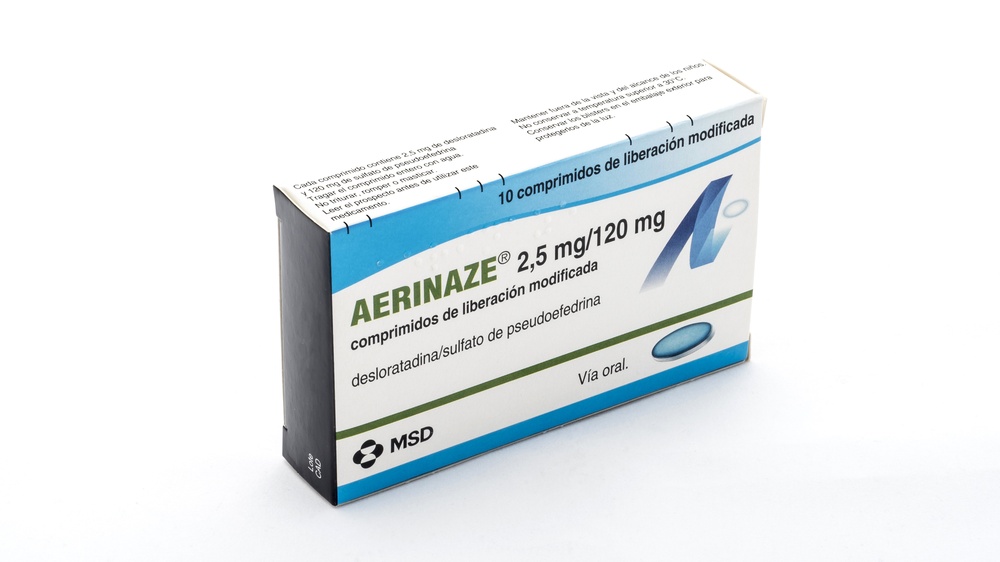
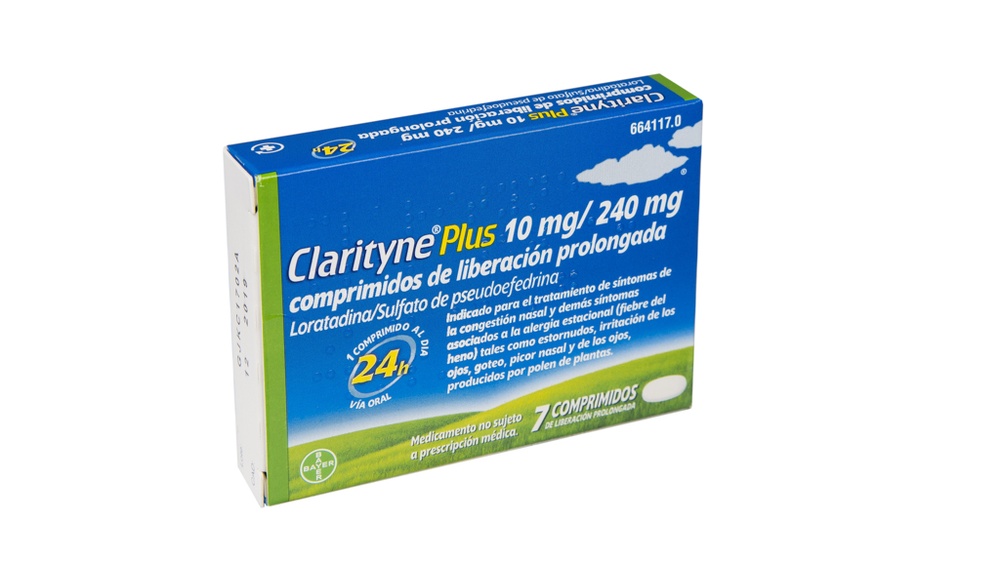
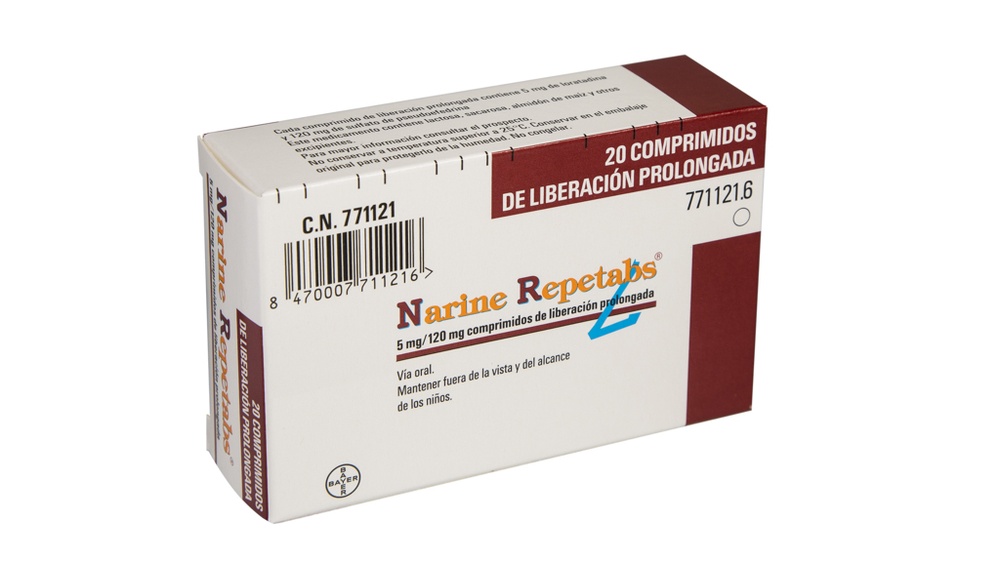
- Alternatives to VIRLIX PLUS PROLONGED-RELEASE TABLETSDosage form: MODIFIED-RELEASE TABLET, 2.5 - REVIEW mgActive substance: pseudoephedrine, combinationsManufacturer: Organon N.V.Prescription requiredDosage form: MODIFIED-RELEASE TABLET, 10mg/240mgActive substance: pseudoephedrine, combinationsManufacturer: Bayer Hispania S.L.Prescription not requiredDosage form: MODIFIED-RELEASE TABLET, 5 mg loratadine / 120 mg pseudoephedrine sulfateActive substance: pseudoephedrine, combinationsManufacturer: Bayer Hispania S.L.Prescription required
Online doctors for VIRLIX PLUS PROLONGED-RELEASE TABLETS
Discuss questions about VIRLIX PLUS PROLONGED-RELEASE TABLETS, including use, safety considerations and prescription review, subject to medical assessment and local regulations.







Frequently Asked Questions
