


SEPTRIN 80 mg/400 mg TABLETS



How to use SEPTRIN 80 mg/400 mg TABLETS
Translated with AI
This page provides general information and does not replace a doctor’s consultation. Always consult a doctor before taking any medication. Seek urgent medical care if symptoms are severe.
Show originalContents of the leaflet
Introduction
Package Leaflet: Information for the User
Septrin 80 mg/400 mg Tablets
(trimethoprim/sulfamethoxazole)
Read all of this leaflet carefully before you start taking this medicine because it contains important information for you.
- Keep this leaflet, you may need to read it again.
- If you have any further questions, ask your doctor or pharmacist.
- This medicine has been prescribed for you only. Do not pass it on to others. It may harm them, even if their signs of illness are the same as yours.
- If you get any side effects, talk to your doctor or pharmacist. This includes any possible side effects not listed in this leaflet.
Contents of the Package Leaflet
- What Septrin 80 mg/400 mg Tablets are and what they are used for
- What you need to know before you take Septrin 80 mg/400 mg Tablets
- How to take Septrin 80 mg/400 mg Tablets
- Possible side effects
- Storage of Septrin 80 mg/400 mg Tablets
- Contents of the pack and other information
1. What Septrin 80 mg/400 mg Tablets are and what they are used for
Septrin is an antibiotic that eliminates the bacteria that cause infections. It contains two different drugs called trimethoprim and sulfamethoxazole (a sulfonamide).
Antibiotics are used to treat bacterial infections and are not effective against viral infections such as the flu or the common cold.
It is essential that you follow the instructions regarding dosage, administration interval, and treatment duration as indicated by your doctor.
Do not store or reuse this medication. If you have any leftover antibiotic after completing treatment, return it to the pharmacy for proper disposal. Do not throw away medications down the drain or in the trash.
Septrin is indicated for the treatment of the following infections: treatment and prevention of pneumonia caused by Pneumocystis jiroveci (P. carinii), prevention of toxoplasmosis, nocardiosis, and melioidosis.
Septrin may also be useful for other infections: middle ear infections, lung infections in patients with chronic bronchitis, urinary tract infections (bladder, kidneys), infectious diarrhea, treatment of toxoplasmosis, genital and/or perianal lesions (granuloma inguinale or donovanosis), and brucellosis.

2. What you need to know before you take Septrin 80 mg/400 mg Tablets
Do not take Septrin 80 mg/400 mg Tablets
- If you are allergic to sulfonamides, trimethoprim, cotrimoxazole, or any of the other components of this medication (listed in section 6: Contents of the pack and other information).
- In the case of premature infants and full-term infants under 6 weeks of age.
- If you have or think you have acute porphyria (a blood disorder in which hemoglobin is not produced properly).
- In combination with dofetilide (a medication used to control irregular or rapid heartbeats).
Warnings and precautions
Consult your doctor or pharmacist before starting to take Septrin 80 mg/400 mg Tablets.
- In elderly patients, as they may be more likely to experience severe effects.
- If you have kidney problems (known renal insufficiency). Your doctor should take special measures. To ensure adequate renal elimination, the patient should receive adequate fluid intake and the urinary pH should be maintained within normal limits, avoiding acidification of the urine.
- If you have liver problems (severe liver parenchymal damage).
- If you have severe blood disorders, except in cases where there is close medical supervision.
- If you have a deficiency of an enzyme called glucose-6-phosphate dehydrogenase (G-6-PD).
- Septrin should not be used to treat streptococcal pharyngitis (S. pyogenes).
- If you take Septrin for a long time or have a folate deficiency, or if you are an elderly patient, your doctor may request that you have blood tests to perform blood counts.
- If you are at risk of hyperkalemia (high potassium levels) and hyponatremia (low sodium levels), your doctor will consider the need for potassium and sodium blood tests.
- If you have phenylketonuria (a metabolic disorder that affects the enzyme phenylalanine), as the administration of trimethoprim alters phenylalanine metabolism. This is not a problem in patients with an adequate restrictive diet.
- Septrin may interfere with the results of some laboratory tests.
- Although this medication is indicated for use in children from 6 weeks of age, your doctor may decide not to administer Septrin to children under 3 months of age.
Rare cases of death have occurred due to severe reactions, including fulminant hepatic necrosis (severe liver damage), agranulocytosis (decrease in the number of a certain type of white blood cell), aplastic anemia (insufficiency of the bone marrow to produce different types of cells), other blood disorders, and hypersensitivity of the respiratory system.
Life-threatening skin rashes have been described with the use of Septrin, initially appearing as red or circular spots, often with a central blister.
Other additional signs that may appear are sores in the mouth, throat, nose, genitals, and conjunctivitis (swollen and red eyes).
These life-threatening skin rashes are often accompanied by flu-like symptoms. The rash can progress to the formation of generalized blisters or skin peeling.
The period of highest risk of severe skin reactions is during the first few weeks of treatment.
If you have developed Stevens-Johnson syndrome, toxic epidermal necrolysis, or acute febrile neutrophilic dermatosis with the use of Septrin, you should not use Septrin again at any time.
If you develop a rash or these skin symptoms, stop taking Septrin, go to a doctor immediately, and inform them that you are taking this medication.
If you experience a severe skin reaction: a red and scaly rash with bumps under the skin and blisters (generalized exanthematous pustulosis), contact a doctor as soon as possible and inform them that you are taking this medication.
Rare cases of hypersensitivity reactions with eosinophilia (increase in a certain type of white blood cell) and associated systemic symptoms have been reported with the use of Septrin.
As a consequence of colonization with Clostridium difficile, the use of Septrin may lead to the development of pseudomembranous colitis, which manifests as diarrhea.
If you experience an unexpected worsening of cough and shortness of breath, inform your doctor immediately.
Haemophagocytic lymphohistiocytosis
Very rare cases of excessive immune reactions due to unregulated activation of white blood cells, causing inflammation (haemophagocytic lymphohistiocytosis), which can be potentially fatal if not diagnosed and treated early, have been reported. If you experience multiple symptoms such as fever, swelling of the lymph nodes, feeling of weakness, dizziness, shortness of breath, bruising, or skin rash, either simultaneously or with a slight delay, contact your doctor immediately.
Taking Septrin 80 mg/400 mg Tablets with other medications
Tell your doctor or pharmacist if you are taking, have recently taken, or might take any other medications.
Septrin may enhance the effect and/or toxicity of some medications. It is essential that you inform your doctor if you are taking or have recently taken any of the following medications:
- Medications used to increase urine elimination: diuretics (especially thiazides). The concomitant administration of diuretics with trimethoprim/sulfamethoxazole in elderly patients may have a higher risk of thrombocytopenia (decrease in the number of platelets) and hyponatremia (low sodium levels).
- Oral anticoagulant medications such as warfarin. Trimethoprim/sulfamethoxazole potentiates the anticoagulant activity of warfarin. Careful monitoring of anticoagulant treatment is advised during the use of Septrin.
- Certain medications used to control blood sugar levels: oral hypoglycemics or antidiabetics (sulfonylurea).
- Medications used to treat heart problems (digoxin). The concomitant use of trimethoprim and digoxin has shown an increase in digoxin levels in some elderly patients.
- Medications used to treat infections caused by certain parasites (pyrimethamine). The concomitant administration of trimethoprim/sulfamethoxazole with doses of pyrimethamine greater than 25 mg per week may lead to the development of megaloblastic anemia (decrease in the number of red blood cells and increase in their size).
- Certain medications used to treat the human immunodeficiency virus (HIV): antiretrovirals (lamivudine, zidovudine). The concomitant treatment of Septrin with zidovudine may increase the risk of adverse hematological reactions to trimethoprim/sulfamethoxazole; consideration should be given to monitoring blood parameters.
- Medications that are antagonists of folic acid, such as phenytoin (used to treat epilepsy) and methotrexate (used to treat various types of cancer and also to treat rheumatoid arthritis). If trimethoprim/sulfamethoxazole is administered with phenytoin, the excessive effect of phenytoin should be considered. If Septrin is administered with methotrexate, consideration should be given to the administration of a folate supplement.
- Medications used in transplants: immunosuppressants (cyclosporin). In patients treated with trimethoprim/sulfamethoxazole and cyclosporin, a reversible deterioration in renal function has been observed after a kidney transplant.
- Medications that produce hyperkalemia (increase in potassium levels in the blood).
- Medications used to control heart rhythm (class III antiarrhythmics), such as dofetilide. Elevated plasma levels of dofetilide have been reported after concomitant administration with trimethoprim.
When trimethoprim is administered with medications such as procainamide and amantadine, there is a possibility of increased plasma concentration of one or both medications.
Pregnancy, breastfeeding, and fertility
If you are pregnant or breastfeeding, think you may be pregnant, or are planning to have a baby, ask your doctor or pharmacist for advice before taking this medication.
Trimethoprim and sulfamethoxazole cross the placenta, and their safety in pregnant women has not been established. Trimethoprim/sulfamethoxazole should be avoided in pregnancy, unless the potential benefit to the mother is greater than the potential risk to the fetus; consideration may be given to supplementation with high doses of folate (up to 4 or 5 mg/day) if trimethoprim/sulfamethoxazole is used during pregnancy.
When Septrin is administered to the mother before birth, there may be a theoretical risk of kernicterus (severe neurological complication due to increased bilirubin levels in the blood) in the newborn. This theoretical risk is particularly important in children with a higher risk of hyperbilirubinemia, such as premature infants or those with glucose-6-phosphate dehydrogenase deficiency.
The administration of trimethoprim/sulfamethoxazole should be avoided in the final stages of pregnancy and in breastfeeding mothers, when the mothers or children have or are at particular risk of developing hyperbilirubinemia.
The medication is excreted in breast milk.
Driving and using machines
The influence of Septrin on the ability to drive and use machines is negligible or nonexistent.
3. How to take Septrin 80 mg/400 mg Tablets
Follow the instructions for administration of the medication contained in this leaflet or as indicated by your doctor. In case of doubt, consult your doctor or pharmacist again.
Remember to take your medication.
Your doctor will indicate the duration of your treatment with Septrin 80 mg/400 mg Tablets. Do not stop treatment before completion.
Septrin 80 mg/400 mg Tablets should be taken preferably after food intake. Take the tablets with a sufficient amount of liquid. If desired, the specified doses can be taken diluted in a small amount of water.
Your doctor will prescribe the most appropriate pharmaceutical form of Septrin according to age, weight, and dosage.
Septrin Pediatric 8 mg/40 mg/ml oral suspension and Septrin Pediatric 20 mg/100 mg tablets are the most suitable presentations for infants and children.
Standard dosage
Adults and children over 12 years:
- 2 tablets of Septrin 80 mg/400 mg every 12 hours (160 mg of trimethoprim/800 mg of sulfamethoxazole/12 hours).
Infants and children under 12 years: the pediatric forms of Septrin are recommended.
If after 7 days of treatment no clinical improvement is observed, the patient will be reevaluated.
As an alternative to the standard dosage, a treatment with 2 tablets of Septrin 80 mg/400 mg (160/800 mg of trimethoprim-sulfamethoxazole) every 12 hours for 3 days is suitable for the treatment of urinary tract infections and infectious diarrhea.
Special dosages
Elderly patients: (see section 2). If not otherwise specified, the standard dosage will be used.
Patients with renal insufficiency:
Adults and children over 12 years (no information is available for children under 12 years):
Creatinine clearance (ml/min) Recommended dosage
> 30 Standard dosage
15-30 Half of the standard dosage
< 15 Not recommended
Your doctor may perform blood tests every 2-3 days to measure the amount of medication in the blood.
Pneumocystis jiroveci (P. carinii) pneumonia
Treatment
Adults and children: 20 mg of trimethoprim and 100 mg of sulfamethoxazole/kg/day, in two or more divided doses, for two weeks.
Prophylaxis (prevention)
Adults:
The following dosing regimens can be used:
- 2 tablets of Septrin 80 mg/400 mg (160 mg of trimethoprim/800 mg of sulfamethoxazole) daily, 7 days a week.
- 2 tablets of Septrin 80 mg/400 mg (160 mg of trimethoprim/800 mg of sulfamethoxazole) three times a week, on alternate days.
- 2 tablets of Septrin 80 mg/400 mg (160 mg of trimethoprim/800 mg of sulfamethoxazole), twice a day, three times a week, on alternate days.
Children: in infants and children under 12 years, the pediatric forms of Septrin are recommended.
Toxoplasmosis
Primary prophylaxis (primary prevention)
Adults and children over 12 years:
- 1 tablet of Septrin 80 mg/400 mg daily.
- 2 tablets of Septrin 80 mg/400 mg (160 mg of trimethoprim/800 mg of sulfamethoxazole) three times a week.
- 2 tablets of Septrin 80 mg/400 mg (160 mg of trimethoprim/800 mg of sulfamethoxazole) daily.
Children: the pediatric forms of Septrin are recommended.
Treatment
Adults(no data are available for children): 5 mg/kg of trimethoprim/25 mg/kg of sulfamethoxazole/12 hours for 6 weeks.
Granuloma Inguinale (Donovanosis)
2 tablets of Septrin 80 mg/400 mg (160 mg of trimethoprim/800 mg of sulfamethoxazole) twice a day for a period of at least 3 weeks or until all lesions have completely disappeared.
Nocardiosis
10-15 mg/kg/day of trimethoprim/50-75 mg/kg/day of sulfamethoxazole in two or more divided doses for a period of 3-6 months. In immunocompromised patients, treatment should be more prolonged. All patients with central nervous system involvement should be treated for at least one year.
Brucellosis
Adults and children over 8 years:
2 tablets of Septrin 80 mg/400 mg every 12 hours (160 mg of trimethoprim/800 mg of sulfamethoxazole/12 hours) for 6 weeks.
Children under 8 years(in this group, it is considered the first choice of treatment): the pediatric forms of Septrin are recommended.
Melioidosis
8 mg/kg/day of trimethoprim and 40 mg/kg/day of sulfamethoxazole (maximum 320 mg of trimethoprim/1,600 mg of sulfamethoxazole) every 12 hours for 3-6 months.
If you take more Septrin 80 mg/400 mg Tablets than you should
Symptoms of overdose include: nausea, vomiting, dizziness, and confusion.
In acute overdose with trimethoprim, bone marrow depression has been observed.
If vomiting does not occur, it should be induced. Gastric lavage should be performed. Depending on the state of renal function, administration of fluids is recommended if urine elimination is low.
Both trimethoprim and sulfamethoxazole are dialyzable by hemodialysis. Peritoneal dialysis is not effective.
In case of overdose or accidental ingestion, consult the Toxicology Information Service. Phone: 91 562 04 20.
If you forget to take Septrin 80 mg/400 mg Tablets
Do not take a double dose to make up for forgotten doses.

4. Possible Adverse Effects
Like all medicines, Septrin 80 mg/400 mg tablets may cause adverse effects, although not all people will experience them.
Severe Adverse Effects
Call emergency services immediately if you experience multiple symptoms such as fever, very low blood pressure, or increased heart rate after taking this medication, as it may be a symptom of shock.
The adverse effects described for Septrin 80 mg/400 mg tablets are classified by frequency and are as follows:
- Very common (may affect more than 1 in 10 people): hyperkalemia (elevated potassium level).
- Common (may affect up to 1 in 10 people): candidiasis (overgrowth of the Candida fungus), headache, nausea, diarrhea, and skin rashes.
- Uncommon (may affect up to 1 in 100 people): vomiting.
- Rare (may affect up to 1 in 1,000 people): hypersensitivity reactions with eosinophilia (increase in a certain type of white blood cell) and systemic symptoms.
- Very rare (may affect up to 1 in 10,000 people): leukopenia (decrease in the number of white blood cells), neutropenia (decrease in the number of a certain type of white blood cell), thrombocytopenia (decrease in the number of platelets), agranulocytosis (decrease in the number of a certain type of white blood cell), megaloblastic anemia (decrease in the number of red blood cells and increase in their size), aplastic anemia (insufficiency of the bone marrow to produce different types of cells), hemolytic anemia (characterized by an insufficient number of red blood cells), methemoglobinemia (inability of hemoglobin to transport oxygen), eosinophilia (abnormally high amount of a certain type of white blood cell), purpura (red spots on the skin), hemolysis (breakdown of red blood cells) in certain susceptible patients deficient in G-6-PD. Serum sickness (hypersensitivity reaction similar to an allergy), anaphylaxis (severe allergic reaction), allergic myocarditis (allergic reaction affecting the heart), angioedema (fluid retention in the skin and mucous membranes), fever, allergic vasculitis similar to Schoenlein-Henoch purpura (inflammation affecting mainly small veins), periarteritis nodosa (vascular disease), systemic lupus erythematosus (immune system disease).
Hypoglycemia (decrease in blood glucose), hyponatremia (decrease in sodium in the blood), anorexia (metabolic disorder). Depression, hallucinations, aseptic meningitis, convulsions, peripheral neuritis (lesion and deterioration of peripheral nerves), ataxia (loss of coordination), vertigo, tinnitus (ringing in the ears), dizziness, cough, difficulty breathing, pulmonary infiltrates, glossitis (inflammation of the tongue), stomatitis (lesions in the mouth), pseudomembranous colitis (inflammation of the colon), pancreatitis (inflammation of the pancreas), hepatobiliary disorders (alteration of liver function), photosensitivity (skin reaction produced by interaction with light), exfoliative dermatitis (severe inflammation of the entire skin surface), fixed drug eruption (allergic reaction), erythema multiforme (allergic reaction affecting the skin), arthralgia (joint pain), myalgia (muscle pain), alteration of renal function, uveitis (inflammation of the eye). Skin rashes may appear that can threaten the patient's life (Stevens-Johnson syndrome, toxic epidermal necrolysis) (see section 2: Warnings and precautions).
- Frequency not known (cannot be estimated from the available data):
In some cases, skin rashes have been observed that can threaten the patient's life, such as purple, raised, and painful blisters on the extremities and sometimes on the face and neck, with fever (Sweet's syndrome) (see section 2: Warnings and precautions).
Contact a doctor as soon as possible if you experience a severe skin reaction: a red and scaly rash with bumps under the skin and blisters (acute generalized exanthematous pustulosis). (See section 2: Warnings and precautions).
- Very rare adverse effects (may affect up to 1 in 10,000 people) related to the treatment of Pneumocystis jiroveci (P. carinii) pneumonia: severe hypersensitivity reactions, rashes, fever, neutropenia (decrease in the number of a certain type of white blood cell), thrombocytopenia (decrease in the number of platelets), increase in liver enzymes, hyperkalemia (elevated potassium level), hyponatremia (decrease in sodium in the blood), and rhabdomyolysis (destruction or inflammation of muscle tissue that causes severe muscle pain and weakness).
If you experience adverse effects, consult your doctor or pharmacist, even if they are adverse effects that do not appear in this leaflet.
Reporting of Adverse Effects:
If you experience any type of adverse effect, consult your doctor, pharmacist, or nurse, even if it is a possible adverse effect that does not appear in this leaflet. You can also report them directly through the Spanish Pharmacovigilance System for Human Use Medicines: www.notificaram.es. By reporting adverse effects, you can contribute to providing more information on the safety of this medication.
5. Storage of Septrin 80 mg/400 mg Tablets
No special storage conditions are required.
Keep this medication out of the sight and reach of children.
Do not use this medication after the expiration date that appears on the packaging after CAD. The expiration date is the last day of the month indicated.
Medicines should not be disposed of through wastewater or household waste. Deposit the packaging and any unused medication in the SIGRE collection point at the pharmacy. In case of doubt, ask your pharmacist how to dispose of the packaging and any unused medication. This will help protect the environment.
6. Package Contents and Additional Information
Composition of Septrin 80 mg/400 mg Tablets
- The active ingredients are trimethoprim and sulfamethoxazole. Each tablet contains 80 mg of trimethoprim and 400 mg of sulfamethoxazole.
- The other ingredients are: sodium carboxymethyl starch (type A) (derived from potato starch), polyvinylpyrrolidone K30 (povidone), sodium docusate, magnesium stearate.
Appearance of the Product and Package Contents
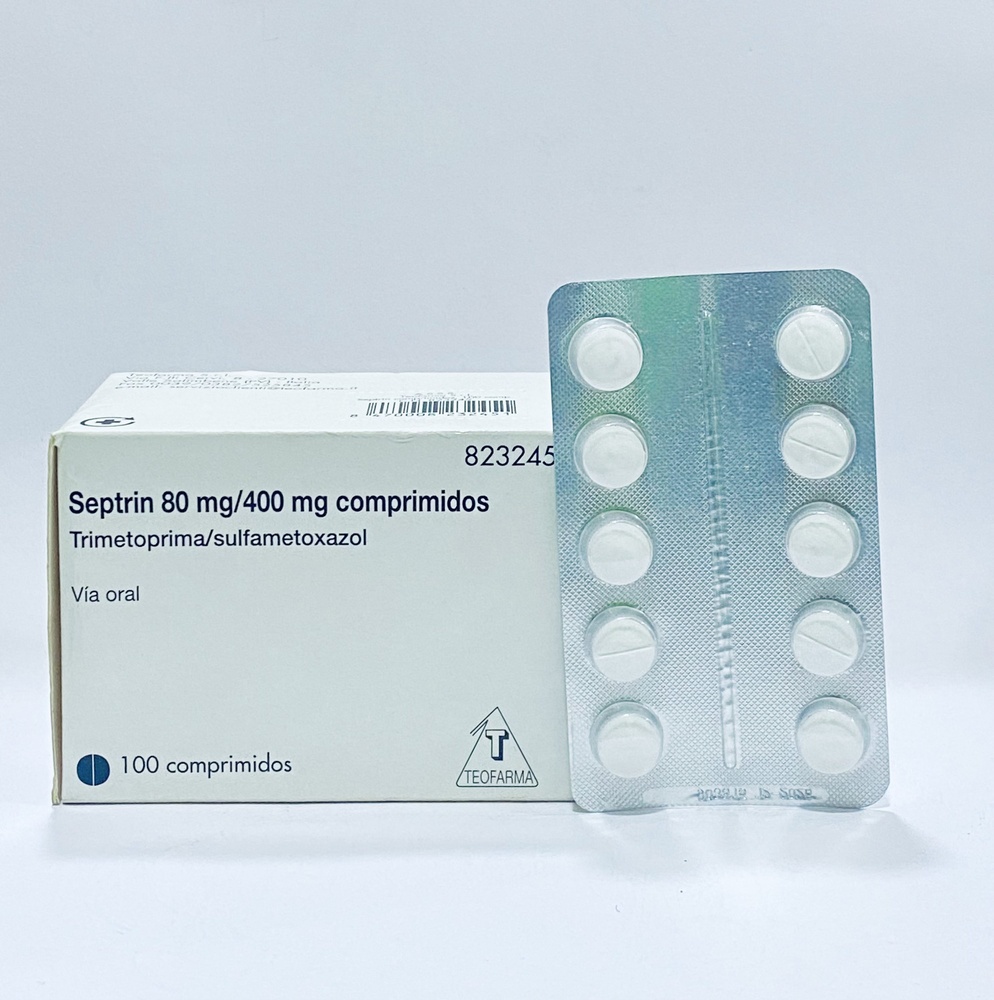
Septrin 80 mg/400 mg tablets are white, round (with an approximate diameter of 11 mm), biconvex, and scored.
PVC/Aluminum blisters of 20 and 100 tablets.
Marketing Authorization Holder
TEOFARMA S.r.l.
Via F.lli Cervi, 8
27010 Valle Salimbene
Pavia – Italy
Manufacturer
Alcalá Farma, S.L
Avenida de Madrid 82, Alcalá de Henares
28802 Madrid Spain
Other Presentations
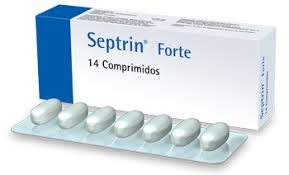
- Septrin Forte 160 mg/800 mg tablets.
Packaging of 20 and 50 tablets.
- Septrin Pediatric 20 mg/100 mg tablets.
Packaging of 20 and 100 tablets.
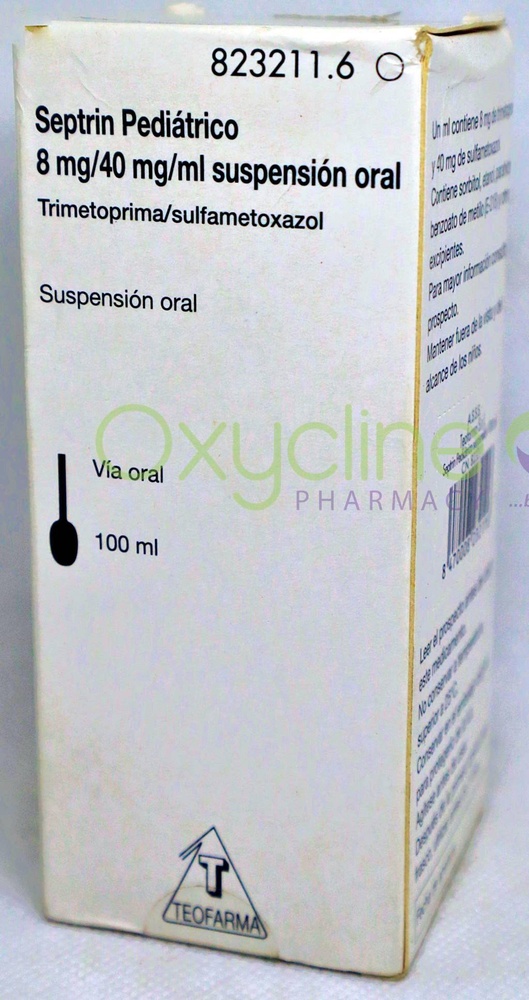
- Septrin Pediatric 8 mg/40 mg/ml oral suspension.
Container with 100 ml.
Date of the Last Revision of this Leaflet: July 2025
Detailed and updated information on this medication is available on the website of the Spanish Agency for Medicines and Health Products (AEMPS) http://www.aemps.gob.es/
- Country of registration
- Average pharmacy price7.24 EUR
- Active substance
- Prescription requiredYes
- Manufacturer
- This information is for reference only and does not constitute medical advice. Always consult a doctor before taking any medication. Oladoctor is not responsible for medical decisions based on this content.
- Alternatives to SEPTRIN 80 mg/400 mg TABLETSDosage form: TABLET, 160 mg trimethoprim; 800 mg sulfamethoxazoleActive substance: sulfamethoxazole and trimethoprimManufacturer: Teofarma S.R.L.Prescription requiredDosage form: TABLET, 20 trimethoprim; 100 mg sulfamethoxazoleActive substance: sulfamethoxazole and trimethoprimManufacturer: Teofarma S.R.L.Prescription requiredDosage form: ORAL SOLUTION/SUSPENSION, 200 mg sulfamethoxazole; 40 mg trimethoprimActive substance: sulfamethoxazole and trimethoprimManufacturer: Teofarma S.R.L.Prescription required
Online doctors for SEPTRIN 80 mg/400 mg TABLETS
Discuss questions about SEPTRIN 80 mg/400 mg TABLETS, including use, safety considerations and prescription review, subject to medical assessment and local regulations.











Frequently Asked Questions
