


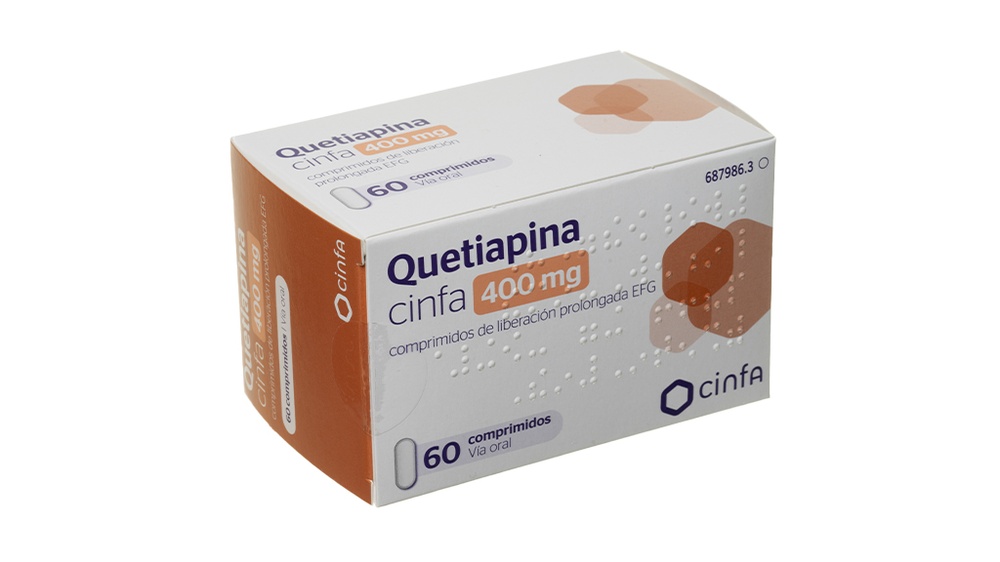
QUETIAPINE CINFA 400 mg PROLONGED-RELEASE TABLETS



How to use QUETIAPINE CINFA 400 mg PROLONGED-RELEASE TABLETS
Translated with AI
This page provides general information and does not replace a doctor’s consultation. Always consult a doctor before taking any medication. Seek urgent medical care if symptoms are severe.
Show originalContents of the leaflet
Introduction
Package Leaflet: Information for the Patient
quetiapine cinfa 400 mg prolonged-release tablets EFG
Quetiapine
Read all of this leaflet carefully before you start taking this medicine because it contains important information for you.
- Keep this leaflet, you may need to read it again.
- If you have any further questions, ask your doctor or pharmacist.
- This medicine has been prescribed for you only. Do not pass it on to others. It may harm them, even if their signs of illness are the same as yours.
- If you get any side effects, talk to your doctor or pharmacist. This includes any possible side effects not listed in this leaflet. See section 4.
Contents of the pack:
- What is quetiapine cinfa and what is it used for
- What you need to know before you take quetiapine cinfa
- How to take quetiapine cinfa
- Possible side effects
- Storage of quetiapine cinfa
- Contents of the pack and other information
1. What is quetiapine cinfa and what is it used for
quetiapine cinfa contains a substance called quetiapine. It belongs to a group of medicines called antipsychotics. quetiapine cinfa can be used to treat several diseases, such as:
- Bipolar depression and major depressive episodes in major depressive disorder: for which you feel sad. You may find that you feel depressed, feel guilty, lack energy, lose appetite, or cannot sleep.
- Mania: for which you may feel very excited, euphoric, agitated, enthusiastic, or hyperactive, or show poor judgment, including being aggressive or violent.
- Schizophrenia: for which you may hear or feel things that are not there, believe things that are not true, or feel abnormally suspicious, anxious, confused, guilty, tense, or depressed.
When quetiapine cinfa is used to treat major depressive episodes in major depressive disorder, it will be taken in addition to another medication that is being used to treat this disease.
Your doctor may continue to prescribe quetiapine cinfa even when you are feeling better.

2. What you need to know before you take quetiapine cinfa
Do not take quetiapine cinfa
- if you are allergic to quetiapine or any of the other ingredients of this medicine (listed in section 6).
- if you are taking any of the following medicines:
- Some medicines for HIV.
- Medicines of the azole type (for fungal infections).
- Erythromycin or clarithromycin (for infections).
- Nefazodone (for depression).
If you are in doubt, consult your doctor or pharmacist before taking quetiapine.
Warnings and precautions
Consult your doctor or pharmacist before starting to take quetiapine cinfa:
- if you, or a family member, have or have had any heart problems, such as heart rhythm problems, muscle weakness, or heart inflammation, or if you are taking any medication that may affect your heart rate.
- if you have low blood pressure.
- if you have had a stroke, especially if you are an elderly patient.
- if you have liver problems.
- if you have ever had a seizure (convulsion).
- if you suffer from depression or other conditions that are treated with antidepressants. The use of these medications along with quetiapine cinfa may cause serotonin syndrome, a potentially life-threatening condition (see "Other medications and quetiapine cinfa").
- if you have diabetes or are at risk of developing diabetes. If so, your doctor may monitor your blood sugar levels while you are taking quetiapine cinfa.
- if you know you have had low white blood cell counts in the past (which may or may not have been caused by other medications).
- if you are an elderly patient with dementia (loss of brain function). If so, you should not take quetiapine cinfa because the group of medications to which quetiapine belongs may increase the risk of stroke, or in some cases the risk of death, in elderly patients with dementia.
- if you are an elderly patient with Parkinson's disease/parkinsonism.
- if you or a family member have a history of blood clots, as medications like this have been associated with the formation of blood clots.
- if you have or have had a condition in which your breathing is interrupted for short periods during normal nighttime sleep (called "sleep apnea") and are taking medications that decrease normal brain activity ("depressants").
- if you have or have had a condition in which you cannot completely empty your bladder (urinary retention), have an enlarged prostate, an obstruction in your intestine, or high pressure inside your eye. These conditions may be caused by medications (called "anticholinergics") that affect how nerve cells work, to treat certain medical conditions.
- if you have a history of alcohol or drug abuse.
Tell your doctor immediately if you experience any of the following after taking quetiapine cinfa:
- Combination of fever, severe muscle stiffness, sweating, or a decrease in the level of consciousness (a disorder called "neuroleptic malignant syndrome"). Immediate medical treatment may be necessary.
- Rapid and irregular heartbeats, even when at rest, palpitations, breathing problems, chest pain, or unexplained fatigue. Your doctor should examine your heart and, if necessary, refer you to a cardiologist immediately.
- Uncontrolled movements, mainly of your face or tongue.
- Dizziness or feeling very drowsy. This can increase the risk of accidental injuries (falls) in elderly patients.
- Seizures (convulsions).
- Prolonged and painful erection (priapism).
These disorders can be caused by this type of medication.
Tell your doctor as soon as possible if you experience:
- Fever, pseudo-flu syndrome, sore throat, or any other infection that could be the result of a low white blood cell count, which may require discontinuation of treatment with quetiapine cinfa and/or additional treatment.
- Constipation with persistent abdominal pain, or constipation that has not responded to treatment, which can lead to more serious intestinal blockage problems.
Suicidal thoughts and worsening of your depression
If you are depressed, you may sometimes think about harming yourself or committing suicide. This can increase when you first start treatment, as all these medications take time to work, usually around two weeks, but sometimes more. These thoughts can also increase if you stop taking your medication abruptly.
You may be more likely to think this way if you are a young adult. Information from clinical trials has shown an increased risk of suicidal thoughts and/or suicidal behavior in young adults under 25 years of age with depression.
If at any time you think about harming yourself or committing suicide, contact your doctor or go to a hospital immediately. It may be helpful to tell a family member or close friend that you are depressed and ask them to read this leaflet. You can ask them to tell you if they think your depression is getting worse, or if they are concerned about changes in your behavior.
Severe skin reactions (SCARs)
With the use of this medication, very rare severe skin reactions (SCARs) have been reported, which can be life-threatening or fatal. These are commonly manifested as:
- Stevens-Johnson syndrome (SSJ), a widespread rash with blisters and peeling of the skin, particularly around the mouth, nose, eyes, and genitals.
- Toxic epidermal necrolysis (TEN), a more severe form that causes extensive peeling of the skin.
- Drug reaction with eosinophilia and systemic symptoms (DRESS), which consists of flu-like symptoms with a rash, fever, swollen lymph nodes, and abnormal blood test results (including an increase in the number of white blood cells (eosinophilia) and elevated liver enzymes).
- Acute generalized exanthematous pustulosis (AGEP), small pus-filled blisters.
- ERYthema multiforme (EM), skin rashes with irregular red patches that itch.
If you develop these symptoms, stop using quetiapine and contact your doctor or seek medical attention immediately.
Weight gain
Weight gain has been observed in patients taking quetiapine. You and your doctor should monitor your weight regularly.
Children and adolescents
quetiapine cinfa is not indicated for use in children or adolescents under 18 years of age.
Other medications and quetiapine cinfa
Tell your doctor if you are taking, have recently taken, or might take any other medications.
Do not take quetiapine cinfa if you are using any of the following medications:
- Some medications for HIV.
- Medicines of the azole type (for fungal infections).
- Erythromycin or clarithromycin (for infections).
- Nefazodone (for depression).
Tell your doctor if you are using any of the following medications:
- Medications for epilepsy (such as phenytoin or carbamazepine).
- Medications for high blood pressure.
- Barbiturates (for difficulty sleeping).
- Thioridazine or lithium (other antipsychotic medications).
- Antidepressants. These medications can interact with quetiapine cinfa, and you may experience symptoms such as involuntary muscle contractions and rhythmic movements of the muscles, including the muscles that control eye movement, agitation, hallucinations, coma, excessive sweating, tremors, exaggerated reflexes, increased muscle tension, and body temperature above 38°C (serotonin syndrome). Contact your doctor if you experience these symptoms.
- Medications that affect your heart rate, such as medications that can cause an imbalance in electrolytes (low potassium or magnesium levels), such as diuretics (medications to urinate) or certain antibiotics (medications to treat infections).
- Medications that can cause constipation.
- Medications (called "anticholinergics") that affect how nerve cells work, to treat certain medical conditions.
Before stopping any of your medications, consult your doctor first.
quetiapine cinfa with food, drinks, and alcohol
- quetiapine cinfa may be affected by food, and therefore, you should take your tablets at least one hour before a meal or before bedtime.
- Be careful with the amount of alcohol you drink. This is because the combined effect of quetiapine cinfa and alcohol can make you drowsy.
- Do not drink grapefruit juice while taking quetiapine cinfa. It can affect how the medication works.
Pregnancy and breastfeeding
If you are pregnant or breastfeeding, think you may be pregnant, or plan to become pregnant, consult your doctor before using this medication. You should not take quetiapine cinfa during pregnancy, unless your doctor has advised you to do so. You should not use quetiapine cinfa if you are breastfeeding.
The following symptoms, which may represent withdrawal symptoms, may occur in the newborn baby, whose mothers have taken quetiapine in the third trimester of pregnancy (last three months of pregnancy): tremors, muscle stiffness and/or weakness, drowsiness, agitation, breathing problems, and difficulty feeding. If your baby develops any of these symptoms, you may need to contact your doctor.
Driving and using machines
quetiapine cinfa can cause symptoms such as drowsiness, dizziness, or changes in vision, and can reduce your reaction ability. These effects, as well as the disease itself, can make it difficult for you to drive vehicles or operate machines. Therefore, do not drive, operate machines, or engage in other activities that require special attention until your doctor assesses your response to this medication.
Effect on drug detection tests in urine
If you are undergoing a urine drug detection test, quetiapine cinfa may produce positive results for methadone or certain antidepressant medications called tricyclic antidepressants (TCAs) when some analysis methods are used, even if you are not taking methadone or TCAs. If this occurs, a more specific test can be performed.
quetiapine cinfa contains sodium
This medication contains less than 1 mmol of sodium (23 mg) per tablet; that is, it is essentially "sodium-free".
3. How to take quetiapine cinfa
Follow the administration instructions of this medication exactly as indicated by your doctor. In case of doubt, consult your doctor or pharmacist again. Your doctor will decide your initial dose. The maintenance dose (daily dose) will depend on your disease and needs, but it will usually be between 150 mg and 800 mg.
- You will take your tablets once a day.
- Do not split, chew, or crush the tablets.
- Swallow your tablets whole with the help of water.
- Take the tablets without food (at least one hour before a meal or at bedtime, your doctor will indicate when).
- Do not drink grapefruit juice while taking quetiapine cinfa. It can affect how the medication works.
- Do not stop taking your tablets even if you feel better, unless your doctor tells you to.
Liver problems
If you have liver problems, your doctor may change your dose.
Elderly patients
If you are an elderly patient, your doctor may change your dose.
Use in children and adolescents
quetiapine cinfa should not be used by children and adolescents under 18 years of age.
If you take more quetiapine cinfa than you should
If you take more quetiapine cinfa than your doctor has prescribed, you may feel drowsy, dizzy, and experience abnormal heartbeats. In case of overdose or accidental ingestion, consult your doctor or pharmacist immediately or call the Toxicology Information Service, Telephone 915 620 420, indicating the medication and the amount ingested. Bring the quetiapine cinfa tablets with you.
If you forget to take quetiapine cinfa
If you forget to take a dose, take it as soon as you remember. If it is close to the time for your next dose, wait until then. Do not take a double dose to make up for forgotten doses.
If you stop taking quetiapine cinfa
If you stop taking quetiapine cinfa abruptly, you may be unable to sleep (insomnia), or you may feel nauseous, or you may experience headaches, diarrhea, vomiting, dizziness, or irritability.
Your doctor may suggest reducing the dose gradually before stopping treatment.
If you have any other questions about the use of this medication, ask your doctor or pharmacist.

4. Possible Adverse Effects
Like all medicines, this medicine can cause adverse effects, although not all people suffer from them.
If you experience any of the following serious adverse effects, stop taking quetiapine cinfaand go to your doctor or the nearest hospital:
Adverse EffectsFrequently(may affect up to 1 in 10 people)
- Suicidal thoughtsand worsening of your depression.
Adverse Effects Less Frequently(may affect up to 1 in 100 people)
- Sudden fever, especially with irritated throatand other flu-like symptoms.This may be due to an abnormally low concentration of white blood cells.
- Skin reactionssuch as rash, hives, bumps, redness, itching, possibly with swelling of the face, eyelids, and lips. This can also cause difficulty breathing, dizziness, or shock.
- Seizuresor convulsions.
- Uncontrolled movements, mainly of the face or tongue (tardive dyskinesia).
- Sensation that the heart is poundingor beating rapidlyalong with dizziness or fainting. These can be symptoms of serious heart rhythm problems and in severe cases could be fatal.
Adverse Effects Rarely(may affect up to 1 in 1,000 people)
- Sharp pain and/or swellingand redness in one leg; sudden sharp painin the chestthat can spread to the left arm or sudden shortness of breath. This may be due to blood clots in the veins.
- Sharp pain in the upper abdomen, which can spread to the back, causing nausea and vomitingin some cases. This may be a symptom of pancreas inflammation.
- Constipation with persistent abdominal painor constipation that does not respond to treatment and can lead to a more serious bowel obstruction.
- Yellowing of the skin and eyes(jaundice), dark urine, along with unusual fatigue or fever (symptom of hepatitis).
- Prolonged and painful erection.
- A combination of fever, sweating, muscle stiffness, feeling very dizzy or weak (a disorder called "neuroleptic malignant syndrome").
Adverse Effects Very Rarely(may affect up to 1 in 10,000 people)
- Severe skin reactions with rash or blisters, irregular red spots and/or peeling of the skin, around the mouth, eyes, or genitals, often with feveror flu-like symptoms. These reactions can appear rapidly.
- Muscle painunexpectedly, sensitivity, or weakness. These can be the first symptoms of severe muscle degradation.
Unknown(frequency cannot be estimated from available data)
- Rapid appearance of areas of red skin with small pus-filled blisters (small blisters filled with white/yellow liquid known as Acute Generalized Exanthematous Pustulosis (AGEP). See section 2.
- Skin rash with irregular red spots (erythema multiforme). See section 2.
- Heart muscle disorder (cardiomyopathy)
- Inflammation of the heart muscle (myocarditis)
- Condition with deficient blood flow in the brain (stroke). Typical signs can be the sudden appearance of facial drooping, weakness in the arms, difficulty speaking, and inability to move or feel on one side of the body.
Drug rash with eosinophilia and systemic symptoms (DRESS, for its acronym in English): Generalized rash, elevated body temperature, elevated liver enzymes, blood abnormalities (eosinophilia), enlarged lymph nodes, and other organs involved (drug rash with eosinophilia and systemic symptoms, also known as DRESS). If you develop these symptoms, stop using quetiapine and contact your doctor or seek immediate medical attention.
Do not worry if you see a tablet in your stoolafter taking quetiapine cinfa. As the tablet passes through the gastrointestinal tract, quetiapine is slowly released. The tablet form remains undissolved and is eliminated in the stool. Therefore, even if you see a tablet in your stool, your dose of quetiapine has been absorbed.
Other Possible Adverse Effects:
Adverse Effects Very Frequently(may affect more than 1 in 10 people)
- Dizziness (could lead to falls), headache, dry mouth.
- Feeling of drowsiness (which may disappear over time as you continue taking quetiapine cinfa) (could lead to falls).
- Withdrawal symptoms (symptoms that occur when you stop taking quetiapine cinfa) include being unable to sleep (insomnia), feeling nauseous, headache, diarrhea, vomiting, dizziness, and irritability. A gradual withdrawal over a period of at least 1 to 2 weeks is advised.
- Weight gain.
- Abnormal muscle movements. This includes difficulty starting muscle movements, tremors, feeling of restlessness, or muscle stiffness without pain.
- Decrease in hemoglobin levels (protein of red blood cells that carries oxygen).
- Increase in certain fats (triglycerides and total cholesterol).
Adverse EffectsFrequently(may affect up to 1 in 10 people)
- Rapid heartbeat.
- Feeling that the heart is pounding, beating rapidly, or has irregular beats.
- Constipation, upset stomach (indigestion).
- Feeling of weakness.
- Swelling of arms or legs.
- Low blood pressure when standing. This can make you feel dizzy or faint (could lead to falls).
- Increased blood sugar levels.
- Blurred vision.
- Abnormal dreams and nightmares.
- Feeling more hungry.
- Feeling irritable.
- Disorder in speech and language.
- Difficulty breathing.
- Vomiting (mainly in elderly patients).
- Fever.
- Changes in the amount of thyroid hormones in the blood.
- Changes in the amount of certain blood cells.
- Increased amount of liver enzymes in the blood.
- Increased amount of prolactin hormone in the blood. This increase in prolactin could, in rare cases, lead to the following:
- Both men and women having breast swelling and unexpected milk production.
- In women, not having menstrual periods or having irregular periods.
Adverse Effects Less Frequently(may affect up to 1 in 100 people)
- Unpleasant sensations in the legs (also called restless legs syndrome).
- Difficulty swallowing.
- Sexual dysfunction.
- Diabetes.
- Slower than normal heart rate that could occur when treatment is started and could be associated with low blood pressure and fainting.
- Difficulty urinating.
- Fainting (could lead to falls).
- Stuffy nose.
- Decrease in the amount of sodium in the blood.
- Worsening of pre-existing diabetes.
- Confusion.
Adverse Effects Rarely(may affect up to 1 in 1,000 people)
- Breast swelling and unexpected milk production (galactorrhea).
- Menstrual disorder.
- Walking, talking, eating, or other activities while sleeping.
- Decrease in body temperature (hypothermia).
- A condition (called "metabolic syndrome") where you may have a combination of 3 or more of the following: increased fat around the abdomen, decreased "good" cholesterol (HDL-C), increased triglycerides in your blood, high blood pressure, and increased blood sugar.
- Increased creatine phosphokinase in the blood (substance from muscles).
Adverse Effects Very Rarely(may affect up to 1 in 10,000 people)
- Inappropriate secretion of a hormone that controls urine volume.
Unknown(frequency cannot be estimated from available data)
- Withdrawal symptoms could occur in newborns of mothers who have used quetiapine cinfa during pregnancy.
- Inflammation of blood vessels (vasculitis), often with skin rash with small red or purple spots.
Some adverse effects are only observed when a blood test is performed. These include changes in the amount of certain fats (triglycerides and total cholesterol) or sugar in the blood, changes in the amount of thyroid hormones in the blood, increased liver enzymes, decreased number of certain types of blood cells, decreased number of red blood cells, increased creatine phosphokinase in the blood (a substance from muscles), decreased sodium in the blood, and an increase in the amount of prolactin hormone in the blood.
The increases in prolactin hormone could, in rare cases, lead to the following:
- Both men and women having breast swelling and unexpected milk production.
- In women, not having menstrual periods or having irregular periods.
Your doctor may ask you to have blood tests from time to time.
Adverse Effects in Children and Adolescents
The same adverse effects that can occur in adults can also occur in children and adolescents.
The following adverse effects have been observed more frequently in children and adolescents or have not been observed in adults:
Adverse Effects Very Frequently(may affect more than 1 in 10 people)
- Increased amount of a hormone called prolactin in the blood. The increases in prolactin hormone could, in rare cases, lead to the following:
- Both boys and girls having breast swelling and unexpected milk production.
- In girls, not having menstrual periods or having irregular periods.
- Increased appetite.
- Vomiting.
- Abnormal muscle movements. This includes difficulty starting muscle movements, tremors, feeling of restlessness, or muscle stiffness without pain.
- Increased blood pressure.
Adverse EffectsFrequently(may affect up to 1 in 10 people)
- Feeling of weakness, fainting (could lead to falls).
- Stuffy nose.
- Feeling of irritability.
Reporting Adverse Effects
If you experience any type of adverse effect, consult your doctor or pharmacist, even if it is a possible adverse effect that does not appear in this leaflet. You can also report them directly through the Spanish Pharmacovigilance System for Human Use Medicines: https://www.notificaram.es. By reporting adverse effects, you can contribute to providing more information on the safety of this medicine.
5. Storage of Qutiapine Cinfa
Keep this medicine out of sight and reach of children.
Do not use this medicine after the expiration date that appears on the packaging and on the blister after CAD. The expiration date is the last day of the month indicated.
Store in the original packaging to protect it from moisture.
This medicine does not require any special storage temperature.
After the first opening of the HDPE bottle, the product must be used within 60 days.
Medicines should not be thrown away through wastewater or household waste. Deposit the packaging and medicines you no longer need in the SIGRE Point of the pharmacy. In case of doubt, ask your pharmacist how to dispose of the packaging and medicines you no longer need. This way, you will help protect the environment.
6. Package Contents and Additional Information
Composition of Qutiapine Cinfa
- The active ingredient is quetiapine. Qutiapine Cinfa tablets contain 400 mg of quetiapine (as quetiapine fumarate).
- The other components (excipients) are:
Core: hypromellose, microcrystalline cellulose, anhydrous sodium citrate, magnesium stearate. Coating: titanium dioxide (E171), hypromellose, macrogol/PEG 400, and polysorbate 80.
Appearance of the Product and Package Contents
Qutiapine Cinfa 400 mg prolonged-release tablets EFG
They are coated tablets, white, biconvex, oblong, and engraved with "Q 400" on one side.
Packaging of 10, 20, 30, 50, 50x1 (perforated unit-dose blister) (hospital packaging), 56 (calendar packaging), 60, 90, and 100 tablets.
HDPE bottles containing 60 tablets.
Not all packaging sizes may be marketed.
Marketing Authorization Holder and Manufacturer
Marketing Authorization Holder
Laboratorios Cinfa, S.A.
Carretera Olaz-Chipi, 10. Polígono Industrial Areta.
31620 Huarte (Navarra) - Spain
Manufacturer
TEVA Pharmaceutical Works Private Limited Company
Pallagi út 13, H-4042 Debrecen
Hungary
Pharmachemie B.V.
Swensweg 5, P.O. Box 552 NL 2003 RN Haarlem
Netherlands
Teva Czech Industries s.r.o.
Ostravska 29, c.p. 305, Building No 80 Small OSD and Building No 881 NOSD
74770 Opava-Komarov
Czech Republic
TEVA OPERATIONS POLAND SP.Z.O.O.
ul. Mogilska 80, 31-546, Krakow
Poland
Teva Pharma, S.L.U.
C/C, n. 4, Polígono Industrial Malpica, 50016 Zaragoza
Spain
Merckle GmbH
Ludwig-Merckle-Straße 3, 89143 Blaubeuren
Germany
Date of the Last Revision of thisLeaflet:June 2024
Detailed and updated information on this medicine is available on the website of the Spanish Agency for Medicines and Health Products (AEMPS) http://www.aemps.gob.es/
You can access detailed and updated information about this medicine by scanning the QR code included in the leaflet and packaging with your mobile phone (smartphone). You can also access this information at the following internet address: https://cima.aemps.es/cima/dochtml/p/75503/P_75503.html
QR code to: https://cima.aemps.es/cima/dochtml/p/75503/P_75503.html
- Country of registration
- Average pharmacy price129.63 EUR
- Prescription requiredYes
- Manufacturer
- This information is for reference only and does not constitute medical advice. Always consult a doctor before taking any medication. Oladoctor is not responsible for medical decisions based on this content.
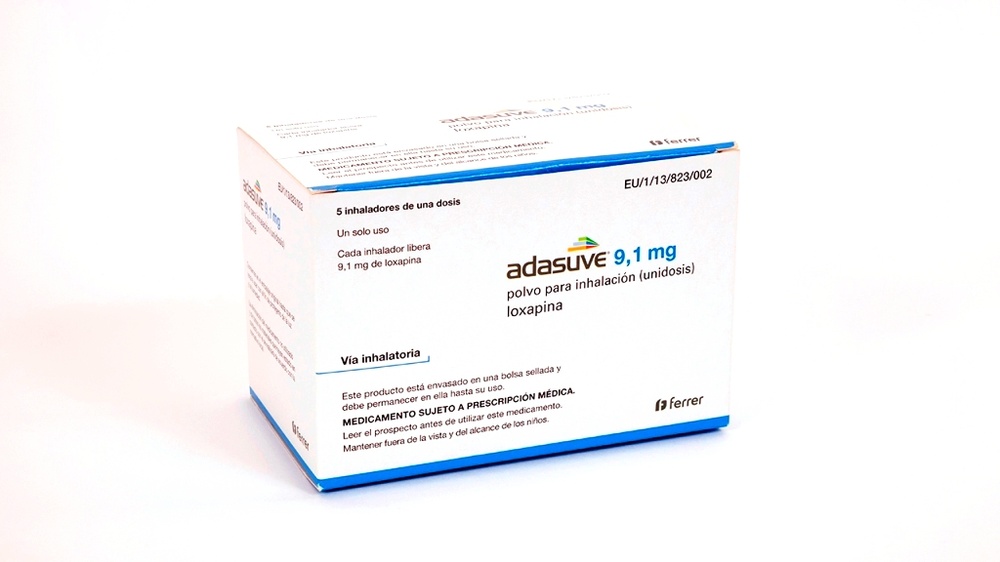
- Alternatives to QUETIAPINE CINFA 400 mg PROLONGED-RELEASE TABLETSDosage form: PULMONARY INHALATION, 9.1 mgActive substance: loxapineManufacturer: Ferrer Internacional S.A.Prescription requiredDosage form: PULMONARY INHALATION, 9.1 mgActive substance: loxapineManufacturer: Ferrer Internacional S.A.Prescription requiredDosage form: TABLET, 100 mgActive substance: clozapineManufacturer: Aristo Pharma GmbhPrescription required
Online doctors for QUETIAPINE CINFA 400 mg PROLONGED-RELEASE TABLETS
Discuss questions about QUETIAPINE CINFA 400 mg PROLONGED-RELEASE TABLETS, including use, safety considerations and prescription review, subject to medical assessment and local regulations.











Frequently Asked Questions
