


POTASSIUM GRIFOLS 0.02 mEq/ml IN 3.3% GLUCOSE AND 0.3% SODIUM CHLORIDE PERFUSION SOLUTION



How to use POTASSIUM GRIFOLS 0.02 mEq/ml IN 3.3% GLUCOSE AND 0.3% SODIUM CHLORIDE PERFUSION SOLUTION
Translated with AI
This page provides general information and does not replace a doctor’s consultation. Always consult a doctor before taking any medication. Seek urgent medical care if symptoms are severe.
Show originalContents of the leaflet
- Introduction
- What Potassium Grifols 0.02 mEq/ml in Glucose 3.3% and Sodium Chloride 0.3% Solution for Infusion is and what it is used for
- What you need to know before you use Potassium Grifols 0.02 mEq/ml in Glucose 3.3% and Sodium Chloride 0.3% Solution for Infusion
- How to use Potassium Grifols 0.02 mEq/ml in Glucose 3.3% and Sodium Chloride 0.3% Solution for Infusion
- Possible Adverse Effects
- Conservation of Potassium Grifols 0.02 mEq/ml in Glucose 3.3% and Sodium Chloride 0.3% Solution for Perfusion
- Package Contents and Additional Information
Introduction
Package Leaflet: Information for the User
Potassium Grifols 0.02 mEq/ml in Glucose 3.3% and Sodium Chloride 0.3% Solution for Infusion
Potassium chloride, Glucose, Sodium chloride
Read all of this leaflet carefully before you start using this medicine because it contains important information for you.
- Keep this leaflet, you may need to read it again.
- If you have any further questions, ask your doctor or nurse.
- If you get any side effects, talk to your doctor or nurse. This includes any possible side effects not listed in this leaflet. See section 4.
Contents of the pack
- What Potassium Grifols 0.02 mEq/ml in Glucose 3.3% and Sodium Chloride 0.3% Solution for Infusion is and what it is used for
- What you need to know before you use Potassium Grifols 0.02 mEq/ml in Glucose 3.3% and Sodium Chloride 0.3% Solution for Infusion
- How to use Potassium Grifols 0.02 mEq/ml in Glucose 3.3% and Sodium Chloride 0.3% Solution for Infusion
- Possible side effects
- Storage of Potassium Grifols 0.02 mEq/ml in Glucose 3.3% and Sodium Chloride 0.3% Solution for Infusion
- Contents of the pack and further information
1. What Potassium Grifols 0.02 mEq/ml in Glucose 3.3% and Sodium Chloride 0.3% Solution for Infusion is and what it is used for
This medicine contains the following active substances: potassium chloride, glucose (as monohydrate) and sodium chloride. This medicine is a solution for infusion and will be administered to you by a vein through a thin tube.
This medicine belongs to a group of medicines called intravenous solutions that affect the electrolyte balance - electrolytes with carbohydrates (used to maintain body fluids in correct balance).
This medicine is indicated for the prevention or treatment of lack of potassium (an electrolyte) in your body, when you require a supply of water, electrolytes, and carbohydrates because dietary measures or oral medication are inadequate.

2. What you need to know before you use Potassium Grifols 0.02 mEq/ml in Glucose 3.3% and Sodium Chloride 0.3% Solution for Infusion
Do not usePotassium Grifols 0.02 mEq/ml in Glucose 3.3% and Sodium Chloride 0.3%Solution for Infusion
- if you are allergic to potassium chloride, glucose or sodium chloride or any of the other components of this medicine (listed in section 6)
- if your blood potassium levels are high (hyperkalemia)
- if you have severe kidney disease with oliguria (reduced urine excretion), anuria (absence of urine production) or azotemia (presence of excess nitrogen waste in the blood due to kidney failure)
- if your blood chloride levels are high (hyperchloremia)
- if your blood sodium levels are high (hypernatremia)
- if you suffer from states of hyperhydration (excess water in the body)
- if you suffer from states of hyperglycemia (high blood glucose levels) such as in cases of hyperosmolar coma, decompensated diabetes or other glucose intolerance as in situations of metabolic stress
- if you suffer from renal tubular acidosis (kidney function disorder)
- if you have had an acute ischemic stroke (sudden loss of brain function due to a blockage in blood flow)
- within the first 24 hours after a head injury.
Warnings and precautions
Consult your doctor or nurse before starting to use Potassium Grifols 0.02 mEq/ml in Glucose 3.3% and Sodium Chloride 0.3% Solution for Infusion.
- Potassium administration should always be carried out under strict medical supervision. During administration of this medicine, and in order to detect early signs of excessive potassium levels (hyperkalemia), your doctor will monitor your heart with electrocardiograms and perform periodic blood tests to determine potassium levels in the blood, especially:
- if you have any heart or kidney disease, or other situations that may favor the appearance of hyperkalemia
- if you are taking other medicines that may increase potassium levels in the blood (see next subsection).
- Your doctor should exercise extreme caution if you are receiving digitalis, especially when stopping potassium administration, since a rapid decrease in potassium levels can cause digitalis toxicity. In these cases, potassium treatment should not be stopped abruptly.
- Potassium solution should only be administered if you have adequate urine flow. If not, you may need to be administered a solution that does not contain potassium.
- Your doctor will perform frequent medical and laboratory tests to monitor changes in fluid and acid-base balance and electrolyte and glucose levels in the blood.
- This medicine can become physiologically hypotonic in the body due to the rapid metabolism of glucose (see section 3).
- Depending on the volume and rate of infusion, your initial clinical condition, and your ability to metabolize glucose, intravenous administration of this type of solution may cause electrolyte disturbances such as hyponatremia (low sodium levels in the blood).
Hyponatremia:
If you are a patient with non-osmotic vasopressin release (e.g., in critical states, pain, postoperative stress, infections, burns, and central nervous system diseases), if you have heart, liver, and kidney disease, and if you are exposed to vasopressin agonists (see next subsection), you are at special risk of suffering from acute hyponatremia after administration of hypotonic solutions.
Acute hyponatremia can cause acute hyponatremic encephalopathy (brain edema) characterized by headache, nausea, seizures, lethargy, and vomiting. Patients with brain edema are at special risk of suffering from severe, irreversible, and potentially fatal brain damage.
Children, women of childbearing age, and patients with reduced brain distensibility (e.g., in cases of meningitis, intracranial hemorrhage, and brain contusion) are at special risk of suffering from severe and potentially fatal brain edema caused by acute hyponatremia.
- If you are in an emergency situation and your blood potassium levels are very low or if you are taking digitalis medications, it is not recommended to administer glucose solutions since the presence of glucose prevents potassium levels from increasing as quickly as they should.
- If you suffer from episodes of intracranial hypertension, your doctor will closely monitor your blood glucose levels.
- Since this medicine contains glucose, it should be administered with caution if you have a vitamin B1 deficiency or diabetes. Your doctor may give you this medicine as long as you have previously received appropriate treatment.
- Since this medicine contains sodium, it should be administered with caution if you have hypertension, congestive heart failure, pulmonary or peripheral edema, renal insufficiency, preeclampsia (development of hypertension during pregnancy), or other conditions associated with sodium retention, as well as if you are taking corticosteroids or corticotropin (see next subsection).
- This medicine should be administered with special caution if you are elderly, as you may be taking other medicines (see next subsection) or your kidneys or heart may not be functioning properly, or you may have other diseases that can affect potassium levels in the blood.
- If administration is prolonged, extravasation (leakage of the solution from the vein into the surrounding tissue) or thrombophlebitis (inflammation of the vein associated with clot formation) may occur.
Other medicines and Potassium Grifols 0.02 mEq/ml in Glucose 3.3% and Sodium Chloride 0.3% Solution for Infusion
It is very important that you inform your doctor if you are taking or have recently taken any of the following medicines:
? Medicines that may cause the amount of potassium in the blood to be too high due to an addition of effects, particularly if your kidneys are not functioning properly:
- Potassium-sparing diuretics (amiloride, triamterene, spironolactone, eplerenone)
- Angiotensin-converting enzyme inhibitors (ACE inhibitors) (such as captopril, enalapril, lisinopril)
- Angiotensin II receptor antagonists (candesartan, telmisartan, eprosartan, irbesartan, losartan, valsartan)
- Medicines that contain potassium such as potassium salts of penicillin
- Non-steroidal anti-inflammatory drugs (NSAIDs) (diclofenac, indomethacin, piroxicam, mefenamic acid, celecoxib)
- Heparin
- Pentamidine, trimethoprim
- Cyclosporine, tacrolimus
- Beta-blockers (propranolol, nadolol, atenolol)
- Succinylcholine (suxamethonium)
? Medicines that may reduce potassium levels in the blood, so higher doses of potassium may be needed:
- Corticosteroids
- Diuretics (loop diuretics, thiazides and related diuretics, osmotic diuretics, carbonic anhydrase inhibitors)
- High doses of penicillins
- Aminoglycosides
- Cisplatin
- Foscarnet
- Amphotericin B
- Theophylline
- Insulin
- Folic acid and vitamin B12
- Beta-2 adrenergic agonists
? Digitalis glycosides (digoxin and methyldigoxin) (high potassium levels can reduce their effect and a sudden decrease in these levels can cause digitalis toxicity)
? Antiarrhythmic medicines (such as quinidine, hydroquinidine, procainamide) (high potassium levels increase their activity and low potassium levels reduce their effectiveness)
? Lithium carbonate (sodium can accelerate the renal excretion of lithium, leading to a decrease in its therapeutic effect)
? Mineralocorticoid corticosteroids (such as fludrocortisone) or ACTH (corticotropin) (these medicines favor water and sodium retention)
? Glucocorticoid corticosteroids (such as hydrocortisone) (these medicines can cause high blood glucose levels)
? Insulin and oral antidiabetics (biguanides, sulfonylureas) (glucose can reduce their effect).
- Medicines that increase the effect of antidiuretic hormone (such as chlorpropamide, clofibrate, carbamazepine, vincristine, selective serotonin reuptake inhibitors, 3,4-methylenedioxymethamphetamine, ifosfamide, antipsychotics, narcotics, NSAIDs, cyclophosphamide, desmopressin, oxytocin, vasopressin, terlipressin). These medicines reduce water excretion in urine and increase the risk of hospital hyponatremia after inadequately balanced treatment with intravenous infusion solutions (see previous subsection and sections 3 and 4)
- Diuretics in general and antiepileptics such as oxcarbazepine, which can increase the risk of hyponatremia.
Tell your doctor if you are using, have recently used, or might use any other medicines.
Pregnancy and breastfeeding
If you are pregnant or breastfeeding, think you may be pregnant, or are planning to have a baby, ask your doctor for advice before using this medicine.
The safety of its use during pregnancy and breastfeeding has not been established. Therefore, it should only be used when the benefits clearly outweigh the potential risks to the fetus or baby.
Maternal administration of large amounts of glucose-containing solutions during labor, especially in complicated deliveries, may cause hyperglycemia, hyperinsulinemia (high insulin levels in the blood), and acidosis in the fetus and, consequently, may be harmful to the newborn.
This medicine should be administered with special caution in pregnant women during labor, especially if administered in combination with oxytocin, due to the risk of hyponatremia (see previous subsections and section 4).
Because this medicine contains sodium chloride, special precautions should be taken in cases of preeclampsia during pregnancy.
If you are pregnant or breastfeeding, your doctor should continuously monitor your heart and potassium levels in the blood, as incorrect levels can cause serious cardiac disorders in both the mother and the fetus or newborn.
Driving and using machines
Not relevant.
3. How to use Potassium Grifols 0.02 mEq/ml in Glucose 3.3% and Sodium Chloride 0.3% Solution for Infusion
This medicine will be administered to you by a doctor or nurse in a hospital through a vein by drip (slow intravenous infusion).
Your doctor will decide the dose you should receive, taking into account the severity of the hypokalemia, your age, weight, and clinical condition (especially if you have any heart or kidney disease), and how long you need to receive it.
You may need to be monitored for fluid balance, serum glucose, serum sodium, and other electrolytes before and during administration, especially if you have an increased release of non-osmotic vasopressin (syndrome of inappropriate antidiuretic hormone secretion, SIADH) and if you receive vasopressin agonist medication simultaneously, due to the risk of hyponatremia. Monitoring of serum sodium is especially important when administering physiologically hypotonic solutions. This medicine can become hypotonic after administration due to the rapid metabolism of glucose in the body (see sections 2 and 4).
The maximum recommended dose of potassium is 2-3 mEq/kg/day. In adults, the dose of potassium should not exceed 200 mEq per day. The recommended dose to meet maintenance requirements is 40-80 mEq per day.
Your doctor will decide the amount of fluid you should receive. However, in general, you should not receive more than 40 ml/kg/day (maximum 3000 ml per day).
The amount of glucose administered with the solution should not exceed 4-5 mg/kg/min.
If your kidneys are not functioning properly, you should receive a lower dose.
As a general rule, the infusion rate should never exceed 20 mEq of potassium per hour when administered through a peripheral vein.
Oral administration of potassium supplements or ingestion of potassium-rich foods should replace intravenous administration of this medicine as soon as possible.
Use in children
In children, the dose of potassium should not exceed 3 mEq/kg/day and daily maintenance needs are 2-2.5 mEq/kg.
The recommended daily fluid dose in these patients is as follows:
- less than 10 kg of weight: 100 ml/kg
- between 10 and 20 kg of weight: 1000 ml + 50 ml/kg that exceeds 10 kg
- more than 20 kg of weight: 1500 ml + 20 ml/kg that exceeds 20 kg
If you receive more Potassium Grifols 0.02 mEq/ml in Glucose 3.3% and Sodium Chloride 0.3% Solution for Infusion than you should
Excessive administration of potassium solutions can cause hyperkalemia, which can be potentially fatal, especially if your kidneys are not functioning properly. In case of overdose, disturbances in fluid and electrolyte balance, swelling, and circulatory and cardiac disorders may also occur (see symptoms in section 4. Possible side effects).
In case of hyperkalemia, your doctor should stop administration and take the most appropriate measures to reduce potassium levels in the blood.
In case of overdose or accidental ingestion, consult the Toxicology Information Service. Phone: 915 620 420.
If you have any further questions on the use of this medicine, ask your doctor or nurse.

4. Possible Adverse Effects
Like all medicines, this medicine can cause adverse effects, although not all people suffer from them.
After administration of this medicine, hyperhydration (fluid retention), hyperglycemia, hyperchloremic acidosis (high chloride content in blood), and hyperkalemia may occur, especially if the solution is administered too quickly or in excess, or if your kidneys do not function properly. The symptoms of hyperkalemia mainly affect the nerves, muscles, and heart, and include itching or tingling of the extremities, muscle weakness, flaccid paralysis, respiratory paralysis, intestinal paralysis, mental confusion, loss of reflexes, apathy, cold skin, pallor (grayish skin tone), weakness, and heaviness of the legs, hypotension (low blood pressure), abnormalities in the electrocardiogram, cardiac arrhythmias, cardiac block, and cardiac arrest. It is very important that your doctor monitors your heart to assess the severity of possible hyperkalemia.
Patients with non-osmotic release of vasopressin, patients with heart, liver, and kidney diseases, and patients treated with vasopressin agonists have a special risk of suffering from acute hyponatremia after administration of hypotonic solutions. Hospital hyponatremia can cause irreversible brain damage and death due to the onset of cerebral edema (see sections 2 and 3).
Adverse effects derived from intravenous administration may also occur. These effects include fever, infection at the injection site, local pain, venous irritation, venous thrombosis (clot formation), inflammation, hardening, or contraction of the vein, extravasation, and necrosis (tissue death).
The following adverse effects may appear in some people:
- High levels of potassium and/or glucose in the blood, fluid retention, hyperchloremic acidosis
- Mental confusion, apathy
- Muscle weakness, itching or tingling of the extremities, loss of voluntary muscle movement (paralysis), loss of reflexes, feeling of weakness and heaviness
- Severe or total weakness of the respiratory muscles
- Intestinal obstruction due to lack of movement of the intestinal muscles
- Abnormalities in heartbeats, cardiac block, cardiac arrest
- Low sodium levels in the blood (acquired during hospitalization)
- Cerebral edema
- Infection at the injection site
- Fever
- Inflammation, hardening, or contraction of the vein where the medicine is administered, venous thrombosis, cold skin, pallor (grayish skin tone), hypotension
- Pain, irritation, extravasation, and necrosis at the injection site
- Abnormalities in the electrocardiogram.
Reporting of Adverse Effects
If you experience any type of adverse effect, consult your doctor or nurse, even if it is a possible adverse effect that is not listed in this prospectus. You can also report them directly through the Spanish Pharmacovigilance System for Human Use Medicines: www.notificaRAM.es. By reporting adverse effects, you can contribute to providing more information on the safety of this medicine.
5. Conservation of Potassium Grifols 0.02 mEq/ml in Glucose 3.3% and Sodium Chloride 0.3% Solution for Perfusion
Keep this medicine out of the sight and reach of children.
Do not use this medicine after the expiration date that appears on the packaging. The expiration date is the last day of the month indicated.
This medicine does not require special storage conditions.
Once the packaging is opened, the solution must be used immediately.
This medicine is for single use. Discard unused solution.
Do not use this medicine if you observe that the solution is not transparent or contains particles, or if the packaging is damaged.
6. Package Contents and Additional Information
Composition of Potassium Grifols 0.02 mEq/ml in Glucose 3.3% and Sodium Chloride 0.3% Solution for Perfusion
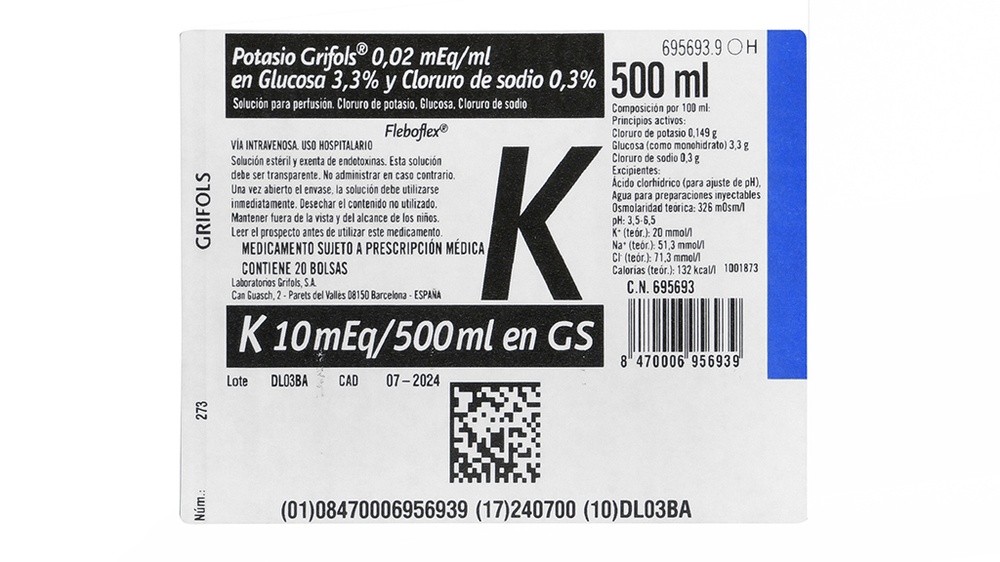
- The active ingredients are potassium chloride, glucose, and sodium chloride. Each 100 ml of this medicine contains 0.149 g of potassium chloride, 3.3 g of glucose (as monohydrate), and 0.3 g of sodium chloride.
- The other components (excipients) are hydrochloric acid (for pH adjustment) and water for injectable preparations.
Appearance of the Product and Package Contents
Potassium Grifols 0.02 mEq/ml in Glucose 3.3% and Sodium Chloride 0.3% is a solution for perfusion. It is a clear, colorless aqueous solution.
This medicine is available in flexible polypropylene bags (Fleboflex) (in boxes containing 20 bags of 500 ml or 10 bags of 1000 ml).
Marketing Authorization Holder
Grifols Laboratories, S.A.
Can Guasch, 2
08150 Parets del Vallès, Barcelona (SPAIN)
Manufacturer
LABORATORIOS GRIFOLS, S.A.
Polígono Los Llanos. C/Marte 4
30565 Las Torres de Cotillas, Murcia (SPAIN)
This medicine is authorized in the member states of the European Economic Area with the following names:
Spain | Potassium Grifols 0.02 mEq/ml in Glucose 3.3% and Sodium Chloride 0.3% Solution for Perfusion |
Portugal | Potassium Chloride 0.15% + Glucose 3.3% + Sodium Chloride 0.3% Grifols Solution for Perfusion |
Date of the Last Revision of this Prospectus:July 2018
Other Sources of Information
Detailed information about this medicine is available on the website of the Spanish Agency for Medicines and Health Products (AEMPS) (http://www.aemps.gob.es/)
---------------------------------------------------------------------------------------------------------------------------
This information is intended only for healthcare professionals:
Potassium Grifols 0.02 mEq/ml in Glucose 3.3% and Sodium Chloride 0.3% Solution for Perfusion is a ready-to-use solution that must be administered by slow perfusion.
The theoretical osmolarity of the solution is 326 mOsm/l.
Given the potassium concentration of the solution (20 mEq/l), this medicine is suitable for administration by peripheral vein. If a central vein is used, it is recommended to use the femoral vein and avoid the jugular and subclavian veins.
In general, it is recommended not to exceed 40 mEq/l by peripheral route.
Posology:
The dose and duration of treatment should be individualized for each patient, depending on the severity of hypokalemia, age, weight, and clinical condition, especially in cases of heart or kidney failure.
It may be necessary to monitor fluid balance, serum glucose, serum sodium, and other electrolytes before and during administration, especially in patients with increased non-osmotic release of vasopressin (syndrome of inappropriate antidiuretic hormone secretion, SIADH) and in patients receiving concomitant medication with vasopressin agonists, due to the risk of hyponatremia. Monitoring of serum sodium is especially important when administering physiologically hypotonic solutions. Potassium Grifols 0.02 mEq/ml in Glucose 3.3% and Sodium Chloride 0.3% may become hypotonic after administration due to the rapid metabolism of glucose in the body.
The dose and rate of administration should be determined by electrocardiographic monitoring and determination of plasma potassium.
In adults, the maximum recommended dose of potassium is 2-3 mEq/kg/day, not exceeding 200 mEq/day, with 40-80 mEq/day being the recommended dose in maintenance therapy.
The administration of fluid should be calculated for each patient based on replacement or maintenance requirements. However, in general, no more than 40 ml/kg/day (max. 3000 ml per day) should be administered.
The amount of glucose administered with the solution should not exceed 4-5 mg/kg/min.
In children, the dose of potassium should not exceed 3 mEq/kg/day, and the daily maintenance requirements are 2-2.5 mEq/kg.
The recommended daily dose of fluid in these patients is as follows:
- <10 kg of weight: 100 ml kg< li>
- between 10 and 20 kg of weight: 1000 ml + 50 ml/kg that exceeds 10 kg
- > 20 kg of weight: 1500 ml + 20 ml/kg that exceeds 20 kg
Patients with renal insufficiency should receive lower doses due to the risk of hyperkalemia.
The administration of intravenous potassium at a rate of 10 mEq/h is considered safe. When the rate of administration is higher than 10 mEq/h, close monitoring of the patient should be performed using ECGs and periodic determinations of plasma potassium concentrations. As a general rule, the rate of perfusion by peripheral route should never exceed 20 mEq/h. By central route, higher administration rates can be achieved.
General recommendations for the administration of intravenous potassium solutions:
Peripheral vein | Central vein | ||
Potassium concentration | ≤ 40 mEq/l | ≤ 100 mEq/l Concentrations higher than 60 mEq/l require close ECG monitoring | |
Perfusion rate | Moderate hypokalemia (K+ ≥ 2.5 mEq/l) | ≤ 10 mEq/h | ≤ 20 mEq/h |
Severe hypokalemia (K+ <2.5 mEq/l) | ≤ 20 mEq/h | ≤ 20 mEq/h (exceptionally, in emergency situations, up to 40 mEq/h with continuous ECG monitoring) |
Precautions for preparation and handling:
The content of each package is for single use. Unused content should be discarded.
The solution should be transparent and not contain particles. Do not administer otherwise.
Check for small leaks by pressing the bag firmly. If leaks are detected, discard the product.
To connect the perfusion equipment, separate the protective tab from the infusion port, exposing the access membrane to the bag.
Use an aseptic technique to administer the solution, as well as to add medications to the solution, if necessary.
As with all parenteral solutions, before adding medications to the solution or administering them simultaneously with other medications, it should be checked that there are no incompatibilities between the added medications and the solution or the packaging. The technical data sheet of the added medication should also be consulted.
It is the user's responsibility to evaluate the incompatibility of the added medication with Potassium Grifols 0.02 mEq/ml in Glucose 3.3% and Sodium Chloride 0.3% Solution for Perfusion, monitoring possible changes in color and/or the formation of precipitates, insoluble complexes, or crystals.
Before administering the mixture, the stability and osmolarity of the final solution should be verified.
When compatible medication is added to this formulation, the solution should be administered immediately, unless the dilution has been carried out in controlled and validated aseptic conditions.
Incompatibilities:
No studies have been found that describe incompatibilities related to this medicine, but they have been found with the active ingredients of the solution.
Potassium chloride in intravenous mixtures has been shown to be incompatible with sodium amoxicillin, amphotericin B, dobutamine hydrochloride, and sodium penicillin G. Similarly, it is not recommended to administer the following drugs in a "Y" connection when administering potassium mixtures: azithromycin, promethazine hydrochloride, diazepam, sodium phenytoin, methylprednisolone sodium succinate, or ergotamine tartrate.
It has been described that the glucose solution with a glucose content of 3.3% and sodium chloride of 0.3% is incompatible with mitomycin due to the low pH of this solution. Similarly, incompatibility samples have been observed for different glucose solutions with: sodium phenytoin, sodium heparin, haloperidol lactate, imipenem-cilastatin sodium, and meropenem. However, some of these drugs may be compatible with glucose solutions depending on different factors such as the concentration of the drug in the solution (sodium heparin) or the time elapsed between dissolution and administration of the solution (imipenem-cilastatin sodium and meropenem).
On the other hand, signs of incompatibility have been described when some medications are diluted in solutions that contain glucose, including: sodium amoxicillin/clavulanic acid, sodium ampicillin, interferon alfa-2b, and procainamide hydrochloride. However, we should note that some of these drugs, such as sodium amoxicillin/clavulanic acid, can be injected directly into the injection point while these perfusion solutions are being administered.
Signs of incompatibility have also been described when some medications are diluted in solutions that contain chloride, including: amsacrine and trimetrexate glucuronate.
Emergency treatment in case of hyperkalemia:
The treatment of hyperkalemia depends on its severity. Different regimens have been established, consisting of the administration of calcium to counteract the negative effects of hyperkalemia on the heart, the use of insulin and glucose or sodium bicarbonate to promote the passage of extracellular potassium into the cell and/or the use of diuretics, cation exchange resins, or dialysis to increase its excretion:
- If there are cardiac manifestations: administration of calcium salts intravenously (10-20 ml of 10% calcium gluconate). In some cases, a second administration may be necessary.
- To rapidly decrease potassium in plasma: intravenous administration of insulin and glucose (e.g., 5-15 units of insulin along with 50 ml of 50% glucose). Alternatively or additionally, in acidotic patients, sodium bicarbonate can be administered intravenously (40-160 mEq administered in 5 minutes).
- To eliminate excess potassium from the body: use of diuretics, especially loop diuretics (furosemide), cation exchange resins (sodium or calcium polystyrene sulfonate) orally or rectally, or hemodialysis or peritoneal dialysis in severe cases of renal failure and hypercatabolism.
A rapid decrease in plasma potassium levels in digitalized patients can cause cardiac toxicity due to digitalis.
Preventive measures to avoid thrombophlebitis:
If administration is prolonged, extravasation or thrombophlebitis may occur. To avoid thrombophlebitis, it is recommended to change the insertion site of the catheter every 24-48 hours.
- Country of registration
- Active substance
- Prescription requiredYes
- Manufacturer
- This information is for reference only and does not constitute medical advice. Always consult a doctor before taking any medication. Oladoctor is not responsible for medical decisions based on this content.
- Alternatives to POTASSIUM GRIFOLS 0.02 mEq/ml IN 3.3% GLUCOSE AND 0.3% SODIUM CHLORIDE PERFUSION SOLUTIONDosage form: INJECTABLE INFUSION, 0.09 g / 0.07 g / 1.6 g / 0.17 g / 12.5 g / 0.19 g / 1.23 gActive substance: electrolytes with carbohydratesManufacturer: Fresenius Kabi España, S.A.U.Prescription requiredDosage form: INJECTABLE PERFUSION, 0.31 g / 21.9 mg / 0.03 g / 0.6 gActive substance: electrolytes with carbohydratesManufacturer: Fresenius Kabi España, S.A.U.Prescription requiredDosage form: INJECTABLE PERFUSION, NAActive substance: electrolytes with carbohydratesManufacturer: Fresenius Kabi España, S.A.U.Prescription required

Online doctors for POTASSIUM GRIFOLS 0.02 mEq/ml IN 3.3% GLUCOSE AND 0.3% SODIUM CHLORIDE PERFUSION SOLUTION
Discuss questions about POTASSIUM GRIFOLS 0.02 mEq/ml IN 3.3% GLUCOSE AND 0.3% SODIUM CHLORIDE PERFUSION SOLUTION, including use, safety considerations and prescription review, subject to medical assessment and local regulations.











Frequently Asked Questions
