


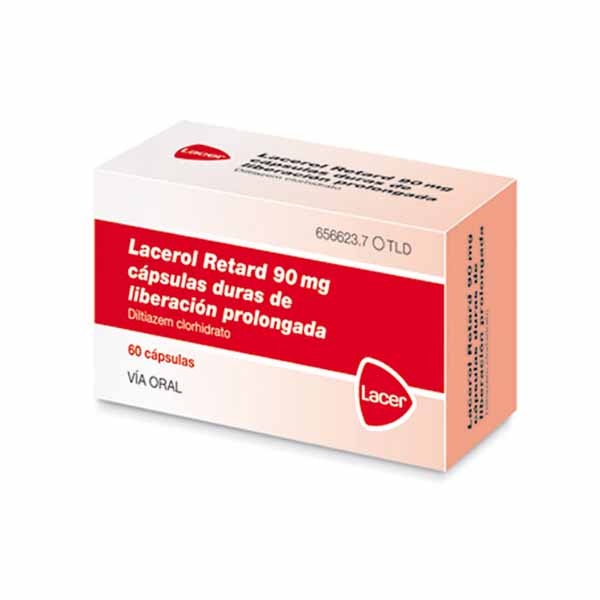
LACEROL RETARD 90 mg PROLONGED-RELEASE HARD CAPSULES



How to use LACEROL RETARD 90 mg PROLONGED-RELEASE HARD CAPSULES
Translated with AI
This page provides general information and does not replace a doctor’s consultation. Always consult a doctor before taking any medication. Seek urgent medical care if symptoms are severe.
Show originalContents of the leaflet
Introduction
Leaflet: information for the patient
Lacerol Retard 90 mg prolonged-release hard capsules
diltiazem hydrochloride
Read the entire leaflet carefully before starting to take this medication, as it contains important information for you.
- Keep this leaflet, as you may need to read it again.
- If you have any doubts, consult your doctor or pharmacist.
- This medication has been prescribed to you only and you should not give it to others, even if they have the same symptoms as you, as it may harm them.
- If you experience side effects, consult your doctor or pharmacist, even if they are side effects not listed in this leaflet. See section 4.
Contents of the leaflet
- What is Lacerol Retard 90 mg and what is it used for?
- What you need to know before taking Lacerol Retard 90 mg.
- How to take Lacerol Retard 90 mg.
- Possible side effects
- Storage of Lacerol Retard 90 mg.
- Contents of the pack and further information.
1. What is Lacerol Retard 90 mg and what is it used for?
Preventive treatment of chest pain attacks and treatment of high blood pressure (arterial hypertension).

2. What you need to know before taking Lacerol Retard 90 mg.
Do not take this medication:
- if you are allergic to diltiazem hydrochloride or any of the other components of this medication (listed in section 6).
- in case of shock.
- in case of uncompensated heart failure.
- if you have severe hypotension.
- if you are suffering from acute myocardial infarction.
- if you suffer from pulmonary congestion (radiographically confirmed) or certain cardiac rhythm disorders (bradycardia - less than 40 beats/minute -, block, of second or third degree, sick sinus node disease).
- if you are being treated with dantrolene in perfusion (a medication to relax muscles).
- if you are already taking a medication that contains ivabradina for the treatment of certain heart diseases.
- if you are already taking a medication that contains lomitapida used for the treatment of high cholesterol levels (see section: "Other medications and Lacerol Retard 90 mg").
- if you have atrial fibrillation or atrial flutter and simultaneous presence of the Wolff-Parkinson-White syndrome (a type of cardiac conduction disorder).
- if you have left ventricular failure with pulmonary congestion.
- if you are pregnant or think you may be pregnant.
- if you are breastfeeding.
- if you are a woman of childbearing age and are not using an adequate contraceptive method.
Warnings and precautions
Consult your doctor or pharmacist before starting to take this medication:
- if you have heart conditions such as left ventricular failure, bradycardia (slow heart rate) or first-degree atrioventricular block (a type of arrhythmia) detected electrocardiographically, it will be necessary for your doctor to closely monitor you.
- in the event of general anesthesia, you should inform the anesthesiologist that you are being treated with this medication.
- if you are an elderly patient or if you have kidney or liver disease (renal or hepatic insufficiency), diltiazem concentrations in the blood may be higher, so it will be necessary to closely monitor your heart rate at the start of treatment.
- if you perceive mood changes or are at risk of depression.
- if you are at risk of developing an intestinal obstruction, as diltiazem, like other medications in the same group, can cause a decrease in intestinal movement.
- if you have diabetes mellitus, as diltiazem can increase blood sugar levels.
- if you have acute porphyria.
- It can cause skin alterations that can be transient and disappear even if treatment is continued. In rare cases, more serious skin rashes have occurred, in which case the medication should be withdrawn. If the skin reaction does not disappear, consult your doctor.
- It can cause an increase in liver enzymes, which is usually reversible if treatment is discontinued. Your doctor will perform periodic checks.
- It can cause hypotension.
- If you have a history of heart failure, new difficulty breathing, slow heartbeats, or low blood pressure. Cases of kidney damage have been reported in patients with these conditions, and it is possible that your doctor may need to monitor your kidney function.
Do not forget that for this medication to be effective, it should be taken regularly and for as long as your doctor has indicated, even if the duration of treatment is long.
You should strictly follow the dosage, without decreasing or increasing it except on the instructions of your doctor.
As the therapeutic effect has not been compared between different diltiazem specialties in retard form, it is not recommended to substitute one for another except on the express recommendation of the doctor.
Children
This medication should not be used in children, as it has not been sufficiently studied in these patients.
Other medications and Lacerol Retard 90 mg
Inform your doctor or pharmacist if you are taking, have recently taken, or may need to take any other medication.
Certain medications can interact with Lacerol Retard 90 mg. In these cases, it may be convenient to change the dose or interrupt treatment with one of the medications.
Contraindicated use:
Diltiazem should not be used with dantrolene or ivabradina.
In particular, do not take this medication and inform your doctor if you are taking:
Medications that contain lomitapida used for the treatment of high cholesterol levels. Diltiazem can increase the concentration of lomitapida, which can lead to an increased probability and severity of liver-related side effects.
Effects of other medications on Lacerol
The following medications can increase the effects of Lacerol by increasing its concentration in the blood:
- fluconazole (used to treat fungal infections).
- erythromycin and other macrolides (antibiotics).
- ritonavir (used to treat viral infections).
- amiodarone (used to decrease heart rate).
- cimetidine and ranitidine (used to decrease stomach acid production).
The following medications can decrease the effects of Lacerol by reducing its concentration in the blood:
- phenytoin (used to treat epilepsy).
- St. John's Wort (used in cases of exhaustion, fatigue, or sleep disorders).
- rifampicin (antibiotic).
Effects of Lacerol on other medications
Lacerol can increase the effects of the following medications by increasing their concentrations in the blood or by enhancing their effect:
- phenytoin, carbamazepine (used to treat epilepsy).
- triazolam, midazolam, buspirone (used to treat anxiety).
- digoxin (used to treat heart diseases).
- cyclosporine, sirolimus (used to suppress the immune system).
- midazolam, triazolam (used to induce sleep).
- methylprednisolone (corticosteroid used to treat inflammatory problems).
- simvastatin and lovastatin (medications to decrease cholesterol levels in the blood).
- theophylline (used to treat asthma).
- medications that reduce blood clot formation (oral anticoagulants, such as acenocoumarol or warfarin).
- rifampicin (antibiotic).
- medications used to reduce blood pressure (nitrates, alpha and beta blockers, diuretics, angiotensin-converting enzyme inhibitors) and to decrease heart rate (amiodarone).
- anesthetics.
- lithium salts (used to treat certain mental illnesses): can increase the risk of intense agitation (psychotic episodes).
The combined use of Lacerol with other medications should be done under medical supervision and with gradual dose adjustment.
Pregnancy, breastfeeding, and fertility
If you are pregnant or breastfeeding, think you may be pregnant, or plan to become pregnant, consult your doctor or pharmacist before using this medication.
Lacerol Retard 90 mg should not be administered to pregnant women or women of childbearing age who are not using an effective contraceptive method.
This medication should not be taken during breastfeeding, as it passes into breast milk. If the doctor considers it essential to take this medication, the baby should be fed with an alternative method.
Driving and using machines
At the start of treatment, it is advisable not to perform tasks that require special attention until the response to the medication is satisfactory.
Lacerol Retard 90 mg contains sucrose.
This medication contains sucrose. If your doctor has told you that you have an intolerance to certain sugars, consult with them before taking this medication.
3. How to take Lacerol Retard 90 mg capsules
Follow your doctor's instructions for taking this medication exactly. If in doubt, consult your doctor or pharmacist again.
Lacerol Retard 90 mg capsules should be swallowed whole with a little water or with food.
Adults:
Chest pain:The usual initial dose is 90 mg twice a day. If necessary, the dose can be gradually increased to 120 mg twice a day, or to 180 mg twice a day. Your doctor will gradually increase the dose until the optimal response is achieved.
Arterial hypertension:The initial dose is 120-180 mg per day. Although each patient may respond to a different dose, the usual maintenance dose range is between 180 mg and 360 mg per day. Your doctor will gradually increase the dose until the optimal response is achieved.
Elderly patients, renal or hepatic insufficiency:
Initial dose adjustment should be done with caution.
All dose modifications and monitoring will be done under medical supervision.
If you take more Lacerol Retard 90 mg than you should
In case of overdose or accidental ingestion, consult your doctor or pharmacist immediately or call the Toxicology Information Service, telephone 91 562 04 20, indicating the medication and the amount ingested.
If you take more tablets than you should, inform your doctor or go immediately to the emergency department of a hospital. Bring the medication packaging with you. This is so the doctor knows what you have taken. The following effects may occur: dizziness or weakness, blurred vision, chest pain, difficulty breathing, fainting, abnormally fast or slow heartbeats, difficulty speaking, confusion, decreased kidney function, coma, and sudden death.
If you forget to take Lacerol Retard 90 mg
Do not take a double dose to make up for forgotten doses.
If you stop taking Lacerol Retard 90 mg
If you stop taking Lacerol Retard, you may experience a worsening of your disease, with symptoms such as chest pain or a sudden increase in blood pressure. Do not stop taking this medication without first consulting your doctor. If you have any other doubts about the use of this product, ask your doctor or pharmacist.

4. Possible side effects
Like all medications, Lacerol Retard 90 mg can cause side effects, although not everyone experiences them.
The following side effects have been reported according to the frequencies detailed below:
Very common: may affect more than 1 in 10 patients.
- Swelling of hands, feet, or ankles (peripheral edema).
Common: may affect up to 1 in 10 patients.
- Swelling (edema).
- Fatigue (asthenia).
- General malaise.
- Redness (rubefaction).
- Interruption or alteration of the electrical signal in the heart of mild, moderate, or severe degree (first-, second-, or third-degree AV block, palpitations, bradycardia).
- Nausea, constipation, dyspepsia, gastric pain.
- Skin rashes, skin redness (erythema).
- Headache, dizziness.
- Joint swelling.
Uncommon: may affect up to 1 in 100 patients.
- Thirst.
- Low blood pressure caused by sudden changes in body position (orthostatic hypotension), low blood pressure (hypotension).
- Chest pain or tightness (angina), irregular heartbeats (arrhythmias), fast heartbeats (tachycardia), slow heartbeats (bradycardia), abnormal heart contractions (ventricular extrasystoles), heart failure with generalized swelling (congestive heart failure), decreased cardiac muscle tone, sinoatrial block.
- Abnormal loss of appetite (anorexia), burning sensation, diarrhea, taste alterations (dysgeusia), vomiting, dry mouth.
- Alterations in liver function tests, elevation of lactate dehydrogenase (LDH), elevation of creatine phosphokinase (CPK), and elevation of bilirubin in blood tests.
- Small red spots on the skin (petechiae), itching (pruritus), skin rash (exanthema), skin reaction to light (photosensitivity), hives, skin lesions typically circular and composed of a red center, pale ring, and outer red ring (erythema multiforme).
- Difficulty initiating or maintaining sleep (insomnia), nervousness, abnormal sensation of tingling or numbness (paresthesias), tendency to fall asleep (somnolence), tremors, vertigo.
- Ringing in the ears (tinnitus).
- Depression, sleep disorders, hallucinations (seeing, hearing, or feeling things that do not exist while awake), and personality changes.
- Elevated blood glucose levels (hyperglycemia).
- Decreased vision (amblyopia), eye irritation.
- Joint pain.
- Need to urinate at night (nocturia) and increased frequency of urination (polyuria).
- Enlargement of lymph nodes (lymphadenopathy) and increase in a specific type of white blood cells (eosinophilia).
- Difficulty breathing (dyspnea), nosebleeds (epistaxis), nasal congestion.
- Alterations in sexual function.
- Elevated liver enzymes (transaminases).
Rare: may affect up to 1 in 1,000 patients.
- Changes in the electrocardiogram.
- Increased bleeding time.
- Skin disorder with blistering and skin peeling (toxic epidermal necrolysis), acute skin reaction with increased sensitivity in mucous membranes (Stevens-Johnson syndrome), generalized acute pustular exanthematous dermatitis.
- Breast enlargement in men (gynecomastia), painful menstruation (dysmenorrhea), vaginal inflammation (vaginitis), prostate disease.
Frequency not known (cannot be estimated from available data)
- Fever, movement and walking problems (extrapyramidal disorders), inflammation of blood vessels (vasculitis), paleness, alterations in heart rhythm such as: pause in sinus rhythm (sinus arrest), cardiac arrest (asystole), atrial flutter, ventricular tachycardia, and ventricular fibrillation, gum inflammation (gingival hyperplasia), tooth anomaly, intestinal muscle paralysis (paralytic ileus), swelling of the skin, mucous membranes, and submucosal tissues (angioneurotic edema), sweating, generalized acute pustular exanthema, skin inflammation with peeling with or without fever (exfoliative dermatitis), skin redness with peeling (erythema multiforme), purpura, skin thickening, memory loss (amnesia), temporary loss of consciousness (syncope), sudden involuntary muscle contractions (myoclonus), increased muscle tone (hypertonia), mood changes (including depression), confusional state, decreased appetite, gout, blurred vision, non-inflammatory retinal disease (retinopathy), muscle pain (myalgia), musculoskeletal pain, joint inflammation (bursitis), urinary bladder inflammation (cystitis), kidney stones (nephrolithiasis), abnormally low platelet count (thrombocytopenia), abnormally low red blood cell count (hemolytic anemia), increased coughing, inflammation of the nasal mucosa and paranasal sinuses (rhinitis, sinusitis), pharyngeal inflammation (pharyngitis), bronchial mucosa inflammation (bronchitis), liver inflammation (hepatitis), granulomatous liver disease, a condition in which the body's defense system attacks normal tissue, causing symptoms such as inflamed joints, fatigue, and skin rashes (lupus-like syndrome).
After marketing and infrequently (without a demonstrated cause-and-effect relationship), the following adverse events have been reported in patients treated with diltiazem: alopecia (hair loss) and leukopenia (decreased white blood cell count).
Reporting side effects
If you experience any type of side effect, consult your doctor or pharmacist, even if it is a possible side effect not listed in this leaflet. You can also report them directly through the Spanish Pharmacovigilance System for Human Use Medications: www.notificaram.es.
By reporting side effects, you can contribute to providing more information on the safety of this medication.
5. Storage of Lacerol Retard 90 mg capsules
No special storage conditions are required.
Keep this medicine out of the sight and reach of children.
Do not use this medicine after the expiration date stated on the packaging after CAD. The expiration date is the last day of the month indicated.
Medicines should not be disposed of via wastewater or household waste. Deposit the packaging and any unused medicines at the SIGRE collection point in your pharmacy. If in doubt, ask your pharmacist how to dispose of the packaging and any unused medicines. This will help protect the environment.
6. Packaging contents and additional information
Composition ofLacerol Retard 90 mg
- The active ingredient is diltiazem hydrochloride. Each capsule contains 90 mg of diltiazem (as diltiazem hydrochloride).
- The other ingredients are sucrose, cornstarch, povidone (E 1201), sodium lauryl sulfate, cetyl alcohol, ethylcellulose (E462), dibutyl sebacate, talc (E553b). Capsule composition: gelatin, red iron oxide, yellow iron oxide, black iron oxide, and titanium dioxide (E171).
Appearance of the product and packaging contents
Lacerol Retard 90 mg prolonged-release hard capsules are hard gelatin capsules with a light brown opaque cap and a transparent body
Lacerol Retard 90 mg prolonged-release hard capsules are presented in cardboard boxes containing 60 capsules in PVC/Aluminum blisters
Marketing authorization holder
LACER, S.A. – Boters, 5
08290 Cerdanyola del Vallès
Barcelona - Spain
Manufacturer Toll Manufacturing Services, S.L. Aragoneses, 2 28108 Alcobendas - Madrid |
Date of the last revision of thisleaflet: April 2023
"Detailed and updated information on this medicine is available on the website of the Spanish Agency for Medicines and Health Products (AEMPS)http://www.aemps.gob.es/"
- Country of registration
- Average pharmacy price13.71 EUR
- Active substance
- Prescription requiredYes
- Manufacturer
- This information is for reference only and does not constitute medical advice. Always consult a doctor before taking any medication. Oladoctor is not responsible for medical decisions based on this content.
- Alternatives to LACEROL RETARD 90 mg PROLONGED-RELEASE HARD CAPSULESDosage form: MODIFIED-RELEASE CAPSULE, 120 mgActive substance: diltiazemManufacturer: Viatris Healthcare LimitedPrescription requiredDosage form: MODIFIED-RELEASE CAPSULE, 180 mgActive substance: diltiazemManufacturer: Viatris Healthcare LimitedPrescription requiredDosage form: MODIFIED-RELEASE CAPSULE, 300 mgActive substance: diltiazemManufacturer: Viatris Healthcare LimitedPrescription required
Online doctors for LACEROL RETARD 90 mg PROLONGED-RELEASE HARD CAPSULES
Discuss questions about LACEROL RETARD 90 mg PROLONGED-RELEASE HARD CAPSULES, including use, safety considerations and prescription review, subject to medical assessment and local regulations.







Frequently Asked Questions
