


GLUCOSALINA GRIFOLS SOLUTION FOR INFUSION



How to use GLUCOSALINA GRIFOLS SOLUTION FOR INFUSION
Translated with AI
This page provides general information and does not replace a doctor’s consultation. Always consult a doctor before taking any medication. Seek urgent medical care if symptoms are severe.
Show originalContents of the leaflet
Introduction
Leaflet: information for the user
Glucosalina Grifols Solution for infusion
Glucose, Sodium Chloride
Read the entire leaflet carefully before starting to use this medication, as it contains important information for you.
- Keep this leaflet, as you may need to read it again.
- If you have any questions, consult your doctor or nurse.
- If you experience side effects, consult your doctor or nurse, even if they are not listed in this leaflet. See section 4.
Contents of the leaflet
- What is Glucosalina Grifols and what is it used for
- What you need to know before starting to use Glucosalina Grifols
- How to use Glucosalina Grifols
- Possible side effects
- Storage of Glucosalina Grifols
- Package contents and additional information
1. What is Glucosalina Grifols and what is it used for
Glucosalina Grifols belongs to the group of intravenous solutions that affect the electrolyte balance.
Glucosalina Grifols is indicated in:
- States of dehydration (loss of body water) with moderate losses of electrolytes
- Disorders of carbohydrate metabolism
- Mild alkalosis states
- As a vehicle for the administration of medications and electrolytes.

2. What you need to know before starting to use Glucosalina Grifols
Do not use Glucosalina Grifols
- if you are allergic to the active substances or to any of the other components of this medication (listed in section 6)
- if you have states of hyperhydration (excess fluid in the body)
- in situations of generalized edema (fluid accumulation in body tissues) or ascitic cirrhosis (chronic progressive liver disease with fluid accumulation)
- if you have hyperglycemia (high blood glucose levels)
- if you have hypernatremia (high sodium levels in blood)
- if you have hyperchloremia (high chloride levels in blood)
- in states of hyperosmolar coma (loss of consciousness due to an increase in blood solute concentration)
- in states of hyperlactatemia (presence of lactic acid in blood)
- in severe cases of heart, liver, or kidney failure (failure of the heart, liver, or kidney, respectively)
- in the first 24 hours after a head injury.
Warnings and precautions
Consult your doctor or nurse before starting to use Glucosalina Grifols.
- The frequent and massive administration of glucose solutions can cause fluid overload (hyperhydration), acid-base balance disorders, and significant ionic depletions, including hypomagnesemia (low magnesium levels in blood), hypokalemia (low potassium levels in blood), and hypophosphatemia (low phosphate levels in blood). In these cases, it will be necessary to administer electrolyte supplements. For this reason, it is recommended that regular controls of blood glucose, serum electrolytes, water balance, and acid-base balance be performed.
- Isotonic glucose solutions can become physiologically hypotonic in the body due to the rapid metabolism of glucose (see section 3).
- Depending on the volume and rate of infusion, the initial clinical condition, and the ability to metabolize glucose, the intravenous administration of glucose solution can cause electrolyte disturbances such as hyponatremia (low sodium levels in blood).
Hyponatremia:
If you are a patient with non-osmotic release of vasopressin (antidiuretic hormone) (e.g., in critical states, pain, postoperative stress, infections, burns, and central nervous system diseases), if you have heart, liver, and kidney diseases, and if you are exposed to vasopressin agonists (see next subsection), you are at special risk of suffering from acute hyponatremia after the administration of hypotonic solutions.
Acute hyponatremia can cause acute hyponatremic encephalopathy (brain edema) characterized by headache, nausea, seizures, lethargy, and vomiting. Patients with brain edema are at special risk of suffering from severe, irreversible, and potentially fatal brain damage.
Children, women of childbearing age, and patients with reduced cerebral distensibility (e.g., in cases of meningitis, intracranial hemorrhage, and cerebral contusion) are at special risk of suffering from severe and potentially fatal brain edema caused by acute hyponatremia.
- To avoid hypokalemia produced during prolonged infusions with glucose solutions, it is recommended to add potassium to the solution as a safety measure.
- Blood glucose levels should be carefully monitored during episodes of intracranial hypertension.
- You should be especially careful if you have had acute ischemic attacks (decreased or absent circulation in arteries), as hyperglycemia has been associated with an increase in cerebral ischemic damage and difficulty in recovery.
- You should be especially careful if you have any of the following diseases: hypertension, heart failure, peripheral or pulmonary edema, renal dysfunction, preeclampsia (symptoms preceding convulsions and blood pressure drop in pregnant women), or other problems associated with sodium retention.
- The administration of glucose-containing solutions can cause vitamin B1 deficiency, especially in cases of malnutrition.
- In case of diabetes mellitus, glucose-containing solutions can be used as long as you receive initial treatment (insulin). Similarly, these solutions should be used with caution if you have Addison's disease or carbohydrate intolerance.
- You should be especially careful if you are administered continuously in the same injection site, due to the risk of thrombophlebitis.
- This medication should be used with caution if your heart, liver, and/or kidneys are not functioning properly, especially if you are elderly.
Other medications and Glucosalina Grifols
Tell your doctor if you are using, have recently used, or may need to use any other medication.
Certain medications may interact with Glucosalina Grifols. In this case, it may be necessary to change the dose or interrupt treatment with one of the medications.
It is important to inform your doctor if you are using any of the following medications:
- Insulin or oral antidiabetics (biguanides, sulfonylureas), as the intravenous administration of glucose-containing solutions in patients treated with these medications can lead to a reduction in their therapeutic efficacy (antagonistic action).
- Corticosteroids: The intravenous administration of glucose solution in patients treated with systemic corticosteroids with glucocorticoid activity (cortisol) can lead to an increase in plasma glucose levels due to the hyperglycemic action of these medications. As for corticosteroids with mineralocorticoid activity, they should be administered with caution due to their ability to retain water and sodium.
- Digitalis glycosides (digoxin), as the intravenous administration of a glucose-containing solution coinciding with therapy with these medications can lead to an increase in digitalis activity, with the risk of developing toxicity from these medications. This is due to the hypokalemia that can be caused by glucose administration if potassium is not added to the solution.
- Lithium carbonate, as the administration of sodium chloride accelerates the renal excretion of lithium, leading to a decrease in its therapeutic effect.
- Medications that increase the effect of antidiuretic hormone (such as chlorpropamide, clofibrate, carbamazepine, vincristine, selective serotonin reuptake inhibitors, 3,4-methylenedioxymethamphetamine, ifosfamide, antipsychotics, narcotics, non-steroidal anti-inflammatory drugs, cyclophosphamide, desmopressin, oxytocin, vasopressin, terlipressin): The intravenous administration of a glucose solution along with these medications that reduce water excretion in urine increases the risk of hospital hyponatremia (see previous subsection and sections 3 and 4).
- Diuretics in general and antiepileptics such as oxcarbazepine, which increase the risk of hyponatremia.
Pregnancy and lactation
If you are pregnant or breastfeeding, think you may be pregnant, or plan to become pregnant, consult your doctor before using this medication.
In case of pregnancy, your doctor will decide whether to use glucose solution, as it should be used with caution in this case.
Excessive administration of glucose-containing solutions during pregnancy can cause hyperglycemia, hyperinsulinemia (high insulin levels in blood), and acidosis in the fetus, and can be harmful to the newborn.
This medication should be administered with special caution in pregnant women during labor, especially if it is administered in combination with oxytocin, due to the risk of hyponatremia (see previous subsections and section 4).
There is no evidence to suggest that Glucosalina Grifols can cause adverse effects during the lactation period in newborns. However, it is recommended to use with caution during this period.
Driving and using machines
There is no indication that this medication can affect the ability to drive or use machines.
3. How to use Glucosalina Grifols
Glucosalina Grifols is presented as a solution for intravenous administration.
This medication will be used in a hospital by the corresponding healthcare personnel.
Your doctor will indicate the duration of your treatment with Glucosalina Grifols.
The dose may vary according to medical criteria, always adjusting the average infusion rate to the patient's clinical need based on age, weight, clinical condition, blood glucose, and hydroelectrolytic and acid-base balance. In general, it is recommended to administer the solution at an average rate of 40 to 80 drops per minute (120-240 ml/h). In adults, the daily dose is usually 40 ml/kg of body weight, and it is recommended not to exceed the maximum daily dose of 3000 ml.
You may need to monitor your fluid balance, blood glucose, serum sodium, and other electrolytes before and during administration, especially if you have an increased release of non-osmotic vasopressin (syndrome of inappropriate antidiuretic hormone secretion, SIADH) and if you receive simultaneous medication with vasopressin agonists, due to the risk of hyponatremia. Monitoring of serum sodium is especially important when administering physiologically hypotonic solutions. This medication can become hypotonic after administration due to the rapid metabolism of glucose in the body (see sections 2 and 4).
If you receive more Glucosalina Grifols than you should
If the administration of the glucose solution is not performed correctly and controlled, some signs of overdose may appear: hyperhydration, electrolyte disturbances, and acid-base balance disorders.
In case of non-compliance with these requirements and the presence of symptoms of intoxication, administration will be suspended and symptomatic treatment will be initiated.
In case of overdose or accidental ingestion, consult the Toxicology Information Service. Phone: 915 620 420.
If you have any other questions about the use of this medication, ask your doctor or nurse.

4. Possible side effects
Like all medications, this medication can cause side effects, although not everyone will experience them.
If the administration of the solution is performed correctly and controlled, the only possible complications are those derived from the intravenous administration technique, which include fever, infection at the injection site, pain, reaction and/or irritation at the injection site, venous thrombosis, or phlebitis that extends from the injection site and extravasation.
To avoid the risk of thrombophlebitis (inflammation of a vein due to a blood clot), it is recommended to vary the insertion site of the catheter (every 24-48 hours).
In patients with non-osmotic release of vasopressin, in patients with heart, liver, and kidney diseases, and in patients treated with vasopressin agonists, the risk of acute hyponatremia after the administration of hypotonic solutions increases. Hospital hyponatremia can cause irreversible brain damage and death due to the development of brain edema (see sections 2 and 3).
The frequencies of the possible side effects described are not established, as no clinical studies have been conducted with this medication.
If used as a vehicle for the administration of other medications, the nature of the added medications will determine the likelihood of other side effects.
Reporting of side effects
If you experience any type of side effect, consult your doctor or nurse, even if it is not listed in this leaflet. You can also report them directly through the Spanish Pharmacovigilance System for Human Use Medicines: www.notificaRAM.es. By reporting side effects, you can contribute to providing more information on the safety of this medication.
5. Storage of Glucosalina Grifols
No special storage conditions are required.
Once the package is opened, the solution should be used immediately.
Keep this medication out of the sight and reach of children.
Do not use this medication after the expiration date stated on the package. The expiration date is the last day of the month indicated.
Do not use this medication if you observe that the solution is not transparent or contains precipitates.
Medications should not be disposed of through wastewater or household waste. Deposit the packages and medications you no longer need in the SIGRE collection point (SIGRE symbol) at the pharmacy. If in doubt, ask your pharmacist how to dispose of the packages and medications you no longer need. This will help protect the environment.
6. Package contents and additional information
Composition of Glucosalina Grifols
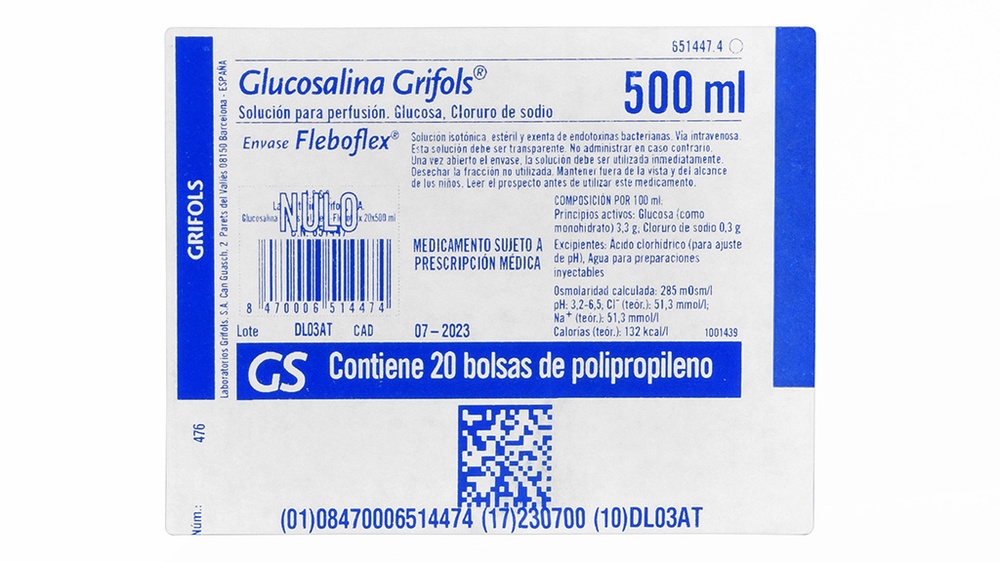
The active ingredients are glucose and sodium chloride. Each 100 ml of solution contains 3.3 g of glucose (as monohydrate) and 0.3 g of sodium chloride.
The other components (excipients) are hydrochloric acid (for pH adjustment) and water for injectable preparations.
Appearance of the product and package contents
Glucosalina Grifols is a clear and colorless solution for infusion, presented in 250 and 500 ml glass bottles and in 250, 500, and 1000 ml flexible polypropylene bags (Fleboflex).
Marketing authorization holder
LABORATORIOS GRIFOLS, S.A.
Can Guasch, 2
08150 Parets del Vallès, Barcelona (SPAIN)
Manufacturer
LABORATORIOS GRIFOLS, S.A.
Polígono Industrial Autopista. Passeig Fluvial, 24
08150 Parets del Vallès, Barcelona (SPAIN)
LABORATORIOS GRIFOLS, S.A.
Polígono Industrial Los Llanos. C/ Marte, 4
30565 Las Torres de Cotillas, Murcia (SPAIN)
Date of the last revision of this leaflet:July 2018
Other sources of information
Detailed information about this medication is available on the website of the Spanish Agency for Medicines and Health Products (AEMPS) (http://www.aemps.gob.es/)
-------------------------------------------------------------------------------------------------------------------
This information is intended only for healthcare professionals:
Glucosalina Grifols will be administered by infusion.
The contents of each package of Glucosalina Grifols are for single infusion.
Once the package is opened, the solution should be administered immediately. The unused fraction should be discarded.
The solution should be transparent and not contain precipitates. Do not administer otherwise.
Fleboflex bags:
- Check for the absence of small leaks by pressing the bag firmly. If leaks are detected, discard the product.
- To connect the infusion equipment, separate the protective tab from the infusion port, exposing the access membrane to the bag.
To administer the solution and in case of adding medications, maximum asepsis should be maintained.
In order to add medications to the solution or to administer simultaneously with other medications, it should be checked that there are no incompatibilities.
It has been described that the glucose solution with a glucose content of 3.3% and sodium chloride content of 0.3% is incompatible with mitomycin, due to the low pH of this solution.
Similarly, incompatibilities have been observed for different isotonic glucose solutions with: sodium amoxicillin, sodium heparin, imipenem-cilastatin sodium, and meropenem. However, these medications may be compatible with this type of solution depending on different factors such as the concentration of the medication (sodium heparin) or the time between dissolution and administration (sodium amoxicillin, imipenem-cilastatin sodium, and meropenem).
On the other hand, incompatibilities have been described when some medications are diluted in glucose-containing solutions, including: sodium ampicillin, amrinone lactate, sodium amoxicillin/clavulanic acid, interferon alfa-2b, procainamide hydrochloride. However, amrinone lactate or sodium amoxicillin/clavulanic acid can be injected directly into the injection site while these infusion solutions are being administered.
Incompatibilities have also been described when some medications are diluted in solutions containing chloride, including: amsacrine and trimetrexate glucuronate.
- Country of registration
- Average pharmacy price21.61 EUR
- Active substance
- Prescription requiredYes
- Manufacturer
- This information is for reference only and does not constitute medical advice. Always consult a doctor before taking any medication. Oladoctor is not responsible for medical decisions based on this content.
- Alternatives to GLUCOSALINA GRIFOLS SOLUTION FOR INFUSIONDosage form: INJECTABLE INFUSION, 0.09 g / 0.07 g / 1.6 g / 0.17 g / 12.5 g / 0.19 g / 1.23 gActive substance: electrolytes with carbohydratesManufacturer: Fresenius Kabi España, S.A.U.Prescription requiredDosage form: INJECTABLE PERFUSION, 0.31 g / 21.9 mg / 0.03 g / 0.6 gActive substance: electrolytes with carbohydratesManufacturer: Fresenius Kabi España, S.A.U.Prescription requiredDosage form: INJECTABLE PERFUSION, NAActive substance: electrolytes with carbohydratesManufacturer: Fresenius Kabi España, S.A.U.Prescription required
Online doctors for GLUCOSALINA GRIFOLS SOLUTION FOR INFUSION
Discuss questions about GLUCOSALINA GRIFOLS SOLUTION FOR INFUSION, including use, safety considerations and prescription review, subject to medical assessment and local regulations.











Frequently Asked Questions
