


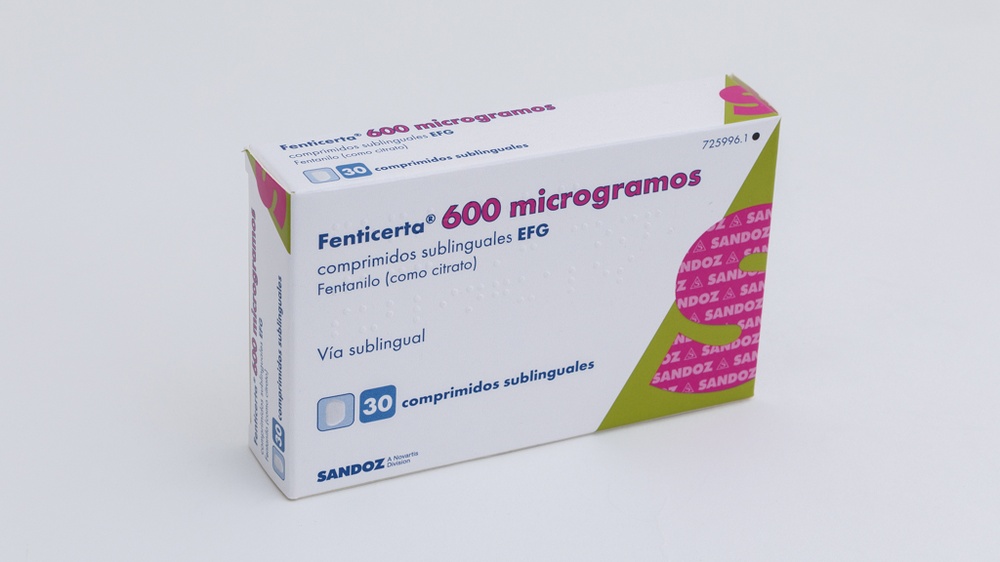
FENTICERTA 600 micrograms SUBLINGUAL TABLETS



How to use FENTICERTA 600 micrograms SUBLINGUAL TABLETS
Translated with AI
This page provides general information and does not replace a doctor’s consultation. Always consult a doctor before taking any medication. Seek urgent medical care if symptoms are severe.
Show originalContents of the leaflet
Introduction
Package Leaflet: Information for the User
Fenticerta®100 micrograms sublingual tablets EFG
Fenticerta®200 micrograms sublingual tablets EFG
Fenticerta®300 micrograms sublingual tablets EFG
Fenticerta®400 micrograms sublingual tablets EFG
Fenticerta®600 micrograms sublingual tablets EFG
Fenticerta®800 micrograms sublingual tablets EFG
fentanyl (as citrate)
Read all of this leaflet carefully before you start taking this medicine because it contains important information for you.
- Keep this leaflet, you may need to read it again.
- If you have any further questions, ask your doctor or pharmacist.
- This medicine has been prescribed for you only. Do not pass it on to others. It may harm them, even if their signs of illness are the same as yours.
- If you get any side effects, talk to your doctor or pharmacist. This includes any possible side effects not listed in this leaflet. See section 4.
Contents of the pack and other information
- What is Fenticerta and what is it used for
- What you need to know before you take Fenticerta
- How to take Fenticerta
- Possible side effects
- Storage of Fenticerta
- Contents of the pack and further information
1. What is Fenticerta and what is it used for
Fenticerta is a treatment for adults who are already taking regular, potent pain medicines (opioids)for their persistent cancer pain, but need treatment for breakthrough pain. If you are not sure, ask your doctor.
Breakthrough pain is a type of pain that comes on quickly, even when you have taken your usual opioid pain medicine for your persistent pain.
The active substance of Fenticerta is fentanyl. Fentanyl belongs to a group of strong pain-relieving medicines called opioids.

2. What you need to know before you take Fenticerta
Do not take Fenticerta:
- if you are allergic to the active substance or any of the other ingredients of this medicine (listed in section 6),
- if you have severe breathing problems,
- if you are not already using a prescribed opioid medicine every day, at the same time, for at least one week, to control your persistent pain. If you have not been using these medicines, do not takefentanyl sublingual tablets, as their use can increase the risk of your breathing becoming slower and/or shallower, and even stopping,
- if you have short-term pain which is not breakthrough pain.
Warnings and precautions
Keep this medicine out of the sight and reach of other people, especially children (see section 5 “Storage of Fenticerta” for further information).
Ask your doctor, pharmacist, or nurse for advice before you take Fenticerta if you have or have had any of the following symptoms, as your doctor will need to take them into account when prescribing your dose:
- A head injury, as Fenticerta may mask the extent of the damage
- Breathing problems or severe myasthenia (a condition characterized by muscle weakness)
- If you have heart problems, especially a low heart rate
- Low blood pressure
- Liver or kidney disease, as you may need your doctor to adjust your dose with more caution
- Brain tumor and/or increased intracranial pressure (increased pressure in the brain that causes severe headache, nausea, vomiting, and blurred vision)
- Mouth ulcers or mucositis (inflammation and redness of the inside of the mouth)
- If you are taking antidepressants or antipsychotics; see the section “Other medicines and Fenticerta”.
- If you have ever had adrenal insufficiency or a lack of sex hormones (androgen deficiency) with the use of opioids.
When taking fentanyl sublingual tablets, inform your doctor or dentist that you are taking this medicine, if
- you are going to have an operation
- you feel pain or increased sensitivity to pain (hyperalgesia) that does not respond to a higher dose of the medicine as prescribed by your doctor.
- you have a combination of the following symptoms: nausea, vomiting, anorexia, fatigue, weakness, dizziness, and low blood pressure. Together, these symptoms can be an indication of a potentially life-threatening condition called adrenal insufficiency, in which the adrenal glands do not produce enough hormones.
Ask your doctor DURINGthe use of Fenticerta:
- if you have sleep-related breathing disorders: Fenticerta may cause sleep-related breathing disorders such as sleep apnea (pauses in breathing during sleep) and sleep-related hypoxemia (low oxygen level in the blood). Symptoms may include pauses in breathing during sleep, waking up at night due to difficulty breathing, difficulty staying asleep, or excessive sleepiness during the day. If you or someone else notices these symptoms, contact your doctor. Your doctor may consider reducing the dose.
Long-term use and tolerance
This medicine contains fentanyl, an opioid. Repeated use of opioid pain relievers can make the medicine less effective (the body gets used to it, which is known as pharmacological tolerance). You may also become more sensitive to pain when using Fenticerta. This is known as hyperalgesia. Increasing the dose of Fenticerta may continue to reduce pain for a while, but it can also be harmful. If you notice that the medicine is becoming less effective, ask your doctor. Your doctor will decide whether it is better to increase the dose or gradually reduce the use of Fenticerta.
Dependence and addiction
This medicine contains fentanyl, which is an opioid. It can cause dependence and/or addiction. |
Repeated use of Fenticerta can also lead to dependence, abuse, and addiction, which can result in a potentially life-threatening overdose. The risk of these side effects may be greater with a higher dose and longer use. Dependence or addiction can cause a feeling of lack of control over the amount of medicine you need to use or how often you need to use it. You may feel the need to continue using the medicine even if it does not help relieve pain.
The risk of dependence or addiction varies from person to person. The risk of becoming dependent on or addicted to Fenticerta may be greater if:
- you or a family member have abused alcohol or experienced dependence on it, prescription medicines, or illegal drugs (“addiction”).
- you smoke.
- you have had mood problems (depression, anxiety, or personality disorder) or have been treated by a psychiatrist for other mental illnesses.
If you notice any of the following symptoms while using Fenticerta, it could be a sign of dependence or addiction.
- you need to use the medicine for longer than your doctor indicated.
- you need to use a higher dose than recommended.
- you are using the medicine for reasons other than those prescribed, for example, “to calm down” or “to help you sleep”.
- you have made repeated unsuccessful attempts to stop using the medicine or control its use.
- you feel unwell when you stop using the medicine (for example, nausea, vomiting, diarrhea, anxiety, chills, tremors, and sweating), and you feel better once you take it again (“withdrawal symptoms”).
If you notice any of these signs, ask your doctor to determine the best treatment for you, when it is appropriate to stop the medicine, and how to do it safely.
If you stop treatment, you may experience withdrawal symptoms. Inform your doctor or nurse if you think this is happening to you (see also section 4. Possible side effects).
Use in athletes
This medicine contains fentanyl, which can produce a positive result in doping tests.
Other medicines and Fenticerta
Tell your doctor or pharmacist that you are taking, have recently taken, or might take any other medicines (other than the opioid medicines you take regularly for pain).
Some medicines may increase or decrease the effects of Fenticerta. Consequently, if you start, change the dose, or stop treatment with the following medicines, inform your doctor, as they may need to adjust your dose of fentanyl sublingual tablets:
- Certain types of antifungal medicines containing substances such as ketoconazole or itraconazole (used to treat fungal infections)
- Certain types of antibiotic medicines used to treat infections (called macrolides, containing substances such as erythromycin)
- Certain types of antiviral medicines called protease inhibitors, which contain, for example, ritonavir (used to treat viral infections).
- Rifampicin or rifabutin (medicines used to treat bacterial infections)
- Carbamazepine, phenytoin, or phenobarbital (medicines used to treat seizures).
- Herbal medicines containing St. John's Wort (Hypericum perforatum)
- Medicines containing alcohol
- Medicines called monoamine oxidase inhibitors (MAOIs), used to treat severe depression and Parkinson's disease. Inform your doctor if you have taken this type of medicine in the last two weeks
- Certain types of strong pain relievers, called partial agonist/antagonists, such as buprenorphine, nalbuphine, and pentazocine (medicines for pain) and some pain relievers for neuropathic pain (gabapentin and pregabalin). You may experience withdrawal symptoms (nausea, vomiting, diarrhea, anxiety, chills, tremors, and sweating) while using these medicines.
Fenticerta may increase the effect of medicines that make you feel drowsy, including:
- other strong pain relievers(opioid-type medicines for pain and cough)
- general anesthetics (used to put you to sleep during operations)
- muscle relaxants
- sleeping pills
- medicines used to treat
- depression
- allergies
- anxiety and psychosis
- medicines containing clonidine (used to treat high blood pressure)
The risk of side effects increases if you are taking certain antidepressants or antipsychotics. Fenticerta may interact with these medicines, and you may experience changes in mental status (e.g., agitation, hallucinations, coma) and other effects such as body temperature above 38°C, increased heart rate, unstable blood pressure, and exaggerated reflexes, muscle stiffness, lack of coordination, and/or gastrointestinal symptoms (e.g., nausea, vomiting, diarrhea). Your doctor will tell you if Fenticerta is suitable for you.
Taking Fenticerta with food, drinks, and alcohol
Fenticerta may cause drowsiness in some people. Do not drink alcohol without consulting your doctor, as it may make you feel more drowsy than usual.
Do not drink grapefruit juice during treatment with Fenticerta, as it may increase the adverse effects of Fenticerta.
Pregnancy and breastfeeding
If you are pregnant or breastfeeding, think you may be pregnant, or plan to become pregnant, ask your doctor or pharmacist for advice before taking this medicine.
You should not take fentanyl during pregnancy unless your doctor has explicitly told you to do so.
Fentanyl can pass into breast milk and cause side effects in the breastfed baby. Do not use Fenticerta if you are breastfeeding. You should not start breastfeeding until at least 5 days after the last dose of fentanyl sublingual tablets.
Ask your doctor or pharmacist for advice before taking any medicine during pregnancy or breastfeeding.
Driving and using machines
Fenticerta may reduce your mental and/or physical ability to perform tasks that require attention, such as driving or using machines.
If you feel dizzy, drowsy, or have blurred vision while taking Fenticerta, do not drive or use machines.
3. How to take Fenticerta
Before starting treatment and regularly during treatment, your doctor will also explain what you can expect from using Fenticerta, when and for how long you should use it, when you should contact your doctor, and when you should stop using it (see also section 2).
Follow the instructions for taking this medicine exactly as your doctor has told you. If you are unsure, ask your doctor or pharmacist again.
YOU SHOULD ONLY USE THIS MEDICINE AS DIRECTED BY YOUR DOCTOR. DO NOT USE IT FOR ANYONE ELSE, AS IT MAY CAUSE SERIOUS RISKS TO THEIR HEALTH, ESPECIALLY IN CHILDREN.
Fenticerta is a different type of medicine from other medicines you may have used to treat breakthrough pain. YOU SHOULD ALWAYS TAKE THE DOSE OF FENTICERTA AS DIRECTED BY YOUR DOCTOR;this may be a different dose from what you have used with other pain medicines.
Starting treatment – Finding the right dose
For treatment with Fenticerta to be successful, your doctor will need to find the right dose for treating your breakthrough pain. Fenticerta is available in a wide range of doses. You may need to try different doses of Fenticerta during different episodes of pain before finding the right dose. Your doctor will help you with this and find the right dose for you.
If you do not get adequate pain relief with a dose, your doctor may tell you to take an additional dose to treat a breakthrough pain episode. Do not take a second dose unless your doctor tells you to, as you may experience an overdose.
Your doctor may advise you to take a dose consisting of more than one tablet at the same time. ONLY DO THIS IF YOUR DOCTOR HAS TOLD YOU TO.
After taking the last dose, wait at least two hours before treating the next episode of breakthrough pain with Fenticerta.
Continuing treatment – Once the right dose is found
Once you and your doctor have found a dose of Fenticerta that controls your breakthrough pain, you should not take this dose more than four times a day. A DOSE OF FENTICERTA MAY CONSIST OF MORE THAN ONE TABLET.
After taking the last dose, wait at least two hours before treating the next episode of breakthrough pain with Fenticerta.
If you think the dose of Fenticerta you are using does not control your breakthrough pain satisfactorily, inform your doctor, as you may need a dose adjustment.
Do not change your dose of Fenticerta unless your doctor tells you to.
Taking the medicine
Fenticerta should be used sublingually. This means you should place the tablet under your tongue, where it will dissolve quickly to allow the active substance to be absorbed through the lining of your mouth. Once absorbed, it starts to work to relieve pain.
When you have an episode of breakthrough pain, take the dose as directed by your doctor as follows:
- If your mouth is dry, take a sip of water to moisten it. Spit or swallow the water.
- Remove the tablet(s) from the blister pack immediately before use as follows:
- Separate one unit from the blister pack by tearing along the perforation (keep the remaining units in the blister pack together).
- Peel back the edge of the foil by the arrow and carefully remove the tablet. Do not try to push the Fenticerta sublingual tablets through the foil, as this will damage the tablets.
- Place the tablet under your tongue as far back as possible, and let it dissolve completely.
- Fenticerta will dissolve quickly under your tongue and be absorbed to provide relief from your pain. It is therefore important that you do not suck, chew, or swallow the tablet.
- Do not drink or eat anything until the tablet has dissolved completely under your tongue.
If you take more Fenticerta than you should
- Remove any remaining tablet from your mouth
- Tell your caregiver or another person what has happened
- You should contact your doctor, pharmacist, or local hospital immediately and ask for advice
- While waiting for the doctor, keep the person awake by talking to them or shaking them from time to time
The symptoms of an overdose include:
- Extreme drowsiness
- Slow, shallow breathing
If this happens, seek medical help immediately.
An overdose can also cause a brain disorder known as toxic leukoencephalopathy.
In case of overdose or accidental ingestion, consult your doctor or pharmacist immediately or call the Toxicology Information Service, phone: 91 562 04 20, indicating the medicine and the amount taken.
If you stop taking Fenticerta
You should stop using Fenticerta when you no longer have breakthrough pain. However, you should continue taking your usual opioid medicines for persistent cancer pain as recommended by your doctor. You may experience withdrawal symptoms similar to the possible side effects of Fenticerta. If you have withdrawal symptoms or are concerned about pain relief, ask your doctor, who will assess whether you need any medicine to reduce or suppress withdrawal symptoms.
If you have any further questions about the use of this medicine, ask your doctor or pharmacist.

4. Possible Adverse Effects
Like all medicines, this medicine can cause adverse effects, although not all people suffer from them.
If you start to feel unusual or extreme drowsiness or your breathing becomes shallow and slow, you or your caregiver should contact your doctor or local hospital for emergency assistance (see also section 3 "If you take more Fenticerta than you should").
Very common adverse effects (may affect more than 1 in 10 people) include:
- nausea
Common adverse effects (may affect up to 1 in 10 people) include:
- dizziness, headache, excessive drowsiness
- shortness of breath/difficulty breathing
- inflammation inside the mouth, vomiting, constipation, dry mouth
- sweating, fatigue/tiredness/lack of energy
Uncommon adverse effects (may affect up to 1 in 100 people):
- allergic reaction, tremors/shaking, altered or blurred vision, slow or rapid heart rate, low blood pressure, memory loss
- depression, suspicious thoughts/fear without reason, feeling of confusion, disorientation, anxiety/unhappiness/concern, feeling unusually happy/healthy, mood changes
- feeling of permanent fullness, stomach pain, indigestion
- mouth ulcers, tongue problems, mouth or throat pain, throat tightness, lip or gum ulcers
- loss of appetite, loss or alteration of sense of smell/taste
- dullness/drowsiness, difficulty sleeping or sleep disturbances, attention problems/easy distraction, lack of energy/weakness/loss of strength
- skin changes, rash, itching, night sweats, decreased sensitivity to touch, easy bruising
- joint pain or stiffness, muscle stiffness
- withdrawal syndrome (may manifest with the following adverse effects: nausea, vomiting, diarrhea, anxiety, chills, tremors, and sweating), accidental overdose, in men inability to achieve or maintain an erection, general malaise
Adverse effects of unknown frequency (cannot be estimated from available data):
- tongue swelling,
- severe respiratory problems,
- falls,
- flushing,
- feeling of excessive heat,
- diarrhea,
- seizure (epileptic fit),
- inflammation of arms or legs,
- seeing or hearing things that are not real (hallucinations),
- fever,
- pharmacological tolerance, drug dependence (addiction), drug abuse (see section 2),
- reduced or lost consciousness,
- itchy rash,
- delirium (symptoms may include a combination of agitation, restlessness, disorientation, confusion, fear, seeing or hearing things that do not really exist, sleep disturbances, nightmares).
Prolonged treatment with fentanyl during pregnancy may cause withdrawal symptoms in the newborn, which can be potentially fatal (see section 2).
Reporting of Adverse Effects
If you experience any type of adverse effect, consult your doctor or pharmacist, even if it is a possible adverse effect that does not appear in this leaflet. You can also report them directly through the Spanish Pharmacovigilance System for Human Use Medicines: www.notificaram.es. By reporting adverse effects, you can contribute to providing more information on the safety of this medicine.
5. Storage of Fenticerta
The pain relief of this medicine is very strong and can be extremely dangerous if a child were to take it accidentally. Keep this medicine out of sight and reach of children.
Store this medicine in a safe and protected place, where others cannot access it. This medicine can cause serious harm and even be fatal for people who use it accidentally or intentionally when it has not been prescribed for them.
Do not use this medicine after the expiration date shown on the blister pack after CAD/EXP. The expiration date is the last day of the month indicated.
No special storage conditions are required.
Medicines should not be disposed of via wastewater or household waste. Deposit the packaging and any unused medicines in the SIGRE collection point at the pharmacy. In case of doubt, ask your pharmacist how to dispose of the packaging and any unused medicines. This will help protect the environment.
6. Package Contents and Additional Information
Composition of Fenticerta
- The active ingredient is fentanyl. One sublingual tablet contains:
- 100 micrograms of fentanyl (as citrate).
- 200 micrograms of fentanyl (as citrate).
- 300 micrograms of fentanyl (as citrate).
- 400 micrograms of fentanyl (as citrate).
- 600 micrograms of fentanyl (as citrate).
- 800 micrograms of fentanyl (as citrate).
- The other ingredients are mannitol (E421), silicified microcrystalline cellulose, sodium croscarmellose, and magnesium stearate.
Appearance of the Product and Package Contents
Fenticerta is a small white sublingual tablet that should be placed under the tongue. It is available in a wide range of doses and forms. Your doctor will prescribe the appropriate dose (form) and number of tablets for you.
The 100 microgram tablet is a circular white tablet.
The 200 microgram tablet is an oval white tablet.
The 300 microgram tablet is a triangular white tablet.
The 400 microgram tablet is a diamond-shaped white tablet.
The 600 microgram tablet is a "D"-shaped white tablet.
The 800 microgram tablet is a capsule-shaped white tablet.
The sublingual tablets are presented in child-resistant, perforated blister packs (PA/AL/PVC//AL/PET) inserted in a cardboard box.
Fenticerta is available in packs of 10x1 or 30x1 tablets.
Only some pack sizes may be marketed.
Marketing Authorization Holder and Manufacturer
Marketing Authorization Holder
Sandoz Farmacéutica, S.A.
Centro Empresarial Parque Norte
Edificio Roble
C/ Serrano Galvache, 56
28033 Madrid, Spain
Manufacturer
Prasfarma S.L.
C/ Sant Joan 11-15
08560 Manlleu – Barcelona
Spain
or
KERN PHARMA, S.L.
Polígono Ind. Colón II
Venus, 72
08228 Terrassa – Barcelona
Spain
or
LEK PHARMACEUTICALS D.D.
Verovškova 57
1526 Ljubljana,
Slovenia
Date of the Last Revision of this Leaflet:April 2025
Detailed and updated information on this medicine is available on the website of the Spanish Agency for Medicines and Health Products (AEMPS) http://www.aemps.gob.es/
- Country of registration
- Average pharmacy price111.27 EUR
- Active substance
- Prescription requiredYes
- Manufacturer
- This information is for reference only and does not constitute medical advice. Always consult a doctor before taking any medication. Oladoctor is not responsible for medical decisions based on this content.
- Alternatives to FENTICERTA 600 micrograms SUBLINGUAL TABLETSDosage form: TRANSDERMAL PATCH, 12 MCG/HActive substance: fentanylManufacturer: Aristo Pharma Iberia S.L.Prescription requiredDosage form: BUCCAL/SUCKING TABLET, 1200 microgramsActive substance: fentanylManufacturer: Ferrer Internacional S.A.Prescription requiredDosage form: BUCCAL/SUCKING TABLET, 1600 microgramsActive substance: fentanylManufacturer: Ferrer Internacional S.A.Prescription required
Online doctors for FENTICERTA 600 micrograms SUBLINGUAL TABLETS
Discuss questions about FENTICERTA 600 micrograms SUBLINGUAL TABLETS, including use, safety considerations and prescription review, subject to medical assessment and local regulations.











Frequently Asked Questions
