



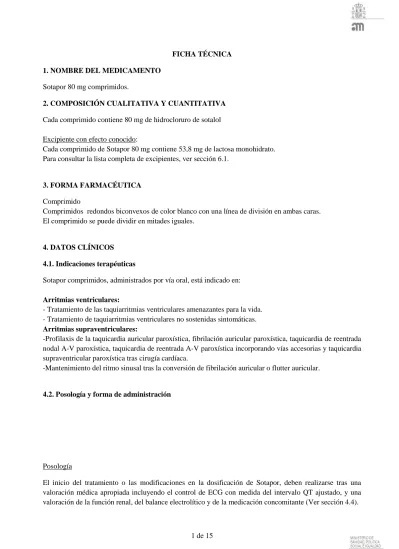
SOTAPOR 80 mg Tablets

Prescription review online
A doctor will review your case and decide whether a prescription is medically appropriate.

Talk to a doctor about this medicine
Discuss your symptoms and possible next steps in a quick online consultation.



How to use SOTAPOR 80 mg TABLETS
Contents of the leaflet
- Introduction
- What Sotapor 80 mg Tablets are and what they are used for
- What you need to know before you take Sotapor 80 mg Tablets
- How to Take Sotapor 80 mg Tablets
- Possible Side Effects
- Storage of Sotapor 80 mg Tablets
- Packaging Content and Additional Information
Introduction
Package Leaflet: Information for the Patient
Sotapor 80 mg Tablets
Sotalol Hydrochloride
Read all of this leaflet carefully before you start taking this medicine because it contains important information for you.
|
Contents of the Package Leaflet:
- What Sotapor 80 mg Tablets are and what they are used for
- What you need to know before you take Sotapor 80 mg Tablets
- How to take Sotapor 80 mg Tablets
- Possible side effects
- Storage of Sotapor 80 mg Tablets
- Contents of the pack and other information
1. What Sotapor 80 mg Tablets are and what they are used for
Sotapor is a medicine that contains the active substance sotalol, which belongs to a group of medicines called beta-blockers.
Sotapor 80 mg Tablets are indicated for the treatment of heart rhythm disorders:
- Ventricular Arrhythmias:
- Treatment of life-threatening ventricular tachyarrhythmias.
- Treatment of non-sustained symptomatic ventricular tachyarrhythmias.
- Supraventricular Arrhythmias:
- Prophylaxis of paroxysmal atrial tachycardia, paroxysmal atrial fibrillation, paroxysmal AV nodal reentrant tachycardia, paroxysmal AV reentrant tachycardia using accessory pathways, and paroxysmal supraventricular tachycardia after cardiac surgery.
- Maintenance of sinus rhythm after conversion of atrial fibrillation or atrial flutter.

Not sure if this medicine is right for you?
Discuss your symptoms and treatment with a doctor online.
2. What you need to know before you take Sotapor 80 mg Tablets
Do not take Sotapor:
- If you are allergic (hypersensitive) to sotalol, sulfonamides, or any of the other ingredients of Sotapor.
- If you have asthma, a feeling of shortness of breath, or other chronic lung diseases (such as chronic obstructive pulmonary disease - COPD).
- If you have a very slow heart rate (less than 50 beats per minute).
- If you have any heart disease, such as sick sinus syndrome (including sinoatrial block) without a pacemaker, AV block of second and third degree in patients without a pacemaker, prolonged QT syndromes (inherited or acquired), torsades de pointes (a serious heart rhythm disorder), cardiogenic shock, uncontrolled heart failure, Prinzmetal's angina.
- If you have severe kidney disease.
- If you have untreated pheochromocytoma.
- If you have low blood pressure that is not associated with arrhythmia (heart rhythm disorder).
- If you have severe peripheral circulatory disorders (Raynaud's syndrome).
- If you are going to have surgery with anesthesia, inform your doctor.
- If you have metabolic acidosis.
- If you are taking medications that may affect heart rhythm (cause torsades de pointes) such as certain antiarrhythmics (quinidine, hydroquinidine, disopyramide, amiodarone, dronedarone...), certain medications used to treat mental health problems (chlorpromazine, levomepromazine, trifluoperazine, haloperidol, tiaprida...), certain antidepressants, certain antibiotics (fluoroquinolones, macrolides...) or other medications such as cisapride, domperidone, etc.
- If you are taking floctafenine (for pain treatment).
Warnings and Precautions
Consult your doctor or pharmacist before starting treatment with Sotapor.
Abrupt withdrawal of treatment should be avoided. The dose should be gradually reduced, especially if you have angina pectoris.
Be careful with Sotapor:
- If you have any heart problems, such as a very slow heart rate, first-degree AV block, history of long QT, severe ventricular arrhythmias, changes in the electrocardiogram (record of the heart's electrical activity).
- If you have congestive heart failure or have recently had a myocardial infarction.
- If you have low levels of potassium and sodium in the blood (especially if you are taking diuretics).
- If you have high levels of sotalol in the blood (due to overdose or kidney malfunction).
- If you are taking medications that promote torsades de pointes (see Use of Sotapor with other medications).
- If you have a history of severe allergic reactions.
- If you have any kidney disease, as a dose adjustment of Sotapor may be necessary.
- If you are diabetic, as you may need to adjust the dose of insulin or any other medication prescribed for the treatment of your diabetes. Sotapor may mask the first symptoms of a hypoglycemic crisis (low blood sugar levels).
- If you have psoriasis, as certain medications in the group to which Sotapor belongs may exacerbate symptoms.
These factors require strict medical monitoring during the administration of Sotapor.
Treatment with Sotapor should be interrupted during episodes of diarrhea or any episode that implies an electrolyte imbalance (low levels of potassium or magnesium), but before doing so, consult your doctor.
When chronic treatment with Sotapor is discontinued, you should be monitored, especially if you are at risk of developing thyrotoxicosis (excessive levels of thyroid hormones circulating in the blood).
If you are going to undergo surgery that requires general anesthesia, you should inform your doctor and anesthesiologist that you are taking Sotapor, as it may increase the risk of hypotension. Similarly, inform your dentist before a dental procedure.
You will have periodic blood tests during your treatment with Sotapor.
Use in Athletes
Athletes are informed that this medication contains a component that may result in a positive doping test.
Use of Sotapor with Other Medications
Tell your doctor or pharmacist if you are taking, have recently taken, or might take any other medications.
Certain medications may interact with Sotapor. The combination of Sotapor with other medications is DELICATE, if not contraindicated. In these cases, it may be necessary to change the dose or interrupt treatment with one of them.
Do not take sotalol if you are taking any of the following medications:
- Floctafenine (for pain treatment).
- Medications that induce torsades de pointes (a type of heart rhythm disorder), such as certain antiarrhythmics (quinidine, hydroquinidine, disopyramide, amiodarone, dronedarone, dofetilide, ibutilide, etc), neuroleptics (certain medications used to treat mental health problems like thioridazine, levomepromazine, trifluoperazine, ciamemazine, phenothiazines, sulpiride, sultopride, amisulpride, tiaprida, pimozide, haloperidol, droperidol...), certain antidepressants, certain antibiotics (fluoroquinolones, macrolides, etc), certain non-sedating antihistamines (terfenadine, astemizole, etc), bepridil, cisapride, difemanil, cimetidine, mizolastine, and intravenous vincamine.
It is not recommended to use sotalol with the following medications:
- Halofantrine (treatment of malaria), pentamidine (treatment of infections).
- Normally, it is not recommended to combine sotalol with verapamil or intravenous diltiazem (medications for the treatment of high blood pressure).
- Sotapor should be given with extreme caution with medications that prolong the QT interval (alteration of the heart's electrical activity):
- Antiarrhythmics for the treatment of heart rhythm disorders: procainamide, ajmaline, flecainide, cibenzoline, azimilide;
- Antidepressants for the treatment of depression: citalopram, escitalopram, fluoxetine, paroxetine, sertraline, fluvoxamine, clomipramine, amitriptyline, desipramine, imipramine, nortriptyline;
- Antipsychotics for the treatment of psychological disorders: mesoridazine, thioridazine, chlorpromazine, fluvoxamine, sertindole;
- Antibiotics for the treatment of infections: ciprofloxacin, moxifloxacin, gatifloxacin, evofloxacin, esparfloxacin, azithromycin, clarithromycin, erythromycin, roxithromycin;
- Antimalarials for the treatment of malaria: chloroquine, artenimol;
- Antihistamines: H1 antihistamines for the treatment of allergies (promethazine, diphenhydramine), H2 antihistamines for the treatment of stomach acid (cimetidine, famotidine);
- Gastric prokinetics/antiemetics for the treatment of nausea: ondansetron;
- Protein kinase inhibitors for the treatment of cancer: vandetanib, sunitinib, sorafenib;
- Others: arsenic trioxide (cancer treatment), donepezil (treatment of dementia), propofol (anesthetic), trazodone (treatment of psychological disorders), hydrocodone (for the treatment of cough), methadone, probucol (treatment of high cholesterol), ranolazine (treatment of stable angina), hydroxyzine (treatment of anxiety), fluconazole (antifungal), papaverine (for the treatment of erectile dysfunction, used in cardiac surgery), anagrelide (treatment of thrombocytosis).
Sotalol should be administered with caution in patients who are taking:
- Medications that decrease potassium levels in the blood, such as diuretics, laxatives, glucocorticoids, tetracosactide, intravenous amphotericin B.
- Medications that act on the heart to decrease heart rate, such as diltiazem, verapamil; clonidine, guanfacine; digitalis glycosides including digoxin; mefloquine, alpha-methyldopa, cholinesterase inhibitors used in Alzheimer's disease (such as donepezil, rivastigmine, tacrine, galantamine, neostigmine, pyridostigmine, etc), other beta-blockers, pilocarpine (used to treat glaucoma).
- Volatile halogenated anesthetics.
- Medications used to treat diabetes, such as insulin and hypoglycemic sulfonamides.
- Propafenone (treatment of heart arrhythmias).
- Baclofen (muscle relaxant).
- Lidocaine intravenously (local anesthetic, treatment of heart arrhythmias).
- Proton pump inhibitors (omeprazole, lansoprazole, pantoprazole, esomeprazole) that reduce stomach acid, used to treat stomach ulcers and esophageal reflux.
Associations to be taken into account:
- Non-steroidal anti-inflammatory drugs such as aspirin and ibuprofen.
- Antidepressants of the imipramine group (tricyclics) and certain neuroleptics (for the treatment of mental health problems).
- Calcium channel blockers (dihydropyridines) for the treatment of high blood pressure, coronary disease, and heart arrhythmia.
- Dipyridamole intravenously (anticoagulant for the prophylactic treatment of cardiovascular accidents and thrombosis).
Interactions with laboratory tests: the presence of sotalol in urine may cause a false increase in the substance called urinary metanephrine.
Pregnancy, Breastfeeding, and Fertility
Consult your doctor or pharmacist before taking a medication.
The use of Sotapor is not recommended during pregnancy. Sotapor should only be administered during pregnancy if the expected benefit justifies the potential risk. If you are pregnant and it is not possible to interrupt treatment with Sotapor in the 2-3 days prior to delivery, your child should be monitored in the 48-72 hours after birth.
The use of Sotapor is not recommended during breastfeeding. Sotalol passes into breast milk and may cause effects in the infant. If your doctor interrupts treatment with Sotapor, do not start or resume breastfeeding until the date indicated by your doctor.
Driving and Using Machines
At the beginning of treatment with Sotapor, symptoms of fatigue and dizziness may appear, so it is advisable not to perform tasks that require special attention (driving vehicles, handling hazardous machinery) until the response to the medication is satisfactory.
Sotapor contains Lactose. If your doctor has told you that you have an intolerance to certain sugars, consult with them before taking this medication.
3. How to Take Sotapor 80 mg Tablets
Follow the instructions for administration of this medication indicated by your doctor. In case of doubt, consult your doctor or pharmacist.
The dose can be taken in a single dose or in divided doses.
Usually, the initial dose is one tablet (80 mg). The dose of Sotapor should be gradually adjusted, at intervals of 2-3 days between each dose increase, and it will be necessary to regularly visit your doctor during the first weeks after starting treatment with Sotapor, so that they can check your response and, if necessary, adjust the dose.
Most patients respond to a daily dose of 160-320 mg/day, administered in 2 divided doses at 12-hour intervals.
Some patients with life-threatening ventricular arrhythmias may require doses of 480-640 mg/day.
Do not interrupt treatment with Sotapor abruptly.
Use in Children and Adolescents
The efficacy and safety of Sotapor have not been established in children under 18 years of age.
Use in Elderly Patients
In elderly patients with impaired renal function and other organic disorders, lower doses are usually used.
Renal Impairment
In patients with renal impairment, lower doses are usually used.
If You Take More Sotapor Than You Should
In case of overdose or accidental ingestion, consult your doctor or pharmacist immediately, or call the Toxicology Information Service, phone 91 562 04 20, indicating the medication and the amount ingested.
The most frequent symptoms of overdose include bradycardia (slow heart rate), congestive heart failure, hypotension (low blood pressure), bronchospasm (spasms in the bronchi that prevent air from passing to the lungs), hypoglycemia (low blood sugar levels), and convulsions (including convulsions caused by low blood sugar levels). It is recommended to go quickly to the doctor or the Emergency Department of the nearest hospital.
If You Forget to Take Sotapor 80 mg Tablets
If you forget to take a dose, do not worry; if it is still time, take it as soon as possible or if it is already time for the next dose, continue with the treatment. Never take a double dose to make up for the forgotten one.
If You Have Doubts About What to Do or If You Forget to Take More Than One Dose, ask your doctor or pharmacist.
If You Interrupt Treatment with Sotapor
Continue taking Sotapor tablets until your doctor advises you otherwise. If you are going to interrupt treatment with Sotapor, you must follow your doctor's instructions exactly. Never interrupt treatment abruptly.

Started taking the medicine and have questions?
Discuss your symptoms and treatment with a doctor online.
4. Possible Side Effects
Like all medications, Sotapor can have side effects, although not everyone gets them.
The following side effects have been observed:
Very common (may affect more than 1 in 10 people): bradycardia (slow heart rate), chest pain, palpitations, edema (swelling), electrocardiogram abnormalities, dyspnea (difficulty breathing), vomiting, diarrhea, dizziness, asthenia (weakness), drowsiness, headache, sleep disorders.
Common (may affect up to 1 in 10 people): arrhythmia (heart rhythm disorders), syncope (fainting), heart failure, presyncope (lightheadedness), torsades de pointes (a type of arrhythmia), asthma, skin rash, pruritus (itching), alopecia (hair loss with itching), hyperhidrosis (excessive sweating), nausea, dyspepsia (indigestion), stomach pain, gas, dysgeusia (taste disorders), muscle cramps, myalgia (muscle pain), arthralgia (joint pain), fatigue, paresthesia, depression, anxiety, mood changes, sexual dysfunction, vision disorders, low blood pressure, fever, and hearing impairment.
Frequency not known (frequency cannot be estimated from the available data)
- Reduced number of cells that help blood clotting - this increases the risk of bleeding or bruising
- Low blood sugar levels
- Decreased blood flow in the limbs (causing fingers and toes to be cold and/or blue, pain in the legs when walking),
- Elevated areas of dry and itchy skin (psoriasis)
- Chest spasms that cause difficulty breathing (bronchospasm)
- Chest pain or pressure (angina pectoris)
- Heart block
Reporting of Side Effects
If you experience any side effects, talk to your doctor, pharmacist, or nurse, even if it is a possible side effect not listed in this leaflet. You can also report them directly through the Spanish Pharmacovigilance System for Human Use Medicines: www.notificaram.es. By reporting side effects, you can help provide more information on the safety of this medication.
5. Storage of Sotapor 80 mg Tablets
Keep out of sight and reach of children.
Do not store above 30°C.
Keep in the original package. Keep the package tightly closed, protected from light and moisture.
Do not use this medication after the expiration date that appears on the package after CAD. The expiration date is the last day of the month indicated.
Medications should not be disposed of through wastewater or household waste. Deposit the packages and medications you no longer need at the SIGRE point in the pharmacy. In case of doubt, ask your pharmacist how to dispose of packages and medications you no longer need. This way, you will help protect the environment.
6. Packaging Content and Additional Information
Composition of Sotapor 80 mg tablets
- The active ingredient is sotalol.
- The other components are: lactose monohydrate, corn starch, stearic acid, colloidal anhydrous silica, microcrystalline cellulose, and magnesium stearate.
Appearance of the Product and Packaging Content
Sotapor 80 mg tablets are presented in the form of scored tablets. Each package contains 30 tablets with 80 mg of sotalol each.
Marketing Authorization Holder and Manufacturer
Manufacturing Authorization Holder
CHEPLAPHARM Arzneimittel GmbH
Ziegelhof 24
17489 Greifswald
Germany
Manufacturer
Farmea
10 rue Bouché Thomas
ZAC d`Orgemont
49000 Angers
France
Local Representative
Laboratorios Rubió, S.A.
C/ Industria, 29 - Pol. Ind. Comte de Sert
08755 Castellbisbal (Barcelona)
Spain
Date of the Last Revision of this Leaflet: September 2022
Detailed and updated information on this medication is available on the website of the Spanish Agency for Medicines and Health Products (AEMPS) http://www.aemps.gob.es/.
- Country of registration
- Dosage formTABLET, 80 mg sotalol hydrochloride
- ATC codeC07AA07
- Average pharmacy price3.12 EUR
- Active substance
- Prescription requiredYes
- Manufacturer
- CompositionLACTOSA (53,8 mg mg)
- This information is for reference only and does not constitute medical advice. Always consult a doctor before taking any medication. Oladoctor is not responsible for medical decisions based on this content.
- Alternatives to SOTAPOR 80 mg TABLETSDosage form: TABLET, 80 mgActive substance: sotalolManufacturer: Sandoz Farmaceutica S.A.Prescription requiredDosage form: ORAL SOLUTION/SUSPENSION, 3.75 mg/mlActive substance: propranololManufacturer: Pierre Fabre MedicamentPrescription requiredDosage form: TABLET, 10 mgActive substance: propranololManufacturer: Accord Healthcare S.L.U.Prescription required
Online doctors for SOTAPOR 80 mg TABLETS
Discuss questions about SOTAPOR 80 mg TABLETS, including use, safety considerations and prescription review, subject to medical assessment and local regulations.
Get SOTAPOR 80 mg TABLETS Prescription Online
Fill in a 2-min form
Tell us your symptoms, history, and what medicine you're requesting.
Pick a doctor or let us assign
Choose a specialist or we'll match you with the next available doctor.
Doctor reviews your case
Usually within 30 minutes. They may ask follow-up questions via chat.
Collect from any pharmacy
Electronic prescription sent to your email — valid across Spain.
Frequently Asked Questions
SOTAPOR 80 mg TABLETS requires a prescription in Spain. You can check with a doctor online whether this medicine may be appropriate for your situation.
The active ingredient in SOTAPOR 80 mg TABLETS is sotalol. This information helps identify medicines with the same composition but different brand names.
The average pharmacy price for SOTAPOR 80 mg TABLETS is around 3.12 EUR. Prices may vary depending on the manufacturer and dosage form.
SOTAPOR 80 mg TABLETS is manufactured by Cheplapharm Arzneimittel Gmbh. Pharmacy brands and packaging may differ depending on the distributor.
Doctors such as Family doctors, Psychiatrists, Dermatologists, Cardiologists, Endocrinologists, Gastroenterologists, Pulmonologists, Nephrologists, Rheumatologists, Hematologists, Infectious disease physicians, Allergists, Geriatricians, Paediatricians, Oncologists may assess whether SOTAPOR 80 mg TABLETS is appropriate, depending on your situation and local regulations. You can book an online consultation to discuss your symptoms and possible next steps.
Spain has a well-developed healthcare infrastructure across major cities such as Madrid, Barcelona, Valencia, and Seville. Pharmacies are widely available and operate under strict regulations, ensuring access to prescribed medications.
You can buy SOTAPOR 80 mg TABLETS in Madrid, Barcelona, Seville, or Valencia at any local pharmacy with a valid prescription.
To obtain a prescription, you can use Oladoctor:
Other medicines with the same active substance (sotalol) include SOTALOL SANDOZ 80 mg TABLETS, HEMANGIOL 3.75 mg/ml ORAL SOLUTION, PROPRANOLOL ACCORD 10 mg FILM-COATED TABLETS. These may have different brand names or formulations but contain the same therapeutic ingredient. Always consult a doctor before switching or starting a new medicine.
