



SOLIAN 100 mg /Ml Oral Solution

Prescription review online
A doctor will review your case and decide whether a prescription is medically appropriate.

Talk to a doctor about this medicine
Discuss your symptoms and possible next steps in a quick online consultation.



How to use SOLIAN 100 mg/ml ORAL SOLUTION
Contents of the leaflet
- Introduction
- What is Solian 100 mg/ml Oral Solution and what is it used for
- What you need to know before you take Solian 100 mg/ml Oral Solution
- Use in Children
- How to take Solian 100 mg/ml Oral Solution
- Possible side effects
- Storage of Solian 100 mg/ml Oral Solution
- Packaging Content and Additional Information
Introduction
Package Leaflet: Information for the Patient
Solian 100 mg/ml Oral Solution
Amisulpride
Read all of this leaflet carefully before you start taking this medicine because it contains important information for you.
- Keep this leaflet, you may need to read it again.
- If you have any further questions, ask your doctor or pharmacist.
- This medicine has been prescribed for you only. Do not pass it on to others. It may harm them, even if their signs of illness are the same as yours.
- If you experience any side effects, talk to your doctor, pharmacist or nurse. This includes any possible side effects not listed in this leaflet. See section 4.
Contents of the Package Leaflet
- What is Solian 100 mg/ml Oral Solution and what is it used for
- What you need to know before you take Solian 100 mg/ml Oral Solution
- How to take Solian 100 mg/ml Oral Solution
- Possible side effects
- Storage of Solian 100 mg/ml Oral Solution
- Contents of the pack and other information
1. What is Solian 100 mg/ml Oral Solution and what is it used for
Amisulpride belongs to a group of medicines called antipsychotics.
Solian 100 mg/ml Oral Solution is indicated for the treatment of schizophrenia.

Not sure if this medicine is right for you?
Discuss your symptoms and treatment with a doctor online.
2. What you need to know before you take Solian 100 mg/ml Oral Solution
Do not take Solian 100 mg/ml Oral Solution
- if you are allergic to the active substance or to any of the other ingredients of this medicine (listed in section 6).
- if you have a tumor that is dependent on prolactin (a hormone secreted by the pituitary gland that stimulates milk production in the mammary glands), such as pituitary prolactinoma or breast cancer.
- if you have pheochromocytoma (a tumor of the adrenal gland).
- if you are a child, up to puberty.
- if you are being treated with levodopa.
Warnings and Precautions
Consult your doctor, pharmacist or nurse before starting treatment with Solian 100 mg/ml Oral Solution,
- as with other antipsychotic medicines, a potentially life-threatening complication called neuroleptic malignant syndrome may occur, characterized by high fever, muscle stiffness, altered nervous system function (autonomic instability), altered consciousness (obnubilation), rhabdomyolysis (muscle breakdown associated with muscle pain) and increased levels of an enzyme called creatine phosphokinase (CPK). In the event of high fever, especially when using high doses, all antipsychotic medications, including amisulpride, should be discontinued.
Rhabdomyolysis has also been observed in patients without neuroleptic malignant syndrome.
- if you have Parkinson's disease.
- if you have known cardiovascular disease or a family history of QT interval prolongation, and the use of neuroleptic medications should be avoided.
- if you have risk factors for stroke.
- in elderly patients with psychosis related to dementia, who are being treated with antipsychotics (possibility of increased risk of death).
- in patients with risk factors for thromboembolism (see section "Possible side effects");
- if you have a history or family history of breast cancer.
- if pituitary tumor is diagnosed, treatment with amisulpride should be discontinued;
- if you have established diabetes mellitus or risk factors for diabetes.
- if you have a history of seizures.
- if you have renal insufficiency.
- withdrawal symptoms (nausea, vomiting or insomnia) have been described after abrupt discontinuation of treatment at high doses. Psychotic symptoms and involuntary movement disorders may also reappear suddenly, such as akathisia (inability to remain seated quietly), dystonia (involuntary muscle contractions) and dyskinesia (incoordination of movements). Therefore, gradual withdrawal is recommended.
- as with other antipsychotic medications, leukopenia, neutropenia, and agranulocytosis may occur. The onset of unexplained fever or infections may indicate these blood disorders (see section "Possible side effects") and may require immediate blood analysis.
- serious liver problems have been reported with Solian. Consult your doctor immediately if you experience fatigue, loss of appetite, nausea, vomiting, abdominal pain or yellowing of the eyes or skin.
Using Solian 100 mg/ml Oral Solution with other medicines
Tell your doctor or pharmacist if you are taking, have recently taken or might take any other medicines.
Certain medicines used may alter the effect of Solian, and your doctor may change the dose during combined treatment.
The use of Solian with levodopa is contraindicated.
Amisulpride may counteract the effect of dopaminergic agonists (e.g., bromocriptine and ropinirol).
It is not recommended to use medications containing alcohol with Solian, as amisulpride may enhance the central effects of alcohol.
It is essential that you inform your doctor if you are currently taking any of the following medications:
- Central nervous system depressants, including narcotics, analgesics, sedating H1 antihistamines, barbiturates, benzodiazepines, and other anxiolytics, clonidine, and derivatives.
- Blood pressure-lowering medications.
- Clozapine.
- Medications that prolong the QT interval, such as antiarrhythmic medications (quinidine, disopyramide, amiodarone, and sotalol), some antihistamines, other antipsychotics, and some medications for the treatment of malaria (mefloquine).
- Lithium salts.
- Sucralfate.
- Antacids.
Taking Solian 100 mg/ml Oral Solution with food and drinks
This medicine may enhance the effects of alcohol; therefore, it is not recommended to consume alcoholic beverages during treatment.
Pregnancy, Breast-feeding, and Fertility
If you are pregnant or breastfeeding, think you may be pregnant, or plan to become pregnant, consult your doctor or pharmacist before taking this medicine.
Pregnancy:
Solian is not recommended during pregnancy or in women of childbearing potential who do not use contraceptive methods.
If you take Solian during the last three months of pregnancy, your baby may experience agitation, muscle stiffness, and/or muscle weakness, tremors, numbness, breathing difficulties, or feeding difficulties. If your baby develops any of these symptoms, you should contact your doctor.
Breast-feeding:
You should not breast-feed during treatment with Solian. Consult your doctor about the best way to feed your baby if you are taking Solian.
Use in Children
The safety and efficacy of amisulpride have not been established between puberty and 18 years of age: the available data on the use of amisulpride in adolescents with schizophrenia are limited. Therefore, the use of amisulpride is not recommended between puberty and 18 years of age. In children, up to puberty, amisulpride is contraindicated.
Driving and Using Machines
Solian 100 mg/ml Oral Solution may cause symptoms such as drowsiness, dizziness, visual disturbances, blurred vision, and decreased reaction capacity. These effects, as well as the underlying disease, may impair your ability to drive vehicles or operate machines. Therefore, do not drive, operate machinery, or engage in other activities that require special attention until your doctor assesses your response to this medicine.
Solian 100 mg/ml Oral Solution contains potassium, sodium, propyl parahydroxybenzoate, and methyl parahydroxybenzoate, and ethanol:
Patients with renal insufficiency or low-potassium diets should note that this medicine contains 208 mg (5.32 mmol) of potassium per 4 ml.
Patients with low-sodium diets should note that this medicine contains 13.2 mg (0.57 mmol) of sodium per 4 ml.
As it contains propyl parahydroxybenzoate (E216) and methyl parahydroxybenzoate (E218) as excipients, this medicine may cause allergic reactions (possibly delayed).
This medicine contains 2.9 mg of alcohol (ethanol) per ml of oral solution, which is equivalent to 0.29% (v/v). The amount in one ml of oral solution of this medicine is equivalent to less than 0.07 ml of beer or 0.029 ml of wine.
The small amount of ethanol in this medicine does not produce any noticeable effect.

Started taking the medicine and have questions?
Discuss your symptoms and treatment with a doctor online.
3. How to take Solian 100 mg/ml Oral Solution
Follow exactly the administration instructions of this medicine given by your doctor or pharmacist. If you are in doubt, consult your doctor or pharmacist again.
Remember to take your medicine. Your doctor will indicate the duration of treatment and how to increase the dose. Do not stop treatment abruptly; your symptoms may reappear.
Solian 100 mg/ml is an oral solution for administration by mouth.
Adults:
The dose should be adjusted according to your clinical response and tolerability to treatment.
A dose between 400 mg/day (4 ml) and 800 mg/day (8 ml) is recommended. In individual cases, the daily dose may be increased up to 1200 mg/day (12 ml).
The daily dose should be administered in a single intake or divided into two intakes in case of doses above 400 mg/day.
Elderly:
Solian should be used with special caution due to the possible risk of hypotension (abnormally low blood pressure) and sedation. Your doctor will adjust the dose due to renal insufficiency.
Patients with renal insufficiency:
Your doctor will adjust the dose.
If you take more Solian 100 mg/ml Oral Solution than you should
Consult your doctor immediately or go to the nearest hospital.
In case of overdose or accidental ingestion, consult the Toxicology Information Service, telephone 91 562 04 20.
In case of taking more doses than prescribed, symptoms such as drowsiness, sedation, and even coma, decreased blood pressure, as well as abnormal movements may appear. Cases of death have been reported, mainly in combination with other psychotropic agents.
If you forget to take Solian 100 mg/ml Oral Solution
Do not take a double dose to make up for forgotten doses.
If you have any further questions about the use of this medicine, ask your doctor or pharmacist.
4. Possible side effects
Like all medicines, Solian 100 mg/ml Oral Solution can cause side effects, although not everybody gets them.
If you experience side effects, talk to your doctor or pharmacist, even if they are not listed in this leaflet.
Side effects observed according to their frequency of occurrence: Very common (may affect more than 1 in 10 patients); Common (may affect up to 1 in 10 patients); Uncommon (may affect up to 1 in 100 patients); Rare (may affect up to 1 in 1,000 patients); Very rare (may affect up to 1 in 10,000 patients); frequency not known (cannot be estimated from available data), have been:
Blood and lymphatic system disorders:
Uncommon: leukopenia (decrease in white blood cell count) and neutropenia (decrease in a type of white blood cell, neutrophils) (see section "Warnings and Precautions").
Rare: agranulocytosis (decrease in a type of white blood cell, granulocytes) (see section "Warnings and Precautions").
Immune system disorders:
Uncommon: allergic reactions.
Endocrine disorders:
Common: milk secretion, absence of menstruation, breast growth (in males), breast pain, and erectile dysfunction.
Rare: benign pituitary tumor, such as prolactinoma (see sections "Do not take Solian" and "Warnings and Precautions").
Metabolic and nutritional disorders:
Uncommon: hyperglycemia (elevated blood glucose levels) (see section "Warnings and Precautions"), increased triglycerides and cholesterol in the blood.
Rare: hyponatremia and syndrome of inappropriate antidiuretic hormone secretion.
Psychiatric disorders:
Common: insomnia, anxiety, agitation, orgasmic dysfunction.
Uncommon: confusion.
Nervous system disorders:
Very common: tremor, rigidity, poverty of movement, increased salivation, and inability to remain seated quietly, incoordination of movements.
Common: acute dystonia (torticollis, oculogyric crisis, contraction of the masticatory muscles) and somnolence.
Uncommon: rhythmic, involuntary movements in the tongue and/or face, after long-term administration, and epileptic seizures.
Rare: neuroleptic malignant syndrome, which is a potentially life-threatening complication (see section "Warnings and Precautions").
Frequency not known: restless legs syndrome (unpleasant sensation in the legs, which is temporarily relieved by movement, and symptoms worsen at the end of the day).
Eye disorders:
Common: blurred vision (see section "Driving and Using Machines").
Cardiac disorders:
Uncommon: bradycardia (slow heart rate).
Rare: QT interval prolongation, ventricular arrhythmias, such as torsades de pointes, ventricular tachycardia, which may lead to ventricular fibrillation or cardiac arrest, sudden death (see section "Warnings and Precautions").
Vascular disorders:
Common: hypotension.
Uncommon: increased blood pressure.
Rare: venous thromboembolism (process characterized by blood clotting in the veins), including pulmonary embolism, sometimes fatal, and deep vein thrombosis (see section "Warnings and Precautions").
Respiratory, thoracic, and mediastinal disorders:
Uncommon: nasal congestion and aspiration pneumonia (mainly associated with other antipsychotics and central nervous system depressants).
Gastrointestinal disorders:
Common: constipation, nausea, vomiting, dry mouth.
Hepatobiliary disorders:
Uncommon: liver tissue damage.
Skin and subcutaneous tissue disorders:
Rare: angioedema (generalized urticaria accompanied by inflammation of feet, hands, throat, lips, and respiratory tract) and urticaria.
Frequency not known: increased sensitivity of your skin to sunlight and ultraviolet light (photosensitivity).
Musculoskeletal and connective tissue disorders:
Uncommon: bone disorders (osteopenia, osteoporosis).
Frequency not known: rhabdomyolysis (muscle breakdown associated with muscle pain).
Renal and urinary disorders:
Uncommon: urinary retention.
Pregnancy, puerperium, and perinatal conditions:
Frequency not known: withdrawal syndrome in newborns (see section "Pregnancy and Breast-feeding").
Investigations:
Common: weight gain.
Uncommon: elevated liver enzymes, mainly transaminases.
Frequency not known: elevated creatine phosphokinase levels (blood test indicating muscle damage).
Accidents, poisonings, and complications of surgical and medical care:
Frequency not known: falls due to reduced body balance, which sometimes result in fractures.
Important: you should see a doctor immediately:
- if during treatment with Solian 100 mg/ml Oral Solution you experience any of the following symptoms: high fever, generalized muscle stiffness, rapid breathing, abnormal sweating, or decreased alertness, a potentially life-threatening complication called neuroleptic malignant syndrome (see section "Warnings and Precautions").
- or if you notice your heart rhythm is altered, you suffer from dizziness, vertigo, difficulty breathing, or chest pain, as isolated cases of severe ventricular arrhythmias, such as torsades de pointes, ventricular tachycardia, which may lead to atrial fibrillation or cardiac arrest, and fatal outcome have been reported (see section "Warnings and Precautions").
Reporting of Side Effects
If you experience any side effects, talk to your doctor or pharmacist, even if they are not listed in this leaflet. You can also report side effects directly through the Spanish Pharmacovigilance System for Human Use Medicines: https://www.notificaram.es. By reporting side effects, you can help provide more information on the safety of this medicine.
5. Storage of Solian 100 mg/ml Oral Solution
No special storage conditions are required.
Keep this medicine out of the sight and reach of children.
Do not use this medicine after the expiry date stated on the packaging. The expiry date is the last day of the month stated.
Medicines should not be disposed of via wastewater or household waste. Return the containers and any unused medicines to the pharmacy. If you are in doubt, ask your pharmacist how to dispose of containers and unused medicines. This will help protect the environment.
6. Packaging Content and Additional Information
Composition of Solian 100 mg/ml Oral Solution
- The active ingredient is amisulpride.
- The other components are: caramel flavor (contains ethanol), concentrated hydrochloric acid for pH adjustment, sodium saccharin, sodium gluconate, gluconodeltalactone, methyl parahydroxybenzoate (E218), propyl parahydroxybenzoate (E216), potassium sorbate, and purified water.
Product Appearance and Packaging Content
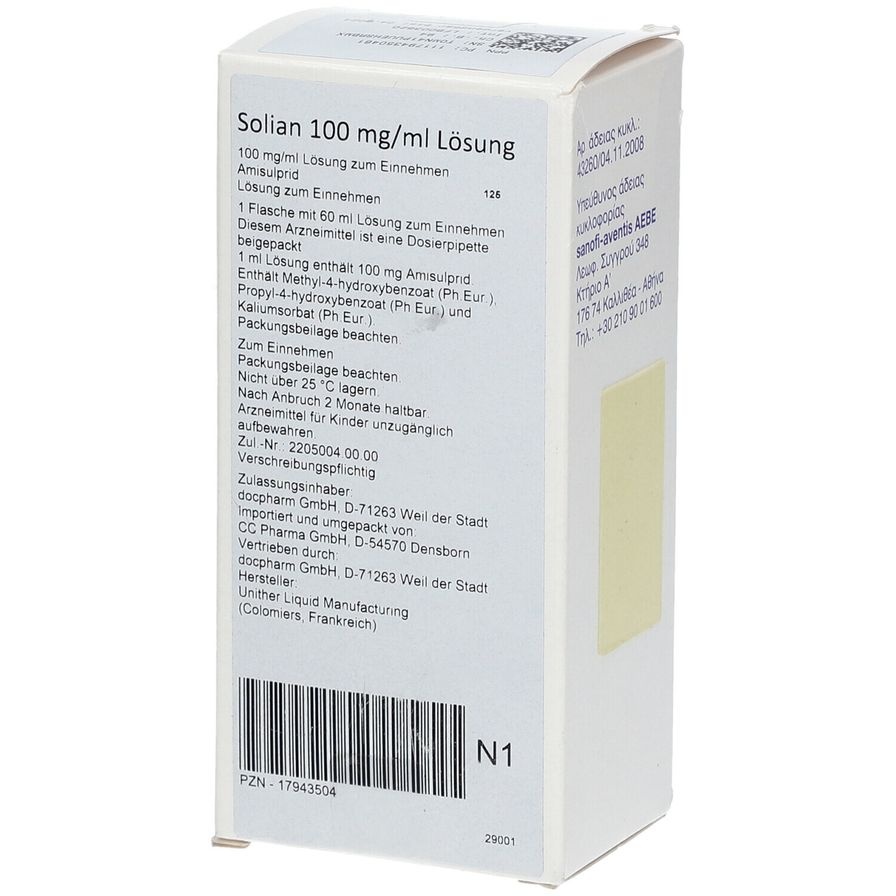
Solian 100 mg/ml is a clear yellow oral solution with a caramel odor. It is presented in 60 ml topaz glass bottles. Each ml of solution contains 100 mg of amisulpride.
Marketing Authorization Holder and Manufacturer
Holder:
sanofi-aventis, S.A.
C/ Rosselló i Porcel, 21
08016 Barcelona
Spain
Manufacturer:
Unither Liquid Manufacturing
1-3 allée de la Neste Z.I. en Sigal
31770 Colomiers (France)
Date of the Last Revision of this Leaflet: September 2023
Detailed information on this medication is available on the website of the Spanish Agency for Medicines and Health Products (AEMPS) http://www.aemps.gob.es/
- Country of registration
- Dosage formORAL SOLUTION/SUSPENSION, 100 mg amisulpride/ ml
- ATC codeN05AL05
- Average pharmacy price19.94 EUR
- Active substance
- Prescription requiredYes
- Manufacturer
- CompositionPARAHIDROXIBENZOATO DE METILO (E-218) (0,100 g mg), PARAHIDROXIBENZOATO DE PROPILO (0,050 g mg), SORBATO POTASICO (0,200 g mg)
- This information is for reference only and does not constitute medical advice. Always consult a doctor before taking any medication. Oladoctor is not responsible for medical decisions based on this content.
- Alternatives to SOLIAN 100 mg/ml ORAL SOLUTIONDosage form: TABLET, 100 mgActive substance: amisulprideManufacturer: Aurovitas Spain, S.A.U.Prescription requiredDosage form: TABLET, 200 mgActive substance: amisulprideManufacturer: Aurovitas Spain, S.A.U.Prescription requiredDosage form: TABLET, 400 mgActive substance: amisulprideManufacturer: Aurovitas Spain, S.A.U.Prescription required
Online doctors for SOLIAN 100 mg/ml ORAL SOLUTION
Discuss questions about SOLIAN 100 mg/ml ORAL SOLUTION, including use, safety considerations and prescription review, subject to medical assessment and local regulations.







Get SOLIAN 100 mg/ml ORAL SOLUTION Prescription Online
Fill in a 2-min form
Tell us your symptoms, history, and what medicine you're requesting.
Pick a doctor or let us assign
Choose a specialist or we'll match you with the next available doctor.
Doctor reviews your case
Usually within 30 minutes. They may ask follow-up questions via chat.
Collect from any pharmacy
Electronic prescription sent to your email — valid across Spain.
Frequently Asked Questions
SOLIAN 100 mg/ml ORAL SOLUTION requires a prescription in Spain. You can check with a doctor online whether this medicine may be appropriate for your situation.
The active ingredient in SOLIAN 100 mg/ml ORAL SOLUTION is amisulpride. This information helps identify medicines with the same composition but different brand names.
The average pharmacy price for SOLIAN 100 mg/ml ORAL SOLUTION is around 19.94 EUR. Prices may vary depending on the manufacturer and dosage form.
SOLIAN 100 mg/ml ORAL SOLUTION is manufactured by Sanofi Aventis S.A.. Pharmacy brands and packaging may differ depending on the distributor.
Doctors such as Family doctors, Psychiatrists, Dermatologists, Cardiologists, Endocrinologists, Gastroenterologists, Pulmonologists, Nephrologists, Rheumatologists, Hematologists, Infectious disease physicians, Allergists, Geriatricians, Paediatricians, Oncologists may assess whether SOLIAN 100 mg/ml ORAL SOLUTION is appropriate, depending on your situation and local regulations. You can book an online consultation to discuss your symptoms and possible next steps.
Spain has a well-developed healthcare infrastructure across major cities such as Madrid, Barcelona, Valencia, and Seville. Pharmacies are widely available and operate under strict regulations, ensuring access to prescribed medications.
You can buy SOLIAN 100 mg/ml ORAL SOLUTION in Madrid, Barcelona, Seville, or Valencia at any local pharmacy with a valid prescription.
To obtain a prescription, you can use Oladoctor:
Other medicines with the same active substance (amisulpride) include AMISULPRIDE AUROVITAS 100 mg TABLETS, AMISULPRIDE AUROVITAS 200 mg TABLETS, AMISULPRIDE AUROVITAS 400 mg FILM-COATED TABLETS. These may have different brand names or formulations but contain the same therapeutic ingredient. Always consult a doctor before switching or starting a new medicine.
