



SCINTIMUN 1 mg Radiopharmaceutical

Prescription review online
A doctor will review your case and decide whether a prescription is medically appropriate.

Talk to a doctor about this medicine
Discuss your symptoms and possible next steps in a quick online consultation.



How to use SCINTIMUN 1 mg, KIT FOR RADIOPHARMACEUTICAL PREPARATION
Contents of the leaflet
- Introduction
- What is Scintimun and what is it used for
- What you need to know before you use Scintimun
- How to use Scintimun
- Possible side effects
- Storage of Scintimun
- Contents of the pack and further information
Introduction
Package Leaflet: Information for the Patient
Scintimun 1 mg, kit for radiopharmaceutical preparation
Besilesomab
Read all of this leaflet carefully before you start using this medicine because it contains important information for you.
- Keep this leaflet, you may need to read it again.
- If you have any further questions, ask your doctor or the nuclear medicine specialist who will be supervising the procedure.
- If you experience any side effects, talk to your doctor or nuclear medicine specialist or pharmacist, even if they are not listed in this leaflet. See section 4.
Contents of the package leaflet
- What is Scintimun and what is it used for
- What you need to know before you use Scintimun
- How to use Scintimun
- Possible side effects
- Storage of Scintimun
- Contents of the pack and further information
1. What is Scintimun and what is it used for
Scintimun is a medicine that contains an antibody (besilesomab) used to target specific cells called granulocytes (a type of white blood cell in your blood involved in the inflammation process) in your body. Scintimun is used to prepare a radioactive injectable solution of technetium (99mTc)-besilesomab. The technetium (99mTc) is a radioactive element that allows the organs where the besilesomab accumulates to be seen using a special camera.
This medicine is a radiopharmaceutical for diagnostic use only in adults.
After injection into your vein, your doctor may obtain images (scans) of your organs that provide more information about the detection of inflammation and/or infection sites. However, Scintimun should not be used for the diagnosis of diabetic foot infections.
The administration of Scintimun involves receiving a small amount of radioactivity. Your doctor and the nuclear medicine specialist have considered that the clinical benefit you will obtain from this procedure with the radiopharmaceutical outweighs the risk due to radiation.

Not sure if this medicine is right for you?
Discuss your symptoms and treatment with a doctor online.
2. What you need to know before you use Scintimun
Do not use Scintimun:
- if you are allergic to besilesomab, mouse antibodies, or any other antibody, or to the sodium pertechnetate (99mTc) solution or to any of the other components of this medicine (see section 6).
- if you have a positive response to the test for the detection of anti-mouse antibodies (HAMA test). Consult your doctor if you are unsure.
- if you are pregnant.
Warnings and precautions
Consult your nuclear medicine specialist before starting to use Scintimun:
- If you have been previously administered Scintimun, because Scintimun should only be administered once in your lifetime. If you are unsure whether you have received this medicine before, please inform your doctor.
- If you have had a technetium scan in the last 2 days.
- If you have a tumor condition that involves the secretion of carcinoembryonic antigen (CEA) that could interfere with this investigation.
- If you have any blood disease.
- If you are breastfeeding.
Before administration of Scintimun:
To obtain images of better quality and to reduce radiation exposure to your bladder, you should drink sufficient amounts and empty your bladder before and after the scan.
Children and adolescents
This product is not recommended for use in patients under 18 years of age.
Use of Scintimun with other medicines
Inform your nuclear medicine specialist if you are taking, have recently taken, or might take any other medicine, including those bought without a prescription, as they may interfere with the interpretation of the images.
Medicines that reduce inflammation and medicines that affect blood cell production (such as corticosteroids or antibiotics) may affect the results of your scan.
Pregnancy and breastfeeding
If you are pregnant or breastfeeding, think you may be pregnant, or are planning to have a baby, ask your doctor or pharmacist for advice before using this medicine.
You must inform the nuclear medicine specialist before administration of Scintimun if there is any possibility that you may be pregnant, if you have a delayed period, or if you are breastfeeding.
In case of doubt, it is important that you consult your nuclear medicine specialist, who will be supervising the procedure.
Scintimun should not be administered if you are pregnant.
Nuclear medicine scans may involve a risk to the embryo.
If you are breastfeeding, you should interrupt breastfeeding for 3 days after your injection and the milk expressed during this period should be discarded. If you wish, you can express and store your milk beforethe injection. This will protect your baby from the radiation that may be present in your milk.
Your doctor will tell you when you can restart breastfeeding.
In addition, you should avoid direct contact with your baby during the first 12 hours after the injection.
Driving and using machines
Scintimun is unlikely to affect your ability to drive or use machines.
Scintimun contains sorbitol and sodium
If you have an intolerance to some sugars (e.g. fructose or sorbitol), inform your doctor before Scintimun is administered to you.
This medicine containsless than 1 mmol of sodium (23 mg) per dose; this is essentially ‘sodium-free’.
3. How to use Scintimun
There are strict rules about the use, handling, and disposal of radiopharmaceuticals. Scintimun will only be used in special controlled areas. This product will only be handled and administered by trained and qualified personnel to use it safely. These people will take special care in the safe use of this product and will inform you of their actions.
The nuclear medicine specialist supervising the procedure will decide the amount of technetium (99mTc)-besilesomab to be used in your case, which will be the minimum amount necessary to obtain the desired information.
The recommended amount to administer to an adult is usually between 400 and 800 MBq (megabecquerel, the unit used to express radioactivity).
Administration of Scintimun and performance of the procedureScintimun is administered intravenously.
A single injectioninto a vein in your arm is sufficient to carry out the procedure that your doctor needs to perform.
Duration of the procedure
Your nuclear medicine specialist will inform you about the usual duration of the procedure.
After administration of Scintimun
Since you may emit radiation that is especially harmful to small children during the first 12 hours after the injection, you should avoid direct contact with small children and pregnant women during this period of time.
The nuclear medicine specialist will inform you if you need to take special precautions after you have been administered this medicine. Consult your nuclear medicine specialist if you have any doubts.
If you have been administered more Scintimun than necessary
As the injection is prepared as a single dose by hospital personnel under strictly controlled conditions, it is very unlikely that an overdose will occur. However, in case of overdose, you will be asked to drink plenty of water and take laxatives to increase the elimination of the product from your body.
If you have any further questions about the use of this medicine, ask the nuclear medicine specialist supervising the procedure.

Started taking the medicine and have questions?
Discuss your symptoms and treatment with a doctor online.
4. Possible side effects
Like all medicines, this medicine can cause side effects, although not everybody gets them.
The administration of this radiopharmaceutical involves receiving a small amount of ionizing radiation with a very low risk of developing cancer and genetic disorders.
It has been observed that approximately 14 out of 100 patients who receive this injection produce antibodies in their blood that react against the antibody present in Scintimun. This may increase the risk of allergic reactions in the event of repeated administration of Scintimun. Consequently, you should not receive Scintimun a second time.
In case of an allergic reaction, you will receive the appropriate treatment from your doctor.
The possible side effects are listed below by frequency:
Very common(may affect more than 1 in 10 people):
Development of human anti-mouse antibodies that react against the antibody present in Scintimun (mouse cell antibody) with a risk of allergic reaction.
Common(may affect up to 1 in 10 people):
Low blood pressure.
Uncommon(may affect up to 1 in 100 people).
Allergic reaction, including swelling of the face, urticaria.
Rare(may affect up to 1 in 1,000 people):
- Severe allergic reaction that causes difficulty breathing or dizziness.
- Muscle or joint pain.
Reporting of side effects
If you experience any side effects, talk to your doctor or nuclear medicine specialist, even if they are not listed in this leaflet. You can also report side effects directly through the national reporting system listed in Appendix V. By reporting side effects, you can help provide more information on the safety of this medicine.
5. Storage of Scintimun
You will not need to store this medicine. This medicine is stored under the responsibility of the specialist in suitable facilities. The storage of radiopharmaceuticals will be carried out in accordance with national regulations on radioactive materials.
6. Contents of the pack and further information
- The active substance is besilesomab (anti-granulocyte monoclonal antibody obtained in mouse). One vial of Scintimun contains 1 mg of besilesomab.
- The other components are (see section 2 “Scintimun contains sorbitol”)
Scintimun
Sodium dihydrogen phosphate, anhydrous
Disodium hydrogen phosphate, anhydrous
Sorbitol E420
Nitrogen
Solvent for Scintimun
Tetrasodium salt of 1,1,3,3-propanetetraphosphonic acid, dihydrate (PTP)
Stannous chloride dihydrate
Sodium hydroxide / Hydrochloric acid
Nitrogen
Appearance and pack contents
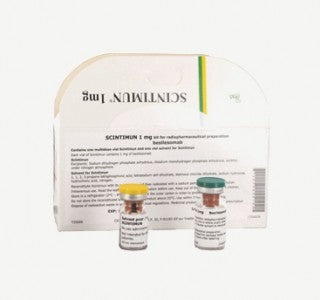
Scintimun is a kit for radiopharmaceutical preparation.
The Scintimun vial contains a white powder.
The Scintimun solvent vial contains a white powder.
The kit contains one or two multidose vials of Scintimun with one or two vials of solvent.
Not all pack sizes may be marketed.
Marketing authorisation holder and manufacturer
CIS bio international
B.P. 32
F-91192 Gif-sur-Yvette Cedex
France
Date of last revision of this leaflet: {MM/AAAA}
Detailed information on this medicine is available on the European Medicines Agency website: http://www.ema.europa.eu
---------------------------------------------------------------------------------------------------------------------------
This information is intended only for healthcare professionals:
The full summary of product characteristics of Scintimun is included as a tear-off section at the end of this leaflet in the product packaging, in order to provide healthcare professionals with additional scientific and practical information on the administration and use of this radiopharmaceutical.
Please consult the summary of product characteristics.
- Country of registration
- Dosage formRADIOPHARMACEUTICAL, 1 mg
- ATC codeV09HA03
- Active substance
- Prescription requiredYes
- Manufacturer
- CompositionHIDROGENO FOSFATO DE DISODIO (0 - mg), DIHIDROGENO FOSFATO DE SODIO (0 - mg), SORBITOL (0 - mg)
- This information is for reference only and does not constitute medical advice. Always consult a doctor before taking any medication. Oladoctor is not responsible for medical decisions based on this content.
- Alternatives to SCINTIMUN 1 mg, KIT FOR RADIOPHARMACEUTICAL PREPARATIONDosage form: INJECTABLE, 74-185 MBq. Up to 260 MBq for SPECTActive substance: gallium (67Ga) citrateManufacturer: Curium Pharma Spain S.A.Prescription requiredDosage form: RADIOPHARMACEUTICAL, 37 MBq/mlActive substance: indium (111In) oxinate labelled cellsManufacturer: Curium Pharma Spain S.A.Prescription requiredDosage form: INJECTABLE, 74 MBq iobenguane (123I)Active substance: iobenguane (123I)Manufacturer: Ge Healthcare Bio-Sciences, S.A.U.Prescription required
Online doctors for SCINTIMUN 1 mg, KIT FOR RADIOPHARMACEUTICAL PREPARATION
Discuss questions about SCINTIMUN 1 mg, KIT FOR RADIOPHARMACEUTICAL PREPARATION, including use, safety considerations and prescription review, subject to medical assessment and local regulations.


Get SCINTIMUN 1 mg, KIT FOR RADIOPHARMACEUTICAL PREPARATION Prescription Online
Fill in a 2-min form
Tell us your symptoms, history, and what medicine you're requesting.
Pick a doctor or let us assign
Choose a specialist or we'll match you with the next available doctor.
Doctor reviews your case
Usually within 30 minutes. They may ask follow-up questions via chat.
Collect from any pharmacy
Electronic prescription sent to your email — valid across Spain.
Frequently Asked Questions
SCINTIMUN 1 mg, KIT FOR RADIOPHARMACEUTICAL PREPARATION requires a prescription in Spain. You can check with a doctor online whether this medicine may be appropriate for your situation.
The active ingredient in SCINTIMUN 1 mg, KIT FOR RADIOPHARMACEUTICAL PREPARATION is technetium (99mTc) antigranulocyte antibody. This information helps identify medicines with the same composition but different brand names.
SCINTIMUN 1 mg, KIT FOR RADIOPHARMACEUTICAL PREPARATION is manufactured by Telix Innovations. Pharmacy brands and packaging may differ depending on the distributor.
Doctors such as Family doctors, Psychiatrists, Dermatologists, Cardiologists, Endocrinologists, Gastroenterologists, Pulmonologists, Nephrologists, Rheumatologists, Hematologists, Infectious disease physicians, Allergists, Geriatricians, Paediatricians, Oncologists may assess whether SCINTIMUN 1 mg, KIT FOR RADIOPHARMACEUTICAL PREPARATION is appropriate, depending on your situation and local regulations. You can book an online consultation to discuss your symptoms and possible next steps.
Spain has a well-developed healthcare infrastructure across major cities such as Madrid, Barcelona, Valencia, and Seville. Pharmacies are widely available and operate under strict regulations, ensuring access to prescribed medications.
You can buy SCINTIMUN 1 mg, KIT FOR RADIOPHARMACEUTICAL PREPARATION in Madrid, Barcelona, Seville, or Valencia at any local pharmacy with a valid prescription.
To obtain a prescription, you can use Oladoctor:
Other medicines with the same active substance (technetium (99mTc) antigranulocyte antibody) include GALLIUM CITRATE (67Ga) CURIUM PHARMA SPAIN 37 MBq/ml INJECTABLE SOLUTION, INDIO (111In) OXINA CURIUM PHARMA SPAIN 37 MBq/ml RADIOPHARMACEUTICAL PRECURSOR IN SOLUTION, ADREVIEW 74 MBq/ml INJECTABLE SOLUTION. These may have different brand names or formulations but contain the same therapeutic ingredient. Always consult a doctor before switching or starting a new medicine.
