



RENVELA 0.8 g Oral Suspension Powder

Prescription review online
A doctor will review your case and decide whether a prescription is medically appropriate.

Talk to a doctor about this medicine
Discuss your symptoms and possible next steps in a quick online consultation.



How to use RENVELA 0.8 g ORAL SUSPENSION POWDER
Contents of the leaflet
- Introduction
- What is Renvela and what is it used for
- What you need to know before you take Renvela
- How to take Renvela
- Possible side effects
- Storing Renvela
- Packaging Contents and Additional Information
Introduction
Package Leaflet: Information for theuser
Renvela 0.8 g powder for oral suspension
sevelamer carbonate
Read all of this leaflet carefully before you start taking this medicine because it contains important information for you.
- Keep this leaflet, you may need to read it again.
- If you have any further questions, ask your doctor or pharmacist.
- This medicine has been prescribed for you only. Do not pass it on to others. It may harm them, even if their signs of illness are the same as yours.
- If you get any side effects, talk to your doctor or pharmacist. This includes any possible side effects not listed in this leaflet. See section 4.
Contents of the pack
- What is Renvela and what is it used for
- What you need to know before you take Renvela
- How to take Renvela
- Possible side effects
- Storing Renvela
- Package contents and further information
1. What is Renvela and what is it used for
Renvela contains sevelamer carbonate as the active substance. It binds to phosphate from food in the digestive tract and thereby reduces serum phosphate levels in the blood.
This medicine is used to control hyperphosphataemia (high phosphate levels in the blood) in:
- adult patients on dialysis (a technique for cleaning the blood). It can be used in patients undergoing haemodialysis (using a machine to filter the blood) or peritoneal dialysis (where fluid is pumped into the abdomen and a body membrane filters the blood);
- adult patients with chronic kidney disease (long-term) who are not on dialysis and have a serum phosphate level of 1.78 mmol/l or higher.
- paediatric patients over 6 years of age with chronic kidney disease (long-term) and with a certain height and weight (which your doctor will use to calculate your body surface area).
This medicine should be used with other treatments such as calcium and vitamin D supplements to prevent the development of bone disease.
Increased serum phosphate levels can cause hard deposits in the body called calcifications. These deposits can harden in blood vessels and make it more difficult for blood to be pumped through the body. Increased serum phosphate levels can also cause skin itching, red eyes, bone pain, and fractures.

Not sure if this medicine is right for you?
Discuss your symptoms and treatment with a doctor online.
2. What you need to know before you take Renvela
Do not take Renvela
- if you are allergic to the active substance or any of the other ingredients of this medicine (listed in section 6)
- if you have low phosphate levels in the blood (your doctor will check this for you)
- if you have intestinal obstruction.
Warnings and precautions
- Talk to your doctor before taking Renvela if you are in any of the following situations: stomach and intestinal motility problems
- you frequently vomit
- active intestinal inflammation
- you have undergone major stomach or intestinal surgery.
Talk to your doctor while taking Renvela:
- if you experience severe abdominal pain, stomach or intestinal disorders, or blood in your stools (gastrointestinal bleeding). These symptoms can be due to a severe inflammatory bowel disease caused by the deposition of sevelamer crystals in the intestine. Contact your doctor, who will decide whether to continue treatment or not.
Additional treatments
Due to your kidney condition or dialysis treatment, you may:
- have low or high calcium levels in your blood. As this medicine does not contain calcium, your doctor may prescribe calcium supplement tablets.
- have a low level of vitamin D in your blood. Therefore, your doctor may monitor your vitamin D levels in your blood and prescribe a vitamin D supplement if necessary. If you do not take multivitamin supplements, your blood levels of vitamins A, E, K, and folic acid may also decrease, so your doctor may monitor these levels and prescribe vitamin supplements as needed.
- have altered bicarbonate levels in your blood and increased acidity in your blood and other body tissues. Your doctor should monitor your bicarbonate levels in your blood.
Special note for patients on peritoneal dialysis
You may develop peritonitis (infection of the abdominal fluid) associated with peritoneal dialysis. This risk can be reduced with careful use of sterile techniques during bag changes. You should immediately inform your doctor if you experience any new signs or symptoms of abdominal discomfort, abdominal swelling, abdominal pain, abdominal tenderness, or abdominal stiffness, constipation, fever, chills, nausea, or vomiting.
Children
The safety and efficacy of Renvela have not been studied in children (under 6 years). Therefore, the use of this medicine is not recommended in children under 6 years.
Other medicines and Renvela
Tell your doctor if you are taking, have recently taken, or might take any other medicines.
- Renvela should not be taken at the same time as ciprofloxacin (an antibiotic).
- If you are using other medicines for heart rhythm problems or for epilepsy, you should consult your doctor when taking Renvela.
- The effects of medicines such as cyclosporin, mycophenolate mofetil, and tacrolimus (medicines used to suppress the immune system) may be reduced by Renvela. Your doctor will advise you if you are taking these medicines.
- A rare deficit of the thyroid hormone may be observed in certain individuals taking levothyroxine (used to treat low thyroid hormone levels) and Renvela. Therefore, your doctor may monitor your thyroid-stimulating hormone levels in your blood more closely.
- Medicines for treating stomach acid and reflux in your stomach or oesophagus, such as omeprazole, pantoprazole, or lansoprazole, known as "proton pump inhibitors", may reduce the effectiveness of Renvela. Your doctor should monitor your phosphate levels in your blood.
Your doctor will check for interactions between Renvela and other medicines on a regular basis.
In some cases, when Renvela needs to be taken with another medicine, your doctor may tell you to take this medicine 1 hour before or 3 hours after taking Renvela. Your doctor should also consider monitoring the levels of that medicine in your blood.
Pregnancy and breastfeeding
If you are pregnant or breastfeeding, or think you may be pregnant or are planning to have a baby, ask your doctor for advice before taking this medicine. The potential risk of Renvela during human pregnancy is unknown. Talk to your doctor, who will decide whether you can continue treatment with Renvela.
It is unknown whether Renvela can pass into breast milk and affect the baby. Talk to your doctor, who will decide whether you can breastfeed your baby or not and whether it is necessary to interrupt treatment with Renvela.
Driving and using machines
Renvela is unlikely to affect your ability to drive or use machines.
Excipients
This medicine contains less than 1 mmol of sodium (23 mg) per sachet; this is essentially "sodium-free".
This medicine contains 8.42 mg of propylene glycol in each 0.8 g sachet.
3. How to take Renvela
Renvela should be taken as directed by your doctor. The doctor will determine the dose based on your serum phosphate levels.
For the 0.8 g dose, the powder for oral suspension in the sachet should be dispersed in 30 ml of water. Drink within 30 minutes of preparation. It is important to drink all the liquid and you may need to rinse the glass with water and drink it to ensure you take all the powder.
Instead of water, the powder can be mixed with a small amount of cold drink (approximately 120 ml or half a glass) or food (about 100 grams), and taken within 30 minutes. Do not heat Renvela powder (e.g. in the microwave) or add it to hot liquids or foods.
The recommended initial dose of this medicine for adults and elderly patients is 2.4-4.8 g per day, divided into three meals. Talk to your doctor, pharmacist, or nurse if you are unsure. Your doctor will determine the exact initial dose and administration schedule.
Take Renvela after a meal or with food.
(Instructions for the presentation with a dosing spoon)
For 0.4 g doses, the powder in the sachet can be divided. In this case, the 0.4 g dose of Renvela powder should be measured with the dosing spoon included in the package.
Always use the dosing spoon included in the package.
(Instructions for the presentation WITHOUT a dosing spoon)
If 0.4 g doses need to be administered, please use the 0.8 g powder presentation with a dosing spoon.
Use in children and adolescents
The recommended initial dose of Renvela for children is based on their height and weight (which your doctor will use to calculate their body surface area). For children, the powder presentation is preferred as tablets are not suitable for this population. This medicine should not be taken on an empty stomach and should be taken with meals or snacks. Your doctor will determine the exact initial dose and administration schedule.
For doses less than 0.8 g, the powder in the sachet can be divided. The 0.4 g dose of Renvela powder should be measured with the dosing spoon included in the package.
Preparation using a dosing spoon:
Use the provided dosing spoon for each 0.4 g dose of Renvela powder.
For a 0.4 g dose:
- Before opening the sachet, shake it by the top corner to move the powder to the bottom of the sachet.
- Open the sachet by tearing along the marked line.
- Make sure the dosing spoon is dry.
- Hold the spoon horizontally and pour the powder from the sachet into the dosing spoon
- Fill the spoon to the level of the powder.
- Do not tap the dosing spoon to compact the powder.
- Mix the powder from the dosing spoon in 30 ml of water. Stir the suspension and drink within 30 minutes of preparation. It is important to drink all the liquid to ensure you take all the powder.
- Close the sachet by folding it twice.
- The remaining powder can be used for the next dose within the next 24 hours.
- Discard the remaining powder in the sachet if it has been open for more than 24 hours.
Initially, your doctor will check your phosphate levels in your blood every 2-4 weeks and may adjust the dose of Renvela as needed to achieve an adequate phosphate level.
Follow the diet prescribed by your doctor.
If you take more Renvela than you should
In case of a possible overdose, contact your doctor immediately.
If you forget to take Renvela
If you miss a dose, it should be omitted, so the next dose should be taken at the usual time with a meal. Do not take a double dose to make up for forgotten doses.
If you stop taking Renvela
Taking your treatment with Renvela is important to maintain an appropriate phosphate level in your blood. Stopping treatment with Renvela would have significant consequences, such as calcification in blood vessels. If you consider stopping your treatment with Renvela, contact your doctor or pharmacist first.
If you have any further questions on the use of this medicine, ask your doctor or pharmacist.

Started taking the medicine and have questions?
Discuss your symptoms and treatment with a doctor online.
4. Possible side effects
Like all medicines, this medicine can cause side effects, although not everybody gets them.
Constipation is a very common side effect (may affect more than 1 in 10 patients). It can be an early symptom of intestinal obstruction. If you experience constipation, inform your doctor or pharmacist.
Some side effects can be serious. If you get any of the following side effects, seek medical attention immediately:
- Allergic reaction (signs include rash, hives, swelling, difficulty breathing). This is a very rare side effect (may affect up to 1 in 10,000 patients).
- Intestinal obstruction has been reported (signs include: severe bloating, abdominal pain, swelling, or cramps, severe constipation). The frequency is unknown (cannot be estimated from the available data).
- Intestinal wall rupture has been reported (signs include: severe stomach pain, chills, fever, nausea, vomiting, or a painful or tender abdomen). The frequency is unknown.
- Severe inflammation of the large intestine has been reported (symptoms include: severe abdominal pain, stomach or intestinal disorders, blood in the stools [intestinal bleeding]) and crystal deposition in the intestine. The frequency is unknown.
Other side effects have been reported in patients taking Renvela:
Very common:
vomiting, upper abdominal pain, nausea
Common (may affect up to 1 in 10 patients):
diarrhoea, stomach pain, indigestion, flatulence
Frequency unknown:
cases of itching, rash, slow intestinal motility (movement).
Reporting of side effects
If you experience any side effects, talk to your doctor, even if they are not listed in this leaflet. You can also report side effects directly through the national reporting system listed in Appendix V. By reporting side effects, you can help provide more information on the safety of this medicine.
5. Storing Renvela
Keep this medicine out of the sight and reach of children.
Do not use this medicine after the expiry date which is stated on the sachet after the letters "EXP". The expiry date is the last day of the month shown.
The reconstituted suspension should be taken within 30 minutes of reconstitution.
This medicine does not require any special storage conditions.
Instructions for the presentation with a dosing spoon
Discard the sachet 24 hours after opening.
Do not throw away any medicines via wastewater or household waste. Ask your pharmacist how to throw away medicines you no longer use. These measures will help protect the environment.
6. Packaging Contents and Additional Information
Renvela Composition
- The active ingredient is sevelamer carbonate. Each sachet contains 0.8 g of sevelamer carbonate.
- The other ingredients are propylene glycol alginate (E405), citrus cream flavor, sodium chloride, sucralose, and yellow iron oxide (E172).
Product Appearance and Packaging Contents
Renvela oral powder for suspension is a pale yellow powder supplied in an aluminum foil sachet. The sachets are packaged in an outer carton.
(Instructions for Presentation with Dosage Spoon)
A 0.4 g dosage spoon is included in the carton.
Package Size:
90 sachets per carton.
Only certain package sizes may be marketed.
Marketing Authorization Holder:
Sanofi Winthrop Industrie
82 Avenue Raspail
94250 Gentilly
France
Manufacturer:
Genzyme Ireland Limited
IDA Industrial Park
Old Kilmeaden Road
Waterford
Ireland
ROVI Pharma Industrial Services, S.A.
Vía Complutense, 140, Alcalá de Henares,
Madrid, 28805
Spain
For further information about this medicinal product, please contact the local representative of the marketing authorization holder.
België/Belgique/Belgien/Luxembourg/Luxemburg Sanofi Belgium Tél/Tel: + 32 2 710 54 00 | Lietuva Swixx Biopharma UAB Tel: +370 5 236 91 40 |
| Magyarország SANOFI-AVENTIS Zrt Tel: +36 1 505 0050 |
Ceská republika Sanofi s.r.o. Tel: +420 233 086 111 | Malta Sanofi S.r.l. Tel: +39 02 39394275 |
Danmark Sanofi A/S Tlf: +45 45 16 70 00 | Nederland Sanofi B.V. Tel: +31 20 245 4000 |
Deutschland Sanofi-Aventis Deutschland GmbH Tel: 0800 52 52 010 Tel. from abroad: +49 69 305 21 131 | Norge sanofi-aventis Norge AS Tlf: + 47 67 10 71 00 |
Eesti Swixx Biopharma OÜ Tel: +372 640 10 30 | Österreich sanofi-aventis GmbH Tel: + 43 1 80 185 - 0 |
Ελλάδα sanofi-aventis AEBE Τηλ: +30 210 900 1600 | Polska Sanofi Sp. z o.o. Tel.: +48 22 280 00 00 |
España sanofi-aventis, S.A. Tel: +34 93 485 94 00 | Portugal Sanofi – Produtos Farmacêuticos, Lda. Tel: +351 21 35 89 400 |
France sanofi-aventis France Tél : 0 800 222 555 Call from abroad: +33 1 57 63 23 23 | România Sanofi Romania SRL Tel: +40 (0) 21 317 31 36 |
Hrvatska Swixx Biopharma d.o.o. Tel: +385 1 2078 500 | Slovenija Swixx Biopharma d.o.o. Tel: +386 1 235 51 00 |
Ireland sanofi-aventis Ireland Ltd T/A SANOFI Tel: +353 (0) 1 4035 600 | Slovenská republika Swixx Biopharma s.r.o. Tel: +421 2 208 33 600 |
Ísland Vistor hf. Sími: +354 535 7000 | Suomi/Finland Sanofi Oy Puh/Tel: + 358 201 200 300 |
Italia Sanofi S.r.l. Tel: 800.536 389 | Sverige Sanofi AB Tel: +46 (0)8 634 50 00 |
Κύπρος C.A. Papaellinas Ltd. Τηλ: +357 22 741741 Latvija Swixx Biopharma SIA Tel: +371 6 616 47 50 | United Kingdom (Northern Ireland) sanofi-aventis Ireland Ltd. T/A SANOFI Tel: +44 (0) 800 035 2525 |
Date of Last Revision of this Leaflet
Other Sources of Information
Detailed information on this medicinal product is available on the European Medicines Agency website: http://www.ema.europa.eu.
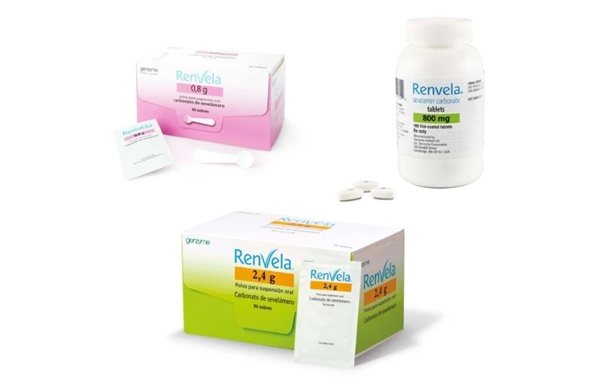
- Country of registration
- Dosage formORAL SOLUTION/SUSPENSION, 0.8 g
- ATC codeV03AE02
- Average pharmacy price73.53 EUR
- Active substance
- Prescription requiredYes
- Manufacturer
- CompositionALGINATO DE PROPILENGLICOL (8,42 mg mg), CLORURO DE SODIO (8,42 mg mg)
- This information is for reference only and does not constitute medical advice. Always consult a doctor before taking any medication. Oladoctor is not responsible for medical decisions based on this content.
- Alternatives to RENVELA 0.8 g ORAL SUSPENSION POWDERDosage form: TABLET, 800 mgActive substance: sevelamerManufacturer: Sanofi Winthrop IndustriePrescription requiredDosage form: ORAL SOLUTION/SUSPENSION, 2.4 gActive substance: sevelamerManufacturer: Laboratorios Rubio S.A.Prescription requiredDosage form: TABLET, 800 mgActive substance: sevelamerManufacturer: Laboratorios Rubio S.A.Prescription required
Online doctors for RENVELA 0.8 g ORAL SUSPENSION POWDER
Discuss questions about RENVELA 0.8 g ORAL SUSPENSION POWDER, including use, safety considerations and prescription review, subject to medical assessment and local regulations.









Get RENVELA 0.8 g ORAL SUSPENSION POWDER Prescription Online
Fill in a 2-min form
Tell us your symptoms, history, and what medicine you're requesting.
Pick a doctor or let us assign
Choose a specialist or we'll match you with the next available doctor.
Doctor reviews your case
Usually within 30 minutes. They may ask follow-up questions via chat.
Collect from any pharmacy
Electronic prescription sent to your email — valid across Spain.
Frequently Asked Questions
RENVELA 0.8 g ORAL SUSPENSION POWDER requires a prescription in Spain. You can check with a doctor online whether this medicine may be appropriate for your situation.
The active ingredient in RENVELA 0.8 g ORAL SUSPENSION POWDER is sevelamer. This information helps identify medicines with the same composition but different brand names.
The average pharmacy price for RENVELA 0.8 g ORAL SUSPENSION POWDER is around 73.53 EUR. Prices may vary depending on the manufacturer and dosage form.
RENVELA 0.8 g ORAL SUSPENSION POWDER is manufactured by Sanofi Winthrop Industrie. Pharmacy brands and packaging may differ depending on the distributor.
Doctors such as Family doctors, Psychiatrists, Dermatologists, Cardiologists, Endocrinologists, Gastroenterologists, Pulmonologists, Nephrologists, Rheumatologists, Hematologists, Infectious disease physicians, Allergists, Geriatricians, Paediatricians, Oncologists may assess whether RENVELA 0.8 g ORAL SUSPENSION POWDER is appropriate, depending on your situation and local regulations. You can book an online consultation to discuss your symptoms and possible next steps.
Spain has a well-developed healthcare infrastructure across major cities such as Madrid, Barcelona, Valencia, and Seville. Pharmacies are widely available and operate under strict regulations, ensuring access to prescribed medications.
You can buy RENVELA 0.8 g ORAL SUSPENSION POWDER in Madrid, Barcelona, Seville, or Valencia at any local pharmacy with a valid prescription.
To obtain a prescription, you can use Oladoctor:
Other medicines with the same active substance (sevelamer) include SEVELAMER CARBONATE WINTHROP 800 MG FILM-COATED TABLETS, FOSQUEL 2.4 g ORAL SUSPENSION POWDER, FOSQUEL 800 MG FILM-COATED TABLETS. These may have different brand names or formulations but contain the same therapeutic ingredient. Always consult a doctor before switching or starting a new medicine.
