


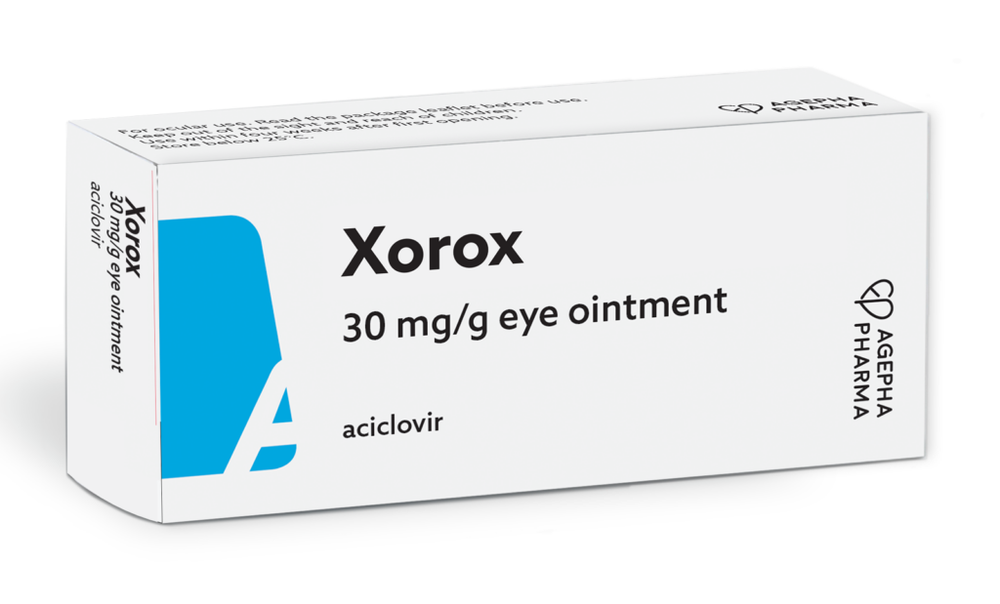



How to use Xorox
LEAFLET INCLUDED IN THE PACKAGING: INFORMATION FOR THE PATIENT
Xorox, 30 mg/g, eye ointment
acyclovir
Read the leaflet carefully before using this medicine, as it contains important information for the patient.
- Keep this leaflet, you may need to read it again.
- In case of any doubts, consult a doctor or pharmacist.
- This medicine has been prescribed specifically for you. Do not pass it on to others. The medicine may harm another person, even if their symptoms are the same.
- If the patient experiences any side effects, including any side effects not listed in this leaflet, they should tell their doctor or pharmacist. See section 4.
Table of contents of the leaflet
- 1. What is Xorox 30 mg/g eye ointment and what is it used for
- 2. Important information before using Xorox 30 mg/g eye ointment
- 3. How to use Xorox 30 mg/g eye ointment
- 4. Possible side effects
- 5. How to store Xorox 30 mg/g eye ointment
- 6. Contents of the pack and other information
1. What is Xorox 30 mg/g eye ointment and what is it used for
Xorox eye ointment contains a medicine called acyclovir, which belongs to a group of medicines called antiviral medicines.
It is used to treat eye infections caused by the Herpes simplexvirus. Its action involves
killing the viruses or stopping their growth in the front part of the eyeball (cornea).
2. Important information before using Xorox 30 mg/g eye ointment
When not to use Xorox 30 mg/g eye ointment
- If the patient is allergic to acyclovir or valacyclovir, or any of the other ingredients of this medicine (listed in section 6).
Warnings and precautions
Before starting to use Xorox 30 mg/g eye ointment, the patient should discuss it with their doctor or pharmacist.
- Xorox 30 mg/g eye ointment should only be used for the eyes.
- Immediately after application, a mild burning or stinging sensation may occur.
- If the patient experiences immediate allergic reactions, such as sudden swelling of the face, throat, arms, and legs (angioedema), they should contact their doctor immediately.
- If allergic reactions occur, such as itching of the eyelids, swelling, or redness of the eye, the patient should stop using Xorox 30 mg/g eye ointment and consult their doctor.
- The patient should seek medical advice immediately if any symptoms worsen or recur.
Contact lenses should not be worn during treatment with Xorox 30 mg/g eye ointment.
Children and adolescents
Recommendations are the same as for adults.
Xorox 30 mg/g eye ointment and other medicines
The patient should tell their doctor or pharmacist about all medicines they are currently taking
or have recently taken, as well as any medicines they plan to take.
When used topically in the eye, no significant interactions have been observed so far.
However, there is not enough information about the use of Xorox 30 mg/g eye ointment and the simultaneous
use of eye medicines containing corticosteroids. The suitability of the eye ointment for a given patient
will be assessed by the doctor.
Pregnancy and breastfeeding
If the patient is pregnant or breastfeeding, thinks they may be pregnant, or plans to have a child, they should consult their doctor or pharmacist before using this medicine.
Xorox 30 mg/g eye ointment can be used during pregnancy and breastfeeding, as no adverse effects are expected during pregnancy, for the fetus, or for the newborn, when used at the recommended doses.
Driving and using machines
Due to its form, the medicine may cause temporary vision disturbances. Therefore, the patient should be particularly careful when driving vehicles, working without protection, and operating machines.
3. How to use Xorox 30 mg/g eye ointment
Instructions for use
For use in the eyes
The medicine should always be used as directed by the doctor. In case of doubts, the patient should consult their doctor or pharmacist.
Unless the doctor recommends otherwise, the recommended dose is as follows:
Apply a 1 cm long strip of ointment inside the lower conjunctival sac 5 times a day (every 4 hours). The recommended times are: 7:00, 11:00, 15:00, 19:00, and 23:00.
Pull down the lower eyelid and place the strip of ointment inside the conjunctival sac. Close the eyelids
and roll the eyeball to distribute the ointment.
The effectiveness of the treatment depends significantly on the regular use of Xorox 30 mg/g eye ointment throughout the day,
regularly every 4 hours. After the corneal ulcer has healed, treatment should be continued for at least 3
days.
Use in children and adolescents
Recommendations are the same as for adults.
Using more than the recommended dose of Xorox 30 mg/g eye ointment
In case of using too much Xorox 30 mg/g eye ointment, the patient should consult their doctor or pharmacist.
Xorox 30 mg/g eye ointment is intended for use in the eyes. If it is swallowed, the patient should consult their doctor or pharmacist.
Missing a dose of Xorox 30 mg/g eye ointment
If a dose of Xorox 30 mg/g eye ointment is missed, the patient should use it as soon as possible. However, if it is almost time for the next application, the missed dose should be skipped.
The patient should not use a double dose to make up for the missed dose.
Stopping the use of Xorox 30 mg/g eye ointment
In case of any further doubts about the use of this medicine, the patient should consult their doctor or pharmacist.
4. Possible side effects
Like all medicines, Xorox 30 mg/g eye ointment can cause side effects, although not everybody gets them.
Immediately after application, a temporary mild burning or stinging sensation may occur. If the patient notices swelling of the face, angioedema, etc., they should stop using Xorox 30 mg/g eye ointment and consult their doctor immediately.
Allergic reactionsvery rare (may occur in less than 1 in 10,000 people)
If an allergic reaction or acute hypersensitivity reaction occurs, the patient should stop using Xorox 30 mg/g eye ointment and contact their doctor immediately.
Symptoms may include:
- rash, itching, or hives on the skin
- swelling of the face, lips, tongue, or other parts of the body
- difficulty breathing, wheezing, or shortness of breath
- unexplained high fever and feeling of fainting, especially when standing up.
Other side effects include:
Very common (may occur in more than 1 in 10):
burning or irritation, photophobia/light sensitivity, or a feeling of a foreign body in the eye
(superficial punctate keratitis)
Usually does not require discontinuation of treatment and heals immediately
Uncommon (may occur in less than 1 in 100):
transient mild burning or stinging sensation occurring immediately after application
eye swelling, tearing (conjunctivitis)
Rare (may occur in less than 1 in 1,000):
swollen, red, irritated, itchy eyelids (blepharitis)
If any side effect worsens or any side effects not listed in this leaflet occur, the patient should consult their doctor or pharmacist.
Reporting side effects
If the patient experiences any side effects, including any side effects not listed in this leaflet, they should tell their doctor or pharmacist. Side effects can be reported directly to the Department of Adverse Reaction Monitoring of Medicinal Products, Medical Devices, and Biocidal Products
Jerozolimskie Avenue 181C
02-222 Warsaw
Phone: +48 22 49 21 301
Fax: +48 22 49 21 309
Website: https://smz.ezdrowie.gov.pl
Side effects can also be reported to the marketing authorization holder.
By reporting side effects, more information can be gathered on the safety of the medicine.
5. How to store Xorox 30 mg/g eye ointment
Store at a temperature below 25°C.
The medicine should be stored out of sight and reach of children.
Do not use Xorox 30 mg/g eye ointment after the expiry date stated on the label and carton. The expiry date refers to the last day of the month.
Shelf life after first opening the tube: 4 weeks
Medicines should not be disposed of via wastewater or household waste. The patient should ask their pharmacist how to dispose of medicines they no longer use. This will help protect the environment.
6. Contents of the pack and other information
What Xorox 30 mg/g eye ointment contains:
- The active substance is acyclovir. 1 g of ointment contains 30 mg of acyclovir.
- The excipient is white petrolatum.
What Xorox 30 mg/g eye ointment looks like and what the pack contains
1 carton contains one aluminum tube with an inner coating of epoxy-phenolic lacquer with a nozzle (tip) made of HDPE and a cap made of HDPE, containing 4.5 g of ointment, white to off-white in color.
Marketing authorization holder and manufacturer
AGEPHA Pharma s.r.o
Diaľničná cesta 5,
903 01 Senec
Slovakia
Phone: +421 226 226 032
This medicinal product is authorized in the Member States of the European Economic Area under the following names:
| Country | Medicinal product name |
| Austria | Xorox 30 mg/g Augensalbe |
| Belgium | Aciclovir Agepha 30 mg/g oogzalf |
| Croatia | Xorox 30 mg/g mast za oko |
| Cyprus | Xorox 30 mg/g eye ointment |
| Czech Republic | Xorox 30 mg/g oční mast |
| Denmark | Xorox 30 mg/g øjensalve |
| Estonia | Aciclovir Agepha 30 mg/g silma salv |
| Finland | Xorox 30 mg/g silmävoide |
| France | Aciclovir Agepha 30 mg/g pommade ophtalmique |
| Germany | Xorox 30 mg/g Augensalbe |
| Hungary | Aciclovir Agepha 30 mg/g szemkenőcs |
| Iceland | Xorox 30 mg/g augnsmyrsli |
| Ireland | Aciclovir “Agepha” 30 mg/g eye ointment |
| Italy | Xorox 30 mg/g Unguento Oftalmico |
| Latvia | Xorox 30 mg/g acu ziede |
| Luxembourg | Xorox 30 mg/g Augensalbe |
| Malta | Xorox 30 mg/g eye ointment |
| Norway | Xorox 30 mg/g øyesalve |
| Portugal | Xorox 30 mg/g pomada oftálmica |
| Romania | Xorox 30 mg/g unguent oftalmic |
| Spain | Xorox 30 mg/g pomada oftálmica |
| Sweden | Xorox 30 mg/g ögonsalva |
| Netherlands | Aciclovir Agepha 30 mg/g oogzalf |
| United Kingdom | Aciclovir Agepha 30 mg/g eye ointment |
| Slovenia | Xorox 30 mg/g mazilo za oko |
| Poland | Xorox 30 mg/g maść do oczu |
Date of last revision of the leaflet: October 2024
- Country of registration
- Active substance
- Prescription requiredYes
- ImporterAGEPHA Pharma s.r.o.
- This information is for reference only and does not constitute medical advice. Always consult a licensed doctor before taking any medication. Oladoctor is not responsible for medical decisions based on this content.
- Alternatives to XoroxDosage form: Ointment, 30 mg/gActive substance: aciclovirManufacturer: Ursapharm Arzneimittel GmbHPrescription requiredDosage form: Gel, 1.5 mg/gActive substance: ganciclovirManufacturer: Fermila- Thea Farmaceutici S.p.A.Prescription requiredDosage form: Gel, 1.5 mg/gActive substance: ganciclovirPrescription required
Alternatives to Xorox in other countries
The best alternatives with the same active ingredient and therapeutic effect.
Alternative to Xorox in Spain
Alternative to Xorox in Ukraine
Online doctors for Xorox
Discuss dosage, side effects, interactions, contraindications, and prescription renewal for Xorox – subject to medical assessment and local rules.

Get updates and exclusive offers
Be the first to know about new services, marketplace updates, and subscriber-only promos.

