



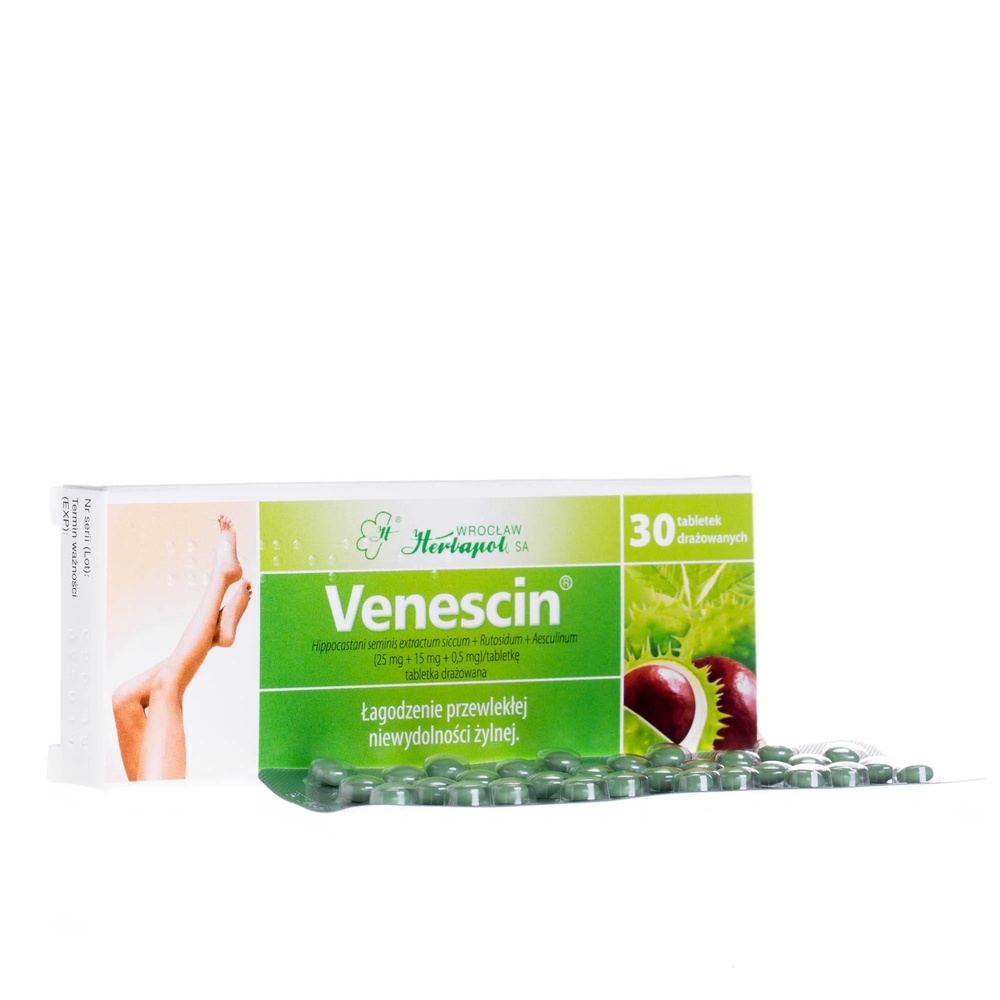
VENESCIN 25 mg/15 mg /0.5 Mg Tablets

Prescription review online
A doctor will review your case and decide whether a prescription is medically appropriate.

Talk to a doctor about this medicine
Discuss your symptoms and possible next steps in a quick online consultation.



How to use Venescin
Contents of the leaflet
- Leaflet attached to the packaging: patient information
- VENESCIN
- What is Venescin and what is it used for
- Important information before using Venescin
- How to use Venescin
- Possible side effects
- How to store Venescin
- Contents of the packaging and other information
Leaflet attached to the packaging: patient information
VENESCIN
Hippocastani seminis extractum siccum + Rutosidum trihydricum + Aesculinum
(25 mg + 15 mg + 0.5 mg)/tablet, sugar-coated tablets
You should carefully read the contents of the leaflet before using the medicine, as it contains important information for the patient.
This medicine should always be used exactly as described in the patient leaflet or as directed by your doctor or pharmacist.
- You should keep this leaflet, so you can read it again if you need to.
- If you need advice or additional information, you should consult a pharmacist. If you experience any side effects, including any possible side effects not listed in the leaflet, you should tell your doctor or pharmacist. See section 4.
- If after 21 days the symptoms worsen, do not improve, or you feel worse, you should contact your doctor.
Table of contents of the leaflet
- 1. What is Venescin and what is it used for
- 2. Important information before using Venescin
- 3. How to use Venescin
- 4. Possible side effects
- 5. How to store Venescin
- 6. Contents of the packaging and other information

Not sure if this medicine is right for you?
Discuss your symptoms and treatment with a doctor online.
1. What is Venescin and what is it used for
Venescin is a medicinal product containing an extract of horse chestnut seeds, rutoside, and aesculin in its composition. It is assumed that the use of the product increases venous tone and reduces permeability and increases the mechanical resistance of capillaries. The medicine is used to alleviate symptoms of chronic venous insufficiency. If after 21 days there is no improvement or you feel worse, you should consult a doctor.
2. Important information before using Venescin
When not to use Venescin
- if you are allergic to the active substances or any of the other ingredients of this medicine (listed in section 6), such as arabic gum,
- during the first trimester of pregnancy.
Warnings and precautions
One sugar-coated tablet of Venescin contains 34.49 mg of sucrose. If you have previously been diagnosed with intolerance to some sugars, you should consult your doctor before taking the medicine. Children and adolescents should not use this medicine.
Venescin and other medicines
You should tell your doctor or pharmacist about all the medicines you are currently taking or have recently taken, as well as any medicines you plan to take.
Using Venescin in children
This medicine should not be used in children.
Pregnancy, breastfeeding, and fertility
Do not use during the first trimester of pregnancy. Due to the lack of studies confirming the safety of use during the remaining period of pregnancy and breastfeeding, the preparation may only be used when, in the doctor's opinion, the benefit to the mother is greater than the potential risk to the fetus. The effect on fertility is unknown.
Driving and using machines
No adverse effect of Venescin on the ability to drive and use machines has been found.

Started taking the medicine and have questions?
Discuss your symptoms and treatment with a doctor online.
3. How to use Venescin
This medicine should always be used exactly as described in the patient leaflet or as directed by your doctor or pharmacist. If you have any doubts, you should consult your doctor or pharmacist. Oral administration. Adults2 sugar-coated tablets 3 times a day. Children and adolescentsshould not use this medicine.
Using a higher dose of Venescin than recommended
There are no known symptoms of overdose.
Missing a dose of Venescin
You should not take a double dose to make up for a missed dose.
4. Possible side effects
Like all medicines, this medicine can cause side effects, although not everybody gets them. Side effects are presented according to the classification of organs and systems according to MedDRA and frequency of occurrence: rare - side effects may occur in 1 to 10 patients out of 10,000 patients using the medicine. During the use of the Venescin medicinal product, the following may occur:
- gastrointestinal disorders (nausea, abdominal pain) - rare. If side effects occur, you should stop the treatment, and if the symptoms do not disappear, consult a doctor.
Reporting side effects
If you experience any side effects, including any possible side effects not listed in the leaflet, you should tell your doctor or pharmacist. Side effects can be reported directly to the Department of Monitoring of Adverse Reactions to Medicinal Products of the Office for Registration of Medicinal Products, Medical Devices, and Biocidal Products, Al. Jerozolimskie 181 C, 02-222 Warsaw, phone: +48 22 49-21-301, fax: +48 22 49-21-309, e-mail: [email protected]. Side effects can also be reported to the marketing authorization holder. By reporting side effects, you can help gather more information on the safety of the medicine.
5. How to store Venescin
The medicine should be stored at a temperature not exceeding 25°C, out of sight and reach of children. Do not use this medicine after the expiry date stated on the blister or carton. The expiry date refers to the last day of the given month. Medicines should not be disposed of via wastewater or household waste containers. You should ask your pharmacist how to dispose of medicines that are no longer needed. This will help protect the environment.
6. Contents of the packaging and other information
What Venescin contains
The active substances of the medicine are: Dry extract of horse chestnut seeds (Hippocastani seminis extractum siccum) (5.5-8:1) containing on average 22% triterpenoid saponins calculated as anhydrous escin 25 mg, extraction solvent: ethanol 70% (V/V), Rutoside trihydrate (Rutosidum trihydricum), 15 mg, Aesculin (Aesculinum (6-glucoside of 6,7-dihydrocoumarin)) 0.5 mg. The excipients are: potato starch, magnesium stearate, shellac, castor oil, arabic gum, talc, sucrose, indigotine (E 132), quinoline yellow (E 104).
What Venescin looks like and what the pack contains
Al/PVC foil blister in a cardboard box with an information leaflet. The blister contains 30 sugar-coated tablets.
Marketing authorization holder and manufacturer
Wrocławskie Zakłady Zielarskie "Herbapol" S.A. 50-951 Wrocław, ul. Św. Mikołaja 65/68 Tel: +48 71 33 57 225 Fax: +48 71 37 24 740 E-mail: [email protected] For more detailed information about the medicine, you should contact the marketing authorization holder, tel. 71 321 86 04, ext. 123
Date of last revision of the leaflet:
- Country of registration
- Dosage formTablets, 25 mg + 15 mg + 0.5 mg
- ATC codeC05CX03
- Active substance
- Prescription requiredNo
- Manufacturer
- ImporterWrocławskie Zakłady Zielarskie "Herbapol" S.A.
- This information is for reference only and does not constitute medical advice. Always consult a doctor before taking any medication. Oladoctor is not responsible for medical decisions based on this content.
- Alternatives to VenescinDosage form: Tablets, 167 mgActive substance: Hippocastani semenManufacturer: Poznańskie Zakłady Zielarskie "Herbapol" S.A.Prescription not requiredDosage form: Ointment, 10 mg triterpene glycosides expressed as escin/gActive substance: Hippocastani semenPrescription not requiredDosage form: Tablets, 21 mg triterpene glycosides expressed as pro-escigeninActive substance: Hippocastani semenPrescription not required
Online doctors for Venescin
Discuss questions about Venescin, including use, safety considerations and prescription review, subject to medical assessment and local regulations.









Get Venescin Prescription Online
Fill in a 2-min form
Tell us your symptoms, history, and what medicine you're requesting.
Pick a doctor or let us assign
Choose a specialist or we'll match you with the next available doctor.
Doctor reviews your case
Usually within 30 minutes. They may ask follow-up questions via chat.
Collect from any pharmacy
Electronic prescription sent to your email — valid across Spain.
Frequently Asked Questions
Venescin does not require a prescription in Poland. You can check with a doctor online whether this medicine may be appropriate for your situation.
The active ingredient in Venescin is Hippocastani semen. This information helps identify medicines with the same composition but different brand names.
Venescin is manufactured by Wrocławskie Zakłady Zielarskie "Herbapol" S.A.. Pharmacy brands and packaging may differ depending on the distributor.
Doctors such as Family doctors, Psychiatrists, Dermatologists, Cardiologists, Endocrinologists, Gastroenterologists, Pulmonologists, Nephrologists, Rheumatologists, Hematologists, Infectious disease physicians, Allergists, Geriatricians, Paediatricians, Oncologists may assess whether Venescin is appropriate, depending on your situation and local regulations. You can book an online consultation to discuss your symptoms and possible next steps.
Spain has a well-developed healthcare infrastructure across major cities such as Madrid, Barcelona, Valencia, and Seville. Pharmacies are widely available and operate under strict regulations, ensuring access to prescribed medications.
You can buy Venescin in Madrid, Barcelona, Seville, or Valencia at any local pharmacy with a valid prescription.
To obtain a prescription, you can use Oladoctor:
Other medicines with the same active substance (Hippocastani semen) include Esceven, Sapoven, Veinofitil. These may have different brand names or formulations but contain the same therapeutic ingredient. Always consult a doctor before switching or starting a new medicine.
