


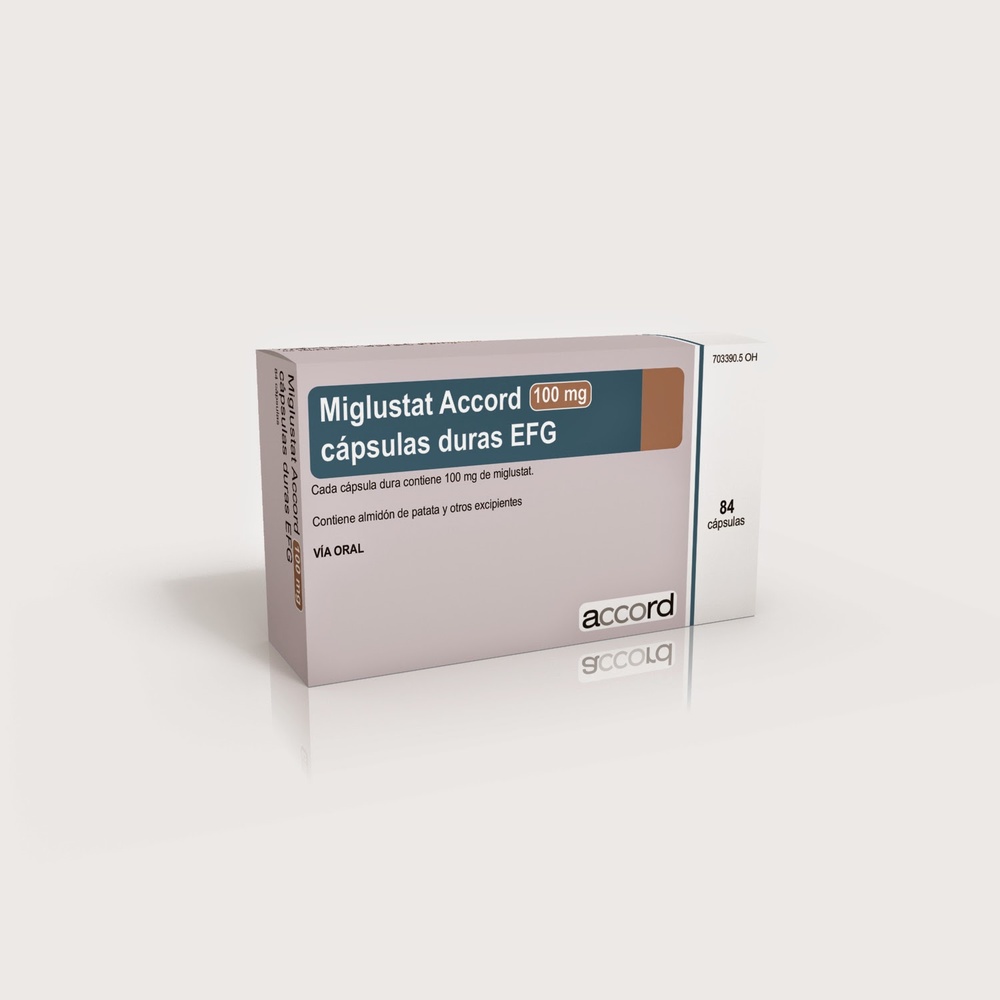



How to use Miglustat Accord
Leaflet attached to the packaging: information for the user
Miglustat Accord, 100 mg, hard capsules
Miglustat
Read the leaflet carefully before taking the medicine, as it contains important information for the patient.
- Keep this leaflet, you may need to read it again.
- If you have any further questions, ask your doctor or pharmacist.
- This medicine has been prescribed for you only. Do not pass it on to others. It may harm them, even if their symptoms are the same as yours.
- If you experience any side effects, including those not listed in this leaflet, please tell your doctor or pharmacist. See section 4.
Table of contents of the leaflet
- 1. What is Miglustat Accord and what is it used for
- 2. Important information before taking Miglustat Accord
- 3. How to take Miglustat Accord
- 4. Possible side effects
- 5. How to store Miglustat Accord
- 6. Contents of the pack and other information
1. What is Miglustat Accord and what is it used for
Miglustat Accord contains the active substance miglustat, which belongs to a group of medicines that affect metabolic processes. It is used to treat two diseases:
Miglustat Accord is used to treat mild to moderate type 1 Gaucher's disease in adults.
In people with type 1 Gaucher's disease, a substance called glucocerebroside is not removed from the body, but starts to accumulate in certain cells of the immune system. This leads to enlargement of the liver and spleen, changes in the blood, and bone disease. The usual treatment for type 1 Gaucher's disease is enzyme replacement therapy. Miglustat Accord is used only in patients who cannot be treated with enzyme replacement therapy.
Miglustat Accord is also used to treat progressive neurological symptoms in Niemann-Pick disease type C in adults and children.
In people with Niemann-Pick disease type C, fats such as glycosphingolipids accumulate in brain cells. This can cause neurological disorders, such as slow eye movement, balance, swallowing, memory, and lead to seizures. The action of Miglustat Accord is to block an enzyme called "glucocerebroside synthase", which is responsible for the first phase of the synthesis of most glycosphingolipids.
2. Important information before taking Miglustat Accord
When not to take Miglustat Accord
Warnings and precautions
Before taking Miglustat Accord, tell your doctor or pharmacist:
Your doctor will perform the following tests before and during treatment with Miglustat Accord:
- nerve tests in hands and feet,
- determination of vitamin B12 levels,
- monitoring of growth in children and adolescents with Niemann-Pick disease type C,
- monitoring of platelet count.
The reason for these tests is that some patients may experience tingling or numbness in hands and feet or weight loss while taking Miglustat Accord. The tests will help your doctor decide whether these symptoms are caused by the disease or other underlying conditions, or are side effects of Miglustat Accord (see section 4). If you experience diarrhea, your doctor may recommend a change in diet (to reduce lactose and other carbohydrate intake, such as sucrose), taking Miglustat Accord between meals, or temporarily reducing the dose. In some cases, your doctor may prescribe an anti-diarrheal medication, such as loperamide. If diarrhea does not decrease or other abdominal symptoms occur after using these methods, you should consult your doctor. In this case, your doctor may order further diagnostic tests. Men should use effective contraception during treatment with Miglustat Accord and for 3 months after stopping treatment.
Children and adolescents
Do not use this medicine in children and adolescents (under 18 years of age) with type 1 Gaucher's disease, as it is not known whether the medicine is effective in treating this disease.
Miglustat Accord and other medicines
Tell your doctor or pharmacist about all medicines you are taking, or have recently taken, and about any medicines you plan to take. Tell your doctor if you are taking medicines containing imiglucerase, which are sometimes used in combination with Miglustat Accord. These medicines may reduce the amount of Miglustat Accord in your body.
Pregnancy, breastfeeding, and fertility
Do not take Miglustat Accord if you are pregnant or planning to become pregnant. For more information, consult your doctor. During treatment with Miglustat Accord, use effective contraception. Do not breastfeed during treatment with Miglustat Accord. Men should use effective contraception during treatment with Miglustat Accord and for 3 months after stopping treatment. If you are pregnant or breastfeeding, think you may be pregnant, or plan to have a child, consult your doctor or pharmacist before taking this medicine.
Driving and using machines
Miglustat Accord may cause dizziness. Do not drive, operate machinery, or use tools if you experience dizziness.
Miglustat Accord contains sodium
This medicine contains less than 1 mmol of sodium (23 mg) per capsule, which means it is essentially "sodium-free".
3. How to take Miglustat Accord
Always take this medicine exactly as your doctor has told you. If you are not sure, ask your doctor or pharmacist. In type 1 Gaucher's disease: The usual dose for adults is one capsule (100 mg) taken three times a day (morning, afternoon, and evening). This means the maximum daily dose is three capsules (300 mg). In Niemann-Pick disease type C:The usual dose for adults and adolescents (over 12 years of age) is two capsules (200 mg) taken three times a day (morning, afternoon, and evening). This means the maximum daily dose is six capsules (600 mg). In children under 12 years of agewith Niemann-Pick disease type C, your doctor will adjust the dose of Miglustat Accord. If you have kidney problems, you may be given a lower starting dose. Your doctor may reduce the dose, for example to one capsule (100 mg) once or twice a day, if you experience diarrhea while taking Miglustat Accord (see section 4). Your doctor will tell you how long to take the medicine. Miglustat Accord can be taken with or without food. Swallow the capsule whole with a glass of water.
Taking too much Miglustat Accord
If you have taken more capsules than you should, contact your doctor immediately. In clinical studies, miglustat was given in doses of up to 3000 mg, which caused a decrease in white blood cell count and other side effects similar to those described in section 4.
Missing a dose of Miglustat Accord
Take the next capsule at the usual time. Do not take a double dose to make up for a forgotten dose.
Stopping treatment with Miglustat Accord
Do not stop taking Miglustat Accord without consulting your doctor. If you have any further questions on the use of this medicine, ask your doctor or pharmacist.
4. Possible side effects
Like all medicines, Miglustat Accord can cause side effects, although not everybody gets them. Severe side effects:
Some patients have experienced tingling or numbness in hands and feet (common).
These may be symptoms of peripheral neuropathy, related to the side effects of Miglustat Accord or underlying diseases. To assess this, your doctor will perform some tests before and during treatment with Miglustat Accord (see section 2).
If you experience any of these side effects, tell your doctor as soon as possible. If you experience mild tremors, mainly hand tremors, tell your doctor as soon as possible.
Tremors usually go away without the need to stop treatment. Sometimes it may be necessary to reduce the dose of Miglustat Accord or stop treatment to prevent tremors. Very common: (may affect more than 1 in 10 people)The most common side effects are: diarrhea, bloating with gas, abdominal pain (stomach), weight loss, and decreased appetite. If you experience weight loss after starting treatment with Miglustat Accord, do not worry. This side effect usually goes away as treatment continues. Common: (may affect up to 1 in 10 people)Common side effects include: headache, dizziness, paresthesia (tingling or numbness), coordination disorders, hypoesthesia (reduced touch sensation), dyspepsia (heartburn), nausea, constipation, and vomiting, abdominal bloating or discomfort (stomach), and thrombocytopenia (reduced platelet count). Neurological symptoms and thrombocytopenia may be caused by the underlying disease. Other possible side effects include: muscle cramps or weakness, fatigue, chills, and malaise, depression, sleep disorders, amnesia, and decreased libido. In most patients, one or more of these side effects occur usually at the beginning of treatment or at certain intervals during treatment. Most cases are mild and go away quickly. If any of these side effects cause problems, contact your doctor, who may reduce the dose of Miglustat Accord or prescribe other medicines to help control the side effects.
Reporting side effects
If you experience any side effects, including those not listed in this leaflet, please tell your doctor or pharmacist. Side effects can be reported directly to the Department of Drug Safety Monitoring of the Office for Registration of Medicinal Products, Medical Devices, and Biocidal Products Al. Jerozolimskie 181C 02-222 Warsaw tel.: + 48 22 49 21 301 fax: + 48 22 49 21 309 website: https://smz.ezdrowie.gov.pl Side effects can also be reported to the marketing authorization holder. By reporting side effects, you can help provide more information on the safety of this medicine.
5. How to store Miglustat Accord
Keep this medicine out of the sight and reach of children. Do not use this medicine after the expiry date stated on the carton after EXP. The expiry date refers to the last day of the month. There are no special storage instructions for this medicine. Medicines should not be disposed of via wastewater or household waste. Ask your pharmacist how to dispose of medicines no longer required. This will help protect the environment.
6. Contents of the pack and other information
What Miglustat Accord contains
- The active substance is miglustat. One hard capsule contains 100 mg of miglustat.
- The other ingredients are: sodium carboxymethylcellulose (type A), povidone K30, magnesium stearate, gelatin, titanium dioxide (E171).
What Miglustat Accord looks like and contents of the pack
Miglustat Accord is a white, hard gelatin capsule, filled with a white to off-white granulate, packaged in PVC/PE/PCTFE/Aluminum blisters in a cardboard box. Pack sizes: 14 x 1 or 84 x 1 capsules. Not all pack sizes may be marketed.
Marketing authorization holder
Accord Healthcare Polska Sp. z o.o. ul. Taśmowa 7 02-677 Warsaw Tel: + 48 22 577 28 00
Manufacturer
G.L. Pharma GmbH Schlossplataz 1 8502, Lannach Austria
This medicinal product is authorized in the Member States of the European Economic Area under the following names:
| Member State | Medicinal product name |
| Czech Republic | Miglustat Accord |
| Finland | Miglustat Accord 100 mg hard capsules |
| France | Miglustat Accord 100 mg, gelule |
| Germany | Miglustat Accord 100 mg Hartkapseln |
| Poland | Miglustat Accord |
| Portugal | Miglustato Accord |
| Romania | Miglustat Accord 100 mg capsules |
| Slovakia | Miglustat Accord |
| Italy | Miglustat Accord |
Date of last revision of the leaflet: March 2023
- Country of registration
- Active substance
- Prescription requiredYes
- Manufacturer
- ImporterG.L. Pharma GmbH
- This information is for reference only and does not constitute medical advice. Always consult a licensed doctor before taking any medication. Oladoctor is not responsible for medical decisions based on this content.
- Alternatives to Miglustat AccordDosage form: Solution, 600 mg/24 mlActive substance: thioctic acidManufacturer: Rompharm Company S.R.L.Prescription requiredDosage form: Capsules, 600 mgActive substance: thioctic acidManufacturer: Chephasaar, Chemisch-pharmazeutische Fabrik GmbHPrescription requiredDosage form: Tablets, 600 mgActive substance: thioctic acidPrescription required
Alternatives to Miglustat Accord in other countries
The best alternatives with the same active ingredient and therapeutic effect.
Alternative to Miglustat Accord in Spain
Alternative to Miglustat Accord in Ukraine
Online doctors for Miglustat Accord
Discuss dosage, side effects, interactions, contraindications, and prescription renewal for Miglustat Accord – subject to medical assessment and local rules.

Get updates and exclusive offers
Be the first to know about new services, marketplace updates, and subscriber-only promos.

