



DALACIN 150 mg Capsules

Prescription review online
A doctor will review your case and decide whether a prescription is medically appropriate.

Talk to a doctor about this medicine
Discuss your symptoms and possible next steps in a quick online consultation.



How to use Dalacin C
Contents of the leaflet
- Leaflet attached to the packaging: information for the user
- DALACIN C, 150 mg, capsules
- What is Dalacin C and what is it used for
- Important information before taking Dalacin C
- How to take Dalacin C
- Possible side effects
- How to store Dalacin C
- Contents of the packaging and other information
- What Dalacin C contains
- What Dalacin C looks like and what the packaging contains
- Marketing authorization holder
- Manufacturer
- To obtain more detailed information about this medicine, the patient should contact the representative of the marketing authorization holder:
- Date of the last update of the leaflet: 09/2024
Leaflet attached to the packaging: information for the user
DALACIN C, 150 mg, capsules
Clindamycin
You should carefully read the contents of the leaflet before using the medicine, as it contains important information for the patient.
- You should keep this leaflet, so that you can read it again if you need to.
- If you have any doubts, you should consult a doctor, pharmacist, or nurse.
- This medicine has been prescribed specifically for you. Do not pass it on to others. The medicine may harm another person, even if their symptoms are the same as yours.
- If the patient experiences any side effects, including any side effects not listed in this leaflet, they should tell their doctor, pharmacist, or nurse. See section 4.
Table of contents of the leaflet
- 1. What is Dalacin C and what is it used for
- 2. Important information before taking Dalacin C
- 3. How to take Dalacin C
- 4. Possible side effects
- 5. How to store Dalacin C
- 6. Contents of the packaging and other information

Not sure if this medicine is right for you?
Discuss your symptoms and treatment with a doctor online.
1. What is Dalacin C and what is it used for
Dalacin C is an antibiotic. The active substance, clindamycin, acts primarily bacteriostatically and also bactericidally to a degree dependent on the concentration at the site of infection and the susceptibility of the microorganisms.
It has been shown that clindamycin is effective in the treatment of the following bacterial infections caused by microorganisms susceptible to clindamycin:
- bone and joint infections,
- middle ear, throat, and sinus infections,
- dental and oral infections,
- lower respiratory tract infections,
- infections in the pelvic and abdominal cavity,
- female genital tract infections,
- skin and soft tissue infections,
- scarlet fever,
- septicemia and endocarditis.
In the case of severe disease, it is recommended to use the medicine intravenously.
In patients with endocarditis or septicemia, it is recommended to start treatment with intravenous administration of clindamycin.
2. Important information before taking Dalacin C
When not to take Dalacin C
- If the patient is allergic to clindamycin, lincomycin (people allergic to one of these substances may also be allergic to the other, so-called cross-allergy) or any of the other ingredients of this medicine (listed in section 6).
Warnings and precautions
Particular caution should be exercised when using Dalacin C in patients:
- allergic to penicillin,
- with liver function disorders,
- with disorders of neuromuscular conduction (myasthenia, Parkinson's disease),
- with a history of gastrointestinal diseases (e.g., previous colitis).
During long-term use of the medicine (for more than 3 weeks), it is necessary to regularly monitor blood morphology and liver and kidney function indicators.
Acute kidney function disorders may occur. The patient should inform their doctor about all medicines being taken and any kidney problems. If the patient's urine output decreases or fluid retention occurs, causing swelling of the legs, ankles, or feet, shortness of breath, or nausea, they should contact their doctor immediately.
Due to the risk of esophagitis and esophageal ulcer, it is essential to take Dalacin C exactly as described in section 3.
Prolonged or repeated use of clindamycin may lead to the overgrowth of resistant bacteria or fungi.
Dalacin C should not be used to treat:
respiratory tract infections caused by viruses,
meningitis, due to the low concentration of the antibiotic achievable in the cerebrospinal fluid.
If the patient experiences severe skin reactions, such as drug rash with eosinophilia and systemic symptoms (a life-threatening allergic reaction), Stevens-Johnson syndrome (a disease characterized by the appearance of numerous blisters on the skin), or acute generalized exanthematous pustulosis (a disease characterized by the appearance of numerous blisters on swollen and reddened skin), the patient should stop taking Dalacin C and immediatelyconsult a doctor.
The patient should consult a doctor if they experience diarrhea during or within a few weeks after treatment. This may be a symptom of pseudomembranous colitis (in most cases caused by Clostridioidesdifficile). This disease, being a complication of antibiotic therapy, can be life-threatening. As soon as the diagnosis of pseudomembranous colitis is established, the doctor should recommend discontinuing Dalacin C and initiating appropriate treatment (oral metronidazole is given, and in severe cases, vancomycin).
Dalacin C and other medicines
The patient should tell their doctor or pharmacist about all medicines they are currently taking or have recently taken, as well as any medicines they plan to take.
Microorganisms resistant to lincomycin also show resistance to clindamycin (so-called cross-resistance).
Due to its neuromuscular blocking properties, clindamycin may enhance the effect of muscle relaxants (e.g., ether, tubocurarine, halogenated pancuronium). This may lead to unexpected, life-threatening complications during surgical operations.
If the patient is taking medicines such as rifampicin (an antibiotic used to treat several types of bacterial infections), St. John's Wort (used as a natural antidepressant and mood enhancer), phenytoin (an antiepileptic drug), or carbamazepine (used to treat epilepsy and neuropathic pain), the doctor should monitor the treatment progress.
The effectiveness of oral contraceptives used concurrently with clindamycin has been questioned. Therefore, during treatment with this medicine, additional contraceptive methods should be used.
Warfarin or similar medicines that affect blood clotting. The patient may have a greater tendency to bleed. The doctor may decide to perform regular blood tests to check its clotting.
Dalacin C with food and drink
Dalacin C is rapidly and almost completely absorbed from the gastrointestinal tract. Food taken at the same time slightly prolongs the absorption period.
After administration on an empty stomach, the medicine reaches its maximum concentration in the serum after about 45-60 minutes, and when administered after a meal, after about 2 hours.
Pregnancy and breastfeeding
If the patient is pregnant or breastfeeding, thinks they may be pregnant, or plans to have a child, they should consult their doctor or pharmacist before taking this medicine.
The doctor may prescribe Dalacin C during pregnancy only if absolutely necessary.
Clindamycin passes into breast milk.
In a breastfed infant, it is not possible to rule out the occurrence of severe side effects.
Therefore, the doctor will decide whether the patient can take clindamycin and breastfeed at the same time.
Driving and using machines
There is no data on the effect of Dalacin C on the ability to drive and use machines.
Dalacin C contains lactose
Patients with intolerance to some sugars should contact their doctor before taking Dalacin C.

Started taking the medicine and have questions?
Discuss your symptoms and treatment with a doctor online.
3. How to take Dalacin C
This medicine should always be taken as directed by the doctor. In case of doubts, the patient should consult their doctor, pharmacist, or nurse.
Adults and adolescents over 14 years old
Depending on the location and severity of the infection, in adults and adolescents over 14 years old, clindamycin is used in a dose of 4 to 12 capsules of 150 mg per day (i.e., 600 mg to 1800 mg per day).
The medicine should be administered in 3 or 4 divided doses throughout the day.
If higher doses are necessary, e.g., for adults and adolescents over 14 years old, Dalacin C with a higher active substance content (300 mg capsules) is available.
In addition, Dalacin C is also available in the form of a solution for injection and infusion 150 mg/ml.
Children
Capsules containing clindamycin should only be used in children who can swallow a capsule.
In young children who may have difficulty swallowing a capsule, it is recommended to use clindamycin in the form of granules for oral suspension.
The doctor will determine the dose of clindamycin based on the patient's total body weight, regardless of overweight.
Depending on the location and severity of the infection, in children over 4 weeks to 14 years old, 8 mg to 25 mg of clindamycin per kilogram of body weight per day is used.
The medicine should be administered in 3 or 4 equal divided doses throughout the day.
If it is not possible to accurately measure the dose of the medicine in mg/kg body weight using capsules, clindamycin in the form of granules for oral suspension should be used.
If smaller doses are necessary, Dalacin C with a lower active substance content (75 mg capsules or granules for oral suspension 75 mg/5 ml) is available.
In the treatment of infections caused by beta-hemolytic streptococci, the medicine should be taken for at least 10 days.
Method of administration
Capsules should be taken whole, with a full glass of water, and at least 30 minutes before lying down to avoid potential esophageal irritation.
Use in patients with liver function disorders
In patients with liver function disorders of moderate and severe degree, the half-life of clindamycin is prolonged.
It is not necessary to reduce the dose when Dalacin C is administered every 8 hours.
However, in patients with advanced liver failure, the doctor should monitor the clindamycin concentration in the serum.
Depending on the results of these tests, it may be necessary to reduce the dose or extend the intervals between doses.
Use in patients with kidney function disorders
In patients with kidney failure, there is a slight prolongation of the half-life of clindamycin, which does not require a dose reduction.
Also, in patients with severe kidney failure, it is not necessary to reduce the dose when Dalacin C is administered every 8 hours.
However, in patients with severe failure or anuria, the doctor should monitor the clindamycin concentration in the serum.
Depending on the results of these tests, it may be necessary to reduce the dose or extend the intervals between doses to 8 or even 12 hours.
Use in patients undergoing hemodialysis
Clindamycin is not removed from the body during hemodialysis.
Therefore, it is not necessary to administer an additional dose of the medicine before dialysis or after dialysis.
Use of a higher than recommended dose of Dalacin C
In case of accidental ingestion of too large a dose of Dalacin C, the patient should immediately consult a doctor or pharmacist.
The doctor will take appropriate actions, e.g., gastric lavage.
Overdose of Dalacin C may cause severe allergic reactions (serum reactions, angioedema, anaphylactic reactions up to anaphylactic shock).
To date, no symptoms of overdose have been observed.
No antidote is known that can be used in case of overdose of Dalacin C.
Hemodialysis and peritoneal dialysis are not effective.
Missing a dose of Dalacin C
A double dose should not be taken to make up for a missed dose.
If a dose is missed, the medicine should be taken as soon as possible, unless it is almost time for the next dose.
Stopping treatment with Dalacin C
In case of any further doubts about the use of this medicine, the patient should consult their doctor or pharmacist.
4. Possible side effects
Like all medicines, this medicine can cause side effects, although not everybody gets them.
The patient should immediately contact their doctorif they experience:
- severe, persistent, or bloody diarrhea (which may be associated with abdominal pain or fever). This is a side effect that may occur during or after antibiotic treatment and may be a sign of severe colitis*.
- symptoms of a severe allergic reaction, such as sudden wheezing, difficulty breathing, dizziness, swelling of the eyelids or face, lips, throat, or tongue, rash, or itching (especially if it affects the whole body)*.
- potentially life-threatening skin rashes:
- blisters and peeling of large areas of skin, fever, cough, malaise, and swelling of the gums, tongue, or lips*.
- widespread rash with blisters and peeling of large areas of skin, especially around the mouth, nose, eyes, and genitals (Stevens-Johnson syndrome)*, as well as a more severe form, causing widespread peeling of the skin (toxic epidermal necrolysis)*.
- widespread red skin rash with small blisters containing pus (exfoliative or pustular dermatitis)*.
- fever, swollen lymph nodes, or skin rash, which may be symptoms of a condition known as DRESS (drug reaction with eosinophilia and systemic symptoms, DRESS), which can be severe and life-threatening. Symptoms of DRESS usually start within a few weeks of exposure to clindamycin*.
- rare skin eruptions characterized by the sudden appearance of red skin areas with small blisters (small blisters filled with white-yellow fluid) (acute generalized exanthematous pustulosis, AGEP)*.
- skin rash, characterized by the appearance of blisters and resembling small spots (central dark spots surrounded by a lighter area, with a dark ring around the edge) called erythema multiforme.
- yellowing of the skin and whites of the eyes (jaundice)*.
- significant decrease in the number of blood cells, which may cause bruising or bleeding, or weakening of the immune system (agranulocytosis)*, decrease in the number of white blood cells (leukopenia)*, decrease in the number of platelets (thrombocytopenia)*.
- fluid retention causing swelling of the legs, ankles, or feet, shortness of breath, or nausea.
Other possible side effects may include:
Common(may occur in up to 1 in 10 people)
- blood clots (thrombophlebitis)
- diarrhea
- increased white blood cell count (eosinophilia)
- abnormal liver function test results
- skin rash characterized by a flat, red area on the skin covered with small bumps.
Uncommon(may occur in up to 1 in 100 people)
- cardiac arrest
- low blood pressure
- vomiting
- abdominal pain
- nausea
- taste disorders
- hives
- pain or abscess at the injection site.
Rare(may occur in up to 1 in 1,000 people)
- itching.
Unknown(frequency cannot be estimated from the available data)
- esophagitis *, open sores or changes in the esophageal mucosa *.
- vaginal and genital infections *.
- red rash resembling measles (pustular rash)*.
- irritation at the injection site *.
* Side effects observed after the medicine was introduced to the market.
Side effects observed only during the use of the injectable form of the medicine.
Side effects observed only during the use of the oral form of the medicine.
The occurrence of these side effects is more likely if Dalacin C is used in a lying position and (or) without drinking an appropriate amount of water.
Rare cases of side effects observed after too rapid intravenous administration of the medicine.
Reporting side effects
If side effects occur, including any side effects not listed in this leaflet, the patient should tell their doctor or pharmacist.
Side effects can be reported directly to the Department of Adverse Reaction Monitoring of Medicinal Products, Medical Devices, and Biocidal Products
Al. Jerozolimskie 181C
02-222 Warsaw
Tel.: +48 22 49 21 301
Fax: +48 22 49 21 309
Website: https://smz.ezdrowie.gov.pl
Side effects can also be reported to the marketing authorization holder or its representative.
By reporting side effects, it is possible to gather more information on the safety of the medicine.
5. How to store Dalacin C
Store at a temperature below 30°C.
The medicine should be stored out of sight and reach of children.
Do not use this medicine after the expiry date stated on the packaging after "Expiry Date (EXP)". The expiry date refers to the last day of the month.
Medicines should not be disposed of via wastewater or household waste.
The patient should ask their pharmacist how to dispose of medicines that are no longer needed.
This will help protect the environment.
6. Contents of the packaging and other information
What Dalacin C contains
The active substance of the medicine is clindamycin.
Each capsule contains 150 mg of clindamycin in the form of clindamycin hydrochloride.
The other ingredients are: magnesium stearate, cornstarch, talc, lactose monohydrate.
Capsule composition: body and cap: titanium dioxide (E 171), gelatin.
What Dalacin C looks like and what the packaging contains
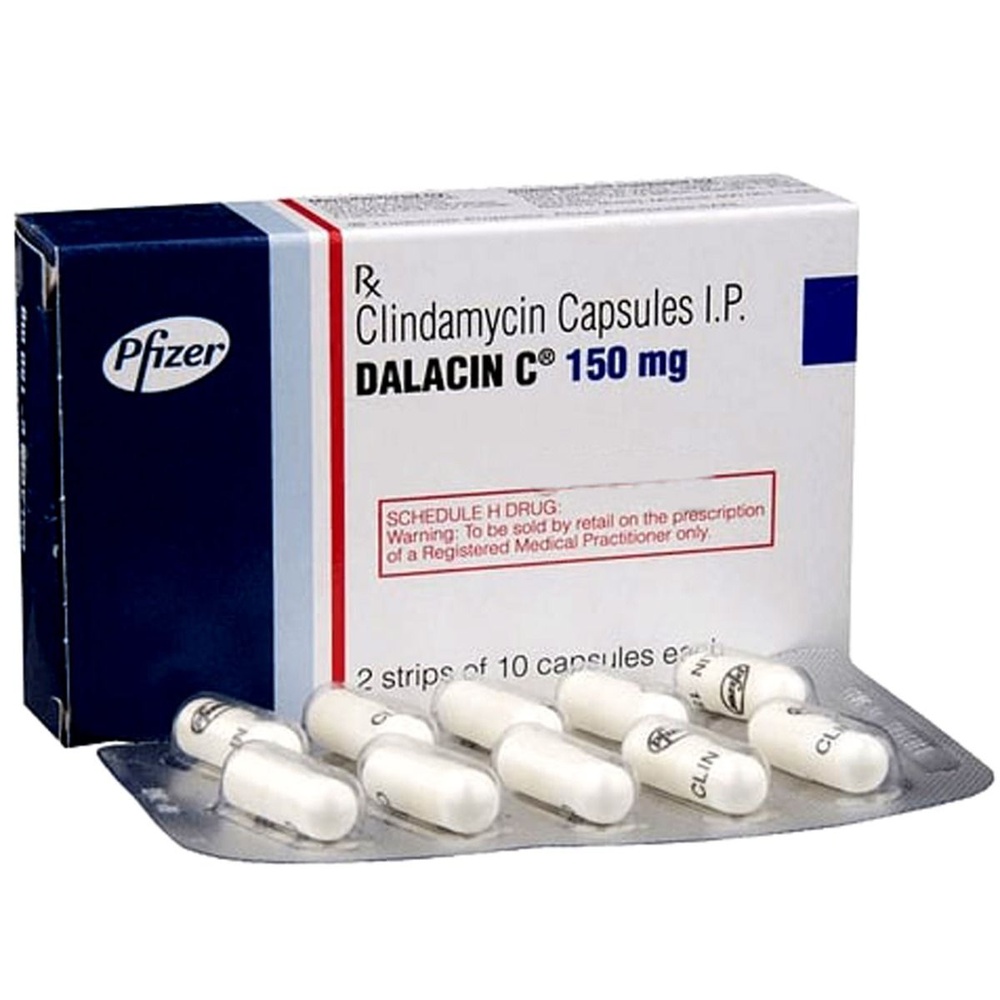
Dalacin C, 150 mg, hard capsules are a two-part, white capsule marked with "CLIN 150" and "Pfizer".
Packaging: PVC/Al foil blisters containing 16, 20, or 100 capsules, in a cardboard box.
Marketing authorization holder
Pfizer Europe MA EEIG, Boulevard de la Plaine 17, 1050 Bruxelles, Belgium
Manufacturer
Fareva Amboise, Zone Industrielle, 29 route des Industries, 37530 Pocé-sur-Cisse, France
To obtain more detailed information about this medicine, the patient should contact the representative of the marketing authorization holder:
Pfizer Polska Sp. z o.o.; tel. 22 335 61 00
Date of the last update of the leaflet: 09/2024
Detailed and up-to-date information about this product can be obtained by scanning the QR code on the outer packaging using a mobile device.
This information is also available at the URL: https://pfi.sr/ulotka-dalacinc150 and on the website of the Office for Registration of Medicinal Products, Medical Devices, and Biocidal Products
http://www.urpl.gov.pl.
- Country of registration
- Dosage formCapsules, 150 mg
- ATC codeJ01FF01
- Active substance
- Prescription requiredYes
- Manufacturer
- ImporterFareva Amboise
- This information is for reference only and does not constitute medical advice. Always consult a doctor before taking any medication. Oladoctor is not responsible for medical decisions based on this content.
- Alternatives to Dalacin CDosage form: Solution, 150 mg/mlActive substance: clindamycinManufacturer: hameln rds s.r.o. Siegfried Hameln GmbHPrescription requiredDosage form: Solution, 150 mg/mlActive substance: clindamycinManufacturer: Labesfal Laboratorios Almiro S.A.Prescription requiredDosage form: Capsules, 300 mgActive substance: clindamycinManufacturer: Balkanpharma-Razgrad ADPrescription not required
Online doctors for Dalacin C
Discuss questions about Dalacin C, including use, safety considerations and prescription review, subject to medical assessment and local regulations.









Get Dalacin C Prescription Online
Fill in a 2-min form
Tell us your symptoms, history, and what medicine you're requesting.
Pick a doctor or let us assign
Choose a specialist or we'll match you with the next available doctor.
Doctor reviews your case
Usually within 30 minutes. They may ask follow-up questions via chat.
Collect from any pharmacy
Electronic prescription sent to your email — valid across Spain.
Frequently Asked Questions
Dalacin C requires a prescription in Poland. You can check with a doctor online whether this medicine may be appropriate for your situation.
The active ingredient in Dalacin C is clindamycin. This information helps identify medicines with the same composition but different brand names.
Dalacin C is manufactured by Fareva Amboise. Pharmacy brands and packaging may differ depending on the distributor.
Doctors such as Family doctors, Psychiatrists, Dermatologists, Cardiologists, Endocrinologists, Gastroenterologists, Pulmonologists, Nephrologists, Rheumatologists, Hematologists, Infectious disease physicians, Allergists, Geriatricians, Paediatricians, Oncologists may assess whether Dalacin C is appropriate, depending on your situation and local regulations. You can book an online consultation to discuss your symptoms and possible next steps.
Spain has a well-developed healthcare infrastructure across major cities such as Madrid, Barcelona, Valencia, and Seville. Pharmacies are widely available and operate under strict regulations, ensuring access to prescribed medications.
You can buy Dalacin C in Madrid, Barcelona, Seville, or Valencia at any local pharmacy with a valid prescription.
To obtain a prescription, you can use Oladoctor:
Other medicines with the same active substance (clindamycin) include Clindamicin hameln, Clindamicin Kabi, Clindamicin Milan. These may have different brand names or formulations but contain the same therapeutic ingredient. Always consult a doctor before switching or starting a new medicine.
