



PHESGO 1200 mg/600 mg Injectable Solution

Prescription review online
A doctor will review your case and decide whether a prescription is medically appropriate.

Talk to a doctor about this medicine
Discuss your symptoms and possible next steps in a quick online consultation.



How to use PHESGO 1200 mg/600 mg Injectable Solution
Contents of the leaflet
- Introduction
- What is Phesgo and what is it used for
- What you need to know before you use Phesgo
- How to use Phesgo
- Possible side effects
- Storage of Phesgo
- Container contents and additional information
Introduction
Package Leaflet: Information for the User
Phesgo 600mg/600mg solution for injection
Phesgo 1.200mg/600mg solution for injection
pertuzumab/trastuzumab
This medicine is subject to additional monitoring. This will allow quick identification of new safety information. You can help by reporting any side effects you may get. The last section of this leaflet includes information on how to report side effects.
Read all of this leaflet carefully before you start using this medicine because it contains important information for you.
- Keep this leaflet, you may need to read it again.
- If you have any further questions, ask your doctor, pharmacist, or nurse.
- If you get any side effects, talk to your doctor, pharmacist, or nurse. This includes any possible side effects not listed in this leaflet. See section 4.
Contents of the pack
- What is Phesgo and what is it used for
- What you need to know before you use Phesgo
- How to use Phesgo
- Possible side effects
- Storage of Phesgo
- Contents of the pack and other information
1. What is Phesgo and what is it used for
Phesgo is a cancer medicine that contains two active substances: pertuzumab and trastuzumab.
- Pertuzumab and trastuzumab are "monoclonal antibodies". They are designed to bind to specific targets on cells called "human epidermal growth factor receptor 2" (HER2).
- HER2 is found in large amounts on the surface of some cancer cells, and stimulates their growth.
- By binding to HER2 on cancer cells, pertuzumab and trastuzumab slow down their growth or destroy them.
Phesgo is available in two different doses. For more information, see section 6.
Phesgo is a medicine used to treat adult patients with breast cancer that is of the "HER2-positive" type – your doctor will have tests done to find out if this is the case. It can be used when:
- the cancer has spread to other parts of the body (has metastasized) such as to the lungs or liver, or the cancer has come back in the breast and the area around the breast, but cannot be operated on and has not been treated with cancer medicines (chemotherapy) or other medicines designed to bind to HER2.
- the cancer has not spread to other parts of the body and treatment is to be given before surgery (neoadjuvant therapy) or after surgery (adjuvant therapy).
In addition to Phesgo, you will receive other medicines called chemotherapeutics. Information about these medicines is described in separate package leaflets. Ask your doctor, pharmacist, or nurse to give you information about these other medicines.

Not sure if this medicine is right for you?
Discuss your symptoms and treatment with a doctor online.
2. What you need to know before you use Phesgo
Do not use Phesgo
- If you are allergic to pertuzumab, trastuzumab, or any of the other ingredients of this medicine (listed in section 6).
If you are not sure, talk to your doctor, pharmacist, or nurse before you are given Phesgo.
Warnings and precautions
Heart problems
Treatment with Phesgo can affect the heart. Tell your doctor, pharmacist, or nurse before you are given Phesgo if:
- you have ever had heart problems (such as heart failure, treatment for serious irregular heartbeats, uncontrolled high blood pressure, recent heart attack). Your doctor will do tests to check if your heart is working properly before and during treatment with Phesgo.
- you have ever had heart problems during previous treatment with a medicine that contains trastuzumab.
- you have ever received a chemotherapy medicine from the group of cancer medicines called anthracyclines, such as doxorubicin or epirubicin; these medicines can damage the heart muscle and increase the risk of heart problems with Phesgo.
- you have ever received radiation therapy in the chest area, as this may increase the risk of heart problems.
If any of the above apply to you (or you are not sure), talk to your doctor or nurse before you are given Phesgo. See the section on "Serious side effects" in section 4 for more details on the signs of heart problems to watch out for.
Injection reactions
Injection reactions can occur. These are allergic reactions and can be serious.
If you have a serious side effect, your doctor may stop treatment with Phesgo. See section 4, "Serious side effects", for more details on the injection-related reactions to watch out for during and after injection.
Your doctor or nurse will check for side effects during the injection and during:
- 30 minutes after the first injection of Phesgo.
- 15 minutes after subsequent injections of Phesgo.
If you have a serious reaction, your doctor will stop treatment with Phesgo.
Low white blood cell count and fever (Neutropenic fever)
When Phesgo is given with chemotherapeutic medicines, the number of white blood cells in the blood may decrease and fever may occur. If you have inflammation of the digestive tract (e.g., mouth pain or diarrhea), you may be more likely to have this side effect. If the fever persists for several days, this may be a sign of worsening of your condition and you should contact your doctor.
Diarrhea
Treatment with Phesgo can cause severe diarrhea. Patients over 65 years of age have a higher risk of diarrhea compared to patients under 65 years of age. If you experience severe diarrhea while receiving your cancer treatment, your doctor may give you medicines to control the diarrhea. Your doctor may also interrupt your treatment with Phesgo until the diarrhea is under control.
Children and adolescents
Phesgo must not be given to patients under 18 years of age because there is no information on its efficacy in this age group.
Elderly patients over 65 years of age
Patients over 65 years of age are more likely to have side effects such as reduced appetite, decrease in the number of red blood cells, weight loss, fatigue, loss or alteration of taste, weakness, numbness, tingling, or itching, mainly in the feet and legs, and diarrhea, compared to patients under 65 years of age.
Other medicines and Phesgo
Tell your doctor, pharmacist, or nurse if you are taking, have recently taken, or might take any other medicines.
Pregnancy, breast-feeding, and fertility
Before starting treatment, you must tell your doctor, pharmacist, or nurse if you are pregnant or breast-feeding, or if you think you may be pregnant or plan to become pregnant. You will be informed of the benefits and risks for you and your baby of Phesgo administration during pregnancy.
- Tell your doctor immediately if you become pregnant during treatment with Phesgo or in the 7 months following the end of treatment. Phesgo may harm the fetus. You must use an effective method of contraception during treatment with Phesgo and for 7 months after the end of treatment.
- Ask your doctor if you can breast-feed during or after treatment with Phesgo.
Driving and using machines
Phesgo may affect your ability to drive or use machines. If during treatment you experience symptoms such as dizziness, chills, fever, injection reactions, or allergic reactions as described in section 4, do not drive or use machines until these symptoms have resolved.
Phesgo contains sodium
Phesgo contains less than 1 mmol of sodium (23 mg) per dose; this is essentially "sodium-free".
3. How to use Phesgo
A doctor or nurse will give you Phesgo in a hospital or clinic by injection under your skin (subcutaneous injection).
- Injections are given every three weeks.
- You will receive the injection first in one thigh and then in the other. You will continue to receive the injection in one thigh and then in the other.
- Your doctor or nurse will make sure that each injection is given in a new place (at a minimum distance of 2.5 cm from the previous injection site), and where the skin is not red, bruised, tender, or hard.
- Different injection sites should be used for other medicines.
Start of treatment (initial dose)
- 1,200 mg / 600 mg of Phesgo will be given under your skin over 8 minutes. Your doctor or nurse will monitor you for side effects during and for 30 minutes after the injection.
- You will also receive chemotherapy.
Subsequent injections (maintenance doses),which will be given if the first injection did not cause you serious side effects:
- 600 mg / 600 mg of Phesgo will be given under your skin over 5 minutes. Your doctor or nurse will monitor you for side effects during and for 15 minutes after the injection.
- According to your doctor's prescription, you will also receive chemotherapy.
- The number of injections you will receive depends on:
- how you respond to treatment
- whether you are receiving treatment before or after surgery or if the disease has spread.
For more information on the initial and maintenance doses, see section 6.
For more information on the dose of chemotherapy (which can also cause side effects), read the package leaflet of those medicines. If you have questions about these medicines, ask your doctor, pharmacist, or nurse.
If you miss a dose of Phesgo
If you do not attend your appointment to receive Phesgo, make another appointment as soon as possible. Depending on how long it has been between the two visits, your doctor will decide what dose of Phesgo to give you.
If you stop treatment with Phesgo
Do not stop treatment with this medicine without talking to your doctor first. It is important that you are given all the injections in the cycle at the right time every three weeks. This helps your medicine work as well as possible.
If you have any other questions about the use of this medicine, ask your doctor, pharmacist, or nurse.

Started taking the medicine and have questions?
Discuss your symptoms and treatment with a doctor online.
4. Possible side effects
Like all medicines, this medicine can cause side effects, although not everybody gets them.
Serious side effects
Tell your doctor or nurse immediately if you notice any of the following side effects:
- Heart problems:slower or faster than usual heartbeat or heart flutter and symptoms that may include cough, difficulty breathing, and swelling (fluid retention) in your legs or arms.
- Injection reactions:these can be mild or more serious and can include feeling unwell, fever, chills, tiredness, headache, loss of appetite, muscle and joint pain, and flushing.
- Diarrhea:can be mild or moderate but can be very severe or persistent diarrhea, with 7 or more bowel movements per day.
- Low white blood cell countshown in a blood test. With or without fever.
- Allergic reactions:swelling of the face and throat, with difficulty breathing, this can be a symptom of a severe allergic reaction.
Tell your doctor or nurse immediately if you notice any of the above side effects.
Other side effects
Very common (may affect more than 1 in 10 people):
- Hair loss
- Rash
- Inflammation of the digestive tract (e.g., mouth pain)
- Decrease in the number of red and white blood cells, shown in a blood test
- Muscle weakness
- Constipation
- Loss or alteration of taste
- Difficulty sleeping
- Feeling weak, numbness, tingling, or itching that mainly affects the feet, legs, and hands
- Nosebleeds
- Acidity
- Dryness, itching, or acne of the skin
- Pain at the injection site, redness of the skin (erythema), and bruising at the injection site
- Nail problems, such as discoloration with white or dark stripes or change in nail color
- Sore throat, redness, pain or runny nose, flu-like symptoms, and fever that can lead to infection in the ear, nose, or throat.
- Increased tear production
- Pain in the body, arms, legs, and abdomen.
- Sharp, stabbing pain, with a feeling of cold or heat.
- Feeling pain from something that should not be painful, such as a light touch
- Losing balance or coordination.
Common (may affect up to 1 in 10 people):
- Difficulty breathing
- Reduced ability to feel changes in heat or cold
- Losing balance or coordination.
- Inflammation of the nail bed where the nail meets the skin
- A condition in which the left side of the heart does not work properly with or without symptoms
- A condition in which the heart muscle becomes weaker, which can lead to difficulty breathing
- Allergic reaction that causes a range of symptoms from mild to severe, such as fever, chills, headache, and difficulty breathing.
Uncommon (may affect up to 1 in 100 people):
- Chest symptoms such as dry cough or difficulty breathing (possible signs of interstitial lung disease, a disease that damages the tissue around the air sacs in the lungs)
- Fluid around the lungs that causes difficulty breathing
Rare side effects have been seen with intravenous pertuzumab but not with Phesgo, such as tumor lysis syndrome (where cancer cells die quickly). Tumor lysis syndrome can include kidney problems (signs include weakness, shortness of breath, fatigue, and confusion), heart problems (signs include heart flutter, from faster to slower heartbeat, seizures, vomiting, or diarrhea, and tingling in the mouth, hands, or feet).
If you experience any of the above side effects, talk to your doctor, nurse, or pharmacist.
If you experience any of these symptoms after treatment with Phesgo has been stopped, you should contact your doctor immediately and tell them that you have been previously treated with Phesgo.
Some of the side effects you suffer from may be due to your breast cancer. If you are given Phesgo with chemotherapy at the same time, some side effects may also be due to these other medicines.
Reporting of side effects
If you experience any side effects, talk to your doctor, pharmacist, or nurse. This includes any possible side effects not listed in this leaflet. You can also report side effects directly via the national reporting system listed in Appendix V. By reporting side effects, you can help provide more information on the safety of this medicine.
5. Storage of Phesgo
Phesgo will be stored by healthcare professionals in the hospital or clinic. The storage details are as follows:
- Keep this medicine out of the sight and reach of children.
- Do not use this medicine after the expiry date which is stated on the carton and vial after EXP. The expiry date is the last day of the month shown.
- Store in a refrigerator (2°C - 8°C).
- Do not freeze.
- Keep the vial in the outer packaging to protect it from light.
- Once the vial is opened, administer the solution immediately. Do not use this medicine if you notice particles in the liquid or if it has an unusual color (see section 6).
- Medicines should not be disposed of via wastewater or household waste. Ask your pharmacist how to dispose of medicines no longer required. This will help protect the environment.
6. Container contents and additional information
Composition ofPhesgo
The active ingredients are pertuzumab and trastuzumab.
- Maintenance dose:A 10 ml vial of solution contains 600 mg of pertuzumab and 600 mg of trastuzumab. Each ml contains 60 mg of pertuzumab and 60 mg of trastuzumab
- Initial dose:A 15 ml vial of solution contains 1,200 mg of pertuzumab and 600 mg of trastuzumab. Each ml contains 80 mg of pertuzumab and 40 mg of trastuzumab.
The other components are: vorhialuronidase alfa, L-histidine, L-histidine hydrochloride monohydrate, α,α-trehalose dihydrate, sucrose, L-methionine, polysorbate 20, and water for injectable preparations (see section 2 “Phesgo contains sodium”).
Appearance of Phesgo and container contents
Phesgo is an injectable solution. It is a clear to slightly opalescent, colorless to pale brown solution contained in a glass vial. Each container contains a vial with a 10 ml or 15 ml solution.
Marketing authorization holder
Roche Registration GmbH
Emil-Barell-Strasse 1
79639 Grenzach-Wyhlen
Germany
Manufacturer
Roche Pharma AG
Emil-Barell-Strasse 1
79639 Grenzach-Wyhlen
Germany
You can request more information about this medicinal product by contacting the local representative of the marketing authorization holder:
Belgium N.V. Roche S.A. Tel: +32 (0) 2 525 82 11 | Lithuania UAB “Roche Lietuva” Tel.: +370 5 2546799 |
| Luxembourg (See Belgium) |
Czech Republic Roche s. r. o. Tel.: +420 - 2 20382111 | Hungary Roche (Hungary) Kft. Tel.: +36 - 1 279 4500 |
Denmark Roche Pharmaceuticals A/S Tel.: +45 - 36 39 99 99 | Malta (See Ireland) |
Germany Roche Pharma AG Tel.: +49 (0) 7624 140 | Netherlands Roche Nederland B.V. Tel.: +31 (0) 348 438050 |
Estonia Roche Eesti OÜ Tel.: + 372 - 6 177 380 | Norway Roche Norge AS Tel.: +47 - 22 78 90 00 |
Greece Roche (Hellas) A.E. Tel.: +30 210 61 66 100 | Austria Roche Austria GmbH Tel.: +43 (0) 1 27739 |
Spain Roche Farma S.A. Tel: +34 - 91 324 81 00 | Poland Roche Polska Sp.z o.o. Tel.: +48 - 22 345 18 88 |
France Roche Tel: +33 (0) 1 47 61 40 00 | Portugal Roche Farmacêutica Química, Lda Tel.: +351 - 21 425 70 00 |
Croatia Roche d.o.o. Tel.: +385 1 4722 333 | Romania Roche România S.R.L. Tel.: +40 21 206 47 01 |
Ireland Roche Products (Ireland) Ltd. Tel.: +353 (0) 1 469 0700 | Slovenia Roche farmacevtska družba d.o.o. Tel.: +386 - 1 360 26 00 |
Iceland Roche Pharmaceuticals A/S c/o Icepharma hf Phone: +354 540 8000 | Slovak Republic Roche Slovensko, s.r.o. Tel.: +421 - 2 52638201 |
Italy Roche S.p.A. Tel.: +39 - 039 2471 | Finland Roche Oy Phone/Tel: +358 (0) 10 554 500 |
Cyprus Γ.Α.Σταμ?της & Σια Λτδ. Tel.: +357 - 22 76 62 76 | Sweden Roche AB Tel.: +46 (0) 8 726 1200 |
Latvia Roche Latvija SIA Tel.: +371 - 6 7039831 | United Kingdom (Northern Ireland) Roche Products (Ireland) Ltd. Tel: +44 (0) 1707 366000 |
Date of last revision of this leaflet
Other sources of information
Detailed information on this medicinal product is available on the European Medicines Agency website: http://www.ema.europa.eu.
This leaflet is available on the European Medicines Agency website in all EU/EEA languages.
- Country of registration
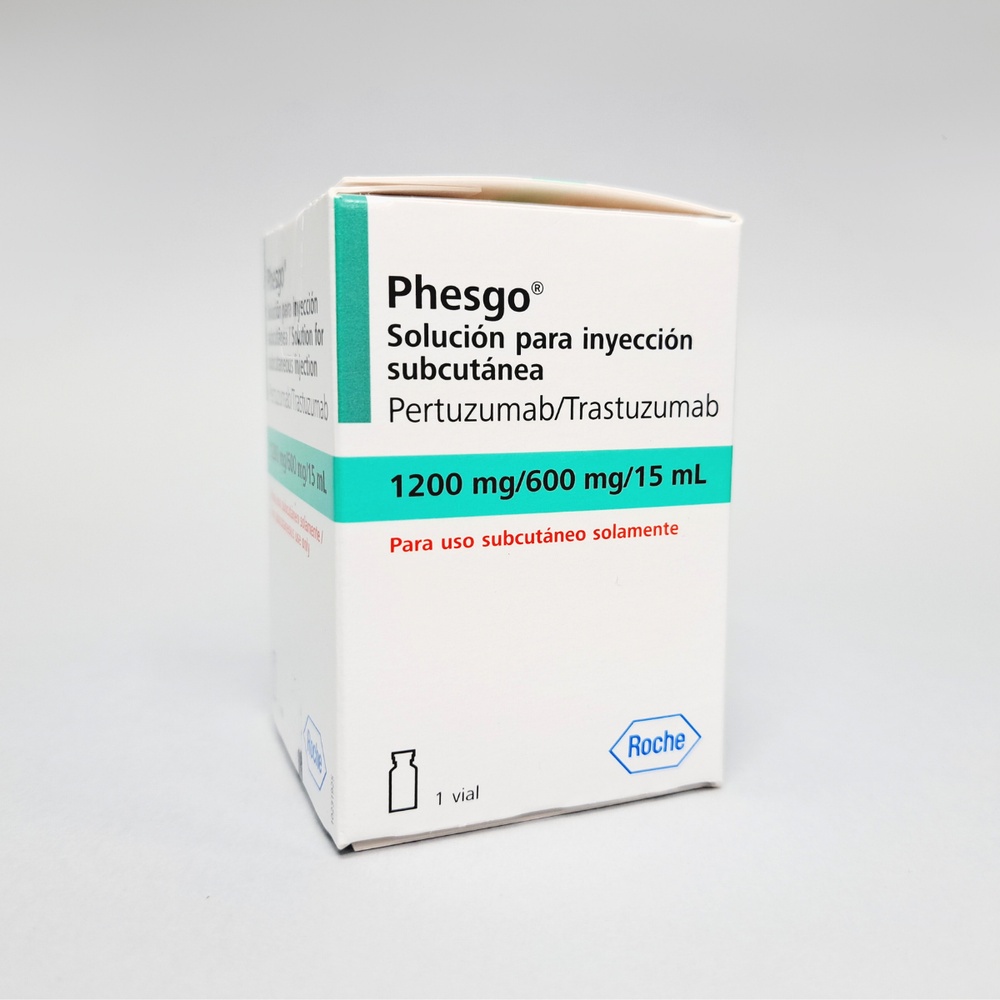
- Dosage formINJECTABLE, 1200 mg / 600 mg
- ATC codeL01FY01
- Active substance
- Prescription requiredYes
- Manufacturer
- CompositionSACAROSA (685 mg mg), POLISORBATO 20 (6 mg mg)
- This information is for reference only and does not constitute medical advice. Always consult a doctor before taking any medication. Oladoctor is not responsible for medical decisions based on this content.
- Alternatives to PHESGO 1200 mg/600 mg Injectable SolutionDosage form: INJECTABLE, 1200 - REVIEW mgActive substance: pertuzumab and trastuzumabManufacturer: Roche Registration GmbhPrescription requiredDosage form: INJECTABLE PERFUSION, 240 mg/80 mgActive substance: nivolumab and relatlimabManufacturer: Bristol-Myers Squibb Pharma EeigPrescription requiredDosage form: INJECTABLE PERFUSION, 25 mg/mlActive substance: bevacizumabManufacturer: Biosimilar Collaborations Ireland LimitedPrescription required
Online doctors for PHESGO 1200 mg/600 mg Injectable Solution
Discuss questions about PHESGO 1200 mg/600 mg Injectable Solution, including use, safety considerations and prescription review, subject to medical assessment and local regulations.
Get PHESGO 1200 mg/600 mg Injectable Solution Prescription Online
Fill in a 2-min form
Tell us your symptoms, history, and what medicine you're requesting.
Pick a doctor or let us assign
Choose a specialist or we'll match you with the next available doctor.
Doctor reviews your case
Usually within 30 minutes. They may ask follow-up questions via chat.
Collect from any pharmacy
Electronic prescription sent to your email — valid across Spain.
Frequently Asked Questions
PHESGO 1200 mg/600 mg Injectable Solution requires a prescription in Spain. You can check with a doctor online whether this medicine may be appropriate for your situation.
The active ingredient in PHESGO 1200 mg/600 mg Injectable Solution is pertuzumab and trastuzumab. This information helps identify medicines with the same composition but different brand names.
PHESGO 1200 mg/600 mg Injectable Solution is manufactured by Roche Registration Gmbh. Pharmacy brands and packaging may differ depending on the distributor.
Doctors such as Family doctors, Psychiatrists, Dermatologists, Cardiologists, Endocrinologists, Gastroenterologists, Pulmonologists, Nephrologists, Rheumatologists, Hematologists, Infectious disease physicians, Allergists, Geriatricians, Paediatricians, Oncologists may assess whether PHESGO 1200 mg/600 mg Injectable Solution is appropriate, depending on your situation and local regulations. You can book an online consultation to discuss your symptoms and possible next steps.
Spain has a well-developed healthcare infrastructure across major cities such as Madrid, Barcelona, Valencia, and Seville. Pharmacies are widely available and operate under strict regulations, ensuring access to prescribed medications.
You can buy PHESGO 1200 mg/600 mg Injectable Solution in Madrid, Barcelona, Seville, or Valencia at any local pharmacy with a valid prescription.
To obtain a prescription, you can use Oladoctor:
Other medicines with the same active substance (pertuzumab and trastuzumab) include PHESGO 600 MG/600 MG INJECTABLE SOLUTION, OPDUALAG 240 mg/80 mg concentrate for infusion solution, ABEVMY 25 mg/mL concentrate for infusion solution. These may have different brand names or formulations but contain the same therapeutic ingredient. Always consult a doctor before switching or starting a new medicine.
