


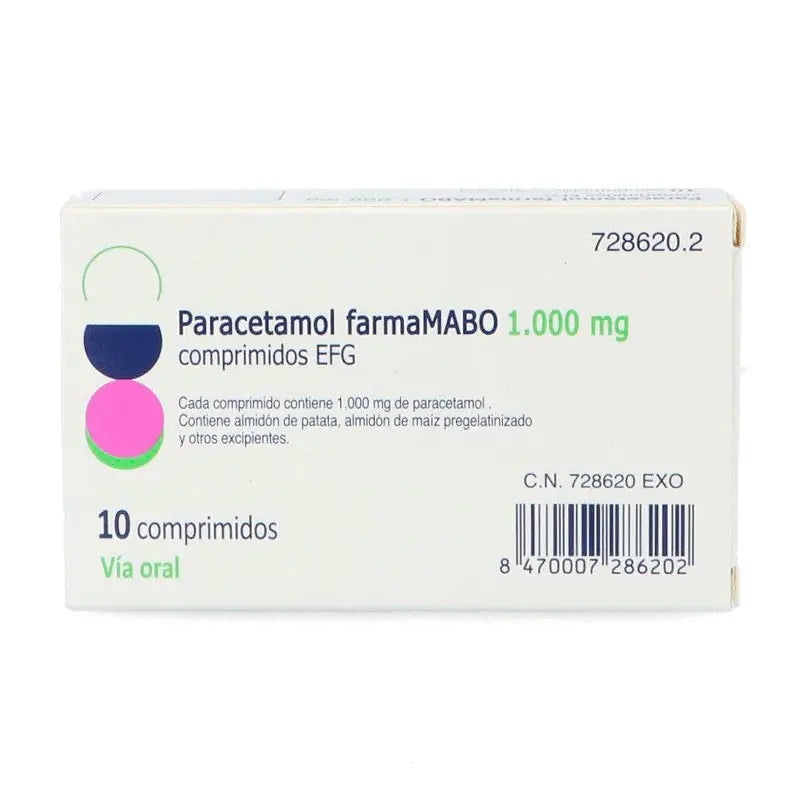
Paracetamol Mabogen 1 g comprimidos

Prescription review online
A doctor will review your case and decide whether a prescription is medically appropriate.

Talk to a doctor about this medicine
Discuss your symptoms and possible next steps in a quick online consultation.



How to use PARACETAMOL MABOGEN 1 g TABLETS
Contents of the leaflet
- Introduction
- What is Paracetamol Mabogen and what is it used for
- What you need to know before taking Paracetamol Mabogen
- How to Take Paracetamol Mabogen
- Possible Side Effects
- Reporting of Side Effects
- Storage of Paracetamol Mabogen
- Package Contents and Additional Information
Introduction
Package Leaflet: Information for the User
Paracetamol Mabogen1 gEFG Tablets
Read the entire package leaflet carefully before starting to take this medication, as it contains important information for you.
- Keep this package leaflet, as you may need to read it again.
- If you have any questions, consult your doctor or pharmacist.
- This medication has been prescribed to you only, and you should not give it to others, even if they have the same symptoms as you, as it may harm them.
- If you experience side effects, consult your doctor or pharmacist, even if they are side effects not listed in this package leaflet. See section 4.
Contents of the Package Leaflet
- What is Paracetamol Mabogen and what is it used for
- What you need to know before taking Paracetamol Mabogen
- How to take Paracetamol Mabogen
- Possible side effects
- Storage of Paracetamol Mabogen
- Package Contents and Additional Information
1. What is Paracetamol Mabogen and what is it used for
Paracetamol is a pain-relieving (analgesic) and fever-reducing (antipyretic) medication.
This medication is used for the symptomatic treatment of mild or moderate pain and fever in adults.

Not sure if this medicine is right for you?
Discuss your symptoms and treatment with a doctor online.
2. What you need to know before taking Paracetamol Mabogen
Do not take Paracetamol Mabogen:
If you are allergic to paracetamol or any of the other components of this medication (listed in section 6).
Warnings and Precautions:
Consult your doctor or pharmacist before starting to take Paracetamol.
- when used by patients on a sodium-free or low-sodium diet (see "Paracetamol Mabogen contains sodium").
Paracetamol may cause severe skin reactions, such as acute generalized exanthematous pustulosis (AGEP), Stevens-Johnson syndrome (SJS), and toxic epidermal necrolysis (TEN), which can be fatal. Patients should be informed about the symptoms of severe skin reactions and should discontinue the use of the medication at the first symptom of skin rash or any other symptom of hypersensitivity.
The maximum recommended dose should not exceed 4 g.
Concomitant use of this medication with other medications containing paracetamol, such as flu and cold medications, should be avoided, as high doses can cause liver damage. Do not use more than one medication containing paracetamol without consulting your doctor.
If you overdose, seek medical attention immediately (see "If you take more Paracetamol Mabogen than you should").
Administration of paracetamol doses higher than recommended implies a very serious risk of liver injury. Medications containing paracetamol should not be taken for more than a few days or in high doses, unless your doctor indicates otherwise.
Prolonged use of pain relievers or inadequate use of high doses can cause headaches, which should not be treated with higher doses of the medication.
During treatment with Paracetamol Mabogen, inform your doctor immediately if: you have severe illnesses, such as severe kidney failure or sepsis (when bacteria and their toxins circulate in the blood, causing organ damage), or if you have malnutrition, chronic alcoholism, or are also taking flucloxacillin (an antibiotic). A serious disease called metabolic acidosis (an anomaly in blood and fluids) has been reported in patients in these situations when paracetamol is used at regular doses for a prolonged period or when paracetamol is taken with flucloxacillin. Symptoms of metabolic acidosis may include: severe breathing difficulties with deep and rapid breathing, drowsiness, feeling unwell (nausea) and vomiting.
Interference with Laboratory Tests
If you are going to have any laboratory tests (including blood, urine, etc.), inform your doctor that you are taking this medication, as it may alter the results.
Paracetamol may alter the values of analytical determinations of uric acid and glucose.
Children and Adolescents
This medication is not recommended for children (see section 3). This medication is indicated only for adults and adolescents over 15 years old and weighing more than 55 kg.
In children under 15 years old or weighing less than 55 kg, consult your doctor or pharmacist, as other presentations with adapted doses for these patients may be available.
Other Medications and Paracetamol
Inform your doctor or pharmacist if you are using or have recently used or may need to use other medications.
In particular, if you are using any of the following medications, it may be necessary to modify the dose of some of them or interrupt treatment:
Medications to treat seizures (antiepileptics such as carbamazepine, phenytoin, phenobarbital, primidone, lamotrigine): the combination of paracetamol and antiepileptic medications can cause or worsen liver damage.
Lamotrigine: The effect of lamotrigine may decrease.
Medications to treat high blood pressure and heart rhythm disorders (arrhythmias) (propranolol): the combination of paracetamol and propranolol can increase the action and/or toxicity.
Medications to treat gout: Probenecid causes a reduction of almost 2 times in the excretion of paracetamol. The dose of paracetamol should be considered for reduction when concomitant treatment with probenecid is administered.
Medications to treat tuberculosis (rifampicin, isoniazid): the combination of paracetamol and rifampicin or isoniazid can cause or worsen liver damage.
Salicylamide, a medication to treat fever and pain, can prolong the elimination half-life (t1/2) of paracetamol.
Medications to reduce cholesterol levels in the blood: colestyramine reduces the absorption of paracetamol. To avoid this, paracetamol should be administered one hour before or 4 hours after the resin.
Medications to prevent nausea and vomiting (metoclopramide and domperidone): the simultaneous ingestion of medications that cause gastric emptying acceleration, e.g., metoclopramide and domperidone, increases the absorption and anticipates the onset of action of paracetamol. However, it is not necessary to avoid concomitant use.
Medications to prevent blood clots (oral anticoagulants such as acenocoumarol, warfarin): paracetamol can increase the effects of oral anticoagulants. Prolonged use of this medication in patients treated with oral anticoagulants should only be done under medical supervision. The potentiation of warfarin effects has been observed with continued high doses of paracetamol.
Medications to increase urine production (loop diuretics such as furosemide): the effects of diuretics may be reduced.
Chloramphenicol, a medication to treat infections: the simultaneous administration of paracetamol and chloramphenicol can significantly delay the elimination of chloramphenicol, increasing its plasma concentrations and causing a higher risk of toxicity.
Zidovudine (AZT), a medication used in viral diseases: the concomitant administration of paracetamol and AZT can increase the incidence of neutropenia or worsen it (reduction of white blood cell count). Paracetamol should only be taken simultaneously with AZT if your doctor recommends it.
Flucloxacillin (antibiotic), due to a serious risk of alteration of blood and fluids (metabolic acidosis with high anion gap) that should be treated urgently (see section 2).
The concomitant use of substances that induce liver enzymes, such as barbiturates, carbamazepine, isoniazid, rifampicin, or ethanol, should be taken into account, as they may potentiate the toxic effect of paracetamol.
Inform your doctor if this medication is taken with medications that delay gastric emptying (e.g., propanteline) or accelerate gastric emptying (e.g., metoclopramide and domperidone).
Use of Paracetamol with Food, Drinks, and Alcohol:
Do not drink alcohol during treatment with paracetamol.
Pregnancy and Breastfeeding
If you are pregnant or breastfeeding, think you may be pregnant, or plan to become pregnant, consult your doctor or pharmacist.
In case of need, Paracetamol can be used during pregnancy. You should use the lowest possible dose that reduces pain or fever and use it for the shortest possible time. Contact your doctor if the pain or fever does not decrease or if you need to take the medication more frequently.
Paracetamol passes into breast milk, so breastfeeding women should consult their doctor or pharmacist before taking this medication.
Driving and Using Machines
This medication does not affect the ability to drive or use machines. However, during treatment with paracetamol, you may observe mild drowsiness and dizziness as side effects.
Paracetamol Mabogen Contains Sodium
This medication contains less than 23 mg of sodium (1 mmol) per unit dose; it is essentially "sodium-free".
3. How to Take Paracetamol Mabogen
Follow the administration instructions of this medication indicated by your doctor or pharmacist exactly. In case of doubt, consult your doctor or pharmacist again.
The recommended dose is:
- Adults and adolescents over 15 years old (and weighing more than 55 kg): the recommended dose is 1 tablet or half (1 g - 500 mg of paracetamol) every 6 or 8 hours. If necessary, administration can be repeated after an interval of at least 4 hours.
Generally, it is not necessary to exceed 3 g of paracetamol per day, i.e., 3 tablets per day. However, for more intense pain, the maximum dose can be increased to 4 g per day (4 tablets).
There should always be a minimum interval of 4 hours between administrations.
Administration after meals may delay the onset of action.
Frequency of Administration
Regular doses prevent variations in pain or temperature.
Liver Diseases
Consult your doctor before taking this medication.
Patients with moderate to severe kidney failure should not take this medication.
Kidney Diseases
Consult your doctor. Patients with moderate to severe impairment should not take this medication.
Liver Failure
You should take the amount prescribed by your doctor with a minimum interval of 8 hours.
Do not take more than 2 g of paracetamol (2 tablets) every 24 hours.
In chronic alcoholics, no more than 2 g/day of paracetamol should be administered.
Elderly Patients
No dose adjustment is necessary.
Use in Children and Adolescents
This medication should not be administered to children or adolescents under 15 years old with a weight of less than 55 kg.
For children with a weight of more than 33 kg between 13 and 15 years old, 500 mg of paracetamol (half a tablet) can be administered 4 times a day with a large glass of water. The doses should be spaced at least 4 hours apart.
Maximum daily dose: 2 g/day.
Other presentations are available that do not require manipulation of the tablet.
Children (under 13 years old). The use of this medication is not recommended in these patients.
Method of Administration:
Paracetamol Mabogen should be taken orally.
The tablet can be divided into equal doses.
According to your preferences, the tablets can be ingested directly or broken in half, with the help of a glass of liquid, preferably water.
Consult your doctor or pharmacist if you have any doubts.
When doses lower than 1 gram of paracetamol per dose are required, it is recommended to use other available presentations of paracetamol that adapt to the required dosing.
If you take more Paracetamol Mabogen than you should
Contact your doctor or pharmacist immediately, even if you feel well. The appearance of symptoms of severe liver damage can be delayed by 1 to 2 days. Adequate control of paracetamol overdose requires immediate treatment. Despite the absence of early symptoms, patients should be taken to the hospital for immediate treatment. Symptoms of overdose include nausea, vomiting, anorexia, pallor, general malaise, sweating, and abdominal pain, and usually appear within the first 24 hours.
In case of overdose or accidental ingestion, go immediately to a medical center or call the Toxicology Information Service (telephone 91 562 04 20), indicating the medication and the amount ingested.
If you forget to take Paracetamol Mabogen
If you forget to take a dose, take another as soon as you remember, unless it is almost time for your next dose. Remember to leave at least four hours between doses. Do not take a double dose to make up for forgotten doses.
If you stop treatment with Paracetamol Mabogen
If you have any other questions about the use of this medication, ask your doctor or pharmacist.

Started taking the medicine and have questions?
Discuss your symptoms and treatment with a doctor online.
4. Possible Side Effects
Like all medications, this medication can cause side effects, although not everyone will experience them.
The following side effects have been reported in patients treated with paracetamol:
Rare:(may affect up to 1 in 1,000 people)
- Low blood pressure (hypotension).
- Increased liver enzymes.
- Malaise.
Very Rare:(may affect up to 1 in 10,000 people)
- Changes in blood, including changes in blood cell counts (such as abnormally low levels of certain blood elements that can cause, for example, bleeding through the nose or gums) and bleeding.
- Allergic reactions (symptoms such as edema, shortness of breath, sweating, nausea, sudden drop in blood pressure).
- Decreased blood sugar.
- Jaundice (yellowing of the skin), liver failure.
- Skin reactions such as allergic dermatitis, urticaria, itching, skin rash.
- Changes in urination (difficult or painful urination, decreased urine output, and blood in the urine).
Frequency Not Known(cannot be estimated from available data): A serious disease called metabolic acidosis (an anomaly in blood and fluids) in patients with severe illness using paracetamol (see section 2).
If you consider that any of the side effects you are experiencing is serious or if you notice any side effect not mentioned in this package leaflet, inform your doctor or pharmacist.
Reporting of Side Effects
If you experience any type of side effect, consult your doctor or pharmacist, even if it is a side effect not listed in this package leaflet. You can also report them directly through the Spanish Medication Surveillance System for Human Use: https://www.notificaram.es. By reporting side effects, you can contribute to providing more information on the safety of this medication.
5. Storage of Paracetamol Mabogen
Keep this medication out of the sight and reach of children.
This medication does not require special storage conditions.
Do not use this medication after the expiration date stated on the packaging (after EXP.). The expiration date is the last day of the month indicated.
Medications should not be disposed of through wastewater or household waste. Deposit the packaging and medications you no longer need at the SIGRE point in the pharmacy. Ask your pharmacist how to dispose of the packaging and medications you no longer need. This will help protect the environment.
6. Package Contents and Additional Information
Composition of Paracetamol Mabogen:
The active ingredient is paracetamol.
The other components (excipients) are stearic acid, povidone, sodium carboxymethyl starch (type A) of potato, and pregelatinized maize starch.
Appearance of the Product and Package Contents:
Paracetamol Mabogen 1 g is presented in the form of oral tablets.
The tablets are white or almost white, capsule-shaped, marked on one side with "10" and "00" on either side of the score line and on the other side with "PA" and "RA" on either side of the score line.
The boxes are of 20 or 40 tablets packaged in opaque PVC/Al blisters and transparent PVC/Al blisters. The tablet can be divided into equal doses.
Marketing Authorization Holder:
MABO-FARMA S.A.
Vía de los Poblados, 3, Edificio 6
28033 Madrid,
Spain.
Manufacturer:
Medis International a.s.
Prumyslova 961/16. Bolatice.
747 23, Czech Republic
or
Qualimetrix, S.A.
579 Mesogeion Avenue,
15343, Agia Paraskevi,
Athens, Greece
This package leaflet was approved in: February 2025
Detailed and updated information on this medication is available on the website of the Spanish Agency for Medicines and Health Products (AEMPS) http://www.aemps.gob.es/
- Country of registration
- Dosage formTABLET, 1 g
- ATC codeN02BE01
- Active substance
- Prescription requiredYes
- Manufacturer
- This information is for reference only and does not constitute medical advice. Always consult a doctor before taking any medication. Oladoctor is not responsible for medical decisions based on this content.
- Alternatives to PARACETAMOL MABOGEN 1 g TABLETSDosage form: TABLET, 1 gActive substance: paracetamolManufacturer: Uxa Farma S.A.Prescription requiredDosage form: TABLET, 1 gActive substance: paracetamolManufacturer: Laboratorios Cinfa S.A.Prescription not requiredDosage form: TABLET, 1 gActive substance: paracetamolManufacturer: Laboratorios Cinfa S.A.Prescription not required
Online doctors for PARACETAMOL MABOGEN 1 g TABLETS
Discuss questions about PARACETAMOL MABOGEN 1 g TABLETS, including use, safety considerations and prescription review, subject to medical assessment and local regulations.









Frequently Asked Questions
PARACETAMOL MABOGEN 1 g TABLETS requires a prescription in Spain. You can check with a doctor online whether this medicine may be appropriate for your situation.
The active ingredient in PARACETAMOL MABOGEN 1 g TABLETS is paracetamol. This information helps identify medicines with the same composition but different brand names.
PARACETAMOL MABOGEN 1 g TABLETS is manufactured by Mabo Farma S.A.. Pharmacy brands and packaging may differ depending on the distributor.
Doctors such as Family doctors, Psychiatrists, Dermatologists, Cardiologists, Endocrinologists, Gastroenterologists, Pulmonologists, Nephrologists, Rheumatologists, Hematologists, Infectious disease physicians, Allergists, Geriatricians, Paediatricians, Oncologists may assess whether PARACETAMOL MABOGEN 1 g TABLETS is appropriate, depending on your situation and local regulations. You can book an online consultation to discuss your symptoms and possible next steps.
The prescription is issued by a doctor after assessing your health. In Spain, PARACETAMOL MABOGEN 1 g TABLETS is then dispensed in pharmacies with that prescription. An online consultation does not guarantee that a prescription will be issued: the decision always rests with the doctor.
To request a review, you can use Oladoctor:
Other medicines with the same active substance (paracetamol) include ABEZEN 1 G FILM-COATED TABLETS, ANTIDOL 1 G FILM-COATED TABLETS, ANTIDOL 1 G TABLETS. These may have different brand names or formulations but contain the same therapeutic ingredient. Always consult a doctor before switching or starting a new medicine.
