


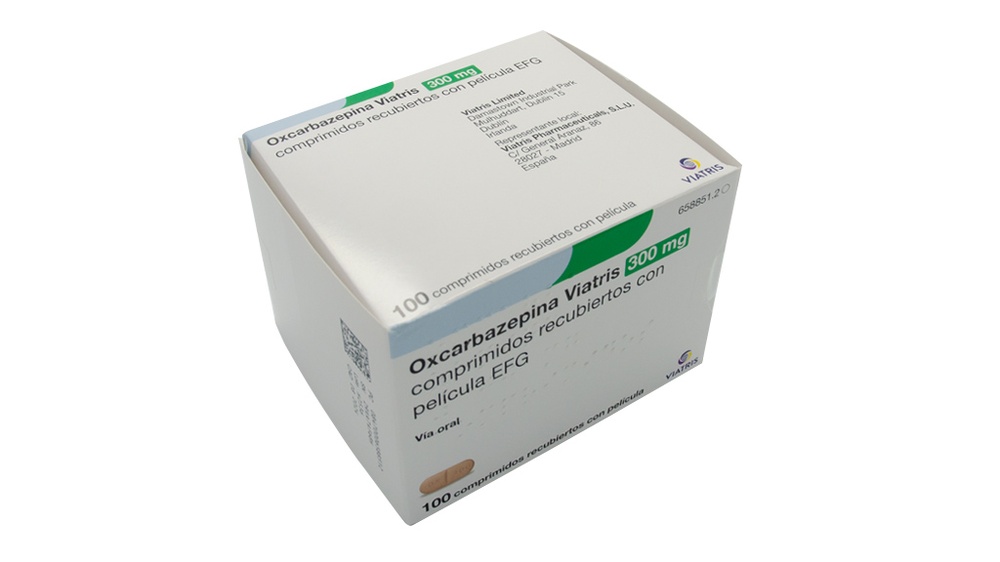
Oxcarbazepina Viatris 300 mg comprimidos recubiertos con película

Prescription review online
A doctor will review your case and decide whether a prescription is medically appropriate.

Talk to a doctor about this medicine
Discuss your symptoms and possible next steps in a quick online consultation.



How to use OXCARBAZEPINE VIATRIS 300 mg FILM-COATED TABLETS
Contents of the leaflet
- Introduction
- What is Oxcarbazepine Viatris and what is it used for
- What you need to know before you take Oxcarbazepine Viatris
- Tell your doctor if you are taking, have recently taken, or might take any other medicines, especially any of the following medicines, as they may interact with oxcarbazepine:
- -Other anticonvulsants such as phenobarbital, phenytoin, carbamazepine, lamotrigine, and valproic acid. Your doctor should adjust the dose of these medicines when taken together with oxcarbazepine. There is a higher risk of side effects such as nausea, drowsiness, dizziness, and headache if administered together with lamotrigine.
- -Hormonal contraceptives (for example, “the pill”). Oxcarbazepine may decrease the effectiveness of these contraceptives. Another reliable contraceptive method should be used.
- -Medicines for treating mental disorders such as lithium and monoamine oxidase inhibitors (MAOIs) such as phenelzine and moclobemide. The combination of lithium and oxcarbazepine may cause an increase in side effects.
- -Medicines that may decrease sodium levels in the blood (for example, diuretics, desmopressin, and non-steroidal anti-inflammatory drugs such as indomethacin and ibuprofen). Treatment with oxcarbazepine may decrease sodium levels in the blood, which can cause symptoms related to low sodium levels (see “Possible side effects”). Your doctor should perform blood tests before starting treatment with oxcarbazepine and at regular intervals once treatment has started.
- -Medicines used to control the body's immune system (immunosuppressants) such as cyclosporine and tacrolimus.
- How to take Oxcarbazepine Viatris
- Possible Adverse Effects
- Storage of Oxcarbazepine Viatris
- Package Contents and Additional Information
Introduction
Package Leaflet: Information for the Patient
Oxcarbazepine Viatris 300 mg film-coated tablets EFG
Read all of this leaflet carefully before you start taking this medicine because it contains important information for you.
- Keep this leaflet, you may need to read it again.
- If you have any further questions, ask your doctor or pharmacist.
- This medicine has been prescribed for you only. Do not pass it on to others. It may harm them, even if their signs of illness are the same as yours.
- If you get any side effects, talk to your doctor or pharmacist. This includes any possible side effects not listed in this leaflet. See section 4.
Contents of the pack
- What is Oxcarbazepine Viatris and what is it used for
- What you need to know before you take Oxcarbazepine Viatris
- How to take Oxcarbazepine Viatris
- Possible side effects
- Storing Oxcarbazepine Viatris
- Contents of the pack and further information
1. What is Oxcarbazepine Viatris and what is it used for
Oxcarbazepine Viatris contains the active substance oxcarbazepine. Oxcarbazepine Viatris belongs to a group of medicines called anticonvulsants or antiepileptics, which are used to treat epilepsy.
Oxcarbazepine is used to help control seizures or epileptic fits in patients who suffer from epilepsy. People with epilepsy are prone to having periods of uncontrolled electrical activity in the brain. These periods of uncontrolled electrical activity can cause seizures. Oxcarbazepine helps to control the electrical activity of the brain. This reduces the likelihood of having seizures.
Oxcarbazepine is used to treat partial seizures with or without secondary generalized tonic-clonic seizures. Partial seizures affect a limited area of the brain, but can spread throughout the brain and cause a generalized tonic-clonic seizure. There are two types of partial seizures: simple and complex. In simple partial seizures, the patient remains conscious, while in complex partial seizures, the patient's consciousness is altered.
Oxcarbazepine is used in adults and children from 6 years of age. Your doctor will usually try to find a single medicine that works best for you or your child. However, for more severe epilepsy, it may be necessary to combine two or more medicines to control seizures.
Oxcarbazepine Viatris can be used as a single medicine or with other antiepileptic medicines.

Not sure if this medicine is right for you?
Discuss your symptoms and treatment with a doctor online.
2. What you need to know before you take Oxcarbazepine Viatris
Follow carefully all instructions given to you by your doctor, even if they differ from those in this leaflet.
Do not take Oxcarbazepine Viatris:
- If you are allergic to oxcarbazepine, eslicarbazepine or any of the other ingredients of this medicine (listed in section 6).
Warnings and precautions
Tell your doctor or pharmacist before you start taking Oxcarbazepine Viatris:
- If you are allergic(for example, you have developed a rash or other allergic reactions) to carbamazepine, a similar anticonvulsant, as there is a possibility of one in four (25%) that you are also allergic to oxcarbazepine.
- If you have liver problems or if they appear during treatment (see “Possible side effects”).
- If you have kidney problems, especially problems associated with low sodium levels in the blood. Oxcarbazepine may decrease sodium levels in the blood, which can cause symptoms related to low sodium levels (see “Possible side effects”). If you have kidney disease, your doctor should perform a blood test before starting treatment with oxcarbazepine and at regular intervals once treatment has started.
- If you are taking other medicines that may decrease sodium levels in the blood (for example, diuretics, desmopressin, or non-steroidal anti-inflammatory drugs (NSAIDs) such as indomethacin or ibuprofen). See below “Taking Oxcarbazepine Viatris with other medicines”.
- If you have heart problems, such as heart failure (difficulty breathing or swollen ankles). Your doctor should regularly check your weight to determine possible fluid retention.
- If you have a heart rhythm disorder.
- If you are taking hormonal contraceptives (see below “Taking Oxcarbazepine Viatris with other medicines”).
During treatment
Tell your doctor if you notice possible symptoms of blood disorders such as fatigue, shortness of breath when exercising, paleness, headache, chills, dizziness, infections with fever, sore throat, mouth ulcers, bleeding or bruising more frequently than usual, nosebleeds, reddish or purplish spots, or spontaneous appearance of spots on the skin.
A certain number of patients treated with antiepileptics such as oxcarbazepine have experienced thoughts of self-harm or suicide. If at any time you experience any of these symptoms, contact your doctor immediately.
Potentially life-threatening skin rashes (Stevens-Johnson syndrome, toxic epidermal necrolysis) have been reported with the use of oxcarbazepine, initially appearing as reddish or circular spots, often with central blisters on the trunk.
Other signs to watch out for include mouth ulcers, throat ulcers, nose ulcers, genital ulcers, and conjunctivitis (red and swollen eyes). These potentially life-threatening skin rashes are often accompanied by flu-like symptoms. The rash can progress to blistering or peeling of the skin.
The greatest risk of serious skin reactions occurs in the first few weeks of treatment. The risk of these reactions is higher in patients of Chinese Han, Thai, or Asian origin (see below, “Patients of Chinese Han or Thai origin”).
If you have developed Stevens-Johnson syndrome or toxic epidermal necrolysis with the use of oxcarbazepine, you should not be re-treated with oxcarbazepine at any time.
If you develop a rash or these skin symptoms, consult your doctor immediately and inform them that you are taking this medicine.
This medicine may cause a condition called hypothyroidism (low thyroid hormone levels). In children, the doctor may perform blood tests at regular intervals after starting treatment with oxcarbazepine.
If you experience an increase in the frequency of seizures, talk to your doctor to decide whether to discontinue treatment with oxcarbazepine. This is especially important in children, although it can also occur in adults.
Before and during treatment with oxcarbazepine, your doctor may perform blood tests to determine the correct dose for you. Your doctor will tell you when to have these tests.
Patients of Chinese Han or Thai origin
In patients of Chinese Han or Thai origin, the risk of serious skin reactions associated with carbamazepine or chemically related compounds should be predicted by analyzing a blood sample from these patients. Your doctor will advise you if a blood test is necessary before taking oxcarbazepine. If you are of a different Asian origin (for example, Filipino or Malay), your doctor may also consider it necessary to perform a blood test before starting treatment.
Children and adolescents
In children, the doctor may recommend monitoring thyroid function before and during treatment.
Taking Oxcarbazepine Viatris with other medicines
Tell your doctor if you are taking, have recently taken, or might take any other medicines, especially any of the following medicines, as they may interact with oxcarbazepine:
-Other anticonvulsants such as phenobarbital, phenytoin, carbamazepine, lamotrigine, and valproic acid. Your doctor should adjust the dose of these medicines when taken together with oxcarbazepine. There is a higher risk of side effects such as nausea, drowsiness, dizziness, and headache if administered together with lamotrigine.
-Hormonal contraceptives (for example, “the pill”). Oxcarbazepine may decrease the effectiveness of these contraceptives. Another reliable contraceptive method should be used.
-Medicines for treating mental disorders such as lithium and monoamine oxidase inhibitors (MAOIs) such as phenelzine and moclobemide. The combination of lithium and oxcarbazepine may cause an increase in side effects.
-Medicines that may decrease sodium levels in the blood (for example, diuretics, desmopressin, and non-steroidal anti-inflammatory drugs such as indomethacin and ibuprofen). Treatment with oxcarbazepine may decrease sodium levels in the blood, which can cause symptoms related to low sodium levels (see “Possible side effects”). Your doctor should perform blood tests before starting treatment with oxcarbazepine and at regular intervals once treatment has started.
-Medicines used to control the body's immune system (immunosuppressants) such as cyclosporine and tacrolimus.
- Rifampicin (an antibiotic used to treat bacterial infections).
Taking Oxcarbazepine Viatris with alcohol
Caution is advised if you consume alcohol during treatment with oxcarbazepine, as it may cause drowsiness.
Pregnancy and breastfeeding
If you are pregnant or breastfeeding, think you may be pregnant, or plan to become pregnant, consult your doctor or pharmacist before using this medicine.
Pregnancy
Oxcarbazepine affects the effectiveness of hormonal contraceptives and there is a risk of pregnancy. You should use other contraceptive methods if you are of childbearing age.
It is essential to control seizures during pregnancy. However, taking antiepileptics during pregnancy can be hazardous to the fetus's development.
Congenital malformations
Studies have not shown an increased risk of congenital malformations associated with oxcarbazepine administered during pregnancy; however, it cannot be completely ruled out that there is a risk of congenital malformations in the fetus.
Neurodevelopmental disorders
Some studies have shown that exposure to oxcarbazepine in the womb affects the development of brain function (neurodevelopment) in children negatively, while in other studies, this effect has not been observed. The possibility that there is an effect on neurodevelopment cannot be ruled out.
Your doctor will inform you about the benefits and possible risks of using oxcarbazepine and will help you decide whether to take oxcarbazepine. Do not stop your treatment with oxcarbazepine during pregnancy without consulting your doctor first.
Breastfeeding
If you are taking this medicine, consult your doctor before starting breastfeeding. The active substance oxcarbazepine passes into breast milk. Although the available data suggest that the amount of oxcarbazepine that passes to the breastfed child is low, a risk of side effects in the baby cannot be ruled out. Your doctor will inform you about the benefits and potential risks of breastfeeding while using oxcarbazepine. If you are breastfeeding during treatment with oxcarbazepine and think your baby is experiencing any side effects such as excessive sleepiness or poor weight gain, inform your doctor immediately.
Driving and using machines
Oxcarbazepine has a moderate effect on the ability to drive and use machines. You should be aware that oxcarbazepine can cause side effects such as dizziness, drowsiness, balance or coordination problems, eye problems such as double or blurred vision, low sodium levels in the blood that can cause muscle weakness, reduced consciousness, especially when starting treatment or increasing the dose, which can affect your ability to drive or use machines. Do not drive or operate tools or machines if you experience any of these reactions.
Oxcarbazepine Viatriscontains lactose
This medicine contains lactose. If your doctor has told you that you have an intolerance to certain sugars, consult them before taking this medicine.
3. How to take Oxcarbazepine Viatris
Follow exactly the instructions for administration of this medicine given to you by your doctor. If you are unsure, consult your doctor or pharmacist.
When the required dose cannot be administered using whole tablets, other presentations containing oxcarbazepine are available.
Probably, your doctor will start your treatment with a small dose and, if necessary, will gradually increase it to suit your needs. The recommended doses are as follows:
Adults
The initial dose is 300 mg twice a day. If necessary, your doctor may gradually increase the dose weekly up to a maximum of 600 mg per day. The maintenance dose is 600 mg to 2,400 mg per day.
If you are taking other anticonvulsant medicines, your doctor should reduce their doses or increase the dose of oxcarbazepine more slowly.
When other anticonvulsant medicines are replaced by oxcarbazepine, their doses should be gradually reduced.
Use in children and adolescents from 6 years of age
The initial dose is 8-10 mg/kg body weight per day, divided into two doses per day. If necessary, your doctor may increase the daily dose by 10 mg/kg body weight at approximately weekly intervals up to a maximum daily dose of 46 mg/kg body weight per day.
The maintenance dose, combined with other anticonvulsant medicines, is usually 30 mg/kg per day.
For children who cannot swallow tablets or when the required dose cannot be administered using tablets, other presentations containing oxcarbazepine are available.
Use in children under 6 years of age
Oxcarbazepine is not recommended in patients under 6 years of age, as safety and efficacy have not been adequately demonstrated.
Patients with kidney problems
If you have kidney problems, your doctor may start treatment with half the usual initial dose and increase the dose of oxcarbazepine more slowly than indicated above.
Patients with severe liver problems
If you have severe liver problems, your doctor may adjust the amount you should take. Always follow your doctor's instructions.
When the required dose cannot be administered using tablets, other pharmaceutical forms containing oxcarbazepine are available.
Method of administration
Swallow the film-coated tablets with a glass of water, with or without food. Do not crush or chew them. The score line is only to facilitate breaking the tablet if you have difficulty swallowing it whole, but it cannot be divided into equal doses.
If you take more Oxcarbazepine Viatris than you should
If you have taken more Oxcarbazepine Viatris than you should, consult your doctor or pharmacist immediately or call the toxicology information service, phone 915620420, indicating the medicine and the amount taken; it is recommended to take the package and the package leaflet of the medicine to the healthcare professional. The symptoms of overdose are low sodium levels in the blood, anger, agitation, confusion, drowsiness, dizziness, nausea, vomiting, fatigue, changes in heart rhythm (irregular and rapid heartbeat), tremors, seizures or convulsions, headache, coma, loss of consciousness, palpitations or uncontrolled jerks, double or blurred vision, pupil constriction, low blood pressure, difficulty breathing, abnormal muscle activity or body, lack of coordination in movements, and uncontrolled eye movements.
If you forget to take Oxcarbazepine Viatris
Take the dose as soon as you remember. However, if it is almost time for your next dose, do not take the missed dose and take your next dose as prescribed. Do not take a double dose to make up for missed doses.
If you stop taking Oxcarbazepine Viatris
Do not stop treatment with oxcarbazepine suddenly without consulting your doctor, as it may cause the appearance of a seizure and/or convulsions. If you stop treatment, you should do it gradually following your doctor's instructions.
If you have any further questions about the use of this medicine, ask your doctor or pharmacist.

Started taking the medicine and have questions?
Discuss your symptoms and treatment with a doctor online.
4. Possible Adverse Effects
Like all medicines, this medicine can cause adverse effects, although not all people suffer from them.
Go to your doctor or go to the emergency department of the nearest hospital if you experience any of these serious adverse effects, they may require medical treatment:
Uncommon(may affect up to 1 in 100 people):
- Increased number of infections that can cause fever, severe chills, sore throat, or ulcers in the mouth (could be a sign that the number of white blood cells has decreased).
- Weight gain, fatigue, hair loss, muscle weakness, feeling of cold (signs of low thyroid gland activity).
- Falls.
Rare(may affect up to 1 in 1,000 people)
- Swelling of the face, lips, eyelids, tongue, throat, or mouth, difficulty speaking, swallowing, and sudden signs of urticaria associated with breathing difficulties, shortness of breath, wheezing (signs of angioedema and anaphylactic reactions)
- Skin rash and/or fever that can be manifestations of drug reaction with eosinophilia and systemic symptoms (DRESS), and acute generalized exanthematous pustulosis (AGEP).
- Fatigue, shortness of breath when exercising, paleness, headache, dizziness, frequent infections with fever, bleeding or bruising more often than usual, nosebleeds, red or purple spots or spontaneous appearance of spots on the skin (signs of a decrease in the number of platelets or a decrease in the number of blood cells).
- Lethargy, confusion, muscle pain, or significant worsening of seizures (these can be symptoms of low sodium levels due to inadequate ADH secretion) (see section "Warnings and Precautions").
Very Rare(may affect up to 1 in 10,000 people):
- Potentially fatal skin rashes, such as blisters on the skin or mucous membranes of the lips, eyes, mouth, nasal passages, or genitals, and skin peeling over a large area of the body surface (signs of severe allergic reaction, including Lyell syndrome, Stevens-Johnson syndrome, toxic epidermal necrolysis) (see section 2, "Warnings and Precautions").
- Irregular red spots (wet) causing itching, similar to measles rash, starting on the extremities and sometimes on the face and the rest of the body. The spots can become blisters or can progress to raised, red marks with a pale center. Affected people may suffer from fever, sore throat, headache, and/or diarrhea (erythema multiforme).
If these skin reactions occur during treatment with oxcarbazepine, you should stop taking oxcarbazepine. Your doctor may decide to withdraw treatment with oxcarbazepine.
- Hypersensitivity reactions that can also affect other parts of the body and can cause problems in the lungs (such as difficulty breathing or coughing, which may be accompanied by mucus or blood), kidneys (difficulty urinating or blood in the urine), or liver (signs of liver problems are described below, however, these can also lead to brain inflammation, causing changes in the way you think or act, or drowsiness). Other effects that can be observed are: changes in blood (described separately in this prospectus), spleen enlargement (causing inflammation and pain or sensitivity in the abdomen), or inflamed and painful lymph nodes in the neck, armpits, or groin.
- Skin rash, mainly on the face, which can be accompanied by fatigue, fever, feeling of dizziness (nausea), or loss of appetite (systemic lupus erythematosus).
- Bleeding or bruising more easily than usual (thrombocytopenia).
- Signs of liver inflammation (nausea, vomiting, loss of appetite, feeling of general discomfort, fever, itching, yellowing of the skin or whites of the eyes (jaundice), light-colored stools, dark-colored urine). Your liver function should be monitored.
- Pancreatitis, which includes the following signs: severe pain in the upper abdomen that extends to the back, often with nausea or vomiting.
- Cardiac disorder that can cause instability, fainting, and irregular heartbeat (atrioventricular block).
Tell your doctor as soon as possible if you have any of the following adverse effects,you may need medical attention:
Common(may affect up to 1 in 10 people):
- Tremors; coordination problems; involuntary eye movements; anxiety and nervousness; depression; mood changes; skin rash.
Rare(may affect up to 1 in 10,000 people):
- Irregular heartbeats or a very fast or slow heart rate.
Other adverse effects that may occur:
They are usually mild or moderate adverse effects of Oxcarbazepine. Most of these effects are transient and tend to decrease over time.
Very Common(may affect more than 1 in 10 people):
- Fatigue, headache, feeling of dizziness, exhaustion, or drowsiness, feeling of discomfort (nausea), discomfort (vomiting), double vision.
Common(may affect up to 1 in 10 people):
- Feeling of weakness; memory loss/changes; difficulty concentrating; lack of emotion or motivation (apathy); agitation or other mood changes; confusion; blurred vision; diarrhea or constipation, stomach pain (abdominal); acne, hair loss, loss of coordination; weight gain, speech disorder.
Uncommon(may affect up to 1 in 100 people):
- High blood pressure; urticaria
- you may also have elevated liver enzyme levels while taking oxcarbazepine.
Rare(may affect up to 1 in 1,000 people):
- bone disorders, including osteopenia and osteoporosis (bone weakening) and fractures, have been reported. Consult your doctor or pharmacist if you have been taking antiepileptics for a long time, have a history of osteoporosis, or are taking steroids.
Reporting Adverse Effects
If you experience any type of adverse effect, consult your doctor or pharmacist, even if it is a possible adverse effect that is not listed in this prospectus. You can also report them directly through the Spanish Pharmacovigilance System for Human Use Medicines: https://www.notificaram.es. By reporting adverse effects, you can contribute to providing more information on the safety of this medicine.
5. Storage of Oxcarbazepine Viatris
Keep this medicine out of the sight and reach of children.
Do not use this medicine after the expiration date that appears on the packaging, blister pack, or carton. The expiration date is the last day of the month indicated.
Do not store above 30°C.
Medicines should not be disposed of through wastewater or household waste. Deposit the packaging and medicines you no longer need at the SIGRE collection point in your pharmacy. If in doubt, ask your pharmacist how to dispose of the packaging and medicines you no longer need. This will help protect the environment.
6. Package Contents and Additional Information
Composition of Oxcarbazepine Viatris
- The active ingredient is oxcarbazepine. Each film-coated tablet contains 300 mg of oxcarbazepine.
- The other ingredients (excipients) are:
Core of the tablets: crospovidone, hypromellose, microcrystalline cellulose, anhydrous colloidal silica, and magnesium stearate.
Coating of the tablets: black iron oxide (E-172), red iron oxide (E-172), yellow iron oxide (E-172), hypromellose, lactose monohydrate (see section 2 "Oxcarbazepine Viatris contains lactose"), macrogol 4000, and titanium dioxide (E-171).
Appearance of the Product and Package Contents
Oxcarbazepine Viatris is presented in the form of film-coated, oblong tablets, beige in color with a score line on each side. The score line is only for breaking the tablet if you find it difficult to swallow it whole and not for dividing it into equal doses.
The 300 mg film-coated tablets are marked with "OX/300" on one side and "G/G" on the other side.
Oxcarbazepine Viatris is available in plastic containers of 100, 200, and 500 tablets and in blister packs of 10, 20, 30, 50, 60, 100, and 200 tablets.
Only some pack sizes may be marketed.
Oxcarbazepine Viatris is available in 300 mg and 600 mg film-coated tablets.
Marketing Authorization Holder and Manufacturer
Marketing Authorization Holder:
Viatris Limited
Damastown Industrial Park
Mulhuddart, Dublin 15
Dublin
Ireland
Manufacturer:
McDermott Laboratories Ltd. T/A Gerard Laboratories
35/36 Baldoyle Industrial Estate, Grange Road, Dublin 13
Ireland
or
Mylan B.V.
Krijgsman 20
1186 DM Amstelveen
Netherlands
or
Mylan Hungary Kft.
Mylan utca 1
Komárom, 2900
Hungary
You can request more information about this medicine by contacting the local representative of the marketing authorization holder:
Viatris Pharmaceuticals, S.L.U.
C/ General Aranaz, 86
28027 - Madrid
Spain
This medicine is authorized in the Member States of the European Economic Area under the following names:
Germany Oxcarbazepin dura 300 mg Filmtabletten
Belgium Oxcarbazepine Mylan 300 mg filmomhulde tabletten
Denmark Oxcarbazepin Mylan 300 mg filmovertrukne tabletter
Slovenia KARBOX 300 mg filmsko obložene tablete
Spain Oxcarbazepina Viatris 300 mg comprimidos recubiertos con película EFG
France OXCARBAZEPINE MYLAN 300 mg, comprimé pelliculé
Netherlands Oxcarbazepine Mylan 300 mg, filmomhulde tabletten
Poland Karbagen, 300 mg, tabletki powlekane
United Kingdom Oxcarbazepine Mylan 300 mg film-coated tablets
Date of the last revision of this prospectus:August 2025
Detailed and updated information on this medicine is available on the website of the Spanish Agency for Medicines and Health Products (AEMPS) https://www.aemps.gob.es/
- Country of registration
- Dosage formTABLET, 300 mg
- ATC codeN03AF02
- Average pharmacy price22.06 EUR
- Active substance
- Prescription requiredYes
- Manufacturer
- CompositionLACTOSA MONOHIDRATO (1,2300 mg mg), LACTOSA MONOHIDRATO (1,2300 mg mg)
- This information is for reference only and does not constitute medical advice. Always consult a doctor before taking any medication. Oladoctor is not responsible for medical decisions based on this content.
- Alternatives to OXCARBAZEPINE VIATRIS 300 mg FILM-COATED TABLETSDosage form: TABLET, 300 mgActive substance: oxcarbazepineManufacturer: Laboratorios Cinfa S.A.Prescription requiredDosage form: TABLET, 600 mgActive substance: oxcarbazepineManufacturer: Laboratorios Cinfa S.A.Prescription requiredDosage form: TABLET, 300 mgActive substance: oxcarbazepineManufacturer: Laboratorios Normon S.A.Prescription required
Online doctors for OXCARBAZEPINE VIATRIS 300 mg FILM-COATED TABLETS
Discuss questions about OXCARBAZEPINE VIATRIS 300 mg FILM-COATED TABLETS, including use, safety considerations and prescription review, subject to medical assessment and local regulations.



Frequently Asked Questions
OXCARBAZEPINE VIATRIS 300 mg FILM-COATED TABLETS requires a prescription in Spain. You can check with a doctor online whether this medicine may be appropriate for your situation.
The active ingredient in OXCARBAZEPINE VIATRIS 300 mg FILM-COATED TABLETS is oxcarbazepine. This information helps identify medicines with the same composition but different brand names.
The average pharmacy price for OXCARBAZEPINE VIATRIS 300 mg FILM-COATED TABLETS is around 22.06 EUR. Prices may vary depending on the manufacturer and dosage form.
OXCARBAZEPINE VIATRIS 300 mg FILM-COATED TABLETS is manufactured by Viatris Limited. Pharmacy brands and packaging may differ depending on the distributor.
Doctors such as Family doctors, Psychiatrists, Dermatologists, Cardiologists, Endocrinologists, Gastroenterologists, Pulmonologists, Nephrologists, Rheumatologists, Hematologists, Infectious disease physicians, Allergists, Geriatricians, Paediatricians, Oncologists may assess whether OXCARBAZEPINE VIATRIS 300 mg FILM-COATED TABLETS is appropriate, depending on your situation and local regulations. You can book an online consultation to discuss your symptoms and possible next steps.
The prescription is issued by a doctor after assessing your health. In Spain, OXCARBAZEPINE VIATRIS 300 mg FILM-COATED TABLETS is then dispensed in pharmacies with that prescription. An online consultation does not guarantee that a prescription will be issued: the decision always rests with the doctor.
To request a review, you can use Oladoctor:
Other medicines with the same active substance (oxcarbazepine) include OXCARBAZEPINE CINFA 300 mg FILM-COATED TABLETS, OXCARBAZEPINE CINFA 600 mg FILM-COATED TABLETS, OXCARBAZEPINE NORMON 300 mg FILM-COATED TABLETS. These may have different brand names or formulations but contain the same therapeutic ingredient. Always consult a doctor before switching or starting a new medicine.
