


Ondansetron Braun 2 mg/ml injectable solution

Prescription review online
A doctor will review your case and decide whether a prescription is medically appropriate.

Talk to a doctor about this medicine
Discuss your symptoms and possible next steps in a quick online consultation.



How to use ONDANSETRON B. BRAUN 2 mg/ml INJECTABLE SOLUTION
Contents of the leaflet
- Introduction
- What is Ondansetron 2 mg/ml and what is it used for
- What you need to know before you use Ondansetron 2 mg/ml
- How to use Ondansetron 2 mg/ml
- Possible side effects
- Storage of Ondansetron 2 mg/ml
- Contents of the pack and other information
Introduction
Package Leaflet: Information for the User
Ondansetron B. Braun 2 mg/ml Solution for Injection EFG
Read all of this leaflet carefully before you start using this medicine because it contains important information for you.
- Keep this leaflet, you may need to read it again.
- If you have any further questions, ask your doctor or pharmacist.
- This medicine has been prescribed for you only. Do not pass it on to others. It may harm them, even if their signs of illness are the same as yours.
- If you get any side effects, talk to your doctor or pharmacist. This includes any possible side effects not listed in this leaflet. See section 4.
Contents of the Package Leaflet
- What is Ondansetron 2 mg/ml and what is it used for
- What you need to know before you use Ondansetron 2 mg/ml
- How to use Ondansetron 2 mg/ml
- Possible side effects
- Storage of Ondansetron 2 mg/ml
- Contents of the pack and other information
1. What is Ondansetron 2 mg/ml and what is it used for
Ondansetron 2 mg/ml belongs to a group of medicines called antiemetics, which act against nausea and vomiting. Some medical treatments with medicines for cancer treatment (chemotherapy) or radiation therapy can make you feel nauseous or vomit. You may also feel nauseous or vomit after surgical treatment.
Ondansetron 2 mg/ml can help reduce these effects:
In adults and in children from 6 months of age:
- To treat nausea and vomiting after cancer treatment.
In children from 1 month of age:
- To prevent and treat nausea and vomiting after surgery.

Not sure if this medicine is right for you?
Discuss your symptoms and treatment with a doctor online.
2. What you need to know before you use Ondansetron 2 mg/ml
Do not use Ondansetron 2 mg/ml(please inform your doctor)
- If you are allergic to ondansetron or any of the other ingredients of this medicine (listed in section 6).
- If you are receiving apomorphine (a medicine for the treatment of Parkinson's disease).
Warnings and precautions
Consult your doctor or pharmacist before starting to use Ondansetron 2 mg/ml.
Be particularly careful with this medicine:
- If you are allergic to other medicines for nausea and vomiting, because you may also develop an allergy to this medicine.
- If you have a blockage in the intestine or if you suffer from severe constipation. Ondansetron may increase the blockage or constipation.
- If you have received medicines that affect your heart.
- If you have had heart problems in the past.
- If you have problems with salt levels in your blood, such as potassium, sodium, or magnesium.
- If your heartbeat has an irregular rhythm (arrhythmia).
- If you are undergoing tonsillectomy.
- If your liver is not working properly.
If your child is receiving this medicine and is also receiving cancer medicines that affect the liver, your doctor should monitor your child's liver function.
Using Ondansetron 2 mg/ml with other medicines
Tell your doctor or pharmacist if you are using, have recently used, or might use any other medicines.
In particular, it is important that your doctor knows if you are taking:
- certain medicines for treating epilepsy (e.g., phenytoin, carbamazepine),
- an antibiotic called rifampicin,
- a powerful pain reliever called tramadol,
- medicines used to treat a depressed mood (such as fluoxetine, sertraline, duloxetine, venlafaxine),
- apomorphine (a medicine used to treat Parkinson's disease), as a pronounced drop in blood pressure and loss of consciousness have been reported with concomitant administration,
- medicines that affect your heart rhythm or heart, such as:
- anti-cancer medicines, such as anthracyclines (e.g., doxorubicin, daunorubicin, or trastuzumab),
- antibiotics (e.g., erythromycin, ketoconazole),
- beta-blockers (e.g., atenolol, timolol),
- anti-arrhythmics (such as amiodarone).
Pregnancy and breastfeeding
Ondansetron 2 mg/ml should not be used during the first trimester of pregnancy. This is because Ondansetron 2 mg/ml may slightly increase the risk of a baby being born with a cleft lip and/or cleft palate.
If you are already pregnant, think you may be pregnant, or are planning to have a baby, ask your doctor or pharmacist for advice before using Ondansetron 2 mg/ml.
If you are a woman of childbearing age, you are advised to use an effective method of birth control.
Ondansetron passes into breast milk in animals. Therefore, mothers who are receiving ondansetron should NOT breastfeed.
Driving and using machines
Ondansetron has no or negligible influence on the ability to drive and use machines.
Ondansetron 2 mg/ml contains sodium
This medicine contains 3.34 mg of sodium (the main component of cooking/table salt) per milliliter. This is equivalent to 0.2% of the maximum recommended daily intake of sodium for an adult.
3. How to use Ondansetron 2 mg/ml
Method of administration
Ondansetron 2 mg/ml is administered as an intravenous or intramuscular injection (into a vein or into a muscle) or, after dilution, as an intravenous infusion (over a longer period). It will usually be administered by a doctor or by nursing staff.
Dose
Your doctor will decide the correct dose of ondansetron therapy for you.
The dose depends on your medical treatment (chemotherapy or surgery), your liver function, and whether it is administered by injection or infusion.
In the case of chemotherapy or radiation therapy, the usual dose in adults is 8-32 mg of ondansetron per day. For the treatment of postoperative nausea and vomiting, a single dose of 4 mg of ondansetron is usually administered.
Use in children over 1 month of age and adolescents
The doctor will decide the dose on an individual basis.
Dose adjustment
Patient with liver insufficiency
In patients with liver problems, the dose must be adjusted to a maximum daily dose of 8 mg of ondansetron.
Patient with renal insufficiency or patient with impaired metabolism of sparteine and debrisoquine
No alteration of the daily dose or the frequency of dosing or the route of administration is required.
Elderly patient
65-74 years: the individual dosage regimen for adults should be followed.
>74 years: special dosage requirements apply. Your doctor is aware of them and will take the precaution of administering a lower amount of this medicine as the first dose. Additionally, this medicine will only be administered to you if it is diluted in another solution.
Duration of treatment
Your doctor will decide the duration of ondansetron therapy for you.
After intravenous administration of Ondansetron 2 mg/ml, therapy may be continued with other routes of administration.
If you use more Ondansetron 2 mg/ml than you should
Your doctor or nurse will administer this medicine to you or your child, so it is unlikely that you or your child will receive more than the prescribed amount. If you think you or your child have been given too much, tell your doctor or nurse.
Currently, very little is known about the effects of an overdose with ondansetron. In most patients, the symptoms were similar to those reported in patients who received the recommended doses of this medicine (see section "Possible side effects"). In some patients, the following effects were observed after an overdose: visual disturbances, severe constipation, low blood pressure, and loss of consciousness. In all cases, the symptoms disappeared completely.
This medicine may alter your heart rhythm, especially in the case of an overdose. In this case, your doctor should monitor your heartbeat afterwards.
There is no specific antidote for ondansetron; therefore, if an overdose is suspected, only the symptoms should be treated.
Tell your doctor if you experience any of these symptoms.
If you have any further questions on the use of this medicine, ask your doctor or pharmacist.

Started taking the medicine and have questions?
Discuss your symptoms and treatment with a doctor online.
4. Possible side effects
Like all medicines, this medicine can cause side effects, although not everybody gets them.
The following side effects may be serious. If you experience any of the following side effects, contact your doctor immediately, as you may need to stop using this medicine:
Uncommon (may affect up to 1 in 100 people):
- Chest pain, irregular heartbeat (arrhythmia that can be fatal in individual cases), and slow heartbeat (bradycardia).
Rare (may affect up to 1 in 1,000 people):
- Immediate allergic reactions, including life-threatening allergic reaction (anaphylaxis). These reactions can be: swelling of hands, feet, ankles, face, lips, mouth, or throat that cause difficulty swallowing or breathing. Additionally, rash or itching and hives.
Frequency not known (frequency cannot be estimated from the available data):
- Myocardial ischemia: signs include sudden chest pain or chest tightness.
Other side effects include:
Very common (may affect more than 1 in 10 people):
- Headache.
Common (may affect up to 1 in 10 people):
- Feelings of warmth or heat.
- Constipation.
- Local reactions at the injection site.
Uncommon (may affect up to 1 in 100 people):
- Disorders of involuntary movements, e.g., spasmodic movements of the eyeball, abnormal muscle contractions that can cause twisting or shaking body movements, convulsions (e.g., epileptic spasms).
- Low blood pressure (hypotension).
- Hiccup.
- Asymptomatic increases in liver function. In particular, these reactions were observed in patients with cancer treatments with cisplatin.
Rare (may affect up to 1 in 1,000 people):
- Dizziness during rapid intravenous administration.
- Transient changes in the electrocardiogram (instrumental measurement of electronic processes that normally occur when the heart beats) mainly after intravenous application of ondansetron (prolonged QTc interval that includes Torsade de Pointes).
- Transient visual disturbances (e.g., blurred vision during rapid intravenous administration.
- Hypersensitivity reactions around the injection site (e.g., skin rash, hives, itching) may occur, which sometimes extend along the vein in which the medicine is administered.
Very rare (may affect up to 1 in 10,000 people)
- Depression.
- In individual cases, transient blindness has been described in patients receiving chemotherapeutic agents, including cisplatin. Most reported cases resolved within 20 minutes.
Reporting of side effects
If you experience any side effects, talk to your doctor or pharmacist. This includes any possible side effects not listed in this leaflet. You can also report side effects directly via the Spanish Medicines and Healthcare Products Agency's website: https://www.notificaRAM.es. By reporting side effects, you can help provide more information on the safety of this medicine.
5. Storage of Ondansetron 2 mg/ml
Keep this medicine out of the sight and reach of children.
Do not use this medicine after the expiry date which is stated on the ampoule label and carton. The expiry date is the last day of the month stated.
Store the ampoules in the outer packaging to protect them from light.
Polyethylene (PEBD) ampoules: do not store above 25°C.
Glass ampoules: no special storage conditions are required.
Medicines should not be disposed of via wastewater or household waste. Ask your pharmacist how to dispose of medicines no longer required. This will help protect the environment.
6. Contents of the pack and other information
Composition of Ondansetron 2 mg/ml
The active substance is ondansetron.
Each 2 ml ampoule contains 4 mg of ondansetron.
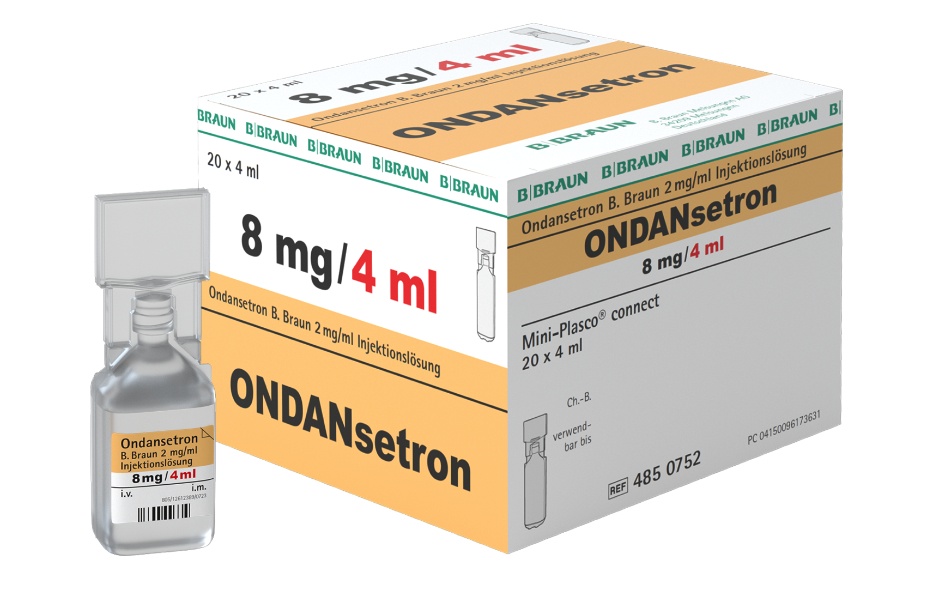
Each 4 ml ampoule contains 8 mg of ondansetron.
Each milliliter contains 2 mg of ondansetron as ondansetron hydrochloride dihydrate.
The other ingredients are sodium chloride, sodium citrate dihydrate, citric acid monohydrate, and water for injections.
Appearance and packaging
Ondansetron 2 mg/ml is a clear and colorless solution. It is available in:
- Colorless glass ampoules containing 2 ml or 4 ml of solution for injection.
Package sizes: 5 and 10 ampoules.
- Plastic ampoules containing 4 ml of solution for injection.
Package size: 20 ampoules.
Not all pack sizes may be marketed.
Marketing authorization holder and manufacturer
- Braun Melsungen AG
Carl-Braun-Strasse 1
34212 Melsungen
Germany
Mailing address:
34209 Melsungen
Germany
This medicine is authorized in the Member States of the European Economic Area under the following names:
Germany | Ondansetron B. Braun 2 mg/ml Injektionslösung |
Austria | Ondansetron B. Braun 2 mg/ml, Injektionslösung |
Belgium | Ondansetron B. Braun 2 mg/ml oplossing voor injectie |
Denmark | Ondansetron B. Braun 2 mg/ml injektionsvæske, opløsning |
Spain | Ondansetrón B. Braun 2 mg/ml solución inyectable EFG |
Finland | Ondansetron B. Braun 2 mg/ml injektioneste, liuos |
Italy | Ondansetron B. Braun 2 mg/ml soluzione iniettabile o per infusione |
Luxembourg | Ondansetron B. Braun 2 mg/ml, Injektionslösung |
Netherlands | Ondansetron B. Braun 2 mg/ml, oplossing voor injectie |
Poland | Ondansetron B. Braun 2 mg/ml roztwór do wstrzykiwan |
Czech Republic | Ondansetron B. Braun 2 mg/ml injekcní roztok |
Slovakia | Ondansetron B. Braun 2 mg/ml injekcný roztok |
Sweden | Ondansetron B. Braun 2 mg/ml injektionsvätska, lösning |
Date of last revision of this leaflet:04/2022
Detailed information on this medicine is available on the website of the Spanish Agency for Medicines and Healthcare Products (AEMPS) http://www.aemps.gob.es
--------------------------------------------------------------------------------------------------------------------
This information is intended only for healthcare professionals:
Prolongation of the QT interval
Rarely and predominantly with intravenous Ondansetron, transient changes in the ECG have been described, including prolongation of the QT interval. Additionally, cases of Torsade de pointes have been described in patients using ondansetron. Caution is advised in patients who have or may develop prolongation of the QTc interval. These disorders include patients with electrolyte imbalances, with congenital long QT syndrome, or patients who are taking other medicines that lead to prolongation of the QT interval. Therefore, caution is advised in patients with conduction or rhythm disorders, in patients treated with anti-arrhythmics or beta-adrenergic blockers, and in patients with significant electrolyte disturbances.
Serotonin syndrome
Pharmacovigilance reports have been received describing patients with serotonin syndrome (including altered mental status, autonomic instability, and neuromuscular abnormalities) after concomitant use of ondansetron and other serotonergic medicines (including selective serotonin reuptake inhibitors (SSRIs) and serotonin-norepinephrine reuptake inhibitors (SNRIs)). If concomitant treatment with ondansetron and other serotonergic medicines is clinically justified, appropriate observation of the patient is recommended.
- Country of registration
- Dosage formINJECTABLE, 8 mg
- ATC codeA04AA01
- Active substance
- Prescription requiredYes
- Manufacturer
- CompositionCLORURO DE SODIO (8,3 mg mg), CITRATO DE SODIO (E-331) (0,33 mg mg)
- This information is for reference only and does not constitute medical advice. Always consult a doctor before taking any medication. Oladoctor is not responsible for medical decisions based on this content.
- Alternatives to ONDANSETRON B. BRAUN 2 mg/ml INJECTABLE SOLUTIONDosage form: INJECTABLE, 2 mg/mLActive substance: ondansetronManufacturer: Accord Healthcare S.L.U.Prescription requiredDosage form: ORALLY DISINTEGRATING TABLET/LIOTAB, 4 mgActive substance: ondansetronManufacturer: Aristo Pharma Iberia S.L.Prescription requiredDosage form: ORALLY DISINTEGRATING TABLET/LIOTAB, 8 mgActive substance: ondansetronManufacturer: Aristo Pharma Iberia S.L.Prescription required
Online doctors for ONDANSETRON B. BRAUN 2 mg/ml INJECTABLE SOLUTION
Discuss questions about ONDANSETRON B. BRAUN 2 mg/ml INJECTABLE SOLUTION, including use, safety considerations and prescription review, subject to medical assessment and local regulations.









Frequently Asked Questions
ONDANSETRON B. BRAUN 2 mg/ml INJECTABLE SOLUTION requires a prescription in Spain. You can check with a doctor online whether this medicine may be appropriate for your situation.
The active ingredient in ONDANSETRON B. BRAUN 2 mg/ml INJECTABLE SOLUTION is ondansetron. This information helps identify medicines with the same composition but different brand names.
ONDANSETRON B. BRAUN 2 mg/ml INJECTABLE SOLUTION is manufactured by B. Braun Melsungen Ag. Pharmacy brands and packaging may differ depending on the distributor.
Doctors such as Family doctors, Psychiatrists, Dermatologists, Cardiologists, Endocrinologists, Gastroenterologists, Pulmonologists, Nephrologists, Rheumatologists, Hematologists, Infectious disease physicians, Allergists, Geriatricians, Paediatricians, Oncologists may assess whether ONDANSETRON B. BRAUN 2 mg/ml INJECTABLE SOLUTION is appropriate, depending on your situation and local regulations. You can book an online consultation to discuss your symptoms and possible next steps.
The prescription is issued by a doctor after assessing your health. In Spain, ONDANSETRON B. BRAUN 2 mg/ml INJECTABLE SOLUTION is then dispensed in pharmacies with that prescription. An online consultation does not guarantee that a prescription will be issued: the decision always rests with the doctor.
To request a review, you can use Oladoctor:
Other medicines with the same active substance (ondansetron) include ONDANSETRON ACCORD 2 mg/ml INJECTABLE SOLUTION, ONDANSETRON ARISTO 4 mg ORALLY DISINTEGRATING TABLETS, ONDANSETRON ARISTO 8 mg ORALLY DISINTEGRATING TABLETS. These may have different brand names or formulations but contain the same therapeutic ingredient. Always consult a doctor before switching or starting a new medicine.
