


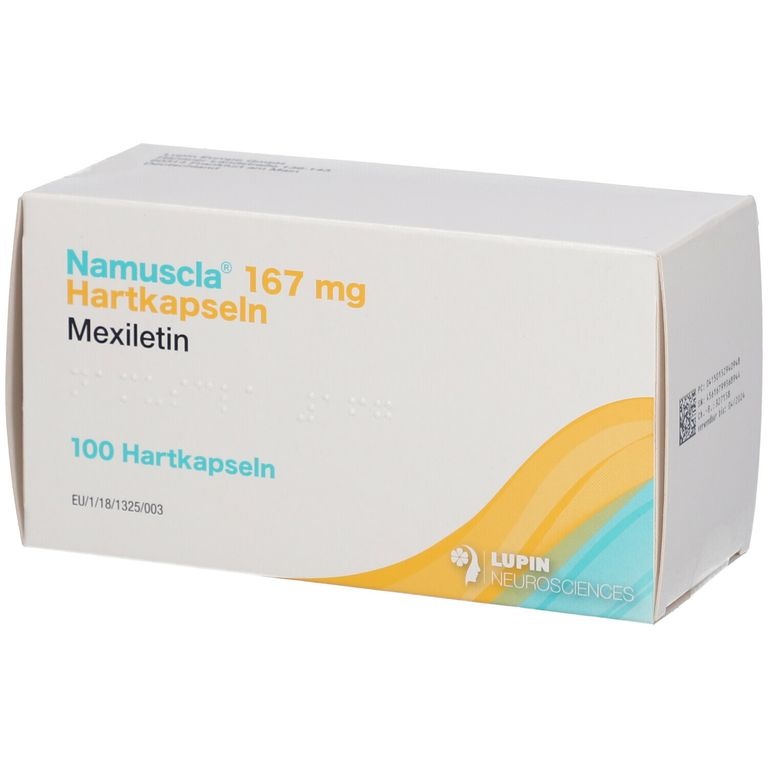
Namuscla 167 mg cápsulas duras

Prescription review online
A doctor will review your case and decide whether a prescription is medically appropriate.

Talk to a doctor about this medicine
Discuss your symptoms and possible next steps in a quick online consultation.



How to use NAMUSCLA 167 mg HARD CAPSULES
Contents of the leaflet
- Introduction
- What is Namuscla and what is it used for
- What you need to know before you take Namuscla
- How to take Namuscla
- Possible side effects
- Storage of Namuscla
- Contents of the pack and further information
Introduction
Package Leaflet: Information for the Patient
Namuscla 167 mg Hard Capsules
mexiletine
Read all of this leaflet carefully before you start taking this medicine because it contains important information for you.
- Keep this leaflet, you may need to read it again.
- If you have any further questions, ask your doctor or pharmacist.
- This medicine has been prescribed for you only. Do not pass it on to others. It may harm them, even if their signs of illness are the same as yours.
- If you get any side effects, talk to your doctor or pharmacist. This includes any possible side effects not listed in this leaflet. See section 4.
There is a Information Cardthat is supplied with Namuscla, to remind you and healthcare professionals of the risk of cardiac arrhythmias. Read the Information Card together with this leaflet and carry the card with you at all times.
Contents of the pack
- What is Namuscla and what is it used for
- What you need to know before you take Namuscla
- How to take Namuscla
- Possible side effects
- Storage of Namuscla
- Contents of the pack and further information
1. What is Namuscla and what is it used for
Namuscla is a medicine that contains the active substance mexiletine.
Namuscla is used to treat the symptoms of myotonia (when muscles relax slowly and with difficulty after use) in adults with non-dystrophic myotonic disorders, caused by genetic effects that affect muscle function.

Not sure if this medicine is right for you?
Discuss your symptoms and treatment with a doctor online.
2. What you need to know before you take Namuscla
Do not take Namuscla
- if you are allergic to mexiletine or any of the other ingredients of this medicine (listed in section 6)
- if you are allergic to any local anaesthetic
- if you have had a heart attack
- if your heart is not working well enough
- if you have certain heart rhythm disorders
- if your heart beats too fast
- if you have damaged heart blood vessels
- if you are also taking certain medicines for heart rhythm disorders (see Other medicines and Namuscla)
- if you are also taking certain medicines that have a narrow therapeutic index (see Other medicines and Namuscla).
If in doubt, ask your doctor or pharmacist.
Warnings and precautions
Tell your doctor, pharmacist or nurse before you start taking Namuscla if you have:
- heart problems
- liver problems
- kidney problems
- low or high potassium levels
- low magnesium levels
- epilepsy
Heart function
Before you start treatment with Namuscla, you will have tests to check your heart function, including an ECG (electrocardiogram). These tests will also be carried out regularly during treatment with Namuscla, and before and after any change in your Namuscla dose. The frequency of these tests depends on your heart function.
If you or your doctor notice any change in your heart rhythm or any of the conditions listed in the section “Do not take Namuscla”, your doctor will stop your treatment with Namuscla.
If you notice changes in your heart rate (if it beats faster or slower), if you feel fluttering or pain in your chest, if you have difficulty breathing, if you feel dizzy, if you sweat or faint, you must contact an emergency centre immediately.
Some patients may have higher blood levels of Namuscla due to slower breakdown in the liver and it may be necessary to adjust the dose accordingly.
Children and adolescents
Namuscla must not be used in children and adolescents under 18 years.
Other medicines and Namuscla
Tell your doctor or pharmacist if you are taking, have recently taken or might take any other medicines.
Do not take Namuscla with certain medicines for treating heart rhythm disorders (quinidine, procainamide, disopyramide, ajmaline, encainide, flecainide, propafenone, moricizine, amiodarone, sotalol, ibutilide, dofetilide, dronedarone, vernakalant). See the section “Do not take Namuscla”. Taking Namuscla with any of these medicines increases the risk of a serious heart rhythm disorder called torsades de pointes.
Do not take Namuscla with certain medicines that have a narrow therapeutic index (medicines where small differences in dose or blood concentration can have an impact on the effect of the medicine or its side effects). Examples of such medicines are digoxin (for heart problems), lithium (mood stabiliser), phenytoin (for treating epilepsy), theophylline (for asthma) and warfarin (for blood clots).
Tell your doctor or pharmacist if you are taking any of the following medicines, as they may affect or be affected by Namuscla:
- medicines for heart problems (lidocaine, tocainide, propranolol, esmolol, metoprolol, atenolol, carvedilol, bisoprolol, nebivolol, verapamil, diltiazem),
- certain other medicines:
or timolol for treating glaucoma (high pressure in the eye),
or certain antibiotics (ciprofloxacin, rifampicin),
or certain antidepressants (fluvoxamine),
or tizanidine (used to relax muscles),
or metformin (used for diabetes),
or omeprazole (for stomach ulcers and acid reflux).
Tobacco and Namuscla
Tell your doctor or pharmacist if you start or stop smoking while taking Namuscla, as smoking affects blood levels of Namuscla and it may be necessary to adjust your dose accordingly.
Using Namuscla with drinks
It is recommended to reduce caffeine intake by half during treatment with mexiletine, as this medicine can increase caffeine levels in the blood.
Pregnancy and breast-feeding
If you are pregnant or breast-feeding, think you may be pregnant or are planning to have a baby, ask your doctor for advice before taking this medicine. If you become pregnant while taking Namuscla, see your doctor immediately, as it is preferable not to take Namuscla during pregnancy. If you become pregnant while taking Namuscla, see your doctor immediately.
Mexiletine passes into breast milk. You should discuss this with your doctor and decide together whether to stop breast-feeding or stop/reduce treatment with mexiletine.
Driving and using machines
Namuscla may rarely cause tiredness, confusion and blurred vision: if you experience these effects, do not drive, cycle or use machines.
3. How to take Namuscla
Always take this medicine exactly as your doctor or pharmacist has told you. If you are not sure, check with your doctor or pharmacist.
The recommended initial dose is 1 capsule per day. Your doctor will gradually increase the dose depending on how well the medicine is working. The maintenance dose is 1 to 3 capsules per day, taken at regular intervals throughout the day.
Do not take more than 3 capsules per day.
Checking heart function
Before you start treatment with Namuscla and at regular intervals during treatment, you will have tests to check your heart function. Depending on how well your heart is working, you may also need tests before and after any change in your Namuscla dose. See the section “Warnings and precautions”. Your doctor will also regularly review your treatment to ensure that Namuscla remains the best medicine for you.
Method of administration
Namuscla is for oral use.
Swallow the capsule with a glass of water while standing or sitting. You can take Namuscla during a meal to avoid stomach upset (see the section “Possible side effects”).
If you take more Namuscla than you should
If you have taken more Namuscla than the recommended dose, contact your doctor. It can be very harmful to your health. You or your partner should contact your doctor immediately if you feel tingling in your arms and legs, if you cannot think clearly or concentrate, if you have hallucinations or convulsions, if you notice that your heart beats slower, if you feel dizzy or faint, if you lose consciousness or if your heart stops beating.
If you forget to take Namuscla
If you have missed a dose, do not take a double dose and take the next dose as usual.
If you have any further questions on the use of this medicine, ask your doctor or pharmacist.

Started taking the medicine and have questions?
Discuss your symptoms and treatment with a doctor online.
4. Possible side effects
Like all medicines, this medicine can cause side effects, although not everybody gets them.
The most serious side effects are:
Contact your doctor or go to your nearest emergency centre immediatelyif you experience any of the following side effects:
- severe allergic reaction to mexiletine (with symptoms such as severe skin rash and fever); this is a very rare side effect, may affect up to 1 in 10,000 people.
- heart rhythm disorders, see the section “Warnings and precautions” for symptoms and more information; this is a common side effect, may affect up to 1 in 10 people.
Other side effects that may occur:
Very common side effects (may affect more than 1 in 10 people):
- abdominal pain (in the abdomen)
- insomnia (difficulty sleeping)
Common side effects (may affect up to 1 in 10 people):
- drowsiness
- headache
- tingling in arms and legs
- blurred vision
- dizziness (feeling of losing balance)
- fast heart rate
- flushing
- low blood pressure (which can cause dizziness or fainting)
- nausea
- acne
- pain in arms and legs
- fatigue
- weakness
- chest discomfort
- general malaise (feeling of general discomfort and illness)
Uncommon side effects (may affect up to 1 in 100 people):
- seizures (fits)
- speech disorders
- slow heart rate
Rare side effects (may affect up to 1 in 1,000 people):
- abnormal liver function (observed after a blood test)
Very rare side effects (may affect up to 1 in 10,000 people):
- liver damage, including inflammation (hepatitis)
- severe reaction to the medicine (with skin rash and fever)
Frequency not known (cannot be estimated from the available data)
- decrease in white blood cell or platelet count
- lupus syndrome (disease of the immune system)
- redness and skin peeling
- Stevens-Johnson syndrome: severe allergic reaction with skin rash, often in the form of blisters and ulcers in the mouth and eyes and on other mucous membranes
- blisters on the skin, general malaise, fever in the context of a condition called DRESS
- hallucinations (seeing or hearing something that is not real)
- transient confusion (temporary inability to think clearly or concentrate)
- double vision
- altered sense of taste
- heart rhythm disorders
- loss of consciousness
- flushing
- pulmonary fibrosis (lung disease)
- diarrhoea
- vomiting
- oesophageal injury (tube that carries food)
Reporting of side effects
If you get any side effects, talk to your doctor or pharmacist. This includes any possible side effects not listed in this leaflet. You can also report side effects directly via the national reporting system listed in Appendix V. By reporting side effects, you can help provide more information on the safety of this medicine.
5. Storage of Namuscla
Keep this medicine out of the sight and reach of children.
Do not use this medicine after the expiry date which is stated on the carton and blister after EXP. The expiry date refers to the last day of the month stated.
Store below 30°C. Store in the original package to protect from moisture.
Medicines should not be disposed of via wastewater or household waste. Ask your pharmacist how to dispose of medicines no longer required. These measures will help protect the environment.
6. Contents of the pack and further information
Composition of Namuscla
Each hard capsule contains:
- mexiletine hydrochloride equivalent to 166.62 mg of mexiletine (active substance)
- other ingredients (maize starch, colloidal anhydrous silica, magnesium stearate, gelatin, iron oxide (E 172) and titanium dioxide (E 171)).
Appearance of Namuscla and contents of the pack
Namuscla capsules are hard gelatin capsules of reddish colour filled with white powder. Namuscla is available in blister packs containing 30, 50, 100 or 200 capsules.
Not all pack sizes may be marketed.
Marketing authorisation holder
Lupin Europe GmbH
Hanauer Landstraße 139-143,
60314 Frankfurt am Main
Germany
Manufacturer
Hormosan Pharma GmbH
Hanauer Landstraße 139-143,
60314 Frankfurt am Main
Germany
Lupin Healthcare (UK) Ltd
The Urban Building, second floor, 3-9 Albert Street
SL1 2BE Slough, Berkshire,
United Kingdom
Etablissement Pharmaceutique de l’AP-HP (Assistance Publique-Hôpitaux de Paris) AGEPS
11-13 rue Lavoisier,
92000 Nanterre, France
Etablissement Pharmaceutique de l’AP-HP (Assistance Publique-Hôpitaux de Paris) AGEPS
7 rue du Fer à Moulin,
75005 Paris, France
Date of last revision of this leaflet.
Detailed information on this medicine is available on the European Medicines Agency web site: http://www.ema.europa.eu/.
- Country of registration
- Dosage formCAPSULE, 167 mg
- ATC codeC01BB02
- Active substance
- Prescription requiredYes
- Manufacturer
- This information is for reference only and does not constitute medical advice. Always consult a doctor before taking any medication. Oladoctor is not responsible for medical decisions based on this content.
- Alternatives to NAMUSCLA 167 mg HARD CAPSULESDosage form: TABLET, 200 mgActive substance: amiodaroneManufacturer: Aurovitas Spain, S.A.U.Prescription requiredDosage form: INJECTABLE, 10 mg flecainide acetate/mlActive substance: flecainideManufacturer: Viatris Healthcare LimitedPrescription requiredDosage form: TABLET, 100 mg flecainide acetateActive substance: flecainideManufacturer: Viatris Healthcare LimitedPrescription required
Online doctors for NAMUSCLA 167 mg HARD CAPSULES
Discuss questions about NAMUSCLA 167 mg HARD CAPSULES, including use, safety considerations and prescription review, subject to medical assessment and local regulations.
Frequently Asked Questions
NAMUSCLA 167 mg HARD CAPSULES requires a prescription in Spain. You can check with a doctor online whether this medicine may be appropriate for your situation.
The active ingredient in NAMUSCLA 167 mg HARD CAPSULES is mexiletine. This information helps identify medicines with the same composition but different brand names.
NAMUSCLA 167 mg HARD CAPSULES is manufactured by Lupin Europe Gmbh. Pharmacy brands and packaging may differ depending on the distributor.
Doctors such as Family doctors, Psychiatrists, Dermatologists, Cardiologists, Endocrinologists, Gastroenterologists, Pulmonologists, Nephrologists, Rheumatologists, Hematologists, Infectious disease physicians, Allergists, Geriatricians, Paediatricians, Oncologists may assess whether NAMUSCLA 167 mg HARD CAPSULES is appropriate, depending on your situation and local regulations. You can book an online consultation to discuss your symptoms and possible next steps.
The prescription is issued by a doctor after assessing your health. In Spain, NAMUSCLA 167 mg HARD CAPSULES is then dispensed in pharmacies with that prescription. An online consultation does not guarantee that a prescription will be issued: the decision always rests with the doctor.
To request a review, you can use Oladoctor:
Other medicines with the same active substance (mexiletine) include AMIODARONE AUROVITAS 200 mg TABLETS, APOCARD 10 mg/ml INJECTABLE SOLUTION, APOCARD 100 mg TABLETS. These may have different brand names or formulations but contain the same therapeutic ingredient. Always consult a doctor before switching or starting a new medicine.
