


MINURIN 4 micrograms/ml injectable solution
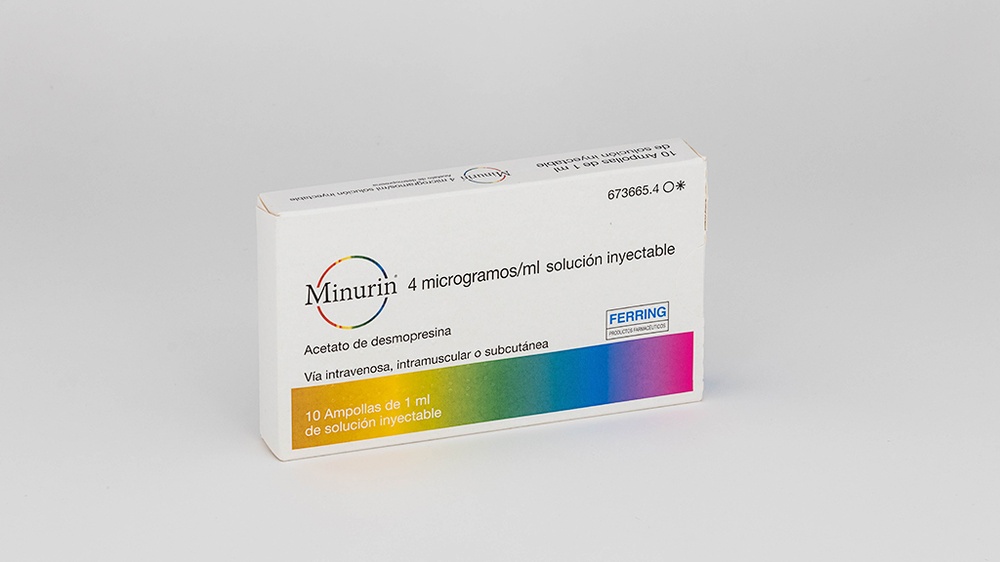



How to use MINURIN 4 micrograms/ml injectable solution
Translated with AI
This page provides general information and does not replace a doctor’s consultation. Always consult a doctor before taking any medication. Seek urgent medical care if symptoms are severe.
Show originalContents of the leaflet
Introduction
Package Leaflet: Information for the User
Minurin 4 micrograms/ml solution for injection
Desmopressin acetate
Read all of this leaflet carefully before you start using this medicine because it contains important information for you.
Keep this leaflet, you may need to read it again.
- Keep this leaflet, you may need to read it again.
- If you have any further questions, ask your doctor or pharmacist.
- This medicine has been prescribed for you only. Do not pass it on to others. It may harm them, even if their signs of illness are the same as yours.
- If you get any side effects, talk to your doctor or pharmacist. This includes any possible side effects not listed in this leaflet. See section 4.
Contents of the pack:
- What Minurin is and what it is used for.
- What you need to know before you use Minurin.
- How to use Minurin.
- Possible side effects.
- Storage of Minurin.
- Contents of the pack and other information.
1. What Minurin is and what it is used for
The active substance that makes Minurin work is desmopressin. Minurin belongs to a group of medicines called vasopressin and analogues. Desmopressin is a structural analogue of the natural hormone arginine-vasopressin that temporarily reduces the amount of urine produced by the body, with a rapid onset of action and prolonged duration.
It is used for the treatment of:
- Central Diabetes Insipidus.
- Diagnostic test of renal concentration capacity.
- Corrective and preventive treatment of hemorrhagic accidents observed in the following cases:
- Hemophilia A and von Willebrand disease (Type I, whose coagulant activity of factor VIII is above 5%).
- Maintenance of hemostasis before a surgical intervention.

2. What you need to know before you use Minurin
Do not use Minurin:
- if you are allergic to desmopressin or any of the other components of Minurin (listed in section 6).
- if you have excessive prolonged thirst or due to alcohol abuse.
- if you have heart problems or other pathologies that require treatment with diuretic agents.
- if you suffer from unstable angina, decompensated heart failure.
- if you have von Willebrand disease type IIB, hemophilia A, and von Willebrand disease type I whose coagulant activity of factor VIII is below 5%.
- in hemophilia B and hemophiliacs with anti-factor VIII antibodies.
Warnings and precautions
Consult your doctor or pharmacist before starting to use this medicine.
Special care should be taken to avoid water retention in the body and decreased sodium in the blood in the following cases:
- Very young or elderly patients,
- Medical problems that cause fluid and/or electrolyte imbalance
- Patients at risk of intracranial hypertension.
Special attention should be paid to the risk of fluid retention. Fluid intake should be restricted as much as possible and body weight should be monitored regularly. If used for diagnostic purposes, fluid intake should not exceed 0.5 liters from 1 hour before administration to 8 hours after administration.
If a gradual increase in body weight is observed, a decrease in serum sodium to a level below 130 mmol/l or a decrease in plasma osmolality below 270 mOsm/kg body weight, fluid intake should be drastically reduced and administration of the drug should be interrupted.
The test of renal concentration capacity should only be performed in children under 2 years of age under close medical supervision in a hospital.
In the treatment of hemorrhagic accidents, due to different individual responses, an efficacy test should be performed to verify the correction of bleeding time and, in the case of hemophilia, the elevation of factor VIII.
Special measures should be taken to prevent fluid overload in patients undergoing treatment with diuretic agents.
The patient's blood pressure should be monitored regularly.
Minurin does not reduce prolonged bleeding time in thrombocytopenia.
Interaction of Minurin with other medicines
Tell your doctor or pharmacist if you are using or have recently used other medicines, especially antidepressants, antidiabetics, or antiepileptics.
Pregnancy, breastfeeding, and fertility
If you are pregnant or breastfeeding, think you may be pregnant, or plan to become pregnant, consult your doctor or pharmacist before using this medicine.
Your doctor will carefully weigh the benefits and risks in case you become pregnant.
Breastfeeding
Desmopressin, although in small amounts, passes into breast milk, so if it needs to be administered to a breastfeeding woman, it is recommended to replace breastfeeding with formula feeding.
Driving and using machines
Minurin does not affect the ability to drive or use machines.
3. How to use Minurin
Follow the instructions for administration of Minurin 4 micrograms/ml solution for injection exactly as indicated by your doctor. In case of doubts, consult your doctor or pharmacist again.
Central diabetes insipidus:
When nasal administration (in nasal drops) is considered inadequate, the injectable solution is recommended. The dose is adjusted individually for each patient depending on urinary volume and serum sodium level.
The recommended dose of injectable solution is 0.25 ml to 1 ml (1-4 micrograms) once or twice a day in adults.
It should not be administered to children under 12 years of age since safety and efficacy have not been established.
In those patients who were initially administered the intranasal form and later the injectable form due to inadequate intranasal absorption or surgical intervention, the comparable antidiuretic dose of the injectable is approximately 10% of the intranasal dose.
Test of renal concentration capacity:
It is recommended to follow the administration schedule described below. The product will be injected intramuscularly or subcutaneously:
0.1 micrograms (0.025 ml) (weight <10 kg)< p>
0.2 micrograms (0.05 ml) (weight between 10 and 20 kg)
1 microgram (0.25 ml) (weight between 20 and 30 kg)
2 micrograms (0.5 ml) (weight between 30 and 50 kg)
4 micrograms (1 ml) (weight > 50 kg)
In children, it is recommended to use nasal drops first.
Hemophilia A and von Willebrand disease (Type I, whose coagulant activity of factor VIII is above 5%) - Maintenance of hemostasis before a surgical intervention:
Slow intravenous perfusion of 0.3 micrograms/kg body weight in adults and children over 10 kg body weight, diluted in 50-100 ml of physiological serum, over 15-30 minutes, is recommended. If a positive effect is obtained, the initial dose may be repeated 1 or 2 times at intervals of 6-12 hours. However, another repetition of the dose would produce a decrease in the effect.
The use in children requires special care to prevent the appearance of hyponatremia. It is not recommended for use in children under 3 months.
If you use more Minurin than you should
In case of overdose or accidental ingestion, contact your doctor or pharmacist immediately or call the Toxicology Information Service, phone 915 620 420, indicating the medicine and the amount ingested.
Overdose increases the risk of fluid retention and hyponatremia. Although the treatment of hyponatremia should be individualized, the following recommendations can be followed:
in asymptomatic hyponatremia, suspend treatment with desmopressin and restrict fluid intake. In symptomatic hyponatremia, infuse an isotonic or hypertonic sodium chloride solution (physiological serum). In cases of severe fluid retention (seizures or loss of consciousness), induce diuresis with furosemide.
If you have any further questions on the use of this product, ask your doctor or pharmacist.

4. Possible side effects
Like all medicines, Minurin can cause side effects, although not everybody gets them.
The following side effects are common(may affect up to 1 in 10 people):
- headache,
- stomach pain
- nausea.
- At high doses:
- fatigue,
- transient decrease in blood pressure, with reflex bradycardia and facial flushing at the time of administration.
The following side effects are uncommon(may affect up to 1 in 100 people)
- At high doses: dizziness.
Treatment without restricting fluid intake at the same time may lead to fluid retention accompanied by signs and symptoms (reduction of serum sodium, weight gain, and, in severe cases, seizures).
Reporting of side effects:
If you experience any side effects, talk to your doctor or pharmacist, even if it is possible side effects not listed in this leaflet. You can also report side effects directly through the Spanish Pharmacovigilance System for Human Use Medicines: https://www.notificaRAM.es. By reporting side effects, you can help provide more information on the safety of this medicine.
5. Storage of Minurin
Keep this medicine out of the sight and reach of children.
Store in a refrigerator (between 2°C and 8°C).
Do not use Minurin after the expiry date which is stated on the carton, after “EXP”. The expiry date is the last day of the month stated.
Medicines should not be disposed of via wastewater or household waste. Ask your pharmacist how to dispose of medicines no longer required. These measures will help protect the environment.
6. Contents of the pack and other information
Composition of Minurin 4 micrograms/ml solution for injection
- The active substance is desmopressin acetate. Each 1 ml of Minurin 4 micrograms/ml solution for injection contains 4 micrograms
- The other ingredients are: sodium chloride, hydrochloric acid, and water for injection.
Appearance and packaging of the product
Minurin 4 micrograms/ml solution for injection is presented in ampoules containing 1 ml of sterile solution of 4 micrograms of desmopressin acetate at a concentration of 4 micrograms/ml in water for injection.
The packs contain 10 ampoules.
Marketing authorization holder and manufacturer
Marketing authorization holder:
FERRING S.A.U
C/ del Arquitecto Sánchez Arcas nº3, 1º
28040 Madrid, Spain
Manufacturer:
FERRING GmbH
Wittland 11,
D-24109 Kiel
Germany
This leaflet was last revised in November 2017
Detailed and updated information on this medicine is available on the website of the Spanish Agency for Medicines and Health Products (AEMPS) http://www.aemps.gob.es/
- Country of registration
- Dosage formINJECTABLE, 4 µg/ml
- ATC codeH01BA02
- Average pharmacy price26.73 EUR
- Active substance
- Prescription requiredYes
- Manufacturer
- This information is for reference only and does not constitute medical advice. Always consult a doctor before taking any medication. Oladoctor is not responsible for medical decisions based on this content.
- Alternatives to MINURIN 4 micrograms/ml injectable solutionDosage form: ORAL SOLUTION/SUSPENSION, 360mcg/ml desmopressin (anhydrous base)Active substance: desmopressinManufacturer: Laboratorio Reig Jofre, S.A.Prescription requiredDosage form: SUBLINGUAL TABLET, 120 microgramsActive substance: desmopressinManufacturer: Aristo Pharma GmbhPrescription requiredDosage form: SUBLINGUAL TABLET, 240 microgramsActive substance: desmopressinManufacturer: Aristo Pharma GmbhPrescription required

Online doctors for MINURIN 4 micrograms/ml injectable solution
Discuss questions about MINURIN 4 micrograms/ml injectable solution, including use, safety considerations and prescription review, subject to medical assessment and local regulations.



Frequently Asked Questions
