



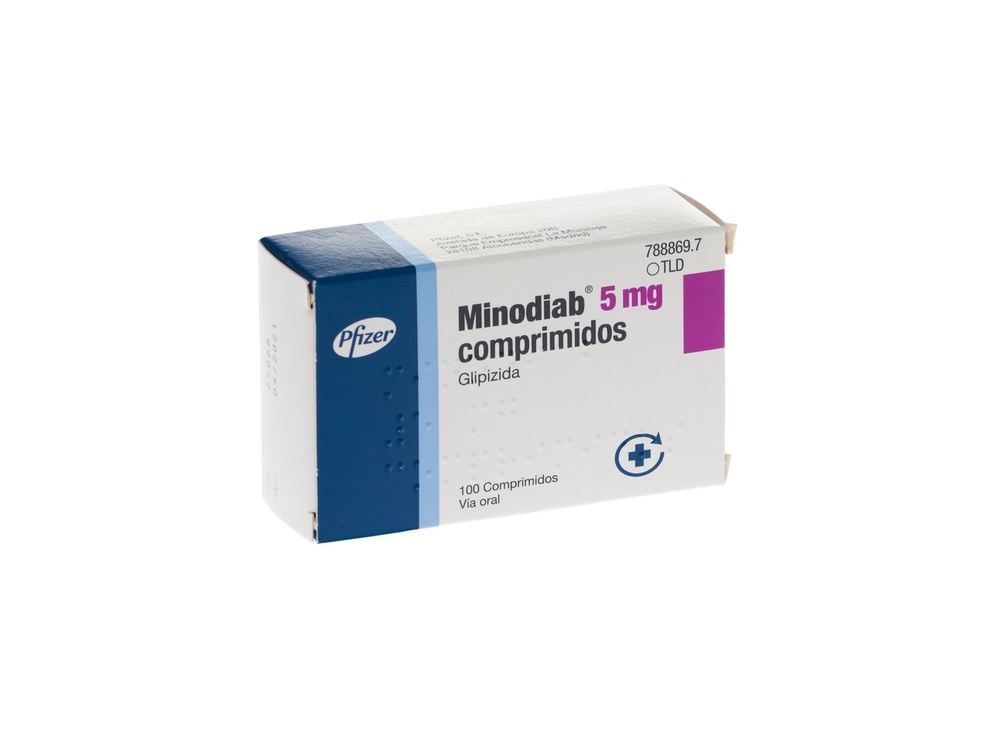
MINODIAB 5 mg Tablets

Prescription review online
A doctor will review your case and decide whether a prescription is medically appropriate.

Talk to a doctor about this medicine
Discuss your symptoms and possible next steps in a quick online consultation.



How to use MINODIAB 5 mg TABLETS
Contents of the leaflet
- Introduction
- What is Minodiab and what is it used for
- What you need to know before you take Minodiab
- How to take Minodiab
- Possible side effects
- Conservation of Minodiab
- Contents of the pack and further information
Introduction
Package Leaflet: Information for the Patient
Minodiab 5 mg Tablets
Glipizide
Read all of this leaflet carefully before you start taking this medicine, because it contains important information for you.
- Keep this leaflet, as you may need to read it again.
- If you have any further questions, ask your doctor or pharmacist.
- This medicine has been prescribed for you only. Do not pass it on to others. It may harm them, even if their symptoms are the same as yours.
- If you experience any side effects, talk to your doctor or pharmacist. This includes any possible side effects not listed in this leaflet. See section 4.
Contents of the Package Leaflet
- What is Minodiab and what is it used for
- What you need to know before you take Minodiab
- How to take Minodiab
- Possible side effects
5 Conservation of Minodiab
- Contents of the pack and further information
1. What is Minodiab and what is it used for
Minodiab is an oral antidiabetic medicine. It belongs to a family of medicines called sulfonylureas and acts by reducing blood sugar levels in adult patients with type 2 diabetes, when diet and physical exercise are not enough to control blood sugar levels.

Not sure if this medicine is right for you?
Discuss your symptoms and treatment with a doctor online.
2. What you need to know before you take Minodiab
Do not take Minodiab
- If you are allergic to glipizide or any of the other ingredients of this medicine (listed in section 6).
- If you have type 1 diabetes.
- If you have diabetic ketoacidosis (a condition with high blood sugar, high levels of ketones in the urine and blood, and increased acidity of the blood).
- If you are in a diabetic coma (reduced level of consciousness).
Warnings and precautions
Consult your doctor or pharmacist before taking Minodiab.
If you experience symptoms of low blood sugar (hypoglycemia) such as sweating, pallor, intense hunger, palpitations. In this case, and to feel better, you should take sugar or sugary drinks immediately.
- If you have any liver or kidney problems (liver or kidney failure), consult your doctor, as these problems may increase the risk of severe hypoglycemia.
- If you are elderly, debilitated, or do not follow a proper diet. These situations may increase the risk of hypoglycemia.
- If you engage in prolonged or intense physical exercise, the risk of hypoglycemia is higher.
- If you are going to undergo surgery, have an accident, or have an infection with fever, your blood sugar levels may increase (hyperglycemia). In these cases, consult your doctor, who may temporarily stop treatment and replace it with insulin.
- If you have been taking Minodiab for a long time, its effectiveness in reducing blood sugar levels may decrease. In this case, consult your doctor.
- If you have a deficiency of an enzyme called glucose-6-phosphate dehydrogenase, as it may cause a type of anemia characterized by the destruction of red blood cells (hemolytic anemia).
To determine your response to treatment, your doctor may require you to undergo various tests.
Taking Minodiab with other medicines
Tell your doctor or pharmacist if you are taking, have recently taken, or might take any other medicines.
Some medicines can lower blood sugar levels, others can raise them, and others can have both effects. In each case, it may be necessary to adjust the dose of Minodiab to avoid too low or too high blood sugar levels.
If you take Minodiab with the following medicines, hypoglycemia may occur:
- Medicines used to treat fungal infections (antifungals).
- Pain relievers (analgesics) or anti-inflammatory medicines, such as non-steroidal anti-inflammatory drugs (NSAIDs), like phenylbutazone and salicylates (e.g., acetylsalicylic acid).
- Medicines used to treat certain heart conditions or high blood pressure, such as ACE inhibitors and beta blockers.
- Medicines used to treat stomach ulcers or stomach discomfort (H2 antagonists).
- Medicines used to treat stomach acidity (antacids).
- Medicines used to treat depression or certain mental and emotional disorders (monoamine oxidase inhibitors, MAOIs).
- Antibiotics (quinolones).
If you take Minodiab with the following medicines, hyperglycemia may occur:
- Medicines used to treat certain mental and emotional disorders (phenothiazines).
- Corticosteroids (used to treat inflammatory conditions, excluding topical administration).
- Medicines that enhance the effects of the sympathetic nervous system (sympathomimetics, such as ritodrine, salbutamol, terbutaline).
- Diuretics.
- Medicines used to treat thyroid gland disorders.
- Oral contraceptives or female sex hormones used for birth control or to treat certain hormonal disorders in women (estrogens and progestogens).
- Medicines used to treat epilepsy (phenytoin).
- Nicotinic acid.
- Medicines used to treat tuberculosis (isoniazid).
- Medicines used to treat certain heart conditions or high blood pressure (calcium channel blockers).
Taking Minodiab with food, drinks, and alcohol
Minodiab should generally be taken 30 minutes before meals with a sufficient amount of water to ensure maximum control of blood sugar levels after meals (postprandial hyperglycemia). Never take Minodiab with alcohol, as it may cause a drop in blood sugar levels and lead to a hypoglycemic coma.
Pregnancy, breastfeeding, and fertility
If you are pregnant or breastfeeding, think you may be pregnant, or plan to become pregnant, consult your doctor or pharmacist before using this medicine.
In general, it is recommended to replace oral antidiabetics, including Minodiab, with insulin during pregnancy. Glipizide will only be used during pregnancy if your doctor considers it appropriate. Your doctor will inform you of the potential risks of taking Minodiab during pregnancy. If glipizide is used during pregnancy, treatment should be stopped at least one month before delivery, and other treatments will be administered to maintain blood sugar levels as close to normal as possible.
If you are breastfeeding, inform your doctor. Breastfeeding should be discontinued or treatment with glipizide should be interrupted during this period. Your doctor will assess the most suitable treatment for you.
Driving and using machines
Your ability to concentrate and react may be impaired due to symptoms caused by hypoglycemia or hyperglycemia, such as blurred vision.
This can be dangerous in situations where these skills are important (e.g., driving or using machines). Therefore, consult your doctor if it is recommended to drive or use machines.
Minodiab contains lactose
This medicine contains lactose. If your doctor has told you that you have an intolerance to certain sugars, consult them before taking this medicine.
3. How to take Minodiab
Follow the instructions for administration of this medicine exactly as indicated by your doctor. If in doubt, consult your doctor or pharmacist again.
Your doctor will determine the dose based on your condition, taking into account periodic blood sugar tests and response to treatment.
Minodiab should generally be taken 30 minutes before meals with a sufficient amount of water to ensure maximum control of blood sugar levels after meals (postprandial hyperglycemia). Never take Minodiab with alcohol.
The recommended initial dose is 5 mg/day, taken before breakfast or a meal.
Your doctor will adjust the dose gradually based on blood sugar test results.
Some patients may be adequately controlled with a single daily dose.
The maximum recommended dose in a single intake is 15 mg/day. If this dose is not sufficient, it may be effective to divide the 15 mg dose into two intakes (1.5 tablets in each intake). Doses above 15 mg should be divided into at least 2 intakes before meals.
The maximum recommended dose is 40 mg/day.
Your doctor will determine the dose based on your condition, taking into account periodic blood sugar tests and response to treatment.
Substitution or combination with other medicines for blood sugar control:
Minodiab can be used alone or in combination with other oral medicines or insulin for better control of blood sugar levels. Do not stop dietary measures or weight control and exercise guidelines indicated by your doctor when starting treatment with Minodiab.
When an oral antidiabetic or insulin treatment is replaced or combined with Minodiab, your doctor will adjust the doses to avoid a higher risk of hypoglycemia and may ask you to monitor your blood sugar levels more closely. Any change, substitution, or combination will be done under strict medical supervision.
Use in elderly patients and high-risk patients
Due to the higher risk of hypoglycemia, a dose adjustment may be necessary. The dose adjustment will be done gradually, taking into account blood sugar control, increasing the dose in a range of 2.5 to 5 mg of glipizide. Your doctor will determine the most suitable dose.
Use in patients with liver or kidney problems
Due to the higher risk of hypoglycemia, a dose adjustment may be necessary. It is recommended to adjust the initial and maintenance doses, starting treatment with 2.5 mg/day. Your doctor will determine the most suitable dose.
Use in children
The safety and efficacy of glipizide in children have not been established.
If you take more Minodiab than you should
If you take more Minodiab than you should, inform your doctor or pharmacist immediately. Overdose can lead to hypoglycemia.
In case of overdose or accidental ingestion, consult your doctor or pharmacist immediately or call the Toxicology Information Service, phone 91 562 04 20, indicating the medicine and the amount taken.
If you forget to take Minodiab
Do not take a double dose to make up for forgotten doses.
If you stop taking Minodiab
Do not stop taking Minodiab unless your doctor tells you to.
If you have any further questions on the use of this medicine, ask your doctor or pharmacist.

Started taking the medicine and have questions?
Discuss your symptoms and treatment with a doctor online.
4. Possible side effects
Like all medicines, this medicine can cause side effects, although not everybody gets them.
Common side effects (may affect up to 1 in 100 people) include:
- Hypoglycemia.
- Nausea, diarrhea, pain in the upper abdomen, abdominal pain.
Uncommon side effects (may affect up to 1 in 1,000 people) include:
- Dizziness, drowsiness, tremors.
- Blurred vision.
- Vomiting.
- Yellowing of the skin due to bile duct disorders (cholestatic jaundice).
- Eczema (skin redness).
Rare side effects (cannot be estimated from the available data) include:
- Decrease in a type of white blood cell called neutrophils and total white blood cell count (agranulocytosis and leucopenia), decrease in platelet count (thrombocytopenia), decrease in red blood cell count due to massive destruction of these cells (hemolytic anemia), decrease in blood cell elements (pancytopenia).
- Decrease in sodium levels in the blood (hyponatremia).
- Confusion.
- Headache.
- Double vision (diplopia), vision changes, decreased visual acuity.
- Constipation.
- Abnormal liver function, liver inflammation (hepatitis).
- Allergic skin reaction (allergic dermatitis), skin redness (erythema), flat red skin rash (morbilliform rash), flat or raised skin redness (maculopapular rash), hives, itching, skin reactions caused by light exposure (photosensitivity reaction).
- A disease known as non-acute porphyria.
- General malaise.
- Increased liver enzymes, such as AST, and other substances in the blood, LDH, alkaline phosphatase, urea, and creatinine.
With other sulfonylureas (medicines of the same family as Minodiab), cases of bone marrow failure to produce all types of blood cells (aplastic anemia) and disulfiram-like reactions have been reported when taken with alcohol, including symptoms such as facial flushing, headache, tachycardia, nausea, and/or difficulty breathing.
Reporting of side effects
If you experience any side effects, talk to your doctor, pharmacist, or nurse. This includes any possible side effects not listed in this leaflet. You can also report side effects directly to the Spanish Medicines and Healthcare Products Agency (AEMPS) through the website: https://www.notificaram.es. By reporting side effects, you can help provide more information on the safety of this medicine.
5. Conservation of Minodiab
Keep this medicine out of the sight and reach of children.
No special storage conditions are required.
Do not use this medicine after the expiry date stated on the outer packaging after (EXP). The expiry date is the last day of the month indicated.
Do not use this medicine if you notice visible signs of deterioration. Do not use any packaging that is damaged or open.
Medicines should not be disposed of via wastewater or household waste. Place the packaging and any unused medicines in the SIGRE collection point at the pharmacy. If in doubt, ask your pharmacist how to dispose of the packaging and any unused medicines. This will help protect the environment.
6. Contents of the pack and further information
Composition of Minodiab
- The active substance is glipizide.
- The other ingredients (excipients) are lactose monohydrate, microcrystalline cellulose, cornstarch, and stearic acid.
Appearance of the product and pack contents
Minodiab 5 mg tablets are presented as white, round, convex, and scored on both sides. The tablet can be divided into two equal halves.
Marketing authorization holder and manufacturer
Marketing authorization holder:
Pfizer, S.L.
Avda. de Europa, 20 B
Parque Empresarial La Moraleja
28108 Alcobendas (Madrid)
Manufacturer:
Pfizer Italia S.r.l.
Via del Commercio, Zona Industriale,
63046 Marino de Tronto (Ascoli Piceno)
Italy
Date of the last revision of this leaflet:10/2016
Detailed and updated information on this medicine is available on the website of the Spanish Agency for Medicines and Healthcare Products (AEMPS) http://www.aemps.gob.es/
- Country of registration
- Dosage formTABLET, 5 mg
- ATC codeA10BB07
- Average pharmacy price3.45 EUR
- Active substance
- Prescription requiredYes
- Manufacturer
- CompositionLACTOSA (153 mg mg)
- This information is for reference only and does not constitute medical advice. Always consult a doctor before taking any medication. Oladoctor is not responsible for medical decisions based on this content.
- Alternatives to MINODIAB 5 mg TABLETSDosage form: TABLET, 2 mgActive substance: glimepirideManufacturer: Sanofi Aventis S.A.Prescription requiredDosage form: TABLET, 4 mgActive substance: glimepirideManufacturer: Sanofi Aventis S.A.Prescription requiredDosage form: ORAL SOLUTION/SUSPENSION, 0.6 mg/mlActive substance: glibenclamideManufacturer: AmmtekPrescription required
Online doctors for MINODIAB 5 mg TABLETS
Discuss questions about MINODIAB 5 mg TABLETS, including use, safety considerations and prescription review, subject to medical assessment and local regulations.

Get MINODIAB 5 mg TABLETS Prescription Online
Fill in a 2-min form
Tell us your symptoms, history, and what medicine you're requesting.
Pick a doctor or let us assign
Choose a specialist or we'll match you with the next available doctor.
Doctor reviews your case
Usually within 30 minutes. They may ask follow-up questions via chat.
Collect from any pharmacy
Electronic prescription sent to your email — valid across Spain.
Frequently Asked Questions
MINODIAB 5 mg TABLETS requires a prescription in Spain. You can check with a doctor online whether this medicine may be appropriate for your situation.
The active ingredient in MINODIAB 5 mg TABLETS is glipizide. This information helps identify medicines with the same composition but different brand names.
The average pharmacy price for MINODIAB 5 mg TABLETS is around 3.45 EUR. Prices may vary depending on the manufacturer and dosage form.
MINODIAB 5 mg TABLETS is manufactured by Pfizer S.L.. Pharmacy brands and packaging may differ depending on the distributor.
Doctors such as Family doctors, Psychiatrists, Dermatologists, Cardiologists, Endocrinologists, Gastroenterologists, Pulmonologists, Nephrologists, Rheumatologists, Hematologists, Infectious disease physicians, Allergists, Geriatricians, Paediatricians, Oncologists may assess whether MINODIAB 5 mg TABLETS is appropriate, depending on your situation and local regulations. You can book an online consultation to discuss your symptoms and possible next steps.
Spain has a well-developed healthcare infrastructure across major cities such as Madrid, Barcelona, Valencia, and Seville. Pharmacies are widely available and operate under strict regulations, ensuring access to prescribed medications.
You can buy MINODIAB 5 mg TABLETS in Madrid, Barcelona, Seville, or Valencia at any local pharmacy with a valid prescription.
To obtain a prescription, you can use Oladoctor:
Other medicines with the same active substance (glipizide) include AMARYL 2 mg TABLETS, AMARYL 4 mg TABLETS, AMGLIDIA 0.6 mg/ml ORAL SUSPENSION. These may have different brand names or formulations but contain the same therapeutic ingredient. Always consult a doctor before switching or starting a new medicine.
