



MENAVEN 1000 IU/G GEL

Prescription review online
A doctor will review your case and decide whether a prescription is medically appropriate.

Talk to a doctor about this medicine
Discuss your symptoms and possible next steps in a quick online consultation.



How to use MENAVEN 1000 IU/G GEL
Contents of the leaflet
- Introduction
- What is Menaven and what is it used for
- What you need to know before using Menaven
- How to Use Menaven
- Possible Side Effects
- Storage of Menaven
- Package Contents and Additional Information
Introduction
Package Leaflet: Information for the User
Menaven 1000 IU/g Gel
Sodium Heparin
Read this package leaflet carefully before you start using this medicine, because it contains important information for you.
Follow exactly the administration instructions of the medicine contained in this package leaflet or as indicated by your doctor or pharmacist.
- Keep this package leaflet, you may need to read it again.
- If you need advice or more information, consult your pharmacist.
- If you experience side effects, consult your doctor or pharmacist even if it is a side effect not listed in this package leaflet. See section 4.
- You should consult a doctor if it worsens or does not improve after 5 days.
Contents of the Package Leaflet
- What is Menaven and what is it used for
- What you need to know before using Menaven
- How to use Menaven
- Possible side effects
- Storage of Menaven
- Package Contents and Additional Information
1. What is Menaven and what is it used for
This medicine is a gel for skin use that contains sodium heparin as the active ingredient.
Menaven is indicated for the local symptomatic relief in adults of superficial venous disorders, such as heaviness and tightness of the legs with varices, and superficial hematomas caused by blows.

Not sure if this medicine is right for you?
Discuss your symptoms and treatment with a doctor online.
2. What you need to know before using Menaven
Do not use Menaven:
- if you are allergic to sodium heparin or any of the other components of this medicine (listed in section 6).
- on mucous membranes, ulcers, and open or infected wounds
Warnings and Precautions
Consult your doctor or pharmacist before starting to use Menaven.
- Avoid contact with the eyes.
- Use only on intact skin
- In case of venous problems of thrombotic origin (such as thromboembolism), it is recommended to apply the product gently and without massage.
- Do not use for a long time or on very large areas of the skin. In prolonged treatments, sensitization phenomena may appear.
- Caution is required in patients with hemorrhagic manifestations or significant alterations of the mechanisms to stop a hemorrhage (hemostasis), or even, at the doctor's discretion, its use should be avoided in these cases.
- Evaluate the clinical situation if the patient suffers from any other condition, is allergic, or is using any other medicine.
- Due to the low absorption of the drug locally, it is unlikely that the adverse reactions typical of the systemic effect (inside the body) of the drug will be observed; however, caution is required in patients with severe hypertension, gastroduodenal ulcer, and hemorrhagic disorders, congenital or acquired, such as hemophilia, thrombocytopenia, and some vascular purpuras, since the risk of hemorrhage is greater.
- The use during menstruation increases the risk of hemorrhage.
Children and Adolescents
Its use is not recommended in children and adolescents as its efficacy and safety have not been established in these populations.
Other Medicines and Menaven
Tell your doctor or pharmacist if you are using, have recently used, or may need to use any other medicine.
Although with Menaven it is not foreseeable the risk of interaction given the low absorption of the active ingredient in the administration route of the medicine, it is described in the bibliography that drugs that affect platelet function such as non-steroidal anti-inflammatory drugs (NSAIDs), dextran, dipyridamole, etc. should be administered with caution in patients who receive heparin as they may interact pharmacologically increasing the risk of hemorrhages.
In turn, other medicines such as nitroglycerin and cardiac glycosides (for heart diseases), nicotine, quinine (for heart arrhythmias), and tetracyclines (antibiotics) may interfere with the anticoagulant effect of heparin.
For heparin by topical route, there are no data on interference with laboratory tests.
It is not recommended to apply other skin preparations to the same area without consulting your doctor.
Pregnancy and Breastfeeding
If you are pregnant or breastfeeding, think you may be pregnant, or plan to become pregnant, consult your doctor or pharmacist before using this medicine.
Heparin does not cross the placenta or distribute in breast milk. Nevertheless, since studies on the administration of heparin during pregnancy and breastfeeding have not been conducted, Menaven should only be administered in these cases when strictly necessary and after consulting your doctor.
Driving and Using Machines
The influence of Menaven on the ability to drive and use machines is nil or insignificant.
Menaven 1000 IU/g Gel contains methyl parahydroxybenzoate (E 218), propyl parahydroxybenzoate (E216), lavender essence, and alcohol (ethanol).
It may cause allergic reactions (possibly delayed) because it contains methyl parahydroxybenzoate (E 218) and propyl parahydroxybenzoate (E216).
This medicine contains lavender essence with amylcinnamaldehyde, citral, eugenol, hydroxycitronellal, coumarin, geraniol, farnesol, linalool, citronellol, D-limonene, which may cause allergic reactions.
This medicine contains 227.3 mg of alcohol (ethanol) in each gram of gel.
It may cause a burning sensation on damaged skin.
3. How to Use Menaven
Follow exactly the administration instructions of the medicine contained in this package leaflet or as indicated by your doctor or pharmacist. In case of doubt, ask your doctor or pharmacist.
Topical use (on the skin).
The recommended dose is one to three applications a day on the affected area, applying 3 to 10 cm of gel depending on the area to be treated, followed by a gentle massage.
After application, wash your hands unless they are the treatment area.
If symptoms persist for more than 5 days, or irritation or worsening occurs, you should consult a doctor.
If you use more Menaven than you should
Since this medicine is for topical use, it is unlikely that intoxication will occur. It is unlikely that overdose cases will occur due to the low systemic absorption of sodium heparin applied topically.
In the event of overdosing by topical route, signs of skin irritation or local reactions on the skin may appear.
In cases of overdose or accidental ingestion of large amounts of Menaven, consult your doctor or pharmacist immediately, or go to a medical center or call the Toxicology Information Service, phone: 91 562 04 20, indicating the medicine and the amount ingested.
Accidental ingestion of large amounts of Menaven, due to its ethanol content, may cause symptoms of acute alcohol intoxication.
If you forget to use Menaven
Do not use a double dose to make up for forgotten doses.
You should continue treatment normally without taking any particular action.
If you have any other doubts about the use of this medicine, ask your doctor or pharmacist.

Started taking the medicine and have questions?
Discuss your symptoms and treatment with a doctor online.
4. Possible Side Effects
Like all medicines, this medicine can cause side effects, although not everybody gets them.
The adverse reactions most frequently presented with Menaven are: contact dermatitis, local irritation, local allergic phenomena, and itching (pruritus).
Less frequently, the appearance of skin redness (erythema), dryness of the skin, burning sensation, feeling of cold, and skin rashes (urticaria) has been described.
Very rarely, the possibility of necrosis in the application area has been described.
Due to the low absorption of the active ingredient of Menaven by topical route, it is not expected that the adverse reactions typical of the systemic effect of the drug will occur.
Although it is not expected to have an effect of the drug at the internal level (systemic), maintain special caution when administering it to patients at risk of hemorrhages (see section 2).
Reporting of Side Effects
If you experience any type of side effect, consult your doctor or pharmacist even if it is a possible side effect not listed in this package leaflet. You can also report them directly through the Spanish Medicines and Health Products Agency: https://www.notificaRAM.es. By reporting side effects, you can contribute to providing more information on the safety of this medicine.
5. Storage of Menaven
Keep this medicine out of the sight and reach of children.
No special storage conditions are required.
Do not use this medicine after the expiry date stated on the carton and tube after EXP. The expiry date is the last day of the month indicated.
Medicines should not be disposed of via wastewater or household waste. Deposit the packaging and medicines that you no longer need in the SIGRE collection point at your pharmacy. If in doubt, consult your pharmacist how to dispose of the packaging and medicines that you no longer need. This will help protect the environment.
6. Package Contents and Additional Information
Composition of Menaven 1000 IU/g Gel
- The active ingredient is sodium heparin. Each gram of gel contains 1000 IU of sodium heparin (equivalent to 5.56 mg)
- The other components (excipients) are methyl parahydroxybenzoate (E218), propyl parahydroxybenzoate (E216), carbomer, ethanol 96%, tromethamine, lavender essence, and purified water.
Appearance of the Product and Package Contents
Menaven 1000 IU/g Gel is a transparent gel with a lavender odor.
It is presented in aluminum tubes of 60 g of gel.
Marketing Authorization Holder and Manufacturer
LABORATORIOS MENARINI, S.A.
Alfons XII, 587 – 08918 Badalona (Barcelona) Spain
- +34 934 628 800
You can request more information about this medicine by contacting the local representative of the marketing authorization holder:
Menarini Consumer Healthcare, S.A.U.
Guifré, 724 – 08918 Badalona (Barcelona) Spain
Date of the Last Revision of this Package Leaflet:June 2020.
Other Sources of Information
Detailed information about this medicine is available on the website of the Spanish Agency for Medicines and Health Products (AEMPS) http://www.aemps.gob.es/
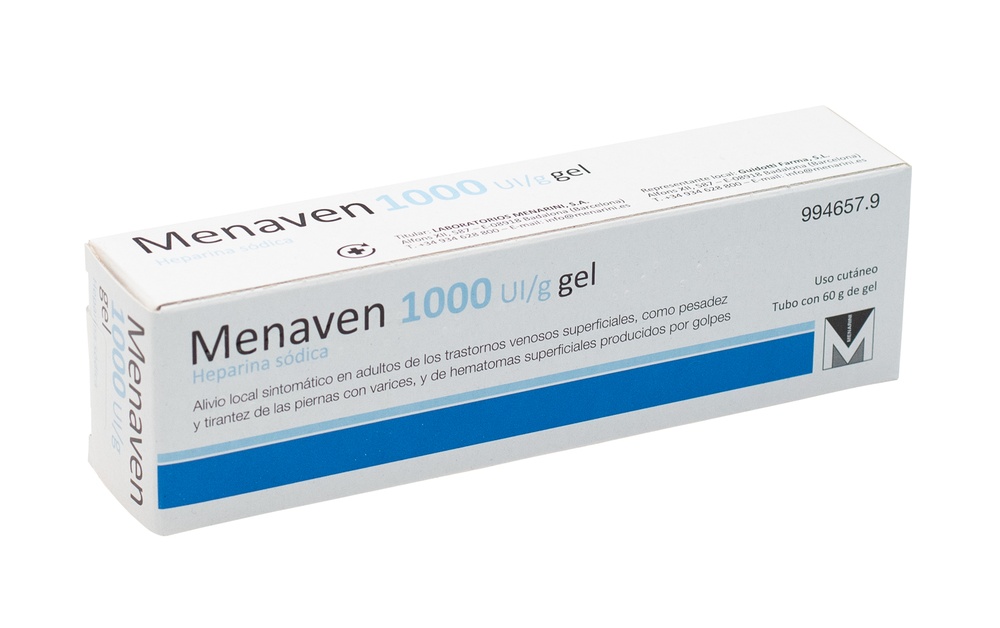
- Country of registration
- Dosage formGEL, 1000 IU
- ATC codeC05BA03
- Active substance
- Prescription requiredNo
- Manufacturer
- CompositionALCOHOL ETILICO (ETANOL) (0,3 ml mg), PARAHIDROXIBENZOATO DE METILO (E-218) (1,2 mg mg), PARAHIDROXIBENZOATO DE PROPILO (0,3 mg mg)
- This information is for reference only and does not constitute medical advice. Always consult a doctor before taking any medication. Oladoctor is not responsible for medical decisions based on this content.
- Alternatives to MENAVEN 1000 IU/G GELDosage form: Ointment, 1 kilo UIActive substance: heparinManufacturer: Laboratorios Menarini S.A.Prescription not requiredDosage form: GEL, 3 mg/gActive substance: organo-heparinoidManufacturer: Laboratorio Stada S.L.Prescription not requiredDosage form: OINTMENT, 3 mg/gActive substance: organo-heparinoidManufacturer: Laboratorio Stada S.L.Prescription not required
Online doctors for MENAVEN 1000 IU/G GEL
Discuss questions about MENAVEN 1000 IU/G GEL, including use, safety considerations and prescription review, subject to medical assessment and local regulations.









Get MENAVEN 1000 IU/G GEL Prescription Online
Fill in a 2-min form
Tell us your symptoms, history, and what medicine you're requesting.
Pick a doctor or let us assign
Choose a specialist or we'll match you with the next available doctor.
Doctor reviews your case
Usually within 30 minutes. They may ask follow-up questions via chat.
Collect from any pharmacy
Electronic prescription sent to your email — valid across Spain.
Frequently Asked Questions
MENAVEN 1000 IU/G GEL does not require a prescription in Spain. You can check with a doctor online whether this medicine may be appropriate for your situation.
The active ingredient in MENAVEN 1000 IU/G GEL is heparin. This information helps identify medicines with the same composition but different brand names.
MENAVEN 1000 IU/G GEL is manufactured by Laboratorios Menarini S.A.. Pharmacy brands and packaging may differ depending on the distributor.
Doctors such as Family doctors, Psychiatrists, Dermatologists, Cardiologists, Endocrinologists, Gastroenterologists, Pulmonologists, Nephrologists, Rheumatologists, Hematologists, Infectious disease physicians, Allergists, Geriatricians, Paediatricians, Oncologists may assess whether MENAVEN 1000 IU/G GEL is appropriate, depending on your situation and local regulations. You can book an online consultation to discuss your symptoms and possible next steps.
Spain has a well-developed healthcare infrastructure across major cities such as Madrid, Barcelona, Valencia, and Seville. Pharmacies are widely available and operate under strict regulations, ensuring access to prescribed medications.
You can buy MENAVEN 1000 IU/G GEL in Madrid, Barcelona, Seville, or Valencia at any local pharmacy with a valid prescription.
To obtain a prescription, you can use Oladoctor:
Other medicines with the same active substance (heparin) include Menaven 1000 ui/g crema, HIRUDOID 3 mg/g GEL, HIRUDOID 3 mg/g OINTMENT. These may have different brand names or formulations but contain the same therapeutic ingredient. Always consult a doctor before switching or starting a new medicine.
