



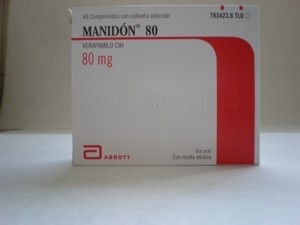
MANIDON 80 mg Film-Coated Tablets

Prescription review online
A doctor will review your case and decide whether a prescription is medically appropriate.

Talk to a doctor about this medicine
Discuss your symptoms and possible next steps in a quick online consultation.



How to use MANIDON 80 mg FILM-COATED TABLETS
Contents of the leaflet
- Introduction
- What is Manidón and what is it used for
- What you need to know before taking Manidón
- Other medications and Manidón
- How to take Manidón
- Possible adverse effects
- Storage of Manidón
- Package contents and additional information
Introduction
Prospect: Information for the User
Manidón 80 mg film-coated tablets
verapamil hydrochloride
Read the entire prospectus carefully before starting to take this medication, as it contains important information for you.
- Keep this prospectus as you may need to read it again.
- If you have any doubts, consult your doctor, pharmacist, or nurse.
- This medication has been prescribed to you only and should not be given to others, even if they have the same symptoms as you, as it may harm them.
- If you experience adverse effects, consult your doctor, pharmacist, or nurse, even if they are not listed in this prospectus. See section 4.
Contents of the Prospectus:
- What is Manidón and what is it used for.
- What you need to know before taking Manidón.
- How to take Manidón.
- Possible adverse effects.
- Storage of Manidón.
- Package contents and additional information.
1. What is Manidón and what is it used for
Manidón belongs to the group of medications called calcium channel blockers, with a preferentially cardiac action. These medications are used to treat chest angina, high blood pressure, or irregular heart rhythm.
Manidón is taken in:
- Prevention and treatment of chest angina. Treatment of high blood pressure.
- Prevention of paroxysmal supraventricular tachycardia, after intravenous treatment.
- Control of patients with chronic atrial flutter and/or fibrillation, except when associated with the existence of accessory conduction pathways.
Secondary prevention post-myocardial infarction in patients without heart failure during the acute phase.

Not sure if this medicine is right for you?
Discuss your symptoms and treatment with a doctor online.
2. What you need to know before taking Manidón
Do not take Manidón
- If you are allergic to verapamil hydrochloride or any of the other components of this medication (listed in section 6).
- If you have any of the following heart diseases: cardiogenic shock (the heart is unable to pump enough blood that the body needs).
- Atrioventricular block of second or third degree (disorder in the electrical conduction between the atria and ventricles), except if a pacemaker is implanted.
- Sick sinus syndrome (heart rhythm problems), except if a pacemaker is implanted.
- Left heart failure.
- Atrial flutter or fibrillation (abnormal heart rhythms).
- If you are taking a medication that contains ivabradine for the treatment of certain heart diseases.
Warnings and precautions
Consult your doctor, pharmacist, or nurse before starting to take Manidón.
Your doctor will need to take special care when administering this medication:
- If you have any of the following heart problems: acute phase of myocardial infarction complicated with bradycardia, marked hypotension, or left ventricular dysfunction; cardiac block, atrioventricular block of first degree, bradycardia, or asystole.
- If you are taking a beta-blocker medication for heart arrhythmias.
- If you are taking digoxin along with Manidón.
- If you have heart failure.
- If you have any of the following diseases that cause muscle weakness: myasthenia gravis, Lambert-Eaton syndrome, or advanced Duchenne muscular dystrophy.
- If you have kidney disease.
- If you have severe liver disease.
Other medications and Manidón
Inform your doctor or pharmacist if you are using, have recently used, or may need to use any other medication.
Some medications, if taken together with Manidón, may alter their effect. If you use or have used any of the following medications, consult your doctor:
- Prazosin, terazosin (for high blood pressure).
- Flecainide, quinidine, disopyramide (for heart arrhythmias).
- Theophylline (for bronchial asthma).
- Carbamazepine (for seizures), phenytoin (antiepileptic).
- Imipramine (for depression).
- Gliburide (for diabetes).
- Metformin: Verapamil may reduce the hypoglycemic effect of metformin.
- Colchicine (for gout).
- Clarithromycin, erythromycin, rifampicin, telithromycin (antibiotics).
- Doxorubicin (for cancer).
- Phenobarbital (for seizures and as a sedative).
- Buspirone, midazolam (sedatives used for insomnia and anxiety).
- Metoprolol, propranolol (for hypertension and heart disorders).
- Digitoxin, digoxin (for heart disorders).
- Cimetidine (for stomach ulcer treatment).
- Cyclosporine, everolimus, sirolimus, tacrolimus (immunosuppressive medications to reduce the body's defenses).
- Atorvastatin, lovastatin, simvastatin (medications to lower high cholesterol levels).
- Almotriptan (for migraine symptoms).
- Sulfinpyrazone (for gouty arthritis).
- Grapefruit juice.
- St. John's Wort (medication for depression).
- AIDS medications such as ritonavir.
- Lithium (for mood problems).
- Muscle relaxants (used as adjuncts in anesthesia).
- Acetylsalicylic acid (aspirin).
- Alcohol.
- Antihypertensives (to lower high blood pressure), diuretics (medications to urinate), vasodilators (medications for circulatory disorders).
- Inhalation anesthetics.
- Dabigatran (medication to prevent blood clot formation).
- Other direct oral anticoagulants (medications to prevent blood clot formation)
Taking Manidón with food, drinks, and alcohol
It has been observed that grapefruit juice increases the plasma levels of verapamil, so Manidón should not be taken together with grapefruit juice.
Taking alcohol together with Manidón may potentiate the hypotensive effect.
Pregnancy, breastfeeding, and fertility
If you are pregnant or breastfeeding, think you may be pregnant, or plan to become pregnant, consult your doctor or pharmacist before using this medication.
There is no experience with the use of Manidón during pregnancy. Consult your doctor if you become pregnant while taking Manidón.
Verapamil is excreted in breast milk in small amounts. Limited data from human studies suggest that the use of verapamil may be compatible with breastfeeding. Manidón will only be administered during breastfeeding if it is essential for the mother's health due to possible serious adverse reactions in breastfed infants.
Driving and using machines
Be careful when driving or using any tool or machinery, as Manidón may reduce your reaction capacity, especially at the beginning of treatment, when the dose is increased, when changing from another medication, and with alcohol consumption.
Manidón 80 mg film-coated tablets contain sodium croscarmellose
This medication contains less than 23 mg of sodium (1 mmol) per tablet; it is essentially "sodium-free".

Started taking the medicine and have questions?
Discuss your symptoms and treatment with a doctor online.
3. How to take Manidón
Follow the administration instructions of this medication indicated by your doctor or pharmacist exactly. If in doubt, consult your doctor or pharmacist again.
The suitable dose of this medication may be different for each patient.
Remember to take your medication.
Your doctor will indicate the duration of treatment with Manidón.
The most frequently recommended doses are those indicated below, but if your doctor has indicated a different dose, do not change it without consulting with them or your pharmacist:
Adults
Chest angina and secondary prevention post-myocardial infarction:
360 mg per day. The optimal daily dose ranges from 240 to 480 mg.
Hypertension:
240 mg per day. If necessary, it can be increased after one week to 360 mg per day and subsequently up to a maximum of 480 mg per day.
Prophylaxis of supraventricular tachycardias:
From 240 to 480 mg per day for non-digitalized patients and from 120 to 360 mg per day for digitalized patients.
Use in children and adolescents
Children: maximum 10 mg/kg body weight per day in several doses.
It is essential that you continue taking this medication until your doctor tells you to stop.
If you think the effect of Manidón is too strong or too weak, inform your doctor or pharmacist.
If you take more Manidón than you should
You may notice some of the following symptoms: feeling of tiredness, shortness of breath, dizziness, weakness, chest pain, feeling of fainting, difficulty thinking, intense thirst, dry and pasty mouth, urge to urinate, somnolence, blurred vision, difficulty speaking or moving, nausea, vomiting, diarrhea, disorientation. If a severe overdose has occurred, the doctor will take the necessary measures.
In case of overdose or accidental ingestion, consult your doctor or pharmacist immediately or call the Toxicological Information Service, phone 91 562 04 20, indicating the medication and the amount ingested, as in the case of a severe overdose, it can cause death.
If you forget to take Manidón
It is essential that you take your Manidón tablets regularly. If you forgot to take your corresponding dose, take it as soon as you remember. However, if the time of the next dose is very close, skip the missed dose and take the next dose at its usual time. Do not take a double dose to make up for the missed doses. Please consult your doctor before continuing your treatment.
4. Possible adverse effects
Like all medications, this medication can cause adverse effects, although not all people experience them.
The following adverse effects come from clinical studies with verapamil or post-marketing surveillance.
The most frequently reported adverse effects are headache, dizziness, gastrointestinal disorders: nausea, constipation, and abdominal pain, as well as bradycardia (decreased heart rate), tachycardia (increased heart rate), palpitations, hypotension (low blood pressure), flushing, peripheral edema (swelling in feet, legs, and ankles), and fatigue.
The following adverse effects have been observed with the following frequencies:
Frequent adverse effects: (may affect up to 1 in 10 patients)
- Constipation
- Nausea
- Bradycardia
- Flushing
- Dizziness
- Headache
- Peripheral edema
- Hypotension (low blood pressure)
Uncommon adverse effects: (may affect up to 1 in 100 patients):
- Abdominal pain
- Tachycardia
- Palpitations
- Fatigue
Rare adverse effects: (may affect up to 1 in 1000 patients):
- Vomiting
- Somnolence
- Burning sensation
- Paresthesia (tingling or numbness)
- Tremor
- Tinnitus (ringing in the ears)
- Excessive sweating
Unknown frequency(the frequency cannot be estimated from the available data):
- Intestinal obstruction
- Gingival hyperplasia (gum overgrowth)
- Abdominal discomfort
- Bronchospasm
- Involuntary movements (extrapyramidal disorder)
- Paralysis (tetraparesis)*,
- Seizures
- Abnormal breast enlargement
- Impotence
- Milk secretion
- Dizziness
- Allergic reactions
- Muscle weakness
- Muscle pain
- Joint pain
- Angioedema
- Redness of the skin (erythema multiforme)
- Stevens-Johnson syndrome (more severe erythema)
- Maculopapular rash (rash with spots and papules)
- Hair loss
- Hives
- Purpura (purple spots on skin and mucous membranes)
- Itching
- Increased liver enzymes
- Increased prolactin in blood (a hormone that stimulates breast development and milk production)
- Atrioventricular block of first, second, and third degree (obstruction in the heart)
- Heart failure
- Sinus pause
- Sinus bradycardia
- Asystole
- Hyperkalemia
- Dyspnea (breathing difficulty)
- Renal failure
*There has been a report of paralysis when verapamil was taken with colchicine, so their combined use is not recommended.
Reporting adverse effects
If you experience any type of adverse effect, consult your doctor, pharmacist, or nurse, even if it is a possible adverse effect that does not appear in this prospectus. You can also report them directly through the Spanish Pharmacovigilance System for Human Use Medications: https://www.notificaram.es. By reporting adverse effects, you can contribute to providing more information on the safety of this medication.
5. Storage of Manidón
Keep this medication out of sight and reach of children.
No special storage conditions are required.
Do not use Manidón after the expiration date shown on the packaging after CAD or EXP. The expiration date is the last day of the month indicated.
Medications should not be thrown down the drain or into the trash. Deposit the packaging and medications you no longer need in the SIGRE collection point at the pharmacy. If in doubt, ask your pharmacist how to dispose of the packaging and medications you no longer need. This way, you will help protect the environment.
6. Package contents and additional information
Composition of Manidón
The active ingredient is verapamil (as hydrochloride). Each film-coated tablet contains 80 mg of active ingredient.
The other components (excipients) are: calcium phosphate monobasic dihydrate, microcrystalline cellulose, sodium croscarmellose, magnesium stearate, anhydrous colloidal silica, talc, macrogol 6000, hypromellose, titanium dioxide (E-171), sodium lauryl sulfate, and purified water.
Appearance of the product and package contents
Manidón is packaged in PVC/Aluminum blisters and comes in packages containing 30 or 60 film-coated tablets, which are round, biconvex, and white.
Marketing authorization holder and manufacturer
Holder:
Viatris Healthcare Limited
Damastown Industrial Park
Mulhuddart, Dublin 15
Dublin
Ireland
Manufacturer:
Famar A.V.E., Anthoussa Plant
Anthoussa Avenue 7
Anthoussa - Attiki
15349, Greece
You can request more information about this medication by contacting the local representative of the marketing authorization holder:
Viatris Pharmaceuticals, S.L.
C/ General Aranaz, 86
28027 Madrid
Spain
Date of the last revision of this prospectus:January 2021
Detailed information about this medication is available on the website of the Spanish Agency for Medicines and Health Products (AEMPS) https://www.aemps.gob.es/
- Country of registration
- Dosage formTABLET, 80 mg verapamil hydrochloride
- ATC codeC08DA01
- Average pharmacy price3.12 EUR
- Active substance
- Prescription requiredYes
- Manufacturer
- CompositionCROSCARMELOSA SODICA (3.6 mg mg), LAURILSULFATO DE SODIO (0.1 mg mg)
- This information is for reference only and does not constitute medical advice. Always consult a doctor before taking any medication. Oladoctor is not responsible for medical decisions based on this content.
- Alternatives to MANIDON 80 mg FILM-COATED TABLETSDosage form: INJECTABLE, 5 mg verapamil hydrochlorideActive substance: verapamilManufacturer: Viatris Healthcare LimitedPrescription requiredDosage form: MODIFIED-RELEASE TABLET, 240 mg verapamil hydrochlorideActive substance: verapamilManufacturer: Viatris Healthcare LimitedPrescription requiredDosage form: MODIFIED-RELEASE TABLET, 120 mg verapamil hydrochlorideActive substance: verapamilManufacturer: Viatris Healthcare LimitedPrescription required
Online doctors for MANIDON 80 mg FILM-COATED TABLETS
Discuss questions about MANIDON 80 mg FILM-COATED TABLETS, including use, safety considerations and prescription review, subject to medical assessment and local regulations.
Get MANIDON 80 mg FILM-COATED TABLETS Prescription Online
Fill in a 2-min form
Tell us your symptoms, history, and what medicine you're requesting.
Pick a doctor or let us assign
Choose a specialist or we'll match you with the next available doctor.
Doctor reviews your case
Usually within 30 minutes. They may ask follow-up questions via chat.
Collect from any pharmacy
Electronic prescription sent to your email — valid across Spain.
Frequently Asked Questions
MANIDON 80 mg FILM-COATED TABLETS requires a prescription in Spain. You can check with a doctor online whether this medicine may be appropriate for your situation.
The active ingredient in MANIDON 80 mg FILM-COATED TABLETS is verapamil. This information helps identify medicines with the same composition but different brand names.
The average pharmacy price for MANIDON 80 mg FILM-COATED TABLETS is around 3.12 EUR. Prices may vary depending on the manufacturer and dosage form.
MANIDON 80 mg FILM-COATED TABLETS is manufactured by Viatris Healthcare Limited. Pharmacy brands and packaging may differ depending on the distributor.
Doctors such as Family doctors, Psychiatrists, Dermatologists, Cardiologists, Endocrinologists, Gastroenterologists, Pulmonologists, Nephrologists, Rheumatologists, Hematologists, Infectious disease physicians, Allergists, Geriatricians, Paediatricians, Oncologists may assess whether MANIDON 80 mg FILM-COATED TABLETS is appropriate, depending on your situation and local regulations. You can book an online consultation to discuss your symptoms and possible next steps.
Spain has a well-developed healthcare infrastructure across major cities such as Madrid, Barcelona, Valencia, and Seville. Pharmacies are widely available and operate under strict regulations, ensuring access to prescribed medications.
You can buy MANIDON 80 mg FILM-COATED TABLETS in Madrid, Barcelona, Seville, or Valencia at any local pharmacy with a valid prescription.
To obtain a prescription, you can use Oladoctor:
Other medicines with the same active substance (verapamil) include MANIDON 2.5 mg/ml INJECTABLE SOLUTION, MANIDON HTA 240 mg PROLONGED-RELEASE TABLETS, MANIDON RETARD 120 mg PROLONGED-RELEASE TABLETS. These may have different brand names or formulations but contain the same therapeutic ingredient. Always consult a doctor before switching or starting a new medicine.
