



LOSARTAN 100 mg Film-Coated Tablets

Prescription review online
A doctor will review your case and decide whether a prescription is medically appropriate.

Talk to a doctor about this medicine
Discuss your symptoms and possible next steps in a quick online consultation.



How to use LOSARTAN SANDOZ 100 mg FILM-COATED TABLETS
Contents of the leaflet
- Introduction
- What is Losartan Sandoz and what is it used for
- What you need to know before taking Losartan Sandoz
- How to take Losartan Sandoz
- Possible Adverse Effects
- Storage of Losartan Sandoz
- Package Contents and Additional Information
Introduction
Package Leaflet: Information for the Patient
Losartan Sandoz 50 mg film-coated tablets EFG
Losartan Sandoz 100 mg film-coated tablets EFG
potassium losartan
Read the entire package leaflet carefully before starting to take this medication, as it contains important information for you
- Keep this package leaflet, as you may need to read it again.
- If you have any questions, consult your doctor or pharmacist.
- This medication has been prescribed to you only, and you should not give it to others, even if they have the same symptoms as you, as it may harm them.
- If you experience side effects, consult your doctor or pharmacist, even if they are not listed in this package leaflet. See section 4.
Contents of the Package Leaflet
- What is Losartan Sandoz and what is it used for
- What you need to know before taking Losartan Sandoz
- How to take Losartan Sandoz
- Possible side effects
- Storage of Losartan Sandoz
- Package contents and additional information
1. What is Losartan Sandoz and what is it used for
Losartan belongs to a group of medications called angiotensin II receptor antagonists.
Angiotensin II is a substance produced in the body that binds to receptors present in blood vessels, causing them to constrict. This leads to an increase in blood pressure. Losartan prevents the binding of angiotensin II to these receptors, resulting in the relaxation of blood vessels, which in turn decreases blood pressure. Losartan reduces the worsening of kidney function in patients with high blood pressure and type 2 diabetes.
Losartan Sandoz is used:
- to treat patients with high blood pressure (hypertension) in adults and in children and adolescents from 6 to 18 years old,
- to protect the kidneys in hypertensive patients with type 2 diabetes and laboratory test results indicating kidney failure and proteinuria ≥ 0.5 g per day (a condition in which the urine contains an abnormal amount of protein),
- to treat patients with chronic heart failure, when their doctor considers that treatment with specific medications called angiotensin-converting enzyme inhibitors (ACE inhibitors, medications used to lower high blood pressure) is not suitable. If your heart failure has been stabilized with an ACE inhibitor, you should not switch to losartan,
- in patients with high blood pressure and increased thickness of the left ventricle of the heart, losartan has been shown to reduce the risk of stroke (LIFE indication).

Not sure if this medicine is right for you?
Discuss your symptoms and treatment with a doctor online.
2. What you need to know before taking Losartan Sandoz
Do not take Losartan Sandoz:
- if you are allergic to losartan or any of the other ingredients of this medication (listed in section 6),
- if you are pregnant for more than 3 months. (It is also recommended to avoid Losartan Sandoz during the first months of pregnancy – see section Pregnancy),
- if your liver function is severely impaired,
- if you have diabetes or kidney failure and are being treated with a blood pressure-lowering medication containing aliskiren.
Warnings and precautions
Consult your doctor or pharmacist before starting to take Losartan Sandoz.
Inform your doctor if you think you are pregnant (or might be). Losartan is not recommended at the start of pregnancy, and it should not be taken if you are pregnant for more than three months, as it may cause serious harm to your child (see section Pregnancy).
Consult your doctor if you experience abdominal pain, nausea, vomiting, or diarrhea after taking losartan. Your doctor will decide whether to continue treatment. Do not stop taking losartan on your own.
Before taking losartan, it is essential that you inform your doctor:
- if you have a history of angioedema (swelling of the face, lips, tongue, and/or throat) (see also section 4. Possible side effects),
- if you have excessive vomiting or diarrhea, which may cause excessive loss of fluid and/or salt from your body,
- if you are taking diuretics (medications that increase the amount of water that passes through your kidneys) or if you are on a low-salt diet that may cause excessive loss of fluids or salt from your body (see section 3. Dosage in special patient groups),
- if you know you have narrowing or blockage of the blood vessels that supply your kidneys or if you have recently undergone a kidney transplant,
- if your liver function is impaired (see sections 2. Do not take Losartan Sandoz and 3. Dosage in special patient groups),
- if you have heart failure with or without kidney failure or life-threatening cardiac arrhythmias. Special attention is necessary when you are being treated with a beta-blocker at the same time,
- if you have problems with the valves in your heart or with the heart muscle,
- if you have coronary heart disease (caused by reduced blood flow in the blood vessels of the heart) or cerebrovascular disease (caused by reduced blood circulation in the brain),
- if you have primary hyperaldosteronism (a syndrome associated with high secretion of the hormone aldosterone by the adrenal gland due to a disorder of this gland),
- if you are taking any of the following medications used to treat high blood pressure (hypertension):
- an angiotensin-converting enzyme inhibitor (ACE inhibitor) (e.g., enalapril, lisinopril, ramipril), particularly if you have kidney problems related to diabetes,
- aliskiren.
Your doctor may monitor your kidney function, blood pressure, and blood electrolyte levels (e.g., potassium) at regular intervals.
See also the information under the heading “Do not take Losartan Sandoz”.
Children and adolescents
Losartan has been studied in children. For more information, talk to your doctor. Losartan is not recommended for use in children with kidney or liver problems, as the available data in these patient groups are limited. Losartan is not recommended for use in children under 6 years of age, as it has not been shown to be effective in this age group.
Other medications and Losartan Sandoz
Inform your doctor or pharmacist if you are taking, have recently taken, or might take any other medication.
While being treated with losartan, be particularly cautious if you take any of the following medications:
- other medications that lower blood pressure, as they may produce an additional reduction in blood pressure. Blood pressure may also be lowered by some of the following medications/classes of medications: tricyclic antidepressants, antipsychotics, baclofen, amifostine,
- medications that retain potassium or may increase potassium levels (e.g., potassium supplements, salt substitutes containing potassium, or potassium-sparing diuretics [e.g., amiloride, triamterene, spironolactone] or heparin),
- non-steroidal anti-inflammatory medications, such as indomethacin, including COX-2 inhibitors (medications that reduce inflammation and can be used to relieve pain), as they may decrease the blood pressure-lowering effect of losartan.
Your doctor may need to adjust your dose and/or take other precautions:
If you are taking an angiotensin-converting enzyme inhibitor (ACE inhibitor) or aliskiren (see also the information under the headings “Do not take Losartan Sandoz” and “Warnings and precautions”).
If your kidney function is impaired, concomitant use of these medications may worsen kidney function.
Medications containing lithium should not be used in combination with losartan without your doctor's careful monitoring. It may be appropriate to take special precautions (e.g., blood tests).
Taking Losartan Sandoz with food and drinks
Losartan Sandoz can be taken with or without food.
Pregnancy and breastfeeding
Pregnancy
If you are pregnant or breastfeeding, think you may be pregnant, or plan to become pregnant, consult your doctor or pharmacist before using this medication. Normally, your doctor will advise you to stop taking Losartan Sandoz before becoming pregnant or as soon as you know you are pregnant and will recommend a different medication instead of Losartan Sandoz. Losartan Sandoz is not recommended during the first trimester of pregnancy, and it should not be taken if you are pregnant for more than 3 months, as it may cause serious harm to your child if used after the third month of pregnancy.
Breastfeeding
Inform your doctor if you are breastfeeding or about to start breastfeeding. Losartan is not recommended for breastfeeding mothers, and your doctor may choose a different treatment for you if you wish to breastfeed. Especially if your child is a newborn or premature.
Consult your doctor or pharmacist before using this medication.
Driving and using machines
No studies have been conducted on the effects on the ability to drive and use machines.
It is unlikely that Losartan Sandoz will affect your ability to drive or use machines. However, like many medications used to treat high blood pressure, losartan may cause dizziness or drowsiness in some people. If you experience dizziness or drowsiness, consult your doctor before performing these activities.
Losartan Sandoz contains lactose and sodium
This medication contains less than 23 mg of sodium (1 mmol) per tablet; this is essentially “sodium-free”.
If your doctor has told you that you have an intolerance to certain sugars, consult with them before taking this medication.
3. How to take Losartan Sandoz
Follow the administration instructions of this medication exactly as indicated by your doctor or pharmacist. If in doubt, consult your doctor or pharmacist again.
Your doctor will decide the appropriate dose of Losartan Sandoz, depending on your condition and whether you are taking other medications. It is essential to continue taking Losartan Sandoz as prescribed by your doctor to maintain constant control of your blood pressure.
Adult patients with high blood pressure
Normally, treatment starts with 50 mg of losartan (one Losartan Sandoz 50 mg tablet) once a day. The maximum blood pressure-lowering effect is achieved between 3 to 6 weeks after starting treatment. After that, in some patients, the dose may be increased to 100 mg of losartan (2 Losartan Sandoz 50 mg tablets or 1 Losartan Sandoz 100 mg tablet) once a day.
If you think the effect of losartan is too strong or too weak, please inform your doctor or pharmacist.
Use in children and adolescents
Children under 6 years of age
Losartan is not recommended for use in children under 6 years of age, as it has not been shown to be effective in this age group.
Children between 6 and 18 years old
The recommended starting dose in patients weighing between 20 and 50 kg is 0.7 mg of losartan per kg of body weight, administered once a day (up to 25 mg of losartan). The doctor may increase the dose if blood pressure is not controlled.
Other pharmaceutical forms of this medication may be more suitable for children; ask your doctor or pharmacist.
Adult patients with high blood pressure and type 2 diabetes
Normally, treatment starts with 50 mg of losartan (one Losartan Sandoz 50 mg tablet) once a day. After that, the dose may be increased to 100 mg of losartan (2 Losartan Sandoz 50 mg tablets or 1 Losartan Sandoz 100 mg tablet) once a day, depending on the response of your blood pressure.
Losartan can be administered with other medications that lower blood pressure (e.g., diuretics, calcium antagonists, alpha or beta blockers, and centrally acting medications), as well as with insulin and other medications frequently used to lower blood glucose levels (e.g., sulfonylureas, glitazones, and glucosidase inhibitors).
Adult patients with heart failure
Normally, treatment starts with 12.5 mg once a day. Normally, the dose is gradually increased weekly (i.e., 12.5 mg per day during the first week, 25 mg per day during the second week, and 50 mg per day during the third week, 100 mg per day during the fourth week, 150 mg per day during the fifth week), up to a maintenance dose determined by your doctor. A maximum dose of 150 mg of losartan (e.g., 3 Losartan Sandoz 50 mg tablets or 1 Losartan Sandoz 100 mg tablet and 1 Losartan Sandoz 50 mg tablet) once a day can be used.
In the treatment of heart failure, losartan is normally combined with a diuretic (a medication that increases the amount of water that passes through your kidneys) and/or digitalis (a medication that helps your heart be stronger and more efficient) and/or a beta-blocker.
Dosage in special patient groups
Your doctor may recommend a lower dose, especially when starting treatment in certain patients, such as those treated with high-dose diuretics, patients with liver failure, or patients over 75 years old. Losartan is not recommended for use in patients with severe liver failure (see section "Do not take Losartan Sandoz").
Administration
The tablets should be swallowed whole with a glass of water. You should try to take your daily dose at approximately the same time each day. It is essential to continue taking Losartan Sandoz until your doctor tells you to stop.
If you take more Losartan Sandoz than you should
If you accidentally take too many tablets, contact your doctor immediately. The symptoms of overdose are low blood pressure, increased heart rate, and possibly decreased heart rate.
If you have taken more Losartan Sandoz than you should, consult your doctor, pharmacist, or call the Toxicology Information Service, phone 91 562 04 20, indicating the medication and the amount ingested.
If you forget to take Losartan Sandoz
If you accidentally miss a dose, simply take the next dose as usual. Do not take a double dose to make up for missed doses.
If you have any other questions about the use of this medication, ask your doctor or pharmacist.

Started taking the medicine and have questions?
Discuss your symptoms and treatment with a doctor online.
4. Possible Adverse Effects
Like all medicines, this medicine can cause adverse effects, although not all people suffer from them.
If you experience the following, stop taking the losartan tablets and inform your doctor immediately or go to the emergency department of your nearest hospital:
A severe allergic reaction (rash, itching, swelling of the face, lips, mouth, or throat that can cause difficulty swallowing or breathing).
This is a serious but rare adverse effect, affecting more than 1 patient in 10,000, but less than 1 patient in 1,000. You may need urgent medical attention or hospitalization.
The following adverse effects have been reported with losartan:
Frequent(may affect up to 1 in 10 patients):
- dizziness,
- low blood pressure (especially after excessive loss of water from the body within the blood vessels, e.g., in patients with severe heart failure or undergoing high-dose diuretic treatment),
- dose-related orthostatic effects, such as a decrease in blood pressure that occurs after standing up from lying down or sitting,
- weakness,
- fatigue,
- low blood sugar (hypoglycemia),
- high potassium levels in the blood (hyperkalemia),
- changes in kidney function, including kidney failure,
- reduced number of red blood cells (anemia),
- increased urea, creatinine, and potassium levels in the blood in patients with heart failure.
Uncommon (may affect up to 1 in 100 patients):
- drowsiness,
- headache,
- sleep disorders,
- feeling of very rapid heartbeats (palpitations),
- severe chest pain (angina pectoris),
- difficulty breathing (dyspnea),
- abdominal pain,
- constipation,
- diarrhea,
- nausea,
- vomiting,
- hives (urticaria),
- itching (pruritus),
- rash,
- localized swelling (edema),
- cough.
Rare (may affect up to 1 in 1,000 patients):
- hypersensitivity,
- angioedema,
- inflammation of the blood vessels (vasculitis, including Schonlein-Henoch purpura),
- numbness or tingling sensation (paresthesia),
- fainting (syncope),
- very rapid and irregular heartbeats (atrial fibrillation),
- stroke (cerebrovascular accident),
- inflammation of the liver (hepatitis),
- elevation of alanine aminotransferase (ALT) levels in the blood, which usually resolves upon discontinuation of treatment.
- intestinal angioedema: swelling in the intestine that presents symptoms such as abdominal pain, nausea, vomiting, and diarrhea,
Frequency not known(frequency cannot be estimated from available data):
- reduced platelet count,
- migraine,
- abnormalities in liver function,
- muscle and joint pain,
- flu-like symptoms,
- back pain and urinary tract infection,
- increased sensitivity to sunlight (photosensitivity),
- muscle pain of unknown origin with dark-colored urine (tea-colored) (rhabdomyolysis),
- impotence,
- inflammation of the pancreas (pancreatitis),
- low sodium levels in the blood (hyponatremia),
- depression,
- generally feeling unwell (malaise),
- ringing, buzzing, noise, or clicking in the ears (tinnitus),
- alteration of taste (dysgeusia).
Adverse effects in children are similar to those observed in adults.
Reporting of Adverse Effects
If you experience any type of adverse effect, consult your doctor or pharmacist, even if it is a possible adverse effect that is not listed in this leaflet. You can also report them directly through the Spanish Pharmacovigilance System for Human Use Medicines: www.notificaram.es.
By reporting adverse effects, you can contribute to providing more information on the safety of this medicine.
5. Storage of Losartan Sandoz
Keep this medicine out of the sight and reach of children.
Do not use this medicine after the expiration date stated on the packaging after CAD. The expiration date is the last day of the month indicated.
The validity period of Losartan Sandoz packaged in an HDPE bottle, once the bottle is opened, is 6 months.
Blister
This medicine does not require special storage conditions.
Do not open the blister until you are ready to take the medicine.
Bottle
It does not require special storage conditions.
Once the bottle is opened, do not store above 25°C.
Medicines should not be disposed of via wastewater or household waste. Deposit the packaging and any unused medicines in the SIGRE collection point at your pharmacy. If in doubt, ask your pharmacist how to dispose of the packaging and any unused medicines. This will help protect the environment.
6. Package Contents and Additional Information
Composition of Losartan Sandoz
- The active ingredient is losartan potassium.
Losartan Sandoz 50 mg tablets: each tablet contains 50 mg of losartan potassium.
Losartan Sandoz 100 mg tablets: each tablet contains 100 mg of losartan potassium.
- The other ingredients are
Core: sodium carboxymethyl starch (type A) (derived from potato starch), microcrystalline cellulose, magnesium stearate, povidone, anhydrous colloidal silica.
Coating: Opadry white (OY-L-28900), which contains: titanium dioxide, hypromellose, lactose monohydrate, and macrogol 4000.
Appearance of the Product and Package Contents
Losartan Sandoz 50 mg are white, oval, film-coated tablets with the inscription "3" on one side and a score line on both sides. The tablet can be divided into equal doses.
Losartan Sandoz 100 mg are white, oblong, film-coated tablets with the inscription "5" on one side and 3 score lines on both sides. The tablet can be divided into equal doses.
Losartan Sandoz is supplied in the following package sizes:
PVC/PVDC/Aluminum blister pack, in packages of 28 film-coated tablets.
HDPE bottle, in packages of 28 film-coated tablets.
Marketing Authorization Holder and Manufacturer:
Marketing Authorization Holder
Sandoz Farmacéutica, S.A.
Centro Empresarial Parque Norte
Edificio Roble,
C/Serrano Galvache, 56
28033 Madrid
Spain
Manufacturer:
Salutas Pharma GmbH
Otto-von-Guericke-Allee, 1
39179 Barleben
Germany
Or
Lek Pharmaceuticals d.d.
Trimlini 2D, 9220
Lendava,
Slovenia
Or
Lek Pharmaceutical Company d.d.
Verovskova, 57
Ljubljana 1526
Slovenia
Or
Lek S.A.
Ul. Podlipie 16
95 010 Strykow
Poland
Date of the Last Revision of this Leaflet: February 2025
Detailed and updated information on this medicine is available on the website of the Spanish Agency for Medicines and Health Products (AEMPS) www.aemps.gob.es
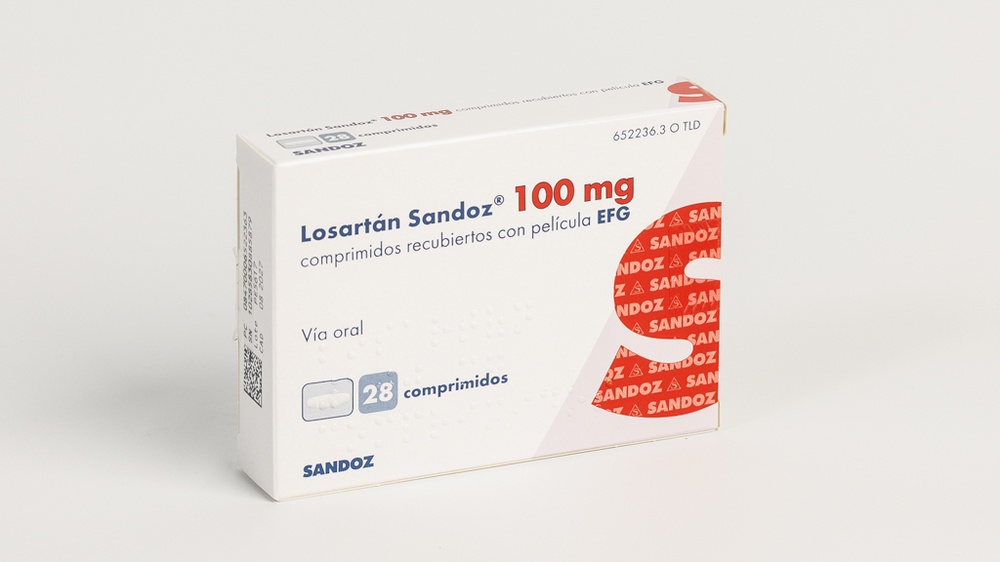
- Country of registration
- Dosage formTABLET, 100 mg losartan potassium
- ATC codeC09CA01
- Average pharmacy price8.34 EUR
- Active substance
- Prescription requiredYes
- Manufacturer
- CompositionCARBOXIMETILALMIDON SODICO (10.8 mg mg)
- This information is for reference only and does not constitute medical advice. Always consult a doctor before taking any medication. Oladoctor is not responsible for medical decisions based on this content.
- Alternatives to LOSARTAN SANDOZ 100 mg FILM-COATED TABLETSDosage form: TABLET, 100 mg losartan potassiumActive substance: losartanManufacturer: Organon Salud S.L.Prescription requiredDosage form: TABLET, 12.5 mg losartan potassiumActive substance: losartanManufacturer: Organon Salud S.L.Prescription requiredDosage form: TABLET, 50 mg losartan potassiumActive substance: losartanManufacturer: Organon Salud S.L.Prescription required
Online doctors for LOSARTAN SANDOZ 100 mg FILM-COATED TABLETS
Discuss questions about LOSARTAN SANDOZ 100 mg FILM-COATED TABLETS, including use, safety considerations and prescription review, subject to medical assessment and local regulations.
Get LOSARTAN SANDOZ 100 mg FILM-COATED TABLETS Prescription Online
Fill in a 2-min form
Tell us your symptoms, history, and what medicine you're requesting.
Pick a doctor or let us assign
Choose a specialist or we'll match you with the next available doctor.
Doctor reviews your case
Usually within 30 minutes. They may ask follow-up questions via chat.
Collect from any pharmacy
Electronic prescription sent to your email — valid across Spain.
Frequently Asked Questions
LOSARTAN SANDOZ 100 mg FILM-COATED TABLETS requires a prescription in Spain. You can check with a doctor online whether this medicine may be appropriate for your situation.
The active ingredient in LOSARTAN SANDOZ 100 mg FILM-COATED TABLETS is losartan. This information helps identify medicines with the same composition but different brand names.
The average pharmacy price for LOSARTAN SANDOZ 100 mg FILM-COATED TABLETS is around 8.34 EUR. Prices may vary depending on the manufacturer and dosage form.
LOSARTAN SANDOZ 100 mg FILM-COATED TABLETS is manufactured by Sandoz Farmaceutica S.A.. Pharmacy brands and packaging may differ depending on the distributor.
Doctors such as Family doctors, Psychiatrists, Dermatologists, Cardiologists, Endocrinologists, Gastroenterologists, Pulmonologists, Nephrologists, Rheumatologists, Hematologists, Infectious disease physicians, Allergists, Geriatricians, Paediatricians, Oncologists may assess whether LOSARTAN SANDOZ 100 mg FILM-COATED TABLETS is appropriate, depending on your situation and local regulations. You can book an online consultation to discuss your symptoms and possible next steps.
Spain has a well-developed healthcare infrastructure across major cities such as Madrid, Barcelona, Valencia, and Seville. Pharmacies are widely available and operate under strict regulations, ensuring access to prescribed medications.
You can buy LOSARTAN SANDOZ 100 mg FILM-COATED TABLETS in Madrid, Barcelona, Seville, or Valencia at any local pharmacy with a valid prescription.
To obtain a prescription, you can use Oladoctor:
Other medicines with the same active substance (losartan) include COZAAR 100 mg FILM-COATED TABLETS, COZAAR 12.5 mg STARTING FILM-COATED TABLETS, COZAAR 50 mg FILM-COATED TABLETS. These may have different brand names or formulations but contain the same therapeutic ingredient. Always consult a doctor before switching or starting a new medicine.
