



LIXIANA 15 mg Film-Coated Tablets

Prescription review online
A doctor will review your case and decide whether a prescription is medically appropriate.

Talk to a doctor about this medicine
Discuss your symptoms and possible next steps in a quick online consultation.



How to use LIXIANA 15 mg FILM-COATED TABLETS
Contents of the leaflet
- Introduction
- What is Lixiana and what is it used for
- What you need to know before you take Lixiana
- How to take Lixiana
- Possible side effects
- Storing Lixiana
- Packaging Content and Additional Information
Introduction
Package Leaflet: Information for the User
Lixiana 15 mg film-coated tablets
Lixiana 30 mg film-coated tablets
Lixiana 60 mg film-coated tablets
edoxaban
Read all of this leaflet carefully before you start taking this medicine because it contains important information for you.
- Keep this leaflet, you may need to read it again.
- If you have any further questions, ask your doctor or pharmacist.
- This medicine has been prescribed for you only. Do not pass it on to others. It may harm them, even if their signs of illness are the same as yours.
- If you get any side effects, talk to your doctor or pharmacist. This includes any possible side effects not listed in this leaflet. See section 4.
Contents of the pack
- What is Lixiana and what is it used for
- What you need to know before you take Lixiana
- How to take Lixiana
- Possible side effects
- Storing Lixiana
- Contents of the pack and other information
1. What is Lixiana and what is it used for
Lixiana contains the active substance edoxaban and belongs to a group of medicines called anticoagulants. This medicine helps to prevent the formation of blood clots. It works by blocking the activity of Factor Xa, an important component of blood clotting.
Lixiana is used in adults:
- to prevent the formation of a blood clot in the brain(stroke) and in other blood vessels of the bodyif they have a type of irregular heartbeat called non-valvular atrial fibrillation and at least one additional risk factor, such as heart failure, having previously had a stroke or high blood pressure;
- to treat blood clots in the veins of the legs(deep vein thrombosis) and in the blood vessels of the lungs(pulmonary embolism), and to prevent these blood clots from happening againin the blood vessels of the legs and/or lungs.

Not sure if this medicine is right for you?
Discuss your symptoms and treatment with a doctor online.
2. What you need to know before you take Lixiana
Do not take Lixiana
- if you are allergic to edoxaban or any of the other ingredients of this medicine (listed in section 6);
- if you are actively bleeding;
- if you have a disease or condition that increases the risk of major bleeding (e.g. stomach ulcer, injury or bleeding in the brain or recent brain or eye surgery);
- if you are taking other medicines to prevent blood clots (e.g. warfarin, dabigatran, rivaroxaban, apixaban or heparin), except when switching treatment or when heparin is administered through a venous or arterial catheter to prevent it from becoming blocked;
- if you have a liver disease that may increase the risk of bleeding;
- if you have uncontrolled high blood pressure;
- if you are pregnant or breastfeeding.
Warnings and precautions
Talk to your doctor or pharmacist before taking Lixiana,
- if you have an increased risk of bleeding, such as if you have any of the following conditions:
- end-stage renal disease or if you are on dialysis;
- severe liver disease;
- bleeding disorders;
- problems with the blood vessels in the back of the eyes (retinopathy);
- recent bleeding in the brain (intracranial or intracerebral bleeding);
- problems with the blood vessels in the brain or spine;
- if you have a mechanical heart valve.
Lixiana 15 mg is only indicated when switching from Lixiana 30 mg to a vitamin K antagonist (e.g. warfarin) (see section 3. How to take Lixiana).
Be careful with Lixiana,
- if you know you have a disease called antiphospholipid syndrome (an immune system disorder that increases the risk of blood clots), inform your doctor to decide if it may be necessary to modify the treatment.
If you need to have surgery,
- it is very important to take Lixiana before and after the operation, exactly at the times indicated by your doctor. If possible, you should stop taking Lixiana at least 24 hours before an operation. Your doctor will decide when to restart Lixiana.
In emergency situations, your doctor will help determine the necessary actions regarding Lixiana.
Children and adolescents
Lixiana is not recommended in children and adolescents under 18 years of age.
Other medicines and Lixiana
Tell your doctor or pharmacist if you are taking, have recently taken or might take any other medicines.
If you are taking any of the following:
- any medicine for a fungal infection (e.g. ketoconazole);
- medicines for treating irregular heartbeat (e.g. dronedarone, quinidine, verapamil);
- other medicines to reduce blood clotting (e.g. heparin, clopidogrel or vitamin K antagonists, such as warfarin, acenocoumarol, phenprocoumon or dabigatran, rivaroxaban, apixaban);
- antibiotics (e.g. erythromycin, clarithromycin);
- medicines to prevent organ rejection after a transplant (e.g. cyclosporin);
- anti-inflammatory and pain-relieving medicines (e.g. naproxen or acetylsalicylic acid);
- antidepressants called selective serotonin reuptake inhibitors or serotonin-noradrenaline reuptake inhibitors.
If any of the above applies to you, tell your doctorbefore taking Lixiana because these medicines may increase the effects of Lixiana and the risk of unwanted bleeding. Your doctor will decide whether you should be treated with Lixiana and whether you should be kept under closer observation.
If you are taking any of the following:
- any medicine for treating epilepsy (e.g. phenytoin, carbamazepine, phenobarbital);
- St. John's Wort, a herbal remedy used for anxiety and mild depression;
- rifampicin, an antibiotic.
If any of the above applies to you, tell your doctorbefore taking Lixiana, because the effect of Lixiana may be reduced. Your doctor will decide whether you should be treated with Lixiana and whether you should be kept under closer observation.
Pregnancy and breastfeeding
Do not take Lixiana if you are pregnant or breastfeeding. If there is a possibility that you may become pregnant, use effective contraception while taking Lixiana. If you become pregnant while taking Lixiana, tell your doctor immediately, who will decide how you should be treated.
Driving and using machines
Lixiana has no or negligible influence on the ability to drive and use machines.
3. How to take Lixiana
Always take this medicine exactly as your doctor or pharmacist has told you. If you are not sure, check with your doctor or pharmacist.
What dose to take
The recommended dose is one 60 mgtablet once a day.
- if you have kidney problems, your doctor may reduce your dose to one 30 mgtablet once a day.
- if you weigh 60 kg or less, the recommended dose is one 30 mgtablet once a day.
- if your doctor has prescribed you medicines known as P-gp inhibitors:cyclosporin, dronedarone, erythromycin or ketoconazole, the recommended dose is one 30 mgtablet once a day.
How to take the tablet
Swallow the tablet, preferably with water.
Lixiana can be taken with or without food.
If you have difficulty swallowing the tablet whole, talk to your doctor about other ways to take Lixiana. The tablet can be crushed and mixed with water or apple sauce immediately before taking it. If necessary, your doctor may also administer the crushed Lixiana tablet through a tube in the nose (nasogastric tube) or through the stomach (gastric feeding tube).
Your doctor may switch your anticoagulant treatment as follows:
Switching from vitamin K antagonists (e.g. warfarin) to Lixiana
Stop taking the vitamin K antagonist (e.g. warfarin). Your doctor will have you take a blood test and will tell you when to start taking Lixiana.
Switching from non-vitamin K antagonist oral anticoagulants (dabigatran, rivaroxaban or apixaban) to Lixiana
Stop taking the previous medicines (e.g. dabigatran, rivaroxaban or apixaban) and start taking Lixiana at the time of the next scheduled dose of the anticoagulant.
Switching from parenteral anticoagulants (e.g. heparin) to Lixiana
Stop taking the anticoagulant (e.g. heparin) and start taking Lixiana at the time of the next scheduled dose of the anticoagulant.
Switching from Lixiana to vitamin K antagonists (e.g. warfarin)
If you are currently taking 60 mg of Lixiana:
Your doctor will tell you to reduce the dose of Lixiana to one 30 mg tablet once a day and take it together with a vitamin K antagonist (e.g. warfarin). Your doctor will have you take a blood test and will tell you when to stop taking Lixiana.
If you are currently taking 30 mg (reduced dose) of Lixiana:
Your doctor will tell you to reduce the dose of Lixiana to one 15 mg tablet once a day and take it together with a vitamin K antagonist (e.g. warfarin). Your doctor will have you take a blood test and will tell you when to stop taking Lixiana.
Switching from Lixiana to non-vitamin K antagonist oral anticoagulants (dabigatran, rivaroxaban or apixaban)
Stop taking Lixiana and start the non-vitamin K antagonist oral anticoagulant (e.g. dabigatran, rivaroxaban or apixaban) at the time of the next scheduled dose of Lixiana.
Switching from Lixiana to parenteral anticoagulants (e.g. heparin)
Stop taking Lixiana and start the parenteral anticoagulant (e.g. heparin) at the time of the next scheduled dose of Lixiana.
Patients undergoing cardioversion:
If you need your irregular heartbeat to be restored to normal through a procedure called cardioversion, take Lixiana at the times indicated by your doctor to prevent the formation of blood clots in the brain and in other blood vessels of your body.
If you take more Lixiana than you should
Tell your doctor immediately if you have taken too many Lixiana tablets. If you take more Lixiana than recommended, you may increase the risk of bleeding.
If you forget to take Lixiana
You should take the tablet as soon as you remember and then continue with your normal daily dose. Do not take a double dose on the same day to make up for a forgotten dose.
If you stop taking Lixiana
Do not stop taking Lixiana without talking to your doctor first, as Lixiana treats and prevents serious diseases.
If you have any further questions on the use of this medicine, ask your doctor or pharmacist.

Started taking the medicine and have questions?
Discuss your symptoms and treatment with a doctor online.
4. Possible side effects
Like all medicines, this medicine can cause side effects, although not everybody gets them.
Like other similar medicines (medicines to reduce blood clotting), Lixiana can cause bleeding, which can be life-threatening. In some cases, the bleeding may not be obvious.
If you experience a bleeding episode that does not stop by itself or if you experience signs of excessive bleeding (exceptional weakness, tiredness, paleness, dizziness, headache or unexplained swelling), talk to your doctor immediately.
Your doctor will decide whether to keep you under closer observation or to change your treatment.
General list of possible side effects:
Common(may affect up to 1 in 10 people)
- stomach pain;
- abnormal liver blood test results;
- bleeding from the skin or under the skin;
- anaemia (low red blood cell count);
- nosebleeds;
- vaginal bleeding;
- skin rash;
- bleeding from the intestines;
- bleeding from the mouth and/or throat;
- blood in the urine;
- bleeding after an injury (puncture);
- stomach bleeding;
- dizziness;
- nausea;
- headache;
- itching.
Uncommon(may affect up to 1 in 100 people)
- bleeding in the eyes;
- bleeding from a surgical wound after an operation;
- blood in the saliva when coughing;
- bleeding in the brain;
- other types of bleeding;
- decrease in the number of platelets in the blood (which may affect blood clotting);
- allergic reaction;
- hives.
Rare(may affect up to 1 in 1,000 people)
- bleeding in the muscles;
- bleeding in the joints;
- bleeding in the abdomen;
- bleeding in the heart;
- bleeding inside the skull;
- bleeding after surgery;
- anaphylactic shock;
- swelling of any part of the body due to an allergic reaction.
Frequency not known(cannot be estimated from the available data)
- bleeding in the kidneys, sometimes with blood in the urine, which can cause the kidneys to stop working properly (anticoagulant-related nephropathy).
Reporting of side effects
If you experience any side effects, talk to your doctor or pharmacist, even if it is not listed in this leaflet. You can also report side effects directly via the national reporting system listed in Appendix V. By reporting side effects, you can help provide more information on the safety of this medicine.
5. Storing Lixiana
Keep this medicine out of the sight and reach of children.
Do not use this medicine after the expiry date which is stated on the carton or on the blister after EXP. The expiry date refers to the last day of the month shown.
This medicine does not require any special storage conditions.
Medicines should not be disposed of via wastewater or household waste. Ask your pharmacist how to dispose of medicines no longer required. These measures will help protect the environment.
6. Packaging Content and Additional Information
Lixiana Composition
- The active ingredient is edoxaban (as tosilate).
Lixiana 15 mg film-coated tablets
Each tablet contains 15 mg of edoxaban (as tosilate).
Lixiana 30 mg film-coated tablets
Each tablet contains 30 mg of edoxaban (as tosilate).
Lixiana 60 mg film-coated tablets
Each tablet contains 60 mg of edoxaban (as tosilate).
- The other components are:
Lixiana 15 mg film-coated tablets
Tablet core: mannitol (E 421), pregelatinized starch, crospovidone (E 1202), hydroxypropylcellulose (E 463), magnesium stearate (E 470b).
Film coating: hypromellose (E 464), macrogol (8000), titanium dioxide (E 171), talc (E 553b), carnauba wax, red iron oxide (E 172), yellow iron oxide (E 172).
Lixiana 30 mg film-coated tablets
Tablet core: mannitol (E 421), pregelatinized starch, crospovidone (E 1202), hydroxypropylcellulose (E 463), magnesium stearate (E 470b).
Film coating: hypromellose (E 464), macrogol (8000), titanium dioxide (E 171), talc (E 553b), carnauba wax, red iron oxide (E 172).
Lixiana 60 mg film-coated tablets
Tablet core: mannitol (E 421), pregelatinized starch, crospovidone (E 1202), hydroxypropylcellulose (E 463), magnesium stearate (E 470b).
Film coating: hypromellose (E 464), macrogol (8000), titanium dioxide (E 171), talc (E 553b), carnauba wax, yellow iron oxide (E 172).
Product Appearance and Packaging Content
Lixiana 15 mg film-coated tablets are orange and round (6.7 mm in diameter) with “DSC L15” engraved on one side.
They are available in blister packs in containers of 10 film-coated tablets or in unit-dose blister packs in containers of 10 x 1 film-coated tablets.
Lixiana 30 mg film-coated tablets are pink and round (8.5 mm in diameter) with “DSC L30” engraved on one side.
They are available in blister packs in containers of 10, 14, 28, 30, 56, 60, 84, 90, 98, or 100 film-coated tablets or in unit-dose blister packs in containers of 10 x 1, 50 x 1, or 100 x 1 film-coated tablets or in bottles of 90 film-coated tablets.
Lixiana 60 mg film-coated tablets are yellow and round (10.5 mm in diameter) with “DSC L60” engraved on one side.
They are available in blister packs in containers of 10, 14, 28, 30, 56, 60, 84, 90, 98, or 100 film-coated tablets or in unit-dose blister packs in containers of 10 x 1, 50 x 1, or 100 x 1 film-coated tablets or in bottles of 90 film-coated tablets.
Only some pack sizes may be marketed.
Marketing Authorization Holder
Daiichi Sankyo Europe GmbH
Zielstattstrasse 48
81379 Munich
Germany
Manufacturer
Daiichi Sankyo Europe GmbH
Luitpoldstrasse 1
85276 Pfaffenhofen
Germany
You can request more information about this medicinal product by contacting the local representative of the marketing authorization holder:
Belgium Daiichi Sankyo Belgium N.V.-S.A. Tel: +32-(0) 2 227 18 80 | Lithuania UAB “SERVIER PHARMA” Tel: +370 (5) 2 63 86 28 |
| Luxembourg Daiichi Sankyo Belgium N.V.-S.A. Tel: +32-(0) 2 227 18 80 |
Czech Republic Organon Czech Republic s.r.o. Tel: +420 277 051 010 | Hungary Organon Hungary Kft. Tel: +36 1 766 1963 |
Denmark Organon Denmark ApS Tel: +45 4484 6800 | Malta Daiichi Sankyo Europe GmbH Tel: +49-(0) 89 7808 0 |
Germany Daiichi Sankyo Deutschland GmbH Tel: +49-(0) 89 7808 0 | Netherlands Daiichi Sankyo Nederland B.V. Tel: +31-(0) 20 4 07 20 72 |
Estonia Servier Laboratories OÜ Tel: +372 664 5040 | Norway Organon Norway AS Tel: +47 24 14 56 60 |
Greece Daiichi Sankyo Europe GmbH Tel: +49-(0) 89 7808 0 | Austria Daiichi Sankyo Austria GmbH Tel: +43-(0) 1 485 86 42 0 |
Spain Daiichi Sankyo España, S.A. Tel: +34 91 539 99 11 | Poland Daiichi Sankyo Europe GmbH Tel: +49-(0) 89 7808 0 |
France Daiichi Sankyo France S.A.S. Tel: +33-(0) 1 55 62 14 60 | Portugal Daiichi Sankyo Portugal, Unip. LDA Tel: +351 21 4232010 |
Croatia Daiichi Sankyo Europe GmbH Tel: +49-(0) 89 7808 0 | Romania Daiichi Sankyo Europe GmbH Tel: +49-(0) 89 7808 0 |
Ireland Daiichi Sankyo Ireland Ltd Tel: +353-(0) 1 489 3000 | Slovenia Daiichi Sankyo Europe GmbH Tel: +49-(0) 89 7808 0 |
Iceland Vistor hf. Tel: +354 535 7000 | Slovakia Organon Slovakia s. r. o. Tel: +421 2 44 88 98 88 |
Italy Daiichi Sankyo Italia S.p.A. Tel: +39-06 85 2551 | Finland Organon Finland Oy Tel: +358 (0) 29 170 3520 |
Cyprus Daiichi Sankyo Europe GmbH Tel: +49-(0) 89 7808 0 | Sweden Organon Sweden AB Tel: +46 8 502 597 00 |
Latvia SIA Servier Latvia Tel: +371 67502039 |
Date of Last Revision of this Leaflet:{MM/AAAA}.
Other Sources of Information
Detailed information on this medicinal product is available on the European Medicines Agency website: https://www.ema.europa.eu.
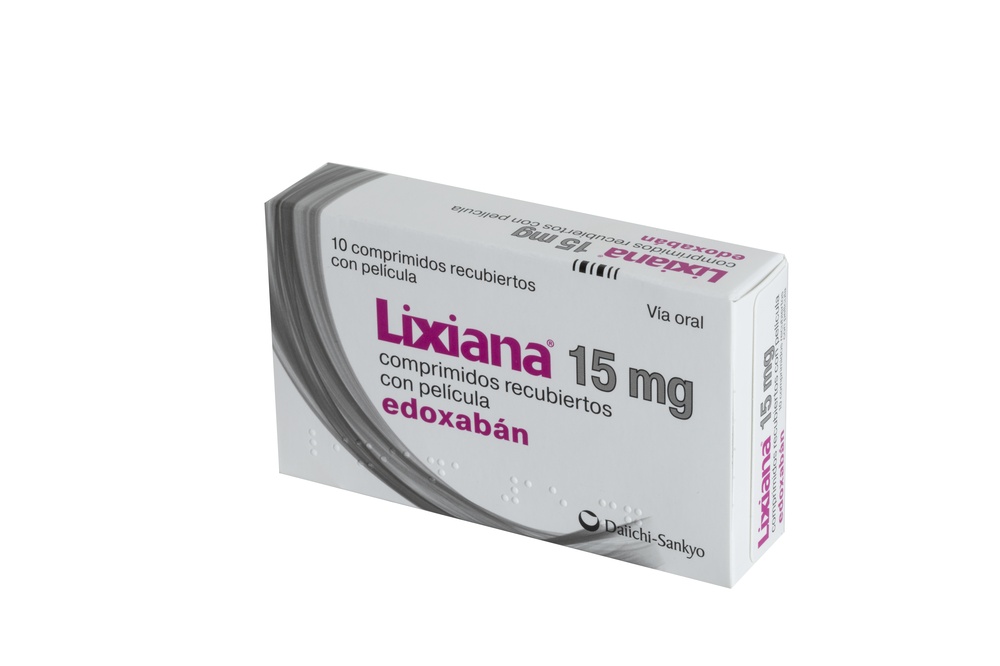
- Country of registration
- Dosage formTABLET, 15 mg
- ATC codeB01AF03
- Average pharmacy price27.32 EUR
- Active substance
- Prescription requiredYes
- Manufacturer
- CompositionMANITOL (E-421) (49,595 mg mg)
- This information is for reference only and does not constitute medical advice. Always consult a doctor before taking any medication. Oladoctor is not responsible for medical decisions based on this content.
- Alternatives to LIXIANA 15 mg FILM-COATED TABLETSDosage form: TABLET, 15 mgActive substance: edoxabanManufacturer: Sandoz Farmaceutica S.A.Prescription requiredDosage form: TABLET, 30 mgActive substance: edoxabanManufacturer: Sandoz Farmaceutica S.A.Prescription requiredDosage form: TABLET, 60 mgActive substance: edoxabanManufacturer: Sandoz Farmaceutica S.A.Prescription required
Online doctors for LIXIANA 15 mg FILM-COATED TABLETS
Discuss questions about LIXIANA 15 mg FILM-COATED TABLETS, including use, safety considerations and prescription review, subject to medical assessment and local regulations.









Get LIXIANA 15 mg FILM-COATED TABLETS Prescription Online
Fill in a 2-min form
Tell us your symptoms, history, and what medicine you're requesting.
Pick a doctor or let us assign
Choose a specialist or we'll match you with the next available doctor.
Doctor reviews your case
Usually within 30 minutes. They may ask follow-up questions via chat.
Collect from any pharmacy
Electronic prescription sent to your email — valid across Spain.
Frequently Asked Questions
LIXIANA 15 mg FILM-COATED TABLETS requires a prescription in Spain. You can check with a doctor online whether this medicine may be appropriate for your situation.
The active ingredient in LIXIANA 15 mg FILM-COATED TABLETS is edoxaban. This information helps identify medicines with the same composition but different brand names.
The average pharmacy price for LIXIANA 15 mg FILM-COATED TABLETS is around 27.32 EUR. Prices may vary depending on the manufacturer and dosage form.
LIXIANA 15 mg FILM-COATED TABLETS is manufactured by Daiichi Sankyo Europe Gmbh. Pharmacy brands and packaging may differ depending on the distributor.
Doctors such as Family doctors, Psychiatrists, Dermatologists, Cardiologists, Endocrinologists, Gastroenterologists, Pulmonologists, Nephrologists, Rheumatologists, Hematologists, Infectious disease physicians, Allergists, Geriatricians, Paediatricians, Oncologists may assess whether LIXIANA 15 mg FILM-COATED TABLETS is appropriate, depending on your situation and local regulations. You can book an online consultation to discuss your symptoms and possible next steps.
Spain has a well-developed healthcare infrastructure across major cities such as Madrid, Barcelona, Valencia, and Seville. Pharmacies are widely available and operate under strict regulations, ensuring access to prescribed medications.
You can buy LIXIANA 15 mg FILM-COATED TABLETS in Madrid, Barcelona, Seville, or Valencia at any local pharmacy with a valid prescription.
To obtain a prescription, you can use Oladoctor:
Other medicines with the same active substance (edoxaban) include EDOXABAN SANDOZ 15 mg FILM-COATED TABLETS, EDOXABAN SANDOZ 30 mg FILM-COATED TABLETS, EDOXABAN SANDOZ 60 mg FILM-COATED TABLETS. These may have different brand names or formulations but contain the same therapeutic ingredient. Always consult a doctor before switching or starting a new medicine.
