



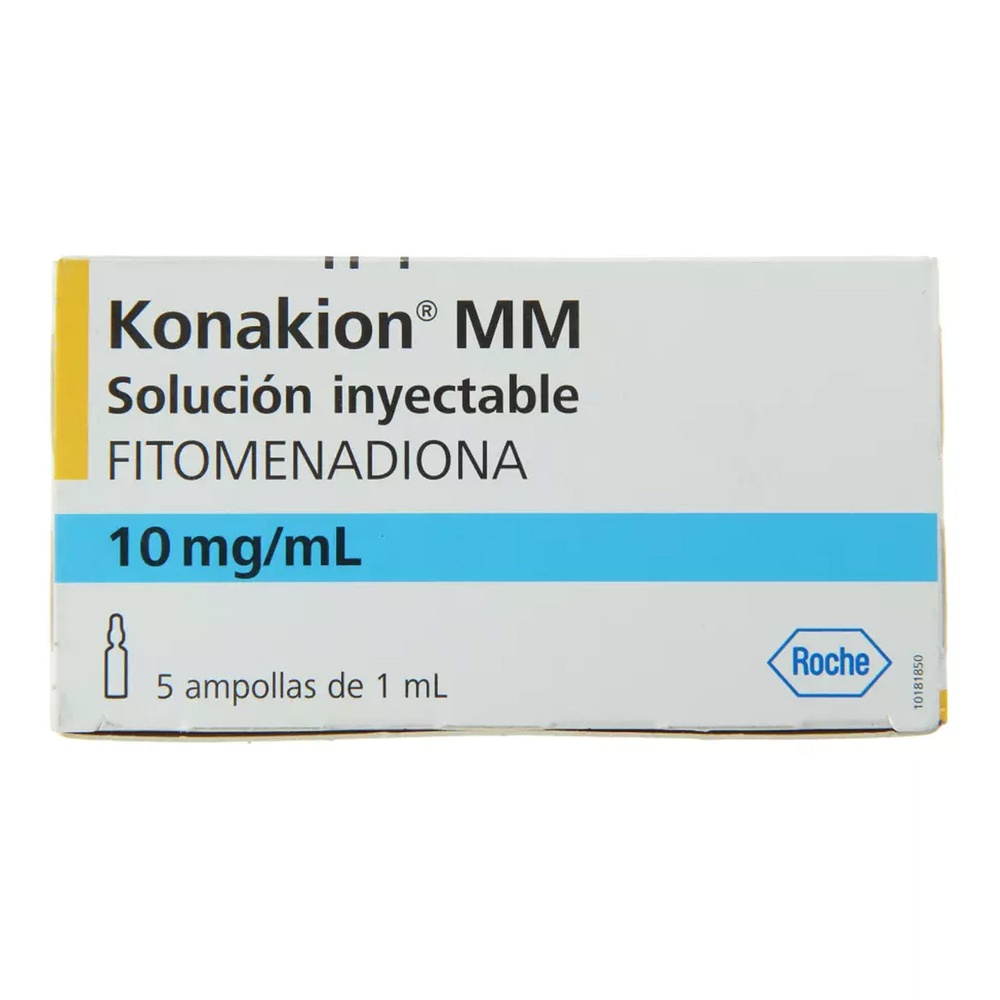
KONAKION 10 mg /Ml Oral Solution/Injectable Solution

Prescription review online
A doctor will review your case and decide whether a prescription is medically appropriate.

Talk to a doctor about this medicine
Discuss your symptoms and possible next steps in a quick online consultation.



How to use KONAKION 10 mg/ml ORAL SOLUTION/INJECTABLE SOLUTION
Contents of the leaflet
- Introduction
- What is Konakion 10 mg/ml and what is it used for
- What you need to know before you use Konakion 10 mg/ml
- How to use Konakion 10 mg/ml
- Possible side effects
- Storage of Konakion
- Contents of the pack and other information
Introduction
Package Leaflet: Information for the User
Konakion 10mg/ml oral solution/injectable solution
Phytomenadione
Read all of this leaflet carefully before you start using this medicine because it contains important information for you.
- Keep this leaflet, you may need to read it again.
- If you have any further questions, ask your doctor or pharmacist.
- This medicine has been prescribed for you only. Do not pass it on to others. It may harm them, even if their signs of illness are the same as yours.
- If you get any side effects, talk to your doctor or pharmacist. This includes any possible side effects not listed in this leaflet. See section 4.
Contents of the pack
- What is Konakion 10 mg/ml and what is it used for
- What you need to know before you use Konakion 10 mg/ml
- How to use Konakion 10 mg/ml
- Possible side effects
- Storage of Konakion 10 mg/ml
- Contents of the pack and other information
1. What is Konakion 10 mg/ml and what is it used for
Konakion contains the active substance phytomenadione, Vitamin K that intervenes in the blood coagulation mechanism. The lack of Vitamin K1 causes an increase in the tendency to bleed.
It is used for the treatment and prevention of bleeding (hemorrhages).
Konakion 10 mg/ml is indicated in:
Prevention and treatment of hypoprothrombinemia (lack of a substance, prothrombin, needed for blood to clot) caused by Vitamin K deficiency.
Therefore, it is indicated in hemorrhages or risk of hemorrhages due to severe hypoprothrombinemia caused by:
- overdose of anticoagulant medications derived from coumarin in patients taking them (medications that prevent the formation of blood clots)
- lack of Vitamin K (hypovitaminosis K) caused by factors that decrease the absorption or synthesis of Vitamin K, such as obstructive jaundice (disorder of bile secretion to the intestine), intestinal or hepatic disorders, and after prolonged treatment with antibiotics, sulfonamides (chemical substances that can be used as antibiotics), or salicylates (e.g., acetylsalicylic acid).
For the prevention and treatment of hemorrhagic disease of the newborn, Konakion 2 mg/0.2 ml pediatric is used.

Not sure if this medicine is right for you?
Discuss your symptoms and treatment with a doctor online.
2. What you need to know before you use Konakion 10 mg/ml
Do not useKonakion
- If you are allergic to phytomenadione or any of the other components of this medicine (listed in section 6)
- It should not be administered intramuscularly if you are being treated with anticoagulants, as this route may hinder the establishment of anticoagulant therapy. Additionally, intramuscular injections have a risk of causing hematomas (bruises) if you are being treated with anticoagulants.
Warnings and precautions
Consult your doctor before starting to use Konakion 10 mg/ml.
- If you have severe liver disease, make sure your doctor knows, as you may need to have blood tests to monitor certain parameters during treatment
- if you have other diseases
- if you have allergies
Children
For newborns and children under 1 year of age, another medicine of the same brand but with a lower dose, Konakion 2 mg/0.2 ml pediatric, should be used.
Use of Konakion 10 mg/ml with other medicines
Tell your doctor or pharmacist if you are using, have recently used, or may need to use any other medicine.
This is very important, as the use of several medicines at the same time can increase or decrease their effect.
The following medicines may interact with Konakion:
Anticoagulants such as warfarin or acenocoumarol (medicines that help prevent the formation of blood clots in blood vessels)
Medicines for epilepsy.
Pregnancy, breastfeeding, and fertility
- If you are pregnant or breastfeeding, think you may be pregnant, or plan to become pregnant, consult your doctor before using this medicine
- Pregnancy
- Konakion can be administered during pregnancy if the benefit to the mother outweighs the risk to the fetus.
- Breastfeeding
- If you are breastfeeding, you can be treated with Konakion.
It is not recommended to administer Konakion for the prevention of hemorrhagic disease of the newborn to women in advanced gestation or during breastfeeding.
Driving and using machines
The influence of Konakion on the ability to drive or operate machinery is negligible or insignificant.
Konakion10 mg/ml contains sodium hydroxide
This medicine contains less than 23 mg (1 mmol) of sodium per ampoule, so it is considered essentially "sodium-free".
3. How to use Konakion 10 mg/ml
Follow exactly the administration instructions of this medicine indicated by your doctor. In case of doubt, consult your doctor or pharmacist again. Depending on the nature of your illness, your doctor will administer the correct dose of this medicine.
The route of administration will depend on the severity of your illness and the risks associated with administration by each route. Konakion 10 mg/ml can be administered orally or intravenously, the latter may be indicated when the oral route is not feasible or useful.
Usual dose for adults
Severe or very severe bleeding, e.g., during anticoagulant therapy:
After discontinuation of treatment with the coumarin anticoagulant you are taking, a dose of 5-10 mg of Konakion will be administered slowly (for at least 30 seconds) intravenously, along with fresh frozen plasma (FFP) or prothrombin complex concentrate (PCC). The dose of Vitamin K1 may be repeated as needed.
Recommended doses of Vitamin K1for the treatment of patients with asymptomatic elevation of the International Normalized Ratio (INR) with or without mild bleeding:
Anticoagulant | INR | Vitamin K1 orally | Vitamin K1 intravenously |
Warfarin | 5-9 | 1 to 2.5 mg for initial reversal 2 to 5 mg for rapid neutralization (additional dose of 1 to 2 mg if INR remains elevated after 24 hours) | 0.5 to 1 mg 0.5 to 1 mg |
>9 | 2.5 to 5 mg (up to 10 mg) | 1 mg | |
Acenocoumarol | 5-8 | 1 to 2 mg | 1 to 2 mg |
>8 | 3 to 5 mg | 1 to 2 mg | |
Fenprocoumon | 5-9 | 2 to 5 mg | 2 to 5 mg |
>9 | 2 to 5 mg | 2 to 5 mg | |
>10 | Not recommended | Individualized dose for each patient |
For small doses, one or more ampoules of another presentation of Konakion can be used: Konakion 2 mg/0.2 ml pediatric.
Recommended doses of Vitamin K1for the treatment of patients with severe or very severe bleeding:
Anticoagulant | Situation | Vitamin K1 intravenously | Concomitant treatment |
Warfarin | Severe bleeding | 5 to 10 mg | FFP or PCC |
Very severe bleeding | 10 mg | FFP, PCC, or recombinant factor VIIa | |
Acenocoumarol | Severe bleeding | 5 mg | FFP, PCC, or prothrombin and factor VII concentrates |
Fenprocoumon | Severe bleeding with INR <5 | 5 mg | PCC |
Severe bleeding with INR >5 | 10 mg | PCC |
FFP, fresh frozen plasma
PCC, prothrombin complex concentrate
Hypoprothrombinemia due to other causes
In hypoprothrombinemia due to absorption disorders or treatment with antibiotics, salicylates, or sulfonamides, an oral or injectable dose of 2 mg of Konakion 10 mg/ml can be administered in adults. Konakion should be administered at the lowest effective dose.
The dose and route of administration will depend on the severity of the deficiency and the response to the medicine.
Elderly patients
Elderly patients tend to be more sensitive to the effect of this medicine. Therefore, the dose in this group should be at the lower limits of the recommended values. It has been shown that small doses of 0.5 to 1 mg of Vitamin K1 intravenously or orally effectively reduce the INR to <5 within 24 hours of administration.
Use in children
Children over 1 year of age
The doctor will decide the appropriate dose based on the indication and patient weight. It has been reported that a single dose corresponding to one-tenth of the total intravenous dose of Vitamin K1 in adults is effective in reversing asymptomatic elevations of INR (>8) in clinically well children.
Newborns and children under 1 year of age
For this group of patients, due to the small dose required, Konakion 2 mg/0.2 ml pediatric should be used.
Normally, you will be administered Konakion as a single dose, but if your response is not sufficient, administrations may be repeated.
Instructions for correct administration of the preparation
The Konakion solution should be clear at the time of use. If the ampoules have not been stored correctly, they may be cloudy or have phase separation. If this occurs, the ampoule should be discarded.
Oral route: Konakion can be administered with a syringe as follows: Break the neck of the ampoule and extract the necessary amount from the ampoule using a syringe with a needle. Remove the needle from the syringe and administer the contents of the syringe directly into the patient's mouth. Rinse the syringe with liquid.
Parenteral route: Konakion should not be diluted or mixed with other parenteral medicines, but it can be injected into the lower part of an infusion set.
If you use more Konakion 10 mg/ml than you should
Cases of intoxication with Vitamin K1 (phytomenadione) are unknown. It may affect the resumption of treatment with anticoagulants.
In case of overdose or accidental ingestion, consult your doctor or pharmacist immediately or go to a medical center or call the Toxicology Information Service. Phone 91 562.04.20 indicating the medicine and the amount administered.

Started taking the medicine and have questions?
Discuss your symptoms and treatment with a doctor online.
4. Possible side effects
Like all medicines, this medicine can cause side effects, although not everybody gets them.
Very rare side effects, which may affect up to 1 in 10,000 people: severe allergic reaction (anaphylactic reaction) and inflammation at the injection site. Venous irritation or phlebitis with intravenous administration of Konakion 10 mg/ml.
Reporting of side effects
If you experience any side effects, consult your doctor or pharmacist, even if it is a possible side effect not listed in this leaflet. You can also report them directly through the Spanish Pharmacovigilance System for Human Use Medicines: www.notificaRAM.es.
By reporting side effects, you can help provide more information on the safety of this medicine.
5. Storage of Konakion
Store below 25°C.
Keep the ampoules in the outer packaging to protect them from light.
Keep this medicine out of the sight and reach of children.
Do not use this medicine after the expiration date stated on the packaging after EXP. The expiration date is the last day of the month indicated.
Do not use this medicine if you notice that the solution is cloudy or has phase separation.
For stability reasons, the unused contents of opened ampoules cannot be used and should be discarded.
Medicines should not be disposed of via wastewater or household waste. Deposit the packaging and medicines you no longer need at the SIGRE collection point in the pharmacy. If in doubt, ask your pharmacist how to dispose of the packaging and medicines you no longer need. This will help protect the environment.
6. Contents of the pack and other information
Composition of Konakion 10 mg/ml oral solution/injectable solution
- The active substance is phytomenadione (synthetic Vitamin K1). Each ampoule contains 10 mg of phytomenadione (Vitamin K1) in 1 ml.
- The other components are glycolic acid, sodium hydroxide, lecithin, 25% hydrochloric acid, and water for injectable preparations.
Appearance of the product and contents of the pack
Konakion is an oral and injectable solution contained in ampoules. Clear to slightly opalescent liquid.
Each pack contains 5 amber glass ampoules of 1 ml.
Other presentations:
Konakion2 mg/0.2 ml pediatric oral solution/injectable solution
Marketing Authorization Holder
CHEPLAPHARM Arzneimittel GmbH
Ziegelhof 24
17489 Greifswald
Germany
Local Representative
Laboratorios Rubió, S.A.
C/ Industria, 29 - Pol. Ind. Comte de Sert
08755 Castellbisbal (Barcelona)
Spain
Manufacturer
CHEPLAPHARM Arzneimittel GmbH
Ziegelhof 23-24
17489 Greifswald
Germany
Date of the last revision of this leaflet:December 2015.
Detailed and updated information on this medicine is available on the website of the Spanish Agency for Medicines and Health Products (AEMPS) http://www.aemps.es/
- Country of registration
- Dosage formORAL/INJECTABLE SOLUTION/SUSPENSION, 10mg/1ml
- ATC codeB02BA01
- Average pharmacy price9.37 EUR
- Active substance
- Prescription requiredYes
- Manufacturer
- CompositionHIDROXIDO DE SODIO (E 524) (4,588 mg mg)
- This information is for reference only and does not constitute medical advice. Always consult a doctor before taking any medication. Oladoctor is not responsible for medical decisions based on this content.
- Alternatives to KONAKION 10 mg/ml ORAL SOLUTION/INJECTABLE SOLUTIONDosage form: ORAL/INJECTABLE SOLUTION/SUSPENSION, 2 mg phytomenadione/0.2mlActive substance: phytomenadioneManufacturer: Cheplapharm Arzneimittel GmbhPrescription requiredDosage form: INJECTABLE, 1,000 IUActive substance: coagulation factor VIIIManufacturer: Takeda Manufacturing Austria AgPrescription requiredDosage form: INJECTABLE, 1500 IUActive substance: coagulation factor VIIIManufacturer: Takeda Manufacturing Austria AgPrescription required
Online doctors for KONAKION 10 mg/ml ORAL SOLUTION/INJECTABLE SOLUTION
Discuss questions about KONAKION 10 mg/ml ORAL SOLUTION/INJECTABLE SOLUTION, including use, safety considerations and prescription review, subject to medical assessment and local regulations.









Get KONAKION 10 mg/ml ORAL SOLUTION/INJECTABLE SOLUTION Prescription Online
Fill in a 2-min form
Tell us your symptoms, history, and what medicine you're requesting.
Pick a doctor or let us assign
Choose a specialist or we'll match you with the next available doctor.
Doctor reviews your case
Usually within 30 minutes. They may ask follow-up questions via chat.
Collect from any pharmacy
Electronic prescription sent to your email — valid across Spain.
Frequently Asked Questions
KONAKION 10 mg/ml ORAL SOLUTION/INJECTABLE SOLUTION requires a prescription in Spain. You can check with a doctor online whether this medicine may be appropriate for your situation.
The active ingredient in KONAKION 10 mg/ml ORAL SOLUTION/INJECTABLE SOLUTION is phytomenadione. This information helps identify medicines with the same composition but different brand names.
The average pharmacy price for KONAKION 10 mg/ml ORAL SOLUTION/INJECTABLE SOLUTION is around 9.37 EUR. Prices may vary depending on the manufacturer and dosage form.
KONAKION 10 mg/ml ORAL SOLUTION/INJECTABLE SOLUTION is manufactured by Cheplapharm Arzneimittel Gmbh. Pharmacy brands and packaging may differ depending on the distributor.
Doctors such as Family doctors, Psychiatrists, Dermatologists, Cardiologists, Endocrinologists, Gastroenterologists, Pulmonologists, Nephrologists, Rheumatologists, Hematologists, Infectious disease physicians, Allergists, Geriatricians, Paediatricians, Oncologists may assess whether KONAKION 10 mg/ml ORAL SOLUTION/INJECTABLE SOLUTION is appropriate, depending on your situation and local regulations. You can book an online consultation to discuss your symptoms and possible next steps.
Spain has a well-developed healthcare infrastructure across major cities such as Madrid, Barcelona, Valencia, and Seville. Pharmacies are widely available and operate under strict regulations, ensuring access to prescribed medications.
You can buy KONAKION 10 mg/ml ORAL SOLUTION/INJECTABLE SOLUTION in Madrid, Barcelona, Seville, or Valencia at any local pharmacy with a valid prescription.
To obtain a prescription, you can use Oladoctor:
Other medicines with the same active substance (phytomenadione) include KONAKION 2 mg/0.2 ml PEDIATRIC ORAL SOLUTION/INJECTABLE SOLUTION, ADVATE 1,000 IU POWDER AND SOLVENT FOR INJECTABLE SOLUTION, ADVATE 1500 IU POWDER AND SOLVENT FOR INJECTABLE SOLUTION. These may have different brand names or formulations but contain the same therapeutic ingredient. Always consult a doctor before switching or starting a new medicine.
