


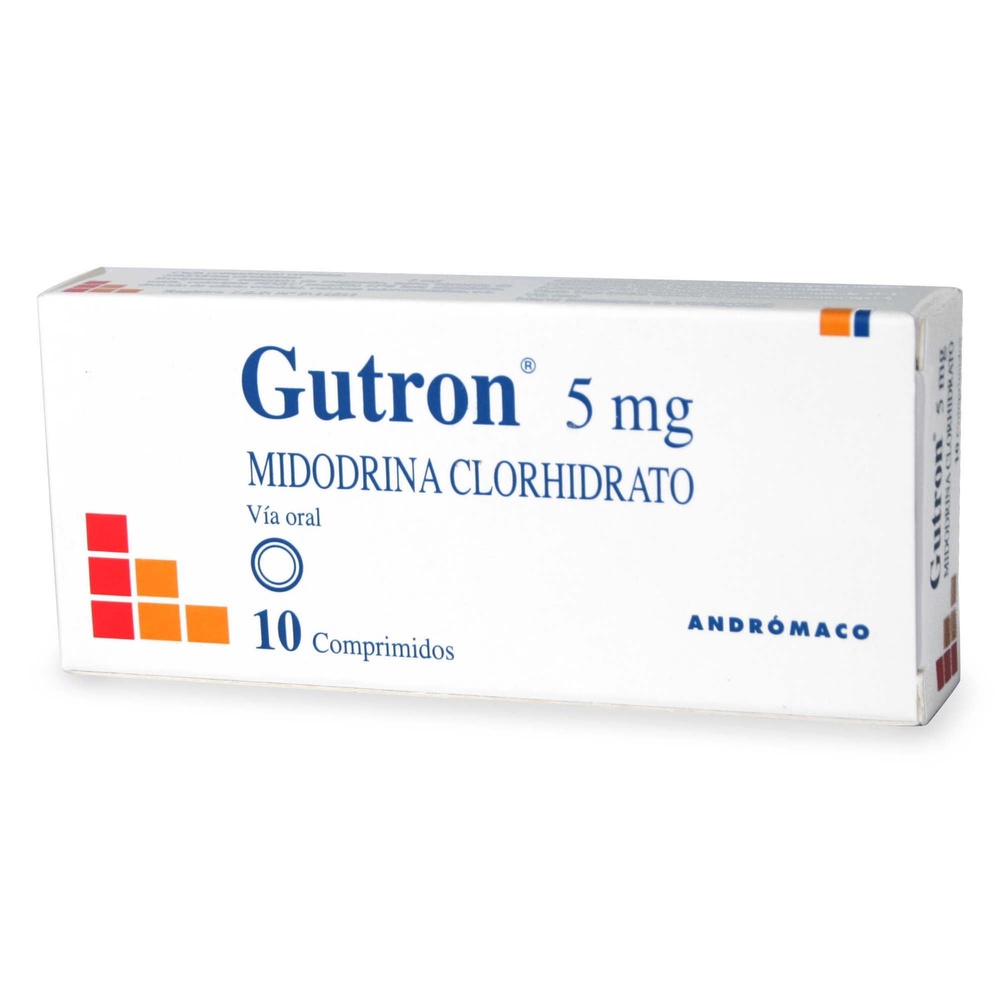
Gutron 5 mg comprimidos

Prescription request online
A doctor will review your case and decide whether a prescription is medically appropriate.

Talk to a doctor about this medicine
Discuss your symptoms and possible next steps in a quick online consultation.



How to use GUTRON 5 mg TABLETS
Contents of the leaflet
- Introduction
- What Gutron is and what it is used for
- What you need to know before you take Gutron
- How to take Gutron
- Possible side effects
- Conservation of Gutron
- Contents of the pack and further information
Introduction
Package Leaflet: Information for the User
Gutron 5mg Tablets
midodrine hydrochloride
Read all of this leaflet carefully before you start taking this medicine, because it contains important information for you.
- Keep this leaflet, you may need to read it again.
- If you have any further questions, ask your doctor or pharmacist.
- This medicine has been prescribed for you only. Do not pass it on to others. It may harm them, even if their signs of illness are the same as yours.
- If you get any side effects, talk to your doctor or pharmacist. This includes any possible side effects not listed in this leaflet. See section 4.
Contents of the pack and other information
- What Gutron is and what it is used for
- What you need to know before you take Gutron
- How to take Gutron
- Possible side effects
5 Conservation of Gutron
- Contents of the pack and further information
1. What Gutron is and what it is used for
Gutron is a cardiac stimulant that contains the active ingredient midodrine hydrochloride.
Gutron is a medicine used for the severe treatment of low blood pressure when other treatments have not been satisfactory.

Not sure if this medicine is right for you?
Discuss your symptoms and treatment with a doctor online.
2. What you need to know before you take Gutron
Do not take Gutron:
- if you are allergic to midodrine hydrochloride or any of the other ingredients of this medicine (listed in section 6).
- if you have high blood pressure
- if you have a slow pulse
- if you have difficulty urinating
- if you suffer from any type of heart or vascular disease
- if you have high eye pressure (glaucoma) and vision problems due to diabetes
- if you have hyperactivity of the thyroid gland
- if you have hormonal disorders due to a tumor in the adrenal medulla (pheochromocytoma)
- if you have severe kidney failure
- if you have an enlarged prostate gland
Warnings and precautions
Consult your doctor or pharmacist before starting to take Gutron:
- if you have high blood pressure when lying down, then your blood pressure will be monitored when standing and sitting due to the risk of high blood pressure when lying down, for example at night.
If you have high blood pressure when lying down and it does not vary when reducing the dose, then treatment with Gutron should be discontinued.
This is important when taking Gutron.
Avoid nighttime administration. The risk of increased blood pressure is also reduced if you sleep with your head elevated.
Patients should be monitored due to possible hypertensive side effects.
- if you have a severe alteration of the autonomic nervous system, because Gutron can lead to a greater decrease in blood pressure when standing. If this is the case, treatment with midodrine should be stopped.
if you suffer from alterations in the circulatory system in the arteries.
- if you suffer from prostate alterations because it can cause difficulty urinating.
It is recommended that your kidney function and blood pressure be monitored before starting treatment with Gutron. During treatment with Gutron, your doctor should occasionally monitor your blood pressure to adjust the dose if necessary.
It is important that you immediately report symptoms related to high blood pressure, such as rapid heartbeat, headache, and blurred vision. Your doctor will decide whether to adjust the dose or discontinue treatment with Gutron.
Consult your doctor if any of the above circumstances have ever occurred to you.
Children
Gutron should not be used in children due to the limited information available on the use of midodrine hydrochloride in this population.
Taking Gutron with other medicines
- Midodrine may affect how some medicines work. These include perfenazine (for the treatment of psychosis, manic episodes), amiodarone (for the treatment of irregular heartbeat), metoclopramide (for the treatment of nausea and vomiting). Taking midodrine with these medicines may increase their respective effects.
- Concomitant treatment with sympathomimetics (substances with a stimulating effect on certain parts of the nervous system) and other vasoconstrictors (agents that cause narrowing of blood vessels) such as reserpine, guanethidine, tricyclic antidepressants, antihistamines, thyroid hormones, and MAO inhibitors should be avoided because they can cause an increase in blood pressure.
- As with other medicines of the same class, the effect of midodrine is nullified by medicines such as prazosin and phentolamine (medication for heart disease)
- It is not recommended to use it simultaneously with digitalis preparations (medicines used for heart disease) because it can cause alterations in cardiac function.
Midodrine may increase the hypertensive effect of fluorocortisone acetate (corticosteroid anti-inflammatory).
- If midodrine is combined with other medicines that can directly or indirectly reduce heart rate, monitoring by your doctor is advised.
Tell your doctor or pharmacist if you are taking, have recently taken, or might take any other medicines.
Pregnancy and breastfeeding
If you are pregnant or breastfeeding, think you may be pregnant, or are planning to have a baby, ask your doctor or pharmacist for advice before taking this medicine.
Gutron is not recommended during pregnancy.
You should not take Gutron during breastfeeding.
Driving and using machines
The effect of Gutron is insignificant; however, in case of dizziness or slight drowsiness, you should be cautious when driving vehicles or operating machinery.
Gutron contains the yellow-orange dye S
It may cause allergic reactions.

Started taking the medicine and have questions?
Discuss your symptoms and treatment with a doctor online.
3. How to take Gutron
Follow exactly the administration instructions of this medicine given by your doctor or pharmacist. If you are unsure, consult your doctor or pharmacist again.
The initial dose is 2.5 mg three times a day. (Gutron can be divided into equal doses of 2.5 mg). This dose can be increased weekly up to 10 mg three times a day, which is the normal maintenance dose of 30 mg per day.
The total daily recommended dose should be administered in three daily doses.
There is no information available on the use in children, in elderly patients, in patients with renal failure, and in patients with altered liver function.
Take the tablets with a small amount of water. The medicine can be taken with food.
The tablet can be divided into equal doses.
Avoid nighttime administration. The last dose should be taken 4 hours before bedtime. Elevating the head at night reduces the risk of increased blood pressure. More information is available in this leaflet in the section "Warnings and precautions".
Your doctor will indicate the duration of treatment with Gutron. The treatment is usually long-term. If you have any impression that the effect of Gutron is too strong or too weak, talk to your doctor or pharmacist.
If you take more Gutron than you should
If you have taken too much Gutron, contact your doctor or pharmacist.
Overdose can cause:
- high blood pressure
- slow heart rate (bradycardia)
- difficulty urinating
- goosebumps
- feeling of cold
In case of overdose or accidental ingestion, consult your doctor or pharmacist immediately or call the Toxicological Information Service, phone 91 562 04 20, indicating the medicine and the amount ingested.
If you forget to take Gutron
Do not take a double dose of Gutron to make up for the forgotten individual dose due to the risk of high blood pressure when lying down.
Avoid nighttime administration.
If you stop taking Gutron
It will not cause a sudden drop in blood pressure.
If you have any other questions about the use of this medicine, ask your doctor or pharmacist.
4. Possible side effects
Like all medicines, this medicine can cause side effects, although not everybody gets them.
Very common (may affect more than 1 in 10 people):
Goosebumps, itching on the head, and pain when urinating.
Common (may affect up to 1 in 10 people):
Numbness and itching, increased blood pressure when lying down, headache, nausea, acidity, inflammation of the mouth mucosa, flushing, skin rash, chills, difficulty urinating.
Uncommon (may affect up to 1 in 100 people)
Sleep disorders, including difficulty sleeping, excitability, agitation, and irritability, slow heartbeats, urgent need to urinate.
Rare (may affect up to 1 in 1,000 people)
Cardiac palpitations, rapid heart rate, altered liver function, including elevated liver enzymes.
Frequency not known (frequency cannot be estimated from the available data)
Anxiety, abdominal pain, vomiting, and diarrhea.
Reporting of side effects
If you experience any side effects, talk to your doctor, pharmacist, or nurse. This includes any possible side effects not listed in this leaflet.
You can also report side effects directly via the Spanish Pharmacovigilance System for Human Use Medicines: www.notificaram.es
By reporting side effects, you can help provide more information on the safety of this medicine.
5. Conservation of Gutron
Keep this medicine out of the sight and reach of children.
Store at a temperature below 25°C. Store in the original package.
Keep the blister pack in the carton box.
Gutron has a shelf life of 3 years. Do not use Gutron after the expiry date stated on the carton after "CAD". The expiry date is the last day of the month indicated.
Medicines should not be disposed of via wastewater or household waste. Place the packaging and any unused medicine in the SIGRE collection point at your pharmacy. If you have any further questions on how to dispose of the packaging and any unused medicine, ask your pharmacist. This will help protect the environment.
6. Contents of the pack and further information
What Gutron contains
The active substance is midodrine hydrochloride
The other ingredients in Gutron are magnesium stearate, talc, anhydrous colloidal silica, microcrystalline cellulose, corn starch, E 110 yellow-orange S.
Appearance of the product and pack contents
Tablets
Orange, round, biplanar tablets with a beveled edge, scored on one side "GU" above and "5" below the score line.
Presentation of 20, 30, or 50 tablets.
100-tablet glass bottle.
Not all pack sizes may be marketed.
Marketing authorisation holder and manufacturer
Marketing authorisation holder
CHEPLAPHARM Arzneimittel GmbH
Ziegelhof 24
17489 Greifswald
Germany
Manufacturer:
Takeda GmbH
Plant Oranienburg
Lehnitzstr., 70-98
DE-16514 Oranienburg
Germany
Local representative
Laboratorios Rubió, S.A.
Industria, 29 - Pol. Ind. Comte de Sert
08755 Castellbisbal (Barcelona)
Spain
This medicine is authorised in the Member States of the European Economic Area under the following names:
NetherlandsGutron 5, 5mg tablets
SpainGutron 5mg tablets
Date of last revision of this leaflet: February 2016
Detailed and updated information on this medicine is available on the website of the Spanish Agency for Medicines and Health Products (AEMPS) http://www.aemps.gob.es
- Country of registration
- Dosage formTABLET, 5 mg
- ATC codeC01CA17
- Active substance
- Prescription requiredYes
- Manufacturer
- This information is for reference only and does not constitute medical advice. Always consult a doctor before taking any medication. Oladoctor is not responsible for medical decisions based on this content.
- Alternatives to GUTRON 5 mg TABLETSDosage form: INJECTABLE, 1 mg/10 mlActive substance: epinephrineManufacturer: Laboratoire AguettantPrescription requiredDosage form: INJECTABLE, Epinephrine base 1 mg/mlActive substance: epinephrineManufacturer: B Braun Medical S.A.Prescription requiredDosage form: INJECTABLE, 1 mg/mlActive substance: epinephrineManufacturer: Laboratorios Basi Industria Farmaceutica S.A.Prescription required
Online doctors for GUTRON 5 mg TABLETS
Discuss questions about GUTRON 5 mg TABLETS, including use, safety considerations and whether a prescription is appropriate, subject to medical assessment and local regulations.
Frequently Asked Questions
GUTRON 5 mg TABLETS requires a prescription in Spain. You can check with a doctor online whether this medicine may be appropriate for your situation.
The active ingredient in GUTRON 5 mg TABLETS is midodrine. This information helps identify medicines with the same composition but different brand names.
GUTRON 5 mg TABLETS is manufactured by Cheplapharm Arzneimittel Gmbh. Pharmacy brands and packaging may differ depending on the distributor.
Doctors such as Family doctors, Psychiatrists, Dermatologists, Cardiologists, Endocrinologists, Gastroenterologists, Pulmonologists, Nephrologists, Rheumatologists, Hematologists, Infectious disease physicians, Allergists, Geriatricians, Paediatricians, Oncologists may assess whether GUTRON 5 mg TABLETS is appropriate, depending on your situation and local regulations. You can book an online consultation to discuss your symptoms and possible next steps.
The prescription is issued by a doctor after assessing your health. In Spain, GUTRON 5 mg TABLETS is then dispensed in pharmacies with that prescription. An online consultation does not guarantee that a prescription will be issued: the decision always rests with the doctor.
To request an assessment, you can use Oladoctor:
Other medicines with the same active substance (midodrine) include ADRENALINE AGUETTANT 0.1 mg/mL PRE-FILLED SYRINGE SOLUTION FOR INJECTION, ADRENALINE B. BRAUN 1 mg/ml INJECTABLE SOLUTION, ADRENALINE BASIC 1 mg/ml INJECTABLE SOLUTION. These may have different brand names or formulations but contain the same therapeutic ingredient. Always consult a doctor before switching or starting a new medicine.
