



GAVISCON 50 mg /Ml Oral Solution

Prescription review online
A doctor will review your case and decide whether a prescription is medically appropriate.

Talk to a doctor about this medicine
Discuss your symptoms and possible next steps in a quick online consultation.



How to use GAVISCON ORAL SUSPENSION IN SACHETS MINT FLAVOR
Contents of the leaflet
- Introduction
- What Gaviscon is and what it is used for
- What you need to know before taking Gaviscon
- How to take Gaviscon
- Possible side effects
- Storage of Gaviscon
- Package contents and additional information
Introduction
Leaflet: information for the user
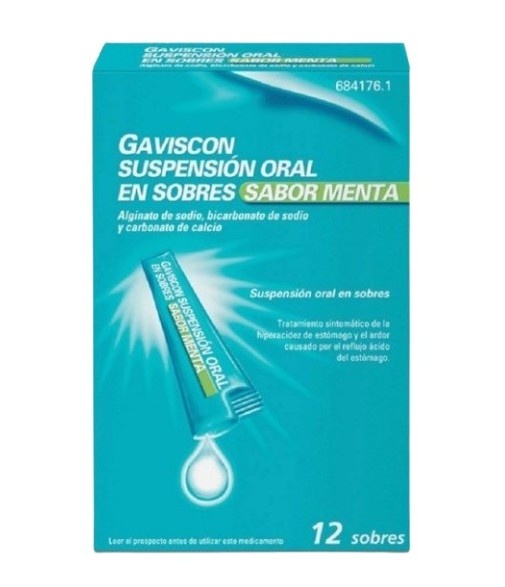
Gaviscon oral suspension in mint-flavored sachets
Sodium alginate, sodium hydrogen carbonate (sodium bicarbonate)
and calcium carbonate
Read this leaflet carefully before starting to take this medicine, as it contains important information for you.
Follow the administration instructions for the medicine contained in this leaflet or as indicated by your doctor or pharmacist.
- Keep this leaflet, as you may need to read it again.
- If you need advice or more information, consult your pharmacist.
- If you experience side effects, consult your doctor or pharmacist, even if they are side effects not listed in this leaflet. See section 4.
- You should consult a doctor if your symptoms worsen or do not improve after 7 days.
Contents of the leaflet:
- What Gaviscon is and what it is used for
- What you need to know before taking Gaviscon
- How to take Gaviscon
- Possible side effects
- Storage of Gaviscon
- Package contents and additional information
1. What Gaviscon is and what it is used for
It belongs to the group of medicines called other agents against peptic ulcer and gastroesophageal reflux.
It acts in two distinct ways:
- Sodium alginate, along with sodium hydrogen carbonate (sodium bicarbonate),
and calcium carbonate form a protective barrier in the stomach to prevent gastric reflux, calming the burning sensation in the stomach.
- Sodium hydrogen carbonate (sodium bicarbonate) and calcium carbonate also neutralize excess acid in the stomach.
Gaviscon is indicated for the symptomatic treatment of stomach hyperacidity and heartburn caused by acid reflux in adults and adolescents over 12 years old.
You should consult a doctor if your symptoms worsen or do not improve after 7 days.

Not sure if this medicine is right for you?
Discuss your symptoms and treatment with a doctor online.
2. What you need to know before taking Gaviscon
Do not takeGaviscon
- If you are allergic to calcium carbonate, sodium hydrogen carbonate (sodium bicarbonate), sodium alginate, or any of the other components of this medicine (listed in section 6).
- If you have severe kidney failure or suffer from kidney stones.
- If you have high blood calcium levels or low blood phosphate levels.
- If you have high calcium levels in your urine.
Warnings and precautions
Consult your doctor or pharmacist before starting to take this medicine if: you have mild or moderate kidney problems, you have been diagnosed with sarcoidosis (inflammation that can affect multiple organs in the body), if you suffer from constipation or hemorrhoids, or if you suffer from symptoms of stomach or intestinal diseases, appendicitis, or edema.
If you are taking or are going to take other medicines, you should separate their intake by 1 to 2 hours (see "Other medicines and Gaviscon").
Avoid prolonged use, as it can cause kidney stones, as well as high doses over a long period, which can also cause high blood calcium levels, kidney failure, or worsen it if you already have it.
The medicine should not be taken with milk or dairy products.
If symptoms persist after 7 days of treatment, consult your doctor.
Children and adolescents
Gaviscon is not recommended for children under 12 years old.
Interference with laboratory tests:
If you are going to have any laboratory tests (including blood tests, urine tests, skin tests using allergens, etc.), inform your doctor that you are taking this medicine, as it may alter the results.
Other medicines and Gaviscon
Inform your doctor or pharmacist if you are taking, have recently taken, or may need to take any other medicine.
Before taking Gaviscon, inform your doctor if you are taking antibiotics (tetracyclines, quinolones), heart medicines such as cardiac glycosides (digoxin, digitoxin), or other medicines such as fluorides, phosphates, iron salts, ketoconazole, neuroleptics, thyroid hormones, penicillamine, beta-blockers (atenolol, metoprolol, propranolol), glucocorticoids, chloroquine, estramustine, and bisphosphonates; as it may affect the efficacy of these medicines.
As Gaviscon may interfere with some medicines, after taking it, you should wait 2 hours before taking another oral medicine. If you have taken another medicine, before taking Gaviscon, you should wait 1 to 2 hours to get the maximum benefit from the treatment with that other medicine.
Taking Gaviscon with food and drinks
Like all antacids that contain calcium, this medicine should not be taken with large amounts of milk or dairy products, as it may cause increased blood calcium levels and milk-alkali syndrome (Burnett syndrome).
Pregnancy, breastfeeding, and fertility
If you are pregnant or breastfeeding, think you may be pregnant, or plan to become pregnant, consult your doctor or pharmacist before using this medicine.
This medicine can be used during pregnancy and breastfeeding if taken according to these recommendations and not taken for a long time.
As this medicine provides a significant amount of calcium in addition to what the pregnant or breastfeeding woman takes every day, pregnant or breastfeeding women should not exceed the recommended amounts in the section "3. How to take Gaviscon" and should not take large amounts of dairy products and milk at the same time (1 liter of milk contains 1.2 grams of elemental calcium).
Driving and using machines
This medicine does not affect the ability to drive or use machines.
Gaviscon contains sodium, methyl parahydroxybenzoate, and propyl parahydroxybenzoate.
This medicine contains 285.2 mg of sodium (main component of table salt/cooking salt) in each 2 sachets. This is equivalent to 14.3% of the maximum recommended daily sodium intake for an adult.
Consult your doctor or pharmacist if you need 3 or more sachets per day for a prolonged period, especially if you have been advised to follow a low-salt diet (sodium).
It may cause allergic reactions (possibly delayed) because it contains methyl parahydroxybenzoate (E-218) and propyl parahydroxybenzoate (E-216).
3. How to take Gaviscon
Follow the administration instructions for the medicine contained in this leaflet or as indicated by your doctor or pharmacist. In case of doubt, ask your doctor or pharmacist.
The recommended dose in adults, including elderly people and adolescents over 12 years old, is 1 to 2 sachets, as needed, 1 hour after meals and before bedtime. You can take a maximum of 8 sachets per day.
Kidney failure: caution is required in patients with low-salt diets (see section 2).
How to take:
This medicine is taken orally.
Open the sachet and take it directly from the sachet.
If symptoms persist after 7 days of continuous treatment, consult your doctor to rule out possible more serious diseases.
If you take moreGavisconthan you should
Overdose symptoms include nausea and vomiting, constipation, fatigue, increased urine production, thirst, dehydration, and abnormal muscle weakness.
Drink plenty of water and consult your doctor or pharmacist.
In case of overdose or accidental ingestion, consult your doctor or pharmacist or call the Toxicology Information Service, phone: 91 562 04 20, indicating the medicine and the amount ingested.
If you forget to takeGaviscon
Do not take a double dose to make up for forgotten doses.
When you need it, take it again as indicated in the section "3. How to take Gaviscon"
If you have any other doubts about the use of this medicine, ask your doctor or pharmacist.

Started taking the medicine and have questions?
Discuss your symptoms and treatment with a doctor online.
4. Possible side effects
Like all medicines, this medicine can cause side effects, although not everyone gets them.
During the use of the association of sodium alginate, sodium hydrogen carbonate (sodium bicarbonate), and calcium carbonate, the following side effects have been observed with the following frequencies:
Frequency not known (frequency cannot be estimated from available data):
- Allergic reactions, such as skin rashes and itching, difficulty breathing, and swelling of the face, mouth, or throat, and anaphylactic shock.
- Increased blood calcium levels, especially in people with kidney function disorders (with long-term use and high doses).
- Constipation, nausea, vomiting, fatigue, confusion, increased urine production, thirst, and dehydration (alkalosis) (with prolonged use and high doses).
- Milk-alkali syndrome (Burnett syndrome) that can cause high blood calcium levels (with long-term use and high doses).
Reporting side effects
If you experience any side effects, consult your doctor or pharmacist, even if they are possible side effects not listed in this leaflet. You can also report them directly through the Spanish Medicines and Health Products Agency (AEMPS) website (www.notificaram.es). By reporting side effects, you can help provide more information on the safety of this medicine.
5. Storage of Gaviscon
Keep this medicine out of the sight and reach of children.
Do not use this medicine after the expiration date shown on the packaging after CAD. The expiration date is the last day of the month indicated.
Do not store above 30°C.
Medicines should not be disposed of through wastewater or household waste. Deposit the packaging and medicines you no longer need at the pharmacy's SIGRE point. Ask your pharmacist how to dispose of the packaging and medicines you no longer need. This will help protect the environment.
6. Package contents and additional information
Composition ofGaviscon
- The active ingredients are 500 mg of sodium alginate, 267 mg of sodium hydrogen carbonate (sodium bicarbonate), and 160 mg of calcium carbonate.
- The other ingredients (excipients) are carbomer, methyl parahydroxybenzoate (E-218), propyl parahydroxybenzoate (E-216), sodium saccharin, natural peppermint flavor, sodium hydroxide, and purified water.
Appearance of the product and package contents
Gaviscon is a white suspension with a minty odor and flavor.
It is available in cardboard boxes with 2, 12, 24, or 30 sachets, each containing 10 ml.
Not all pack sizes may be marketed.
Marketing authorization holder and manufacturer
Reckitt Benckiser Healthcare, S.A.
C/ Mataró, 28
08403 Granollers-Barcelona
RB NL Brands B.V.
Schiphol Blvd 207, 1118 BH Schiphol, Netherlands
Date of the last revision of this leaflet: August 2020.
Detailed and updated information on this medicine is available on the website of the Spanish Agency for Medicines and Health Products (AEMPS) http://www.aemps.gob.es/
- Country of registration
- Dosage formORAL SOLUTION/SUSPENSION, 50+26.7+16 mg/ml+mg/ml+mg/ml
- Prescription requiredNo
- Manufacturer
- CompositionPARAHIDROXIBENZOATO DE METILO (E-218) (40,00 mg mg), HIDROXIDO DE SODIO (E 524) (26,7-29,6 mg mg), PARAHIDROXIBENZOATO DE PROPILO (6,00 mg mg), SACARINA SODICA (10,00 mg mg)
- This information is for reference only and does not constitute medical advice. Always consult a doctor before taking any medication. Oladoctor is not responsible for medical decisions based on this content.
- Alternatives to GAVISCON ORAL SUSPENSION IN SACHETS MINT FLAVORDosage form: CAPSULE, 300 mgManufacturer: Laboratorios Vinas S.A.Prescription requiredDosage form: ORAL SOLUTION/SUSPENSION, 300 mgManufacturer: Laboratorios Vinas S.A.Prescription requiredDosage form: TABLET, Bismuth Subcitrate 120 mgActive substance: bismuth subcitrateManufacturer: Tora Laboratories S.L.U.Prescription required
Online doctors for GAVISCON ORAL SUSPENSION IN SACHETS MINT FLAVOR
Discuss questions about GAVISCON ORAL SUSPENSION IN SACHETS MINT FLAVOR, including use, safety considerations and prescription review, subject to medical assessment and local regulations.









Get GAVISCON ORAL SUSPENSION IN SACHETS MINT FLAVOR Prescription Online
Fill in a 2-min form
Tell us your symptoms, history, and what medicine you're requesting.
Pick a doctor or let us assign
Choose a specialist or we'll match you with the next available doctor.
Doctor reviews your case
Usually within 30 minutes. They may ask follow-up questions via chat.
Collect from any pharmacy
Electronic prescription sent to your email — valid across Spain.
Frequently Asked Questions
GAVISCON ORAL SUSPENSION IN SACHETS MINT FLAVOR does not require a prescription in Spain. You can check with a doctor online whether this medicine may be appropriate for your situation.
GAVISCON ORAL SUSPENSION IN SACHETS MINT FLAVOR is manufactured by Reckitt Benckiser Healthcare S.A.. Pharmacy brands and packaging may differ depending on the distributor.
Doctors such as Family doctors, Psychiatrists, Dermatologists, Cardiologists, Endocrinologists, Gastroenterologists, Pulmonologists, Nephrologists, Rheumatologists, Hematologists, Infectious disease physicians, Allergists, Geriatricians, Paediatricians, Oncologists may assess whether GAVISCON ORAL SUSPENSION IN SACHETS MINT FLAVOR is appropriate, depending on your situation and local regulations. You can book an online consultation to discuss your symptoms and possible next steps.
Spain has a well-developed healthcare infrastructure across major cities such as Madrid, Barcelona, Valencia, and Seville. Pharmacies are widely available and operate under strict regulations, ensuring access to prescribed medications.
You can buy GAVISCON ORAL SUSPENSION IN SACHETS MINT FLAVOR in Madrid, Barcelona, Seville, or Valencia at any local pharmacy with a valid prescription.
To obtain a prescription, you can use Oladoctor:
Other medicines with the same active substance () include COPINAL 300 mg CAPSULES, COPINAL 300 mg ORAL SUSPENSION, GASTRODENOL 120 mg FILM-COATED TABLETS. These may have different brand names or formulations but contain the same therapeutic ingredient. Always consult a doctor before switching or starting a new medicine.
